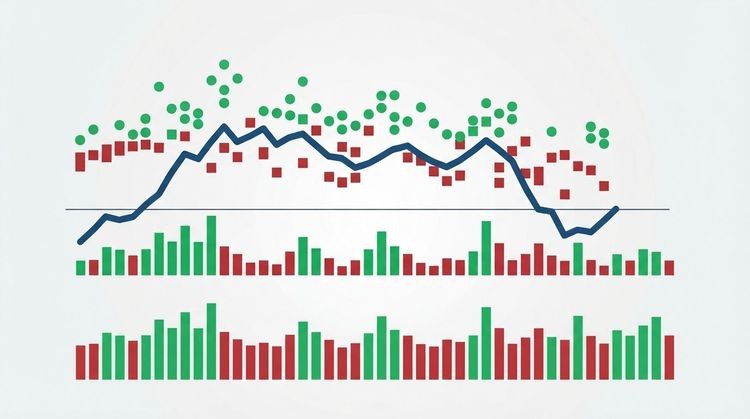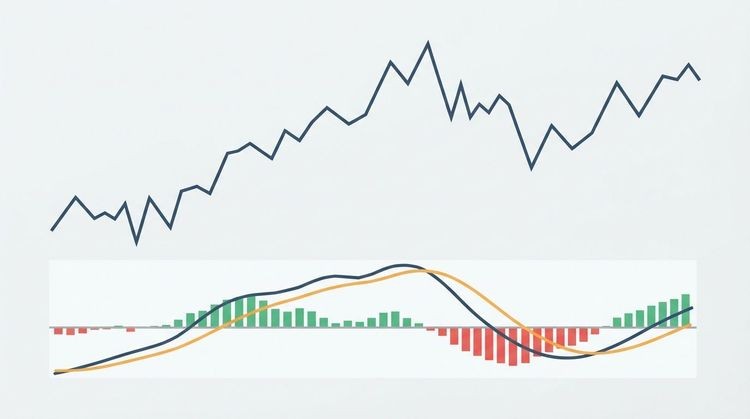


The fastest way to get reliable 52 week high alerts is to set one on a real-time market data platform rather than waiting for delayed screener updates. Sign up for a service like Handy Markets, add the tickers you’re watching, and choose a close or intraday trigger rule depending on how fast you need to act.
A good 52-week-high alert needs three things to actually be useful:
- Real-time or near-real-time data — delayed feeds can put you minutes behind the move
- A clear trigger rule — does it fire the instant price crosses the old high, or only after the candle closes above it
- A delivery channel you’ll actually see — email gets buried, but SMS, Telegram, or Slack rarely do
If you want to skip the setup friction, create a price alert on Handy Markets and pick your channel in under a minute. The rest of this guide covers the mechanics so your alerts fire when they should and stay quiet when they shouldn’t.
Key Takeaways
52-week high alerts work best when they combine a real-time feed, a close-confirmed trigger, and a volume filter, then reach you through a channel you check promptly.
| Point | Details |
|---|---|
| Define the signal clearly | A 52-week high is the highest traded price in the past year, meaningful mainly with volume confirmation. |
| Match trigger to trading style | Use intraday triggers for fast momentum entries, close-only triggers for cleaner longer-term signals. |
| Filter aggressively | Layer volume thresholds, market-cap minimums, and sector context to cut false positives. |
| Verify before acting | Check data timestamp, volume, and news before sizing any position off an alert. |
| Set up with Handy Markets | Handy Markets delivers real-time alerts across stocks and other assets via Telegram, Discord, Slack, SMS, Webhook, or Email with custom thresholds. |
Table of Contents
- What Is a 52 Week High and Why Does It Matter?
- How Do 52-Week-High Alerts Actually Trigger?
- Where Can You Get 52-Week-High Alerts?
- Why Handy Markets Works for Real-Time 52-Week-High Alerts
- How Do You Set Up a 52-Week-High Alert Step by Step?
- What Alert Settings Actually Cut Down the Noise?
- Your Checklist When a 52-Week-High Alert Fires
- When Do These Alerts Actually Help, and When Do They Distract?
- Get Real-Time 52-Week-High Alerts Set Up Today
- Frequently Asked Questions
- Sources
What Is a 52 Week High and Why Does It Matter?
A 52-week high is the highest price a stock has traded at during the past 52 weeks. That’s the whole definition. What makes it worth an alert is what traders do with that information once it fires.
Three interpretations dominate how professionals actually use the signal. First, a fresh 52-week high often reads as a momentum signal: buyers have been in control long enough to push price past every previous ceiling in a year. Second, it works as breakout confirmation when a stock has spent weeks or months consolidating below a resistance level and finally clears it, especially on above-average volume. Third, it provides relative strength context, since a stock hitting new highs while its sector or the broader index lags behind tells you something about capital rotation that a raw price chart won’t show.
None of those interpretations hold up without confirmation. A single tick above the old high on thin volume means far less than a closing price that clears the mark with volume running well above its 30-day average. That’s why most serious alert setups layer a volume filter or a market-cap minimum on top of the raw price trigger, rather than firing on price alone.
Weight your alerts toward volume-confirmed breaks, not raw price crossings.*
How Do 52-Week-High Alerts Actually Trigger?
Not all alerts are built the same way, and the difference changes what you should trust when your phone buzzes. Platforms generally use one of two trigger timings and one of two threshold rules, and mixing them up is where a lot of false positives come from.
Trigger timing breaks down like this:
- Intraday tick crossing fires the moment price touches or exceeds the prior 52-week high, even if it pulls back seconds later
- Close-only new high waits until the stock finishes the session above the old mark, filtering out intraday spikes that don’t hold
Threshold logic matters just as much:
- Match vs. exceed — some systems fire when price equals the old high (>=), others require it to actually break above it (>)
A tighter distinction sits underneath all of this: the quality of the underlying feed. A real-time exchange feed or a consolidated tape reflects trades within milliseconds, while a delayed data source can lag 15 to 20 minutes. On a fast-moving breakout, that lag is the difference between entering near the breakout price and chasing it two percent higher.
Pro Tip: If you’re prone to false positives, switch your trigger from intraday tick to close-confirmation and add a minimum volume filter. You’ll get fewer alerts, but the ones you do get will be worth acting on.
Where Can You Get 52-Week-High Alerts?
Four broad approaches cover almost everyone looking for this kind of notification, and each trades speed and flexibility for cost and simplicity differently.
| Approach | Data speed | Flexibility | Typical cost | Best for |
|---|---|---|---|---|
| Broker platform | Often real-time for account holders | Limited to broker’s alert templates | Usually included with account | Retail investors already trading there |
| Market-data platform | Real-time or near-real-time | Custom thresholds, multi-channel delivery | Free tier plus paid real-time upgrade | Active traders watching many tickers |
| Screener or scanning site | Frequently delayed | Filter-based, not always alert-driven | Free to mid-tier subscription | Idea generation, not execution timing |
| DIY via API or webhook | Depends entirely on the feed you pay for | Fully custom logic | Variable, scales with data costs | Developers and quant-leaning traders |
Broker platforms handle this natively in some cases. Fidelity’s Active Trader Tools, for example, offer a 52 Week High/Low alert type that stays active until you manually remove it, which shows how deeply embedded this alert type already is in mainstream trading tools.
The tradeoff with broker-native alerts is flexibility. You’re usually locked into whatever delivery channels and threshold logic the broker built, with little room to layer in volume filters or route the same alert to a team Slack channel. Market-data platforms built specifically around alerting tend to give you more control over both the trigger and the destination.
Why Handy Markets Works for Real-Time 52-Week-High Alerts
If you’re weighing where to actually set these alerts up, Handy Markets aggregates live prices across stocks, ETFs, crypto, commodities, indices, and national currencies, and lets you build alerts on top of that data without needing a brokerage account tied to the trade.
The feature set is built around flexibility rather than a single fixed alert template:
- Real-time price tracking across stocks and other asset classes, not limited to a single broker’s universe
- Multi-channel delivery through Telegram, Discord, Slack, SMS, Webhook, or Email, so the alert reaches wherever you actually look first
- Customizable watchlists and thresholds, letting you set match or exceed logic per symbol rather than a one-size rule
- Webhook delivery that plugs into automated workflows, useful if you route signals into an order management system or a trading bot
That channel flexibility matters more than it looks on paper. A solo retail trader might want a push straight to a phone via SMS. A small trading desk might route the same signal into a shared Discord channel so three people see it at once and can debate the trade before anyone clicks buy. Webhook delivery covers a third case entirely: feeding the alert directly into an automated execution script or a portfolio rule engine, similar to how automated trading workflows chain signals into execution logic.
Well-designed alerts share a common thread across every industry that uses them: clear wording, an obvious next step, and delivery to a channel the user actually checks. Apple’s threat notification system is a good example outside finance. It lands on the lock screen with a specific recommended action, not a vague warning buried in an app you rarely open.
On pricing, the shape is straightforward: a free tier covers basic monitoring and alert setup, while paid access unlocks real-time data (versus delayed) and higher symbol counts, which matters most if you’re tracking dozens of tickers across multiple asset classes at once. If you’re ready to see it in action, set up a price alert and pick the delivery channel that fits how you actually trade.
How Do You Set Up a 52-Week-High Alert Step by Step?
The exact interface varies by platform, but the underlying workflow is close to universal. Follow this sequence regardless of where you’re setting the alert:
- Pick your symbols. Start with a focused watchlist rather than every ticker in a sector; a broad net just means more noise to sort through later.
- Choose your trigger rule. Decide between intraday tick crossing (fast, noisier) and close-only confirmation (slower, cleaner).
- Set the threshold. Choose whether the alert fires on matching the prior high or only on exceeding it.
- Add filters. Layer in a minimum volume requirement or a market-cap floor to cut out thinly traded names that spike on noise.
- Choose your delivery channel. Match the channel to your workflow, SMS or push for solo trading, Slack or Telegram for a team.
- Test the alert. Set a tight threshold on a currently active stock to confirm the notification actually arrives and reads clearly.
- Monitor and tune. Adjust thresholds after a week of real alerts; most traders overcorrect toward too many notifications at first.
For a longer watchlist you’re just monitoring, a close-only trigger with no volume filter, delivered by email once a day, does the job without pulling your attention every few minutes.
Before trusting any live signal, confirm the data source and check whether you’re on a real-time or delayed feed. A five-second delay barely matters for a watchlist. It matters a great deal if you’re placing a market order the moment the alert lands.
What Alert Settings Actually Cut Down the Noise?
Most traders’ first instinct is to alert on raw price alone, and most traders regret it within a week once their phone won’t stop buzzing on names that don’t matter. A handful of filters fix that fast.
Start with a volume threshold relative to average volume. Add a market-cap minimum if you trade liquid names, since micro-caps can spike on a single large order and reverse just as fast. Filtering by sector or index membership helps too, since a new high in an isolated name means less than the same move happening across five stocks in the same sector on the same day.
Confirmation rules add another layer. Requiring a close confirmation instead of an intraday tick removes a large share of false breakouts that fade before the session ends. Some traders add a relative strength index (RSI) check or a moving-average confirmation on top, only accepting the alert if RSI is trending up or price sits above a 50-day moving average.
Pro Tip: Multi-condition alerts, price plus volume, beat single-condition ones almost every time. A stock at a new high on strong volume with RSI above 60 is a fundamentally different setup than a new high on light volume with RSI flat, even though both trigger the same basic price alert.
Your Checklist When a 52-Week-High Alert Fires
The alert firing is the start of your process, not the end of it. Run through this before deciding anything:
- Verify the data source and timestamp. Confirm you’re looking at a real-time quote, not one that’s 15 minutes stale.
- Check volume and the order book. Is the move backed by real participation, or is a thin order book letting a small trade move the tape?
- Scan recent news and filings. A new high tied to an earnings beat or a contract announcement behaves differently than one with no clear catalyst.
- Check correlated sector or index behavior. A single stock breaking out alone is a weaker signal than a sector-wide move.
- Decide your action. Watch, paper-trade, or take a small starting position, based on how much confirmation you actually have.
Pro Tip: Speed matters for momentum trades, but verification matters more for anything you’re sizing meaningfully. A ten-second pause to check volume and news costs you almost nothing on a real breakout and saves you from a fair number of fakeouts.
If you’re placing a live order the instant an alert fires, factor in slippage. Market orders on a fast-moving breakout can fill well above the price that triggered your alert, especially on lower-liquidity names, so a limit order or a brief manual check often beats a blind market buy.
When Do These Alerts Actually Help, and When Do They Distract?
The honest answer is that 52-week high alerts work best as a filter, not a strategy. Used tactically, they’re excellent at surfacing momentum entries and breakout scans across a universe too large to watch manually. Used strategically, they’re a solid relative-strength filter for longer-term positioning, flagging stocks and sectors gaining strength relative to the broader market over months, not minutes.
Where they fall apart is in low-liquidity names and earnings-driven spikes. A thinly traded stock can print a new 52-week high on a single trade with no real follow-through, and an earnings pop can hit a fresh high one morning and give it all back by the close. Alerts on those names generate a lot of noise for very little edge. Where they add genuine value is in high-volume, broad-market breakouts, the kind where a stock or a sector clears resistance with participation from real institutional flow behind it.
The alert is a starting point for research, never a substitute for it. It tells you where to look, not what to do. Pairing the notification with quick access to price history and recent volume, the same principle apps like Keepa use for retail price tracking, cuts down on reactionary decisions and gives you the context to size a position sensibly instead of chasing a headline number.
Get Real-Time 52-Week-High Alerts Set Up Today
Waiting for a broker’s built-in alert template or refreshing a screener manually costs you the exact edge a 52-week high is supposed to give you: early confirmation of momentum. Handy Markets closes that gap with real-time price tracking across stocks, ETFs, crypto, commodities, and currencies, paired with alert delivery to whichever channel you actually check first.
Getting started takes three steps. Sign up, build a watchlist of the tickers or sectors you’re tracking, and set your 52-week-high alert with your preferred trigger rule and delivery channel, Telegram, Discord, Slack, SMS, Webhook, or Email. From there you can layer in volume filters and market-cap minimums the same way this guide walked through, all without switching platforms or waiting on a broker’s alert queue. Head to the stocks page to browse tickers near their highs, or go straight to the price alert setup to create your first notification now.
Frequently Asked Questions
What counts as a 52-week high?
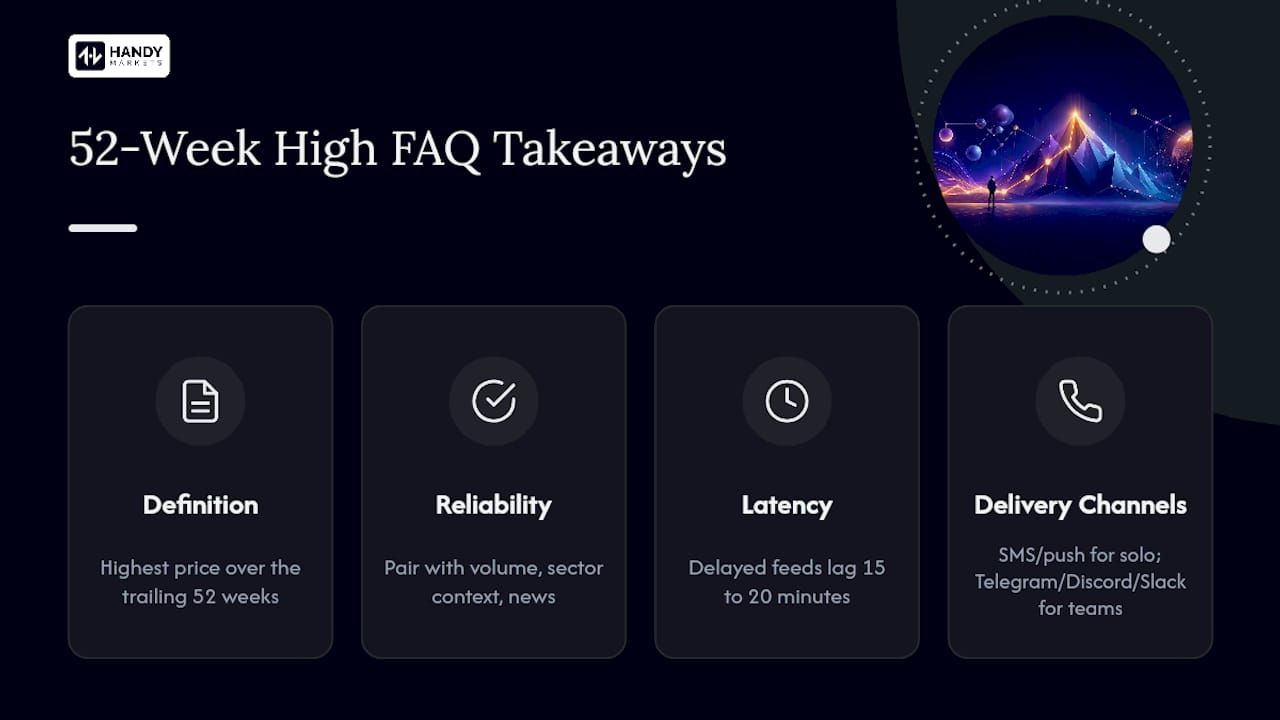
It’s the highest price a stock has traded at over the trailing 52 weeks. Some platforms track it on an intraday basis, others only count closing prices, so check which rule your data source uses.
Are 52-week high alerts reliable for entering trades?
They’re a useful filter, not a standalone strategy. Pairing the alert with volume confirmation, sector context, and a quick news check meaningfully improves reliability over acting on price alone.
What’s the difference between real-time and delayed alerts?
Real-time feeds reflect trades within seconds; delayed feeds often lag 15 to 20 minutes. That gap barely matters for casual monitoring but matters a lot if you’re executing off the alert.
Can I get 52-week high alerts for free?
Many platforms, including Handy Markets, offer a free tier for basic price alert monitoring, with paid upgrades typically unlocking real-time data and higher symbol limits.
Which delivery channel is best for stock alerts?
It depends on your workflow. SMS and push notifications work well for solo traders who need speed, while Telegram, Discord, or Slack fit better for teams that want to see and discuss the same signal together.
This article is general information, not a substitute for advice from a qualified financial advisor. Consult a qualified financial professional about your own circumstances before acting on anything here.
Sources
Before relying on any platform’s alerts for execution decisions, a few checks are worth doing once and revisiting periodically:
- If Apple sends you a push notification alerting you to a spyware attack, take it seriously | TechCrunch