

TL;DR:
- Effective trading alerts require layered workflows that filter noise, prioritize signals, and support broader market context analysis. Building such systems involves selecting proper tools, defining clear rules, and continuously refining alert conditions through disciplined reviews. Integrating real-time data, automation, and sound risk controls turns alerts into smarter, more actionable insights that improve trading discipline and outcomes.
Missed the breakout on Bitcoin because your inbox was buried in irrelevant stock news? Or maybe you acted on a low-priority alert and got burned on a bad trade? Alert overload and alert blindness are two sides of the same coin, and they’re quietly costing traders real money every day. The fix isn’t more alerts or fewer alerts. It’s a smarter, layered workflow that filters noise, prioritizes signals, and keeps you focused on what actually moves your portfolio. This guide walks you through exactly how to build that system from scratch.
Table of Contents
- What you need to set up an effective alert workflow
- Step-by-step: Designing your layered alert workflow
- Integrating real-time execution and automation
- Avoiding false positives and alert fatigue
- Checking context before taking action
- Why a disciplined workflow trumps endless alerts
- Level up your trading with smarter alerts
- Frequently asked questions
Key Takeaways
| Point | Details |
|---|---|
| Layer your alerts | Dividing alerts into discovery, actionable, and execution categories helps reduce noise and prevent missed opportunities. |
| Automate with safeguards | Connect alerts to automated execution only after adding risk controls and rule validation to protect your trades. |
| Minimize false signals | Require multi-factor confirmation and cooldown windows so you act only on meaningful, high-quality signals. |
| Check context before acting | Validate every alert against broad market conditions and sentiment to avoid costly mistakes. |
| Workflow beats quantity | A disciplined workflow with well-designed alerts is the real edge for consistent trading success. |
What you need to set up an effective alert workflow
Now that the challenge of alert overload is clear, let’s list what you need for a streamlined system. Before you configure a single trigger, you need the right building blocks in place. Rushing to set alerts without a solid foundation is like setting a smoke alarm with no batteries: it feels proactive, but it won’t save you when it counts.
The core tools you need
Here is a practical checklist of what every multi-asset alert workflow requires:
- A trading platform or market data service that supports custom alert triggers across asset classes (stocks, crypto, forex, commodities, indices)
- Real-time data feeds that update prices, volume, and news without meaningful delays. Stale data produces stale alerts.
- A notification delivery system capable of pushing alerts through multiple channels such as Telegram, Discord, Slack, SMS, email, or webhooks
- An optional automation or validation layer for traders who want alerts to connect directly to order routing or rule checking
- A clear written rule set defining what each alert type means and what action, if any, it demands
The tool choice matters less than the structure behind it. Even a simple setup can outperform an elaborate one if the logic is sound. We recommend starting with real-time alert monitoring tools that let you customize triggers across different asset classes without needing a coding background.
Understanding alert layers with real-world examples
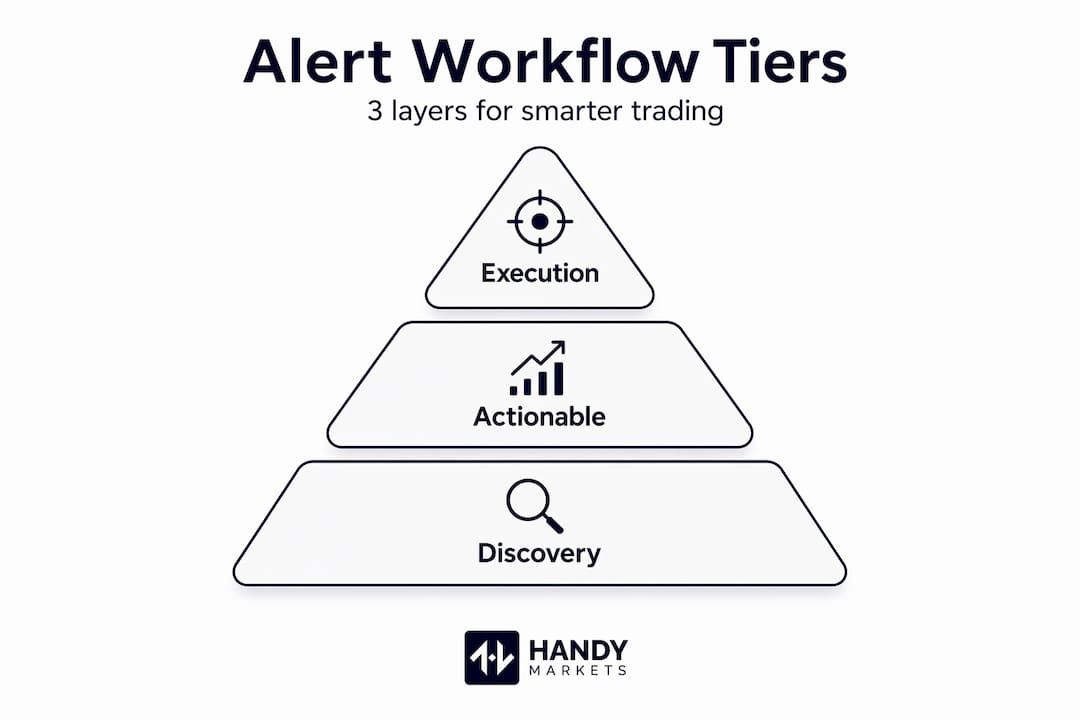
One of the most important concepts in alert design is layering. According to a practical workflow framework, a well-designed market alerts system is typically layered: discovery or attention alerts, like watchlist news, come first, while actionable execution alerts triggered by pre-approved rules come second. Every alert is not equally urgent, and treating them as such leads to burnout and bad decisions.
Think of it this way. A news headline about the Federal Reserve is interesting. A 3% price drop in a stock you are actively watching, confirmed by a volume spike, is actionable. These two pieces of information should never land in the same notification channel with the same urgency level.
For real-time market data to actually drive good decisions, it needs to be filtered, categorized, and routed to your attention at the right moment. That is exactly what a layered alert system accomplishes. Building in solid risk management workflows from the start ensures your alert system supports your broader trading discipline, not just your reflexes.
Data table: Alert tool comparison by feature
| Feature | Basic alert tool | Advanced multi-asset platform |
|---|---|---|
| Asset classes covered | 1 to 2 (stocks or crypto) | 5 or more (stocks, crypto, forex, indices, commodities) |
| Alert delivery channels | Email only | Telegram, Discord, Slack, SMS, Webhook, Email |
| Custom trigger conditions | Limited (price only) | Price, volume, news, technical indicators |
| Automation integration | None | Rule-based order routing support |
| Cooldown and confirmation logic | Rarely available | Supported |
Step-by-step: Designing your layered alert workflow
With your tools in hand, it’s time to structure your workflow for clarity and efficiency. Most traders skip this step and then wonder why their alerts feel chaotic. Structure is not optional. It is the engine that makes every other part work.
The three primary alert layers
A strong workflow separates alerts into three distinct layers, each with its own purpose, conditions, and response expectation.
- Informational layer (discovery alerts): These alerts tell you something happened. A watchlist stock moved more than 2%. A major earnings report dropped. Bitcoin crossed a round number. These alerts do not demand immediate action. They demand your attention and further evaluation.
- Actionable layer (price and volume alerts): These alerts signal that specific pre-defined conditions have been met. For example: “Gold dropped below $2,300 AND volume is 150% of the 20-day average.” This combination means something real is happening. You should check broader context and consider a trade.
- Execution layer (trading signals): These are the highest-priority alerts. They confirm that your pre-approved rules are satisfied and a trade should be placed or reviewed immediately. They should be rare and highly specific.
This layered structure, as emphasized in stock market alert best practices, prevents the common mistake of treating every ping as equally urgent. You can also explore following live market prices to understand how real-time data moves between these layers.
Alert urgency comparison table
| Alert layer | Trigger example | Urgency | Required response |
|---|---|---|---|
| Informational | Watchlist stock up 2% | Low | Monitor and log |
| Actionable | Price breaks key level with volume | Medium | Review context, assess trade |
| Execution | All pre-approved rules confirmed | High | Place or confirm trade |
Step-by-step setup instructions
- Write your rules first, configure alerts second. Before touching any platform, define exactly what conditions must be true for each layer. This discipline prevents impulse alert creation.
- Set informational alerts broadly but deliver them quietly. Route these to email or a low-priority Slack channel. Do not let them interrupt your focus.
- Set actionable alerts with two or more criteria. A single price level is not enough. Combine it with volume, a news trigger, or a technical condition.
- Reserve execution alerts for your most trusted setups. These should route to SMS or Telegram for instant visibility.
- Review and prune your alert list weekly. Stale alerts for positions you no longer hold or setups that are no longer relevant are just clutter. Delete them.
Pro Tip: Color-code or label your notification channels. For example, execution alerts go to a “High Priority” Telegram group, while informational alerts land in an email folder you check twice daily. This separation alone can dramatically reduce your cognitive load. Check out execution workflow best practices for more guidance on routing decisions efficiently.
You can browse multi-asset alert options to see how different asset classes and triggers can be combined into a single monitoring workflow.
Integrating real-time execution and automation
Once your alerts are organized, you can amplify efficiency by linking them directly to real-time execution systems. This is where your workflow shifts from reactive to proactive.

When an execution-layer alert fires, the ideal system does not just notify you. It begins validating whether all trading rules are met. According to Proteryx’s execution framework, alerting can be connected to an order-routing and automation layer that validates rules including portfolio limits, symbol rules, position sizing, and risk controls before preparing and routing trades. That kind of automated validation layer prevents costly errors caused by emotion or speed.
Key risk controls to build into your automation layer
When connecting alerts to automated trading alerts or semi-automated systems, these controls should be non-negotiable:
- Maximum position size limits based on account value and volatility
- Daily loss limits that pause all automation if a threshold is breached
- Symbol-level rules that prevent double-entry into correlated positions
- Stop-loss orders attached to every automated entry
- Pre-trade rule validation that checks all conditions before the order is prepared
- Manual override capability so you can pause or cancel automation instantly
“Treat your automation layer like a co-pilot, not an autopilot. It handles the repetitive checks, but you remain the decision-maker on anything outside your pre-defined rules.”
Pro Tip: Never connect execution alerts to automation until you have run the setup in paper trading mode for at least two weeks. You need to see how the system behaves across different market conditions before real capital is at stake. Review risk management in alerts for specific examples of how experienced traders size positions and set guardrails.
Avoiding false positives and alert fatigue
Automated alerts are powerful, but only when they’re truly reliable. Let’s make sure your system stays smart, not noisy.
False positives, alerts that fire without a genuinely tradeable opportunity behind them, are one of the biggest problems traders face. They train your brain to ignore alerts over time, which is exactly the opposite of what you want. The solution is confirmation logic combined with cooldown periods.
According to research on automated alert systems, a key nuance is confirmation and cooldown. If alerts fire immediately on the first condition match, noise and false positives rise sharply. Robust systems delay escalation until multiple conditions align, such as a headline classification plus price and volume confirmation, and may apply short confirmation windows or cooldown periods to prevent repeated triggering on the same event.
How to implement confirmation and cooldown logic
- Require at least two independent signals before an alert escalates. For example, a price break alone is not enough. Pair it with volume above average or a related news event.
- Set a confirmation window. If the price breaks a level but recovers within three minutes, that alert should not escalate. Require the condition to hold for a defined period, such as five minutes, before triggering.
- Apply cooldown timers. After an alert fires, block re-triggering on the same condition for at least 15 to 30 minutes. This prevents the same event from flooding your channels.
- Cross-check across timeframes. An alert on a 1-minute chart means something different from the same signal on a daily chart. Filtering by timeframe reduces low-quality triggers.
- Audit fired alerts weekly. Review which alerts triggered but did not lead to valid setups. Adjust your conditions based on what you find.
Pro Tip: Keep a simple log of every alert that fires and whether it corresponded to a genuine opportunity. After 30 days, you will have clear data on which alert conditions are producing signal versus noise. This discipline transforms your system from guesswork to evidence. Your volatility checklist is a great companion tool for evaluating alert quality during high-volatility periods. Also review trading rule examples for concrete frameworks you can adapt to your own confirmation logic.
Checking context before taking action
The last line of defense is checking overall market context before committing to trades. An alert, even a well-filtered one, is never the whole story. It is simply a prompt to look closer.
According to design principles for market alerts, alerts should be designed around the trader’s action loop. When an alert triggers, the next step is checking broader live context, including index and sector strength, and whether the move is isolated versus part of a broader shift, rather than blindly acting on the alert alone.
What to check when an actionable or execution alert fires
Build these context checks into your post-alert checklist:
- Index movement: Is the S&P 500, Nasdaq, or relevant index moving in the same direction? A stock breakout during a broad market selloff deserves extra skepticism.
- Sector performance: Are other stocks in the same sector moving similarly? An isolated move may reflect news specific to one company rather than a trend.
- Related assets: For crypto, is Bitcoin leading or lagging? For commodities, is the dollar index moving?
- Recent major news: Has a central bank announcement, economic data release, or geopolitical event just dropped?
- Sentiment shift indicators: Are volatility measures like the VIX (the CBOE Volatility Index, which tracks expected market swings) spiking or falling?
Traders who build this context check into every alert response make fewer reactive trades and catch more genuine opportunities. Reviewing key market indicators helps you build fluency in reading these signals quickly. For simulated practice before going live, explore simulated trading programs that let you test your context-check workflow without risking real capital.
Callout: Research consistently shows that traders who verify broader market context before acting on alerts significantly outperform those who treat alerts as standalone buy or sell signals. Context is not a bonus step. It is the step.
Why a disciplined workflow trumps endless alerts
Here is the uncomfortable truth we see play out again and again: more alerts do not produce better results. They produce more anxiety, more overtrading, and more losses. The traders who consistently outperform are not the ones with the most sophisticated alert systems. They are the ones with the most disciplined systems.
Beginners tend to interpret every alert as an opportunity. They stack conditions, add more triggers, subscribe to every scanner, and end up with a notification feed that never stops buzzing. The result is decision paralysis or impulsive trades made just to feel responsive. Neither is a winning strategy.
Seasoned traders do the opposite. They automate the checks that are clear and objective. They review only the signals that survive multiple filters. And they reserve their cognitive energy for the genuinely ambiguous calls that require human judgment. This is not laziness. It is leverage.
The habit that separates good alert users from great ones is the weekly review. Sit down every Sunday or Monday and ask: which alerts fired this week? How many led to valid setups? How many were noise? Then tighten your conditions based on what you find. Over time, your system gets smarter because you get smarter about what your system is telling you.
Start with a simple price alert setup and add complexity only when the simpler version stops serving you. Most traders will find that a tight three-layer workflow with five to ten high-quality alerts beats a sprawling system with fifty mediocre ones, every single time.
Level up your trading with smarter alerts
If you have been managing market alerts piecemeal, it is time to bring everything under one roof. Handy.markets is built for exactly this kind of workflow: real-time data across stocks, crypto, forex, commodities, and indices, all in one place, with flexible alert delivery across Telegram, Discord, Slack, SMS, Webhook, and email.
You can track all asset prices across multiple asset classes at once, giving you the market-wide context that transforms a good alert workflow into a great one. When you’re ready to activate your layered system, head to set up price alerts and configure your first discovery, actionable, and execution alerts in minutes. The workflow you have built today needs the right platform to bring it to life. This is where you start.
FAQ
What are the main types of market alerts in a workflow?
The main types are discovery alerts (news, watchlist changes), actionable alerts (price or volume triggers), and execution alerts (signals that trigger trades). A layered workflow treats each type differently based on its urgency and required response.
How can I reduce false positives from my market alerts?
Use confirmation logic, such as requiring multiple criteria or a cooldown period before re-alerting, to reduce spurious signals. As research on automated alert systems confirms, immediate single-condition alerts are the primary driver of false positive fatigue.
Should trading alerts be connected to automated order execution?
Yes, when alerts are linked to an automation layer with proper rule checks, trades can be prepared and routed more efficiently and safely. Proteryx’s approach shows that validating portfolio rules, sizing, and risk controls before routing is the key difference between smart automation and reckless automation.
Why is checking market context after an alert so important?
Reviewing context like market trend or sector strength helps filter out misleading signals and avoid emotional trades. Alert design principles confirm that context-checking is a core step in the trader’s action loop, not an optional follow-up.
Recommended
- Market Monitoring Guide: Real-Time Alerts For Traders | Handy.Markets
- Financial Markets: Track Crypto, Stocks, Forex, Indices, Commodities & ETFs Prices With Alerts | Handy.Markets
- How To Follow Live Market Prices: Real-Time Strategies | Handy.Markets
- Top 6 Cryptocurrencyalerting.com Alternatives 2026 | Handy.Markets