
TL;DR:
- Slippage is the difference between expected and actual trade prices, occurring across all asset classes.
- Market volatility, low liquidity, large orders, and network latency cause slippage, especially during major news events.
Slippage in trading is defined as the difference between the price you expect your trade to execute at and the actual price it fills at. This gap appears across every asset class, including stocks, forex, crypto, and futures, and it works in both directions. Positive slippage gives you a better price than expected, while negative slippage delivers a worse one. Most traders encounter negative slippage far more often, and even small, repeated gaps erode profits over time. Understanding slippage meaning in trading is the first step toward protecting your execution quality and building a more realistic risk plan.
What is slippage in trading, and why does it happen?
Slippage is the execution gap between your intended price and your actual fill price. It is not a broker error or a system glitch in most cases. It is a natural result of how markets work, where prices move continuously and orders take time to process.
Every trade you place travels through a chain: your platform, your broker’s server, and the exchange’s matching engine. Each step takes time. During that time, the market price can shift. The fill you receive reflects the price at the moment of execution, not the moment you clicked “buy” or “sell.”
Slippage occurs across all asset classes, from equities to foreign exchange to digital assets. The degree varies by market. Forex markets are among the most liquid in the world, which generally keeps slippage small. Crypto markets, especially for smaller tokens, can produce significant slippage because liquidity is thin and price moves are sharp.
What causes slippage in trading?
The primary causes of slippage are market volatility, low liquidity, large order size, and network latency. Each one creates a different type of execution gap, and they often combine during high-stress market moments.
- Market volatility. Rapid price movement is the most common cause. When prices shift faster than your order can be processed, the fill lands at a different level. This is especially common during major news events like Federal Reserve rate decisions or non-farm payroll releases.
- Low liquidity. Every trade needs a counterparty. When buyers or sellers are scarce, your order may fill at a price further from the quote because the market has to reach deeper into the order book to complete your trade.
- Large order size. A large buy or sell order can consume multiple price levels in the order book. The first portion fills at the quoted price, but subsequent portions fill at progressively worse prices. This is called price impact.
- Network latency. The physical distance between your computer and the exchange’s servers adds milliseconds to your execution. In fast markets, milliseconds matter. Algorithmic traders use virtual private servers (VPS) located near exchange data centers to cut this delay.
- Gaps at market open. Stocks and futures can open at prices far from their previous close after overnight news. Any order placed at the open faces gap risk, which is a form of slippage.
Pro Tip: Avoid placing market orders in the first few minutes after a major economic announcement. Spreads widen, liquidity thins, and slippage spikes. Wait for the initial volatility to settle before entering.
Trading around major news events significantly increases slippage risk because prices gap rapidly and order books thin out. Central bank announcements, earnings releases, and geopolitical shocks all fall into this category.

How does slippage impact your trades?
Slippage directly affects your profit and loss on every trade. The impact ranges from minor to significant depending on market conditions, order size, and asset class.
- Negative slippage increases your cost. If you intend to buy at $100 but fill at $100.50, you start the trade already down $0.50 per share. On 1,000 shares, that is $500 in unexpected cost before the market moves a single tick in your favor.
- Positive slippage improves your outcome. If a sell order fills at $100.20 instead of $100.00, you capture an extra $0.20 per share. Positive slippage is real and does occur, particularly in fast-moving markets where prices overshoot.
- Slippage compounds across many trades. A trader placing dozens of trades per week with consistent negative slippage of even $0.10 per share faces a meaningful drag on annual returns. The effect is proportional to trade frequency and position size.
- Slippage affects stop-loss orders. A stop-loss set at $95 may fill at $94.60 during a fast market. The protection you planned for does not fully materialize, and your actual loss exceeds your intended risk.
- Platform rejection policies add another layer. High-speed platforms may reject orders if the price moves beyond a set slippage tolerance. This protects you from a bad fill but means your trade does not execute at all, which carries its own opportunity cost.
Slippage is treated as a liquidity cost) by quantitative traders rather than an execution error. That framing matters. When you accept slippage as a cost of doing business, you can model it, budget for it, and factor it into your strategy’s expected return.
What strategies can you use to minimize slippage?
Slippage cannot be fully eliminated, but you can reduce its frequency and size with the right tools and habits. The goal is not perfection. The goal is consistent, disciplined execution that keeps slippage within a predictable range.
- Use limit orders instead of market orders. A limit order specifies the maximum price you will pay to buy or the minimum price you will accept to sell. It will not fill at a worse price. The trade-off is that the order may not fill at all if the market moves away. For most traders, this control is worth the occasional missed trade.
- Apply guaranteed stop-loss orders. Limit orders and guaranteed stop-loss orders help mitigate slippage risk by locking in your exit price. Guaranteed stops carry a small premium, but they deliver certainty that a standard stop cannot.
- Set a slippage tolerance on your platform. Many trading platforms allow you to define the maximum acceptable price deviation for an order. If the fill price exceeds that tolerance, the platform rejects the order rather than executing at a worse price.
- Avoid trading during high-volatility windows. Avoiding trade execution during periods around central bank announcements reduces slippage risk significantly. The same applies to major economic data releases and earnings reports.
- Trade liquid markets and instruments. High-volume assets like major forex pairs (EUR/USD, USD/JPY) and large-cap stocks have deep order books. Deep order books mean your order fills closer to the quoted price. You can learn more about how this works in our guide to market liquidity.
- Use a VPS for algorithmic trading. VPS hosting reduces network latency and improves execution speed by placing your trading software physically close to the exchange’s servers.
Pro Tip: When trading forex, check the currency liquidity conditions before entering a position. Thin liquidity windows, such as the period between the New York close and the Tokyo open, produce wider spreads and higher slippage.
How do professionals factor slippage into trading strategies?
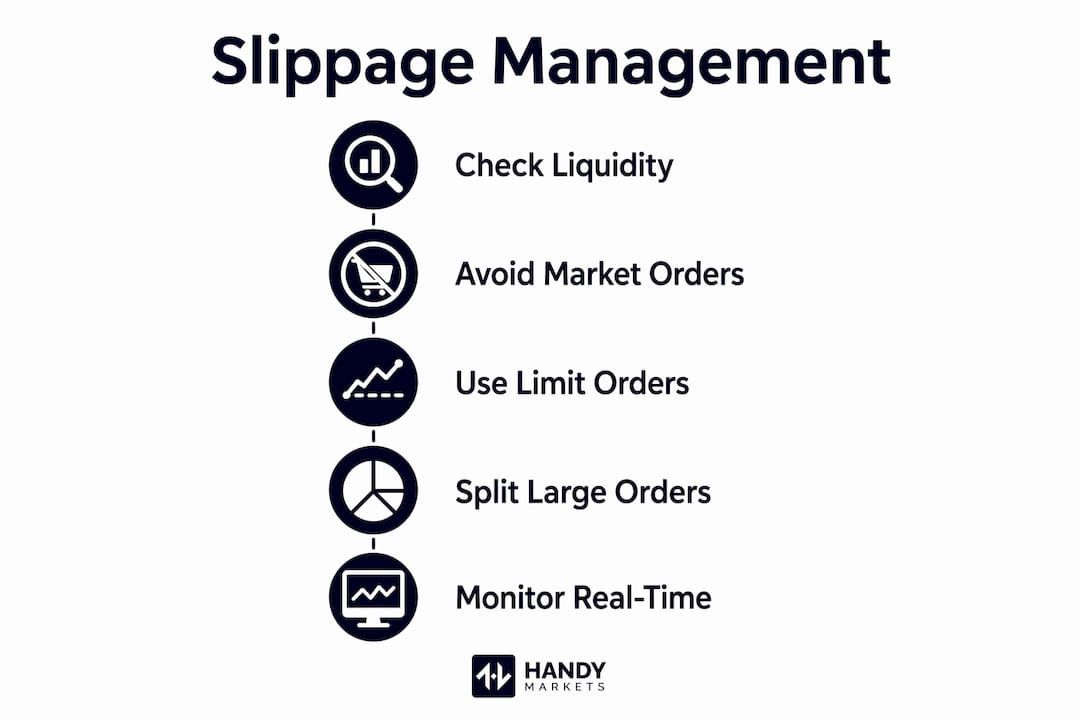
Professional and institutional traders do not treat slippage as an afterthought. They build it into their execution models from the start. This discipline separates strategies that perform well in backtesting from those that hold up in live markets.
The most widely used professional tactic is breaking large orders into smaller child orders. Large orders can consume liquidity across multiple price levels, increasing the average fill price. By splitting a 10,000-share order into ten 1,000-share orders executed over time, a trader reduces the price impact of each individual fill. Institutional desks use algorithms like VWAP (Volume Weighted Average Price) and TWAP (Time Weighted Average Price) to automate this process.
Quantitative traders go further. They model slippage as a liquidity cost and subtract it from expected returns when evaluating a strategy. A strategy that looks profitable before slippage may be marginal or unprofitable after it. Backtesting without slippage assumptions produces results that cannot be replicated in live trading.
| Execution approach | Slippage risk | Best suited for |
|---|---|---|
| Market order | High | Speed-critical entries with small size |
| Limit order | Low | Price-sensitive entries with patience |
| VWAP algorithm | Medium | Large institutional orders over time |
| Guaranteed stop-loss | Minimal | Defined-risk exits with certainty |
One phenomenon professionals watch for is reverse slippage. Reverse slippage can occur) when buying a thinly traded asset at rising prices initially inflates its mark-to-market value. The position looks profitable on paper. But when the trader tries to exit, the liquidity that supported the entry is gone, and the exit price is far worse than expected. This is a particular risk in small-cap stocks and low-liquidity crypto tokens.
Platforms implementing best execution policies reject orders that move beyond tolerance thresholds. This protects traders from catastrophic fills during flash crashes or extreme volatility. The trade-off is a missed entry or exit. Professional traders accept this trade-off as a reasonable cost of execution discipline. Understanding market volatility and how it drives these moments is a core skill for anyone managing slippage at scale.
Key Takeaways
Slippage is an unavoidable cost of market participation, but traders who understand its causes, measure its impact, and apply disciplined order management can keep it within a predictable and manageable range.
| Point | Details |
|---|---|
| Slippage definition | The gap between your expected trade price and your actual fill price across all asset classes. |
| Primary causes | Market volatility, low liquidity, large order size, and network latency all drive slippage. |
| Minimize with limit orders | Limit orders cap your fill price; guaranteed stop-losses lock in your exit with certainty. |
| Avoid high-volatility windows | Trading around central bank announcements and major news events spikes slippage risk. |
| Professional management | Institutional traders split large orders and model slippage as a liquidity cost in backtesting. |
Slippage is manageable. Here is what we have learned.
At Handy Markets, we track price data across thousands of assets every day, and slippage patterns are visible in that data. The traders who struggle most with slippage share a common habit: they use market orders during volatile conditions and then treat the resulting bad fills as bad luck. They are not bad luck. They are predictable outcomes of predictable conditions.
The traders who manage slippage well do two things consistently. First, they match their order type to their priority. If price certainty matters, they use a limit order and accept the risk of no fill. If speed matters, they use a market order and accept the slippage cost. They never confuse the two. Second, they avoid the highest-risk windows. Earnings season, central bank meeting days, and geopolitical shock events all produce conditions where slippage multiplies. Sitting out those moments is not timidity. It is discipline.
The uncomfortable truth about slippage is that most retail traders underestimate its cumulative cost. A few cents per trade feels trivial. Across hundreds of trades per year, it becomes a meaningful drag on returns. Build slippage into your risk management plan from day one, not as an afterthought. That single habit will improve your real-world results more than any indicator or signal ever will.
Stay ahead of slippage with real-time market data
Slippage thrives in conditions you did not see coming. Handy Markets gives you the visibility to see them before they hit.
With live price alerts across crypto, forex, stocks, commodities, and indices, you can track liquidity conditions and volatility in real time. Set instant notifications via Telegram, Discord, Slack, SMS, or email so you always know when market conditions shift. Whether you are monitoring a specific token like TARS AI (TAI) or watching broad market moves, Handy Markets puts the data you need in front of you at the right moment. Better information means better timing, and better timing means less slippage. Visit Handy Markets to set up your first alert in minutes.
FAQ
What is slippage in trading, simply explained?
Slippage is the difference between the price you expect your trade to fill at and the price it actually fills at. It occurs in all markets and can work in your favor (positive slippage) or against you (negative slippage).
What causes the most slippage in forex trading?
Market volatility and low liquidity are the primary causes of slippage in forex trading. Slippage spikes most sharply around major economic announcements like Federal Reserve decisions and non-farm payroll releases.
How do limit orders reduce slippage?
A limit order sets the maximum price you will pay to buy or the minimum you will accept to sell, so your order cannot fill at a worse price. The trade-off is that the order may not fill if the market moves away from your limit.
Can slippage ever be positive?
Yes. Positive slippage occurs when your order fills at a better price than expected, such as a buy order filling below your target price. It happens most often in fast-moving markets where prices overshoot briefly.
How do professional traders account for slippage?
Professional traders model slippage as a liquidity cost and subtract it from expected returns during backtesting. They also break large orders into smaller child orders to reduce price impact and use algorithms like VWAP to spread execution over time.