
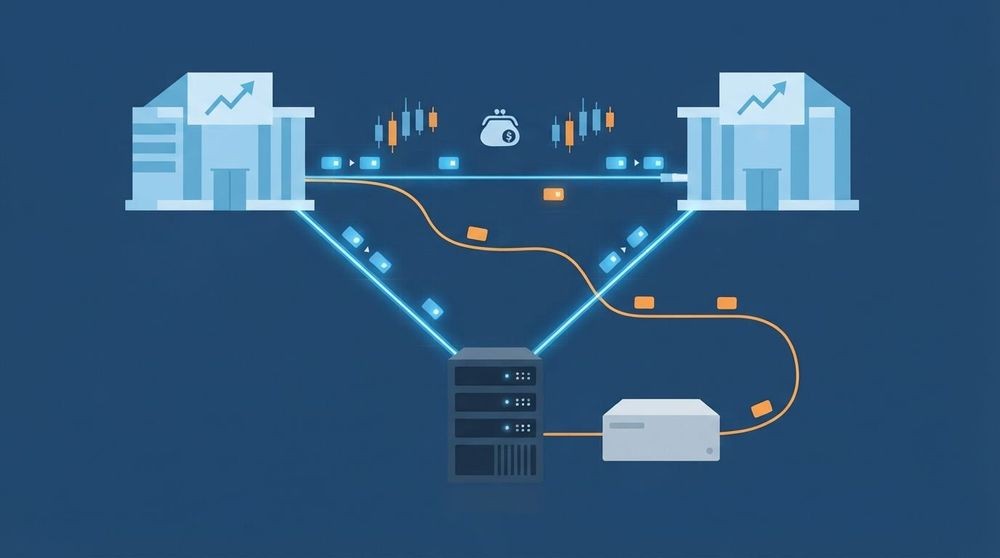
Latency arbitrage is a timing-edge strategy where a faster market participant sees a price change on one venue and trades against the stale quote on a slower venue before that quote updates — the entire sequence measured in microseconds or nanoseconds. The profit per trade is very small, but executed many times it compounds into significant returns for the firms that can afford the infrastructure.
Here is what that means in practice:
- Who benefits: Well-capitalized HFT firms with co-location at exchange data centers like Mahwah (NYSE) and Carteret (Nasdaq), direct market feeds, and FPGA-accelerated decision logic.
- Who is exposed: Slower liquidity providers quoting on multiple venues simultaneously, and retail traders whose brokers route through the consolidated SIP tape rather than direct feeds.
- The regulatory backdrop: Regulation NMS (2007) fragmented U.S. equities trading across multiple venues, widening the windows where stale quotes exist. The SIP (Securities Information Processor) consolidates quotes but lags direct feeds, creating the gap that latency arbitrage exploits.
- Monitoring tools: Platforms like Handy Markets aggregate real-time multi-venue data and configurable alerts, helping traders detect unusual spreads and NBBO dislocations without requiring institutional-grade infrastructure.
Table of Contents
- What is latency arbitrage, step by step?
- The infrastructure behind latency arbitrage in the U.S.
- The economics: tiny profits, massive scale, and real risks
- How U.S. regulation shaped latency arbitrage and what exchanges are doing about it
- What retail traders should know about execution quality
- How to monitor cross-venue price disparities with real-time alerts
- Key Takeaways
- The edge is real, but the window is closing
- Handy Markets keeps you ahead of cross-venue moves
- Useful sources
What is latency arbitrage, step by step?
Picture a stock trading simultaneously on NYSE, Nasdaq, and BATS. A large sell order hits NYSE and moves the best bid down by half a cent. A firm co-located at NYSE’s Mahwah data center receives that update via direct feed in microseconds. The same information traveling through the SIP to a broker’s system may take longer by milliseconds.
During that window, the bids sitting on Nasdaq and BATS are technically wrong. They still reflect the old price.
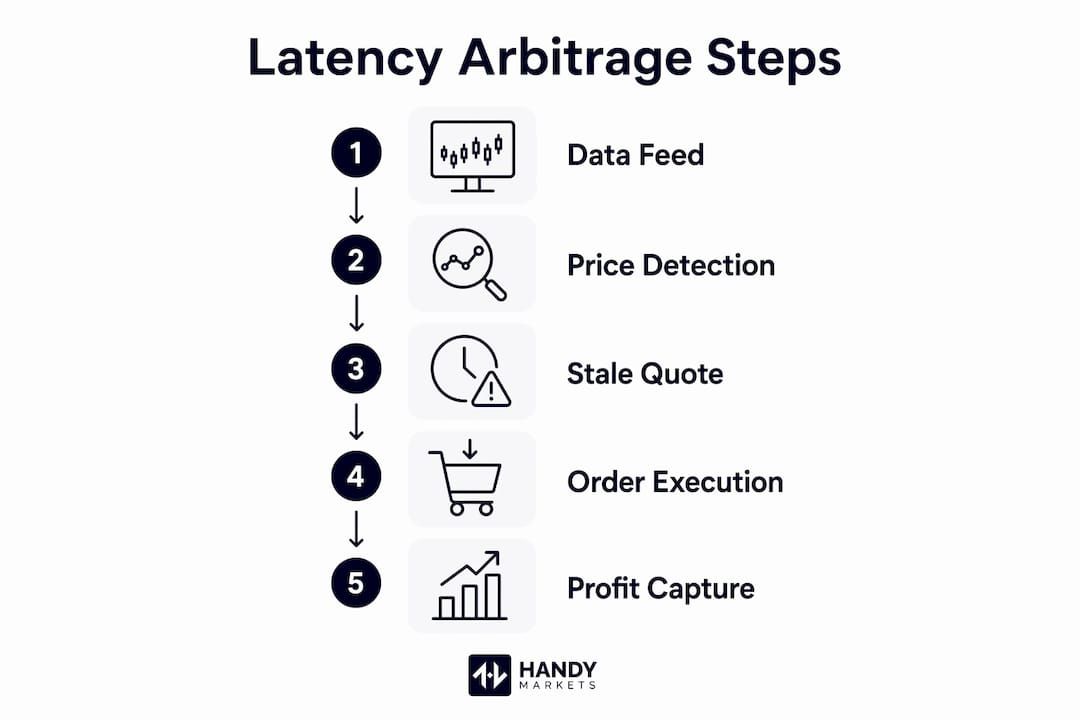
The latency-arbitrage sequence looks like this:
- Tick received on direct feed at Mahwah (t = 0 µs)
- Decision logic fires on FPGA hardware (t ≈ 1–2 µs)
- Order transmitted via co-located network stack to Nasdaq/BATS (t ≈ 3–5 µs)
- Execution against stale quote before the market maker’s cancel reaches the matching engine (t ≈ 8–15 µs)
- SIP update propagates to slower participants (t = several ms later)

The “stale window” is the gap between when the fast firm knows the price has moved and when the slow venue’s quote is updated or canceled. Success depends on arriving at the lagging venue before the market maker’s own cancel order does. That is why co-location in the same data center as the matching engine is standard practice. Fragmented crypto venues work similarly — slower matching engines leave measurable price divergences that fast operators can exploit.
The infrastructure behind latency arbitrage in the U.S.
Latency arbitrage does not run on retail internet speeds. It depends on a specialized physical and software stack, and every layer matters.
| Component | Role | Typical Latency Example |
|---|---|---|
| Co-location (Mahwah / Carteret) | Server racks inside the exchange’s own data center | nanoseconds round-trip to matching engine |
| Direct market feeds | Raw exchange data bypassing the SIP | several milliseconds ahead of consolidated tape |
| FPGA / specialized NICs | Hardware-level decision logic, no OS overhead | very low processing latency in microseconds |
| Fiber optic (Chicago–NY) | Standard backbone connectivity | single-digit millisecond one-way latency |
| Microwave networks (Chicago–NY) | Line-of-sight radio, shorter path than fiber | ~8 ms one-way |
| Custom network stacks | Kernel-bypass software (DPDK, RDMA) | Removes OS scheduling delays |
The core components in plain terms:
- Co-location at Mahwah (NYSE) or Carteret (Nasdaq) puts your server physically adjacent to the matching engine, cutting propagation time to nanoseconds.
- Direct feeds deliver raw order-book data from each exchange, bypassing the SIP’s aggregation delay.
- FPGAs replace general-purpose CPUs for the decision step, executing logic in hardware at speeds no software loop can match.
- Microwave links shave roughly 5 ms off the Chicago–New York route compared with fiber, a meaningful edge when the stale window is measured in single-digit milliseconds.
Fixed costs are steep: rack space at exchange data centers, feed subscriptions, microwave network access, and FPGA development. The edge has commoditized into an arms race where incumbents with sunk infrastructure costs crowd out newcomers.
The economics: tiny profits, massive scale, and real risks
Per-trade profit in latency arbitrage is usually a fraction of a penny per share. The strategy becomes profitable only at scale, and arriving second by even a microsecond typically yields zero. That winner-take-all dynamic shapes everything about how these strategies are built and run.
The profit equation is roughly: win rate × mean edge per win × opportunity frequency − fixed infrastructure cost. When the edge per win is measured in fractions of a cent, frequency must be enormous and win rate must stay high.
Principal risks include:
- Latency spikes: A network hiccup or CPU scheduling delay pushes your order past the stale window. You execute at a price that has already moved against you.
- Software bugs: An error in decision logic at microsecond speeds can generate large unintended positions before a human can intervene.
- Adverse selection: Occasionally the “stale” quote you target is actually a deliberate trap set by a sophisticated market maker.
- Exchange throttles and fee changes: Venues can reprice direct-feed access or add message-rate limits that alter the economics overnight.
- Regulatory changes: New rules targeting speed advantages can eliminate an edge that took years and millions of dollars to build.
Where residual opportunity still exists: younger, fragmented venues — certain crypto pairs on smaller exchanges, tokenized instruments on niche platforms — where matching engines are slower and liquidity is thinner. These are contestable for lean, fast operators even without the full institutional stack. For broader context on where arbitrage opportunities persist, see this analysis of stock arbitrage in 2026.
How U.S. regulation shaped latency arbitrage and what exchanges are doing about it
Regulation NMS, adopted in 2007, required brokers to route orders to the venue displaying the best price across all exchanges. That rule created a multi-venue, fragmented market structure where the same stock trades simultaneously on NYSE, Nasdaq, BATS, IEX, and others. More venues meant more stale-quote windows and more latency arbitrage opportunity.
The SIP vs. direct-feed gap sits at the center of the debate. The SIP consolidates quotes from all venues into the National Best Bid and Offer (NBBO), but it processes and retransmits data, adding latency. Direct feeds skip that step. Firms paying for direct feeds see price changes before the NBBO updates, which is the structural gap latency arbitrage exploits.
Countermeasures now in use:
- Speed bumps: IEX’s 350-microsecond intentional delay neutralizes co-location advantages by equalizing arrival times.
- Batch auctions: Periodic call auctions process orders simultaneously, removing the first-mover advantage within each batch window.
- Synchronized clocks: Exchanges and regulators have pushed for tighter clock synchronization (SIP upgrades, FINRA clock-sync rules) to reduce timestamp ambiguity.
- Premium direct-feed pricing: Some venues price direct feeds to recapture economic rents from speed advantages.
- Enhanced surveillance: Regulators monitor for patterns consistent with systematic stale-quote pick-off.
Academic market-design proposals go further, suggesting synchronized execution timestamps or discrete-time auctions that force simultaneous processing across venues, effectively removing speed as a differentiator. These remain proposals, but they signal where regulatory thinking is heading.
What retail traders should know about execution quality
Retail traders are not competing for microsecond edges. But latency arbitrage affects you indirectly through execution quality and slippage, and understanding that connection helps you make better decisions.
- Prefer limit orders. A limit order controls the price you pay or receive. A market order in a fast-moving stock can execute against a quote that has already been picked off, leaving you with worse-than-expected fill.
- Ask your broker about routing. Does your broker use SIP data or direct feeds for its smart order router? SIP-routed orders may chase prices that have already moved.
- Check execution quality disclosures. SEC Rule 605 requires brokers to publish monthly execution quality statistics. Look at effective spread and price improvement rates.
- Monitor realized slippage. Compare your expected fill price (the quote when you submitted the order) with your actual fill. Persistent negative slippage on liquid names is a signal worth investigating.
- Understand payment for order flow (PFOF). Retail orders routed to wholesalers may receive price improvement, but the wholesaler profits partly by internalizing against the retail flow before it reaches lit venues.
- Use auction-based venues when available. Closing auctions and opening auctions batch orders simultaneously, reducing the impact of speed advantages on your fill.
Latency arbitrage is legal in the United States and distinct from illegal manipulation like spoofing. The debate is about fairness and market structure, not criminality. For a broader look at how cross-exchange arbitrage affects execution, that guide covers the mechanics in depth.
How to monitor cross-venue price disparities with real-time alerts
Real-time multi-venue data and low-latency alerts let traders detect meaningful price disparities, even if retail-grade tools cannot match institutional direct-feed speeds. The goal is not to execute latency arbitrage yourself — it is to see when spreads widen or the NBBO dislocates so you can protect your executions or spot unusual activity.
Capabilities to look for in a monitoring tool:
- Multi-venue consolidated data covering equities, crypto, forex, and ETFs in one view
- Configurable alert thresholds for price divergence, spread widening, or percentage moves
- Multiple notification channels: Telegram, Discord, Slack, SMS, Webhook, and Email
- Alert deduplication to avoid notification floods during volatile periods
- Sub-second refresh rates so you see moves as they develop, not minutes later
Practical alert examples:
- Price divergence threshold: Alert when the same asset shows a spread wider than X basis points across two tracked venues.
- Spread widening: Alert when bid-ask spread on a liquid name exceeds its 30-day average by a set multiple.
- NBBO dislocation: Alert when a reported best bid or offer moves more than a defined percentage in under one second.
Pro Tip: Set your divergence alerts with a minimum duration filter (e.g., the gap must persist for at least 500 ms) to filter out noise from momentary data feed hiccups and focus on dislocations that actually affect your order routing decisions.
Handy Markets provides this kind of pragmatic alerting across crypto, stocks, forex, indices, and ETFs. It is a monitoring and risk-control tool, not an infrastructure provider for institutional-grade latency strategies. For signal-based approaches that complement alert monitoring, signal-based crypto trading offers useful context on how alerts translate into trade decisions.
Key Takeaways
Latency arbitrage is a winner-take-all infrastructure race where the edge belongs to firms with co-location, direct feeds, and FPGAs — but its effects on execution quality touch every trader.
| Point | Details |
|---|---|
| Timing edge, not pricing model | Profit comes from speed, not analysis; arriving second by a microsecond yields zero. |
| Infrastructure is the moat | Co-location at Mahwah/Carteret, direct feeds, and FPGAs are the minimum viable stack. |
| Retail impact is indirect | Latency arbitrage affects you through slippage and execution quality, not direct competition. |
| Regulation NMS created the gap | Fragmented venues under Reg NMS expanded stale-quote windows; speed bumps and batch auctions are the structural response. |
| Handy Markets for monitoring | Use real-time price alerts across Telegram, SMS, and webhook to track spread dislocations and protect your executions. |
The edge is real, but the window is closing
The honest view in 2026: latency arbitrage as a pure speed play in U.S. equities is effectively owned by a handful of incumbents who have spent years and hundreds of millions of dollars building microwave networks, hollow-core fiber, and custom FPGA stacks. The marginal economics collapse for anyone trying to enter that race today. Speed bumps, SIP upgrades, and batch auction mechanisms are steadily narrowing the structural windows that made the strategy so lucrative a decade ago.
Where we see genuine opportunity is at the fringes — fragmented crypto venues, tokenized instruments on newer platforms — where the plumbing is still young enough that a lean, fast operator can find a contestable edge. For everyone else, the practical takeaway is not to replicate HFT infrastructure but to understand how latency dynamics affect your own executions and use monitoring tools to stay informed.
Handy Markets keeps you ahead of cross-venue moves
Catching unusual spreads and NBBO dislocations before they affect your fills is exactly what Handy Markets is built for. While institutional latency arbitrage runs on co-located FPGAs and microwave links, most traders need something far more practical: a single dashboard showing live prices across stocks, crypto, forex, indices, and ETFs, with alerts that fire the moment something moves outside your defined range.
Set up price alerts via Telegram, Discord, Slack, SMS, Webhook, or Email in minutes. Define your own divergence thresholds, spread-widening triggers, or percentage-move alerts, and Handy Markets handles the rest. You will not be running a latency arbitrage desk, but you will know when the market is moving in ways that matter to your positions. Visit Handy Markets to configure your first alert and start monitoring the venues that affect your trades.
Useful sources
- Latency Arbitrage — Fazen Capital: Definition, infrastructure components (Mahwah/Carteret, FPGAs), Reg NMS context, and microwave vs. fiber latency comparison.
- Latency Arbitrage — HFT Book: Per-trade economics, winner-take-all dynamics, commoditization of the edge, legal status, and crypto venue opportunities.
- Latency Arbitrage — QuestDB Glossary: Exchange and regulator countermeasures including speed bumps, batch auctions, and clock synchronization.
- Market Design Proposals to Reduce Latency Edges — Springer: Academic proposals for synchronized execution timestamps and discrete-time auctions to neutralize speed advantages.
- Latency Arbitrage — Wall Street Mojo: Accessible overview of the strategy, co-location mechanics, and risk factors including software glitches.