

TL;DR:
- Arbitrage trading involves exploiting price differences of the same asset across different markets to generate profit. Retail traders should focus on slower strategies like merger and spatial crypto arbitrage to avoid high-speed competition and costs. Proper cost modeling and quick execution are essential to making sustainable arbitrage profits.
Arbitrage trading is the practice of buying and selling identical or equivalent assets simultaneously across different markets to profit from price discrepancies. In formal finance, this strategy is grounded in the Law of One Price, which states that the same asset should trade at the same price everywhere once you account for costs. Understanding what is arbitrage trading matters because it reveals how markets self-correct and where short-lived profit opportunities exist. The strategy is often called “low-risk” rather than “risk-free,” since execution and funding risks are always present. We will walk you through how it works, what types exist, and how retail investors can approach it realistically.
What is arbitrage trading and how does it work?
Arbitrage trading works through a four-step process that must happen quickly and precisely. The steps are:
- Detect mispricing. Scan two or more markets for the same or equivalent asset trading at different prices. This gap is your raw opportunity.
- Lock both positions simultaneously. Buy the asset where it is cheaper and sell it where it is more expensive at the same moment. Simultaneous execution is critical. Any delay creates market exposure and turns a neutral trade into a directional bet.
- Finance the trade. You need capital or margin to hold both positions. Borrowing costs and margin interest start accruing immediately, so speed matters.
- Wait for price convergence. Prices realign as the market corrects the inefficiency. You close both positions and capture the spread as profit.
The core workflow sounds simple, but execution is where most traders stumble. A price gap of $0.50 on a stock can vanish in milliseconds. If your buy order fills but your sell order does not, you are suddenly holding a one-sided position with full market risk.
Pro Tip: Use limit orders on both legs of an arbitrage trade whenever possible. Market orders on the sell side can slip past your target price and erase the entire spread before you realize it.

Consider a straightforward example. Bitcoin trades at $62,000 on Exchange A and $62,200 on Exchange B. You buy one Bitcoin on Exchange A and simultaneously sell one on Exchange B. The gross profit is $200. After accounting for trading fees on both sides, withdrawal fees, and the time it takes to transfer funds, the net profit may shrink to $40 or even turn negative. That math is the heartbeat of every arbitrage decision.
What are the main types of arbitrage trading?
Arbitrage strategies span multiple asset classes and vary widely in complexity, holding period, and technology requirements. Here are the most common types retail investors encounter:
- Spatial (cross-venue) arbitrage. The same asset trades at different prices on two exchanges. You buy on the cheaper venue and sell on the more expensive one. This is the most intuitive form and the starting point for most beginners. Cross-exchange arbitrage in crypto is a popular retail entry point.
- Triangular arbitrage. A forex strategy that exploits pricing inconsistencies among three currency pairs. For example, converting USD to EUR, EUR to GBP, and GBP back to USD can yield a small profit if the exchange rates are misaligned. This is what is forex arbitrage in its most common form.
- Statistical arbitrage. Uses quantitative models to identify pairs of assets whose prices historically move together. When the spread between them widens beyond a statistical threshold, you bet on reversion. This approach requires programming skills and significant data infrastructure.
- Merger arbitrage. After a company announces an acquisition, its stock typically trades below the offer price. You buy the target’s stock and profit when the deal closes at the higher price. Event risk, such as regulatory blocks or deal collapse, is the primary danger here.
- Fixed income arbitrage. Exploits pricing gaps between related bonds or between a bond and its derivatives. Types of fixed income arbitrage include yield curve arbitrage and swap spread arbitrage. These strategies are almost exclusively used by hedge funds due to their capital requirements.
The table below compares these strategies across key dimensions.
| Strategy | Asset class | Complexity | Execution speed needed | Accessible to retail? |
|---|---|---|---|---|
| Spatial (cross-venue) | Stocks, crypto | Low | Moderate | Yes |
| Triangular | Forex | Moderate | High | Partially |
| Statistical | Equities, ETFs | High | Moderate | With tools |
| Merger | Equities | Moderate | Low | Yes |
| Fixed income | Bonds, swaps | Very high | Low | Rarely |
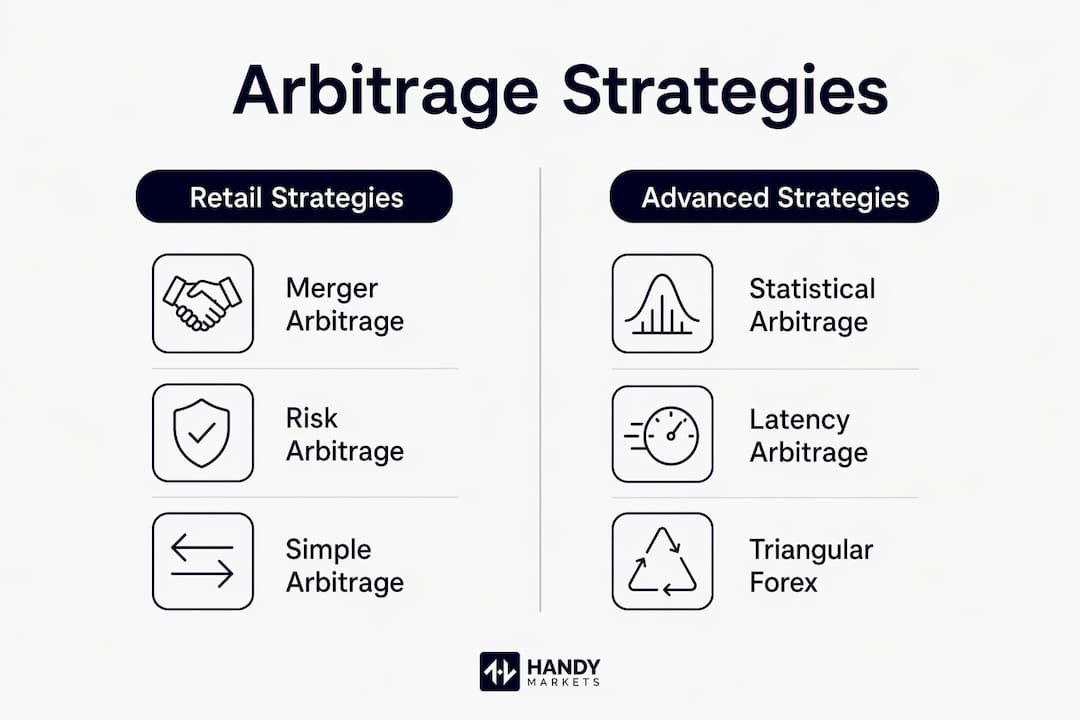
Statistical and latency arbitrage require high-speed technology and are mostly used by hedge funds. Retail investors are best served by spatial and merger arbitrage, where execution windows are wider and capital requirements are lower. For a deeper look at types of crypto exchange arbitrage, the crypto arbitrage methods guide covers six practical approaches for 2026.
What is the spread in arbitrage and why do costs matter?
The spread in arbitrage is the price difference between the buy and sell legs of a trade, minus all associated costs. That net figure is your actual profit. Ignoring any cost category is the most common and costly mistake retail traders make.
Costs that consume your spread include:
- Trading commissions on both the buy and sell sides
- Borrowing or shorting fees if you need to short the expensive asset
- Financing interest on any margin used to fund the position
- Settlement and withdrawal fees, especially relevant in crypto arbitrage
- Slippage, the difference between the price you expected and the price you actually received
Ignoring all transaction costs often causes net losses despite apparent price discrepancies. A spread that looks like $150 in gross profit can become a $30 loss once commissions, transfer fees, and slippage are factored in. Traders must evaluate the “all-in” cost structure before placing any trade.
Financing costs deserve special attention. If you hold a position overnight, margin interest accrues. On a $50,000 position at an annualized rate of 8%, one day of financing costs roughly $11. That amount can easily exceed the spread on a small-cap stock arbitrage. Tracking historical FX rates is also useful when your arbitrage crosses currency boundaries, since exchange rate shifts between legs can silently erode profits.
Pro Tip: Before entering any arbitrage trade, build a simple spreadsheet that lists every fee by category. Total them against the gross spread. If the net margin is below 0.3%, the trade is not worth the execution risk for most retail setups.
What are the risks and challenges of arbitrage trading?
Arbitrage is rarely completely risk-free. Delays or liquidity changes can negate profits quickly. Understanding the specific risks helps you decide which strategies fit your situation.
- Execution risk. If one leg of your trade fills and the other does not, you hold an unhedged position. Price moves against you until you can close it. This is the most immediate danger in any arbitrage attempt.
- Latency risk. Institutional traders use co-location services and microwave links to execute in microseconds. By the time a retail trader sees a price gap and clicks, it may already be gone. Execution logistics are often more challenging than the math suggests.
- Funding and margin risk. Arbitrage positions can require significant capital to hold simultaneously. A margin call during a volatile period can force you to close one leg at a loss before the spread converges.
- Event risk in merger arbitrage. A deal can fail due to regulatory rejection, shareholder votes, or financing collapse. Merger arbitrage losses from blocked deals can be severe, since the target stock often drops sharply back to pre-announcement levels.
- Liquidity risk. Thin markets mean wide bid-ask spreads and difficulty filling large orders at your target price. Crypto markets, especially for smaller tokens, carry significant liquidity risk.
- Regulatory risk. Rules around short selling, cross-border capital flows, and crypto vary by jurisdiction. A trade that is legal in one country may be restricted in another.
Retail investors face one additional structural challenge: competition from high-frequency trading firms. These firms invest millions in technology to capture price gaps in nanoseconds. Attempting to compete with them manually is not realistic. The practical guidance for retail traders is clear: focus on strategies where speed is less critical and where your capital and tools give you a genuine edge.
How can retail investors start with arbitrage trading?
Retail investors can access arbitrage trading without institutional infrastructure, but they need to be selective about which strategies they pursue. The stock arbitrage opportunities guide outlines realistic entry points for 2026. Here is a practical starting framework:
- Start with merger arbitrage or spatial crypto arbitrage. Both offer wider execution windows than latency-dependent strategies. Merger arbitrage requires research skills, not speed. Spatial crypto arbitrage requires fee awareness and fast account setup on multiple exchanges.
- Set up price alerts across multiple markets. You cannot monitor dozens of assets manually. Use a platform that aggregates prices across asset classes and sends alerts the moment a threshold is crossed.
- Allocate a small, defined portion of capital. Treat your first arbitrage trades as learning experiences. Limit your exposure to an amount you can afford to lose entirely while you refine your process.
- Build your cost model before every trade. List commissions, transfer fees, financing costs, and expected slippage. Only proceed if the net spread is positive with a comfortable margin.
- Review every trade after closing. Compare your projected costs to actual costs. Patterns in where you lose money will sharpen your execution over time.
The arbitrage trading checklist from Handy Markets covers the key execution steps and common pitfalls in detail. Reviewing it before your first live trade can save you from the most avoidable mistakes. Understanding the broader asset class landscape also helps you recognize which markets offer the most accessible opportunities for your skill level.
Key Takeaways
Arbitrage trading generates profit by exploiting price gaps between markets, but net returns depend entirely on managing execution speed, financing costs, and strategy-specific risks.
| Point | Details |
|---|---|
| Definition and core principle | Arbitrage buys low and sells high simultaneously across markets, profiting from price convergence. |
| Spread equals net profit | The real spread is the price gap minus all commissions, fees, slippage, and financing costs. |
| Strategy selection matters | Retail investors should focus on spatial and merger arbitrage, not latency or statistical strategies. |
| Execution risk is primary | A single unfilled order leg turns a neutral trade into a directional bet with full market exposure. |
| Cost modeling is non-negotiable | Build a full cost breakdown before every trade to confirm the net spread justifies the risk. |
The honest reality of arbitrage for retail investors
At Handy Markets, we track price movements across dozens of asset classes every day. That vantage point gives us a clear view of how often genuine arbitrage windows appear and how fast they close.
The textbook version of arbitrage sounds almost too good. Buy here, sell there, pocket the difference. The real version is a constant race against fees, latency, and better-funded competitors. We have seen retail traders enter what looked like a clean spatial arbitrage in crypto, only to find that withdrawal processing times on one exchange stretched the holding period long enough for the spread to reverse entirely.
That said, arbitrage is not out of reach for retail investors. Merger arbitrage, in particular, rewards research and patience over raw speed. If you can read an acquisition announcement, model the deal probability, and size your position correctly, you can compete. The edge is analytical, not technological.
The most common mistake we observe is underestimating total costs. Traders calculate the gross spread and stop there. They skip the withdrawal fee, forget the overnight financing charge, and ignore slippage on a thin order book. Those omissions turn profitable-looking trades into losses. Build the full cost model first, every single time.
Arbitrage also teaches you something valuable about markets. Arbitrageurs enforce the Law of One Price and push markets toward efficiency. Even if you never place a single arbitrage trade, understanding how these strategies work makes you a sharper reader of price behavior across any asset class.
Real-time market data for spotting arbitrage opportunities
Spotting arbitrage opportunities requires watching multiple markets at once. Missing a price alert by even a few minutes can mean missing the window entirely.
Handy Markets tracks live prices across cryptocurrencies, stocks, forex, commodities, indices, and ETFs in one place. You can set price alerts through Telegram, Discord, Slack, SMS, Webhook, or Email, so you get notified the moment a threshold is crossed. For retail investors monitoring spread opportunities across markets, that kind of multi-channel alert system replaces the need for constant manual monitoring. Whether you are watching a merger target’s stock or a Bitcoin price gap between two exchanges, Handy Markets keeps you informed without requiring you to stare at screens all day.
FAQ
What is arbitrage trading in simple terms?
Arbitrage trading means buying an asset at a lower price in one market and selling it at a higher price in another market at the same time. The profit comes from the price difference, minus all transaction costs.
Is arbitrage trading risk-free?
Arbitrage is low-risk but not risk-free. Execution delays, liquidity gaps, and financing costs can all turn an apparent profit into a loss.
What is the spread in arbitrage?
The spread in arbitrage is the price difference between the buy and sell legs of a trade. Net profit equals that spread minus all commissions, fees, slippage, and financing costs.
What is forex arbitrage?
Forex arbitrage exploits pricing inconsistencies between currency pairs, most commonly through triangular arbitrage. A trader converts between three currencies in sequence to capture a small profit when exchange rates are misaligned.
Can retail investors realistically profit from arbitrage?
Yes, but only in strategies where execution speed is not the primary edge. Merger arbitrage and spatial crypto arbitrage are the most accessible options for retail investors with limited technology infrastructure.