

TL;DR:
- Index arbitrage exploits brief price differences between stock indexes and futures contracts, mainly executed by institutions with advanced technology. It helps maintain market efficiency by continuously correcting futures prices to match fair value, benefiting all traders through improved liquidity. Retail traders can monitor the basis and dividend schedules to gauge institutional activity without directly executing the strategy.
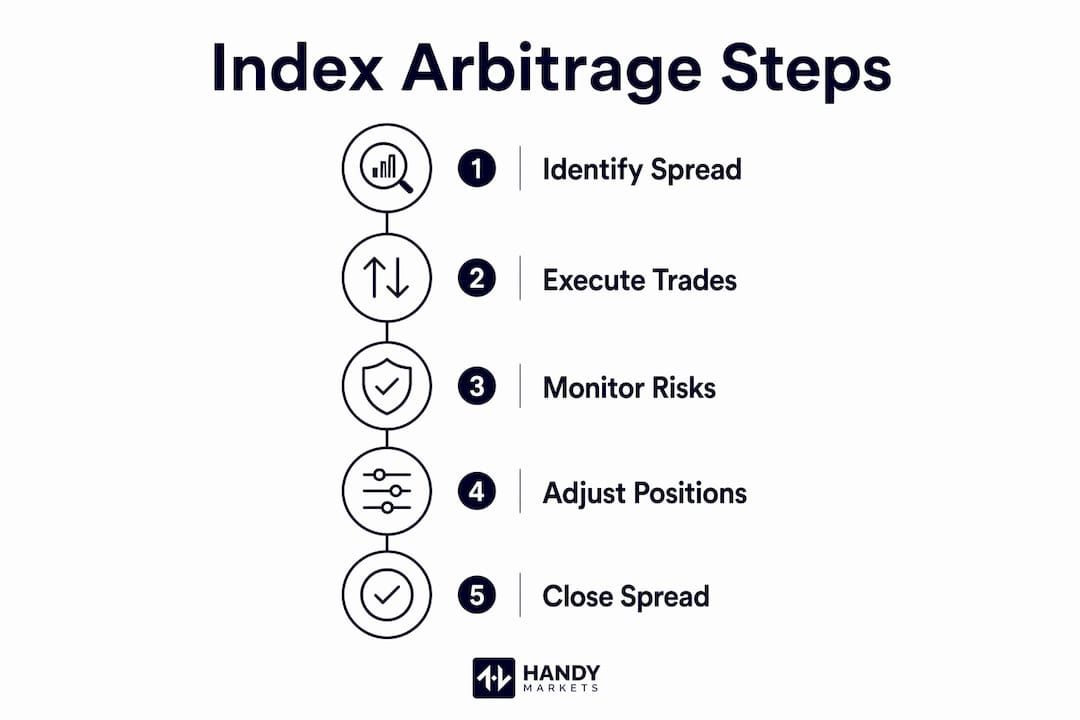
Index arbitrage is defined as a market-neutral trading strategy that profits from temporary price discrepancies between a stock index and its corresponding futures contract. Institutional traders execute simultaneous buy and sell orders across both markets to capture a spread before it closes. The S&P 500 is the most common benchmark for this strategy, with futures contracts traded on the Chicago Mercantile Exchange. These price gaps last milliseconds, which is why the strategy belongs almost entirely to firms running high-frequency algorithmic systems. Understanding how index arbitrage works gives you a clearer picture of how modern markets stay aligned and why prices rarely drift far from fair value.
What is index arbitrage and how does it work?
Index arbitrage exploits a simple but powerful idea: the price of a futures contract on a stock index should equal the index’s current cash price adjusted for the cost of carrying that position to expiration. When the futures price drifts above or below that calculated fair value, a profit opportunity opens. Traders move in immediately to close the gap.

The fair value calculation follows the cost-of-carry model. The formula adjusts the current index price upward for financing costs (the interest you pay to hold the position) and downward for expected dividends paid by index constituents before expiration. Fair value accuracy is the foundation of every profitable index arbitrage trade. A miscalculation here turns a supposed risk-free profit into a directional bet.
Two primary trade structures drive the strategy:
- Long-the-basis (cash-and-carry): The futures contract trades above fair value. The trader buys the underlying basket of stocks and simultaneously sells the overpriced futures contract. Profit locks in when prices converge at expiration.
- Short-the-basis (reverse cash-and-carry): The futures contract trades below fair value. The trader sells the stock basket short and simultaneously buys the underpriced futures contract. Again, profit materializes at convergence.
Both structures require simultaneous execution across the futures market and every constituent stock in the index. A delay of even a fraction of a second can erase the spread entirely.
Pro Tip: Never treat the two legs of an index arbitrage trade as sequential. If one leg fills and the other does not, you hold a naked directional position, not an arbitrage.
What are the main risks in index arbitrage?
Index arbitrage is often described as “risk-free,” but that label is misleading in practice. Transaction costs, slippage, and execution risk eat into the spread before any profit reaches your account. The spread must exceed all-in costs for the trade to make money.
The key risk factors traders face include:
- Execution risk: Price discrepancies close in milliseconds. A slow fill on either leg leaves you exposed to market movement.
- Slippage: Buying or selling a large basket of stocks moves prices. The fill you get is rarely the price you saw when the opportunity appeared.
- Fair value miscalculation: Incorrect dividend estimates or interest rate assumptions produce a wrong fair value. You may enter a trade believing a spread exists when it does not.
- Financing costs: Holding a large stock position overnight carries borrowing costs that can turn a profitable spread into a loss.
- Market volatility: Sharp moves during execution widen bid-ask spreads and increase slippage, compressing or eliminating the arbitrage profit.
Retail traders face an additional structural barrier. High-frequency trading firms with co-located servers and direct market access close most opportunities before a slower participant can even submit an order.
Pro Tip: Before calculating potential profit, subtract commissions, estimated slippage, and financing costs first. If the net spread is not clearly positive, the trade is not worth executing.
How does index arbitrage support market efficiency?
Index arbitrage acts as a self-correcting mechanism in financial markets. Every time a futures price drifts away from fair value, arbitrageurs step in, trade the spread, and push prices back into alignment. This process happens continuously throughout the trading day.
“Index arbitrage is considered an essential mechanism in modern financial markets. It enforces pricing alignment between derivatives and their underlying assets, ensuring that futures contracts accurately reflect the value of the index they track. Without this constant correction, derivatives markets would drift from reality, distorting hedging costs and investment decisions for every market participant.”
The market efficiency role of index arbitrage extends beyond just futures pricing. It improves liquidity in both the futures market and the underlying stock market simultaneously, because every arbitrage trade involves active buying and selling in both venues. Tighter pricing across markets benefits all traders, not just arbitrageurs.
Index arbitrage differs meaningfully from related strategies. Stock arbitrage targets price differences for the same company across two exchanges. ETF-NAV arbitrage targets the gap between an ETF’s market price and the net asset value of its holdings. Index arbitrage specifically targets the futures-to-cash spread on a broad index, making it a distinct arbitrage type with its own mechanics and risk profile. You can also explore crypto arbitrage methods to see how similar logic applies across different asset classes.
Who can actually execute index arbitrage?
The infrastructure required for index arbitrage places it firmly in institutional territory. Automated program trading executes complex basket trades within milliseconds. No human trader can match that speed manually.
| Requirement | Institutional traders | Retail traders |
|---|---|---|
| Execution speed | Millisecond-level via co-located servers | Seconds via standard brokerage platforms |
| Capital base | Large enough to hold full index basket | Typically insufficient for full basket |
| Market access | Direct market access, low-latency feeds | Standard retail brokerage access |
| Basket trading tools | Advanced algorithmic basket execution | Limited or unavailable |
| Fair value systems | Real-time proprietary calculation engines | Manual or delayed estimates |
Capital requirements for margin and holding the full basket of index constituents make this a domain of institutional investors, not individual traders. The S&P 500 index, for example, contains 500 stocks. Buying or selling all 500 simultaneously in the correct proportions requires both capital and technology that retail platforms do not provide.
Some traders attempt ETF-based approximations, buying an ETF like SPY instead of the full basket. This approach reduces capital requirements but introduces tracking error. The ETF price does not move in perfect lockstep with the index, which means the hedge is imperfect and the trade carries residual risk. True index arbitrage, as practiced by institutions, demands precise basket-trading algorithms that execute on every constituent simultaneously.
Institutional traders also benefit from global funds management strategies that integrate index arbitrage within broader market-neutral portfolios, spreading infrastructure costs across multiple strategies.
Practical tips for traders monitoring index arbitrage
Most individual traders will not execute index arbitrage directly. Understanding the mechanics still gives you an edge in reading market behavior and spotting when institutional arbitrage activity is driving price moves.
- Monitor the basis: The basis is the difference between the futures price and the cash index price. When the basis widens sharply, arbitrage activity typically follows and pushes it back toward fair value.
- Track dividend schedules: Upcoming dividends on index constituents change the fair value calculation. A large dividend payment reduces the futures fair value. Traders who miss this adjustment misread the spread.
- Watch financing rates: Rising short-term interest rates increase the cost of carrying a long stock position. This shifts fair value upward, changing where arbitrage opportunities appear.
- Use real-time data feeds: Delayed data makes fair value calculations useless for arbitrage. Even for monitoring purposes, real-time index and futures prices give you a more accurate picture of market conditions.
- Review the arbitrage trading checklist before building any arbitrage-adjacent strategy to confirm you have covered execution, cost, and risk factors.
Pro Tip: Set price alerts on index futures and the underlying index simultaneously. When the two diverge beyond a threshold you define, you get an immediate signal that institutional arbitrage activity may be about to compress the spread.
Key Takeaways
Index arbitrage is the mechanism that keeps futures prices honest, and understanding it makes you a sharper reader of market structure, even if you never execute the strategy yourself.
| Point | Details |
|---|---|
| Core definition | Index arbitrage profits from price gaps between a stock index and its futures contract. |
| Fair value is everything | The cost-of-carry model determines fair value; errors here create directional risk, not profit. |
| Institutional domain | Millisecond execution and full basket capital requirements exclude most retail traders. |
| Market efficiency role | Arbitrageurs act as a self-correcting force, keeping futures prices aligned with cash prices. |
| Retail application | Monitoring the basis and dividend schedules helps traders read institutional activity even without executing the strategy. |
The technology arms race has changed everything
Index arbitrage has always been competitive, but the pace of change since the early 2000s is something most market observers underestimate. When I look at how this strategy has evolved, the clearest shift is that the edge no longer comes from spotting the opportunity. It comes from closing it faster than everyone else.
The transition from manual program trading desks to fully automated systems happened quickly. Today, firms invest heavily in co-location services, custom network hardware, and proprietary execution algorithms just to shave microseconds off their response time. That is the arms race. And like most arms races, it raises the cost of participation without necessarily improving outcomes for the broader market.
What concerns me more is the effect on smaller institutional players. Even mid-sized hedge funds find it difficult to compete in pure index arbitrage because the infrastructure investment required keeps climbing. The strategy has effectively consolidated around a handful of firms with the deepest technology budgets.
The upside is real, though. This competition keeps markets tighter. Bid-ask spreads on major index futures are narrower than they have ever been, and price discovery between cash and futures markets happens faster. Traders who understand this dynamic can use it. When you see a sudden widening in the basis, you know institutional arbitrageurs are about to compress it. That is a readable signal, even if you are not the one executing the trade.
Index arbitrage will remain a cornerstone of market structure. The firms running it will keep evolving their technology. For everyone else, the value is in understanding what it tells you about where prices are heading.
Real-time data for tracking index and futures markets
Staying informed on index and futures prices is the first step toward understanding arbitrage opportunities as they develop.
Handy Markets provides live index and stock prices with real-time percentage changes across indices, equities, commodities, and forex in one place. You can set custom price alerts delivered through Telegram, Discord, Slack, SMS, Webhook, or Email, so you never miss a significant move in the basis or a futures divergence. The platform is built for traders who want clean, fast data without complexity. Whether you are monitoring the S&P 500 futures spread or tracking individual stock price alerts for index constituents, Handy Markets keeps you connected to the market movements that matter.
FAQ
What is index arbitrage in simple terms?
Index arbitrage is a trading strategy that profits from temporary price differences between a stock index and its futures contract. Traders buy the cheaper instrument and sell the more expensive one simultaneously, locking in a spread.
How does index arbitrage differ from ETF arbitrage?
Index arbitrage trades the futures-to-cash spread using the full basket of index constituent stocks. ETF arbitrage targets the gap between an ETF’s market price and its net asset value, which is a related but structurally different trade.
Why can’t retail traders execute index arbitrage?
Price discrepancies close in milliseconds, and executing trades on every stock in a major index simultaneously requires institutional-grade technology and capital that retail platforms do not provide.
What is the cost-of-carry model in index arbitrage?
The cost-of-carry model calculates the fair value of a futures contract by adjusting the current index price for financing costs and expected dividends. Accurate fair value is the foundation of every profitable index arbitrage trade.
Does index arbitrage benefit regular investors?
Yes. Index arbitrage keeps futures prices aligned with cash index prices, which tightens spreads and improves price discovery. That benefits every market participant who trades index-linked products, including ETF investors and options traders.