


A crypto index is a rules-based, transparent benchmark composed of selected cryptocurrencies, weighted typically by market capitalization, designed to track the overall performance of the crypto market or a specific segment of it. Think of it as the S&P 500 of digital assets: instead of buying Bitcoin, Ethereum, and a dozen other coins individually, you get a single number that tells you how the broader market is moving. That single number also becomes the foundation for investment products, trading strategies, and performance benchmarks.
Here is what makes a crypto index distinct from simply holding a few coins:
- Rules-based selection: Assets are included or excluded according to published eligibility criteria, not discretionary picks.
- Transparent weighting: Most indices weight constituents by market capitalization, so larger assets carry more influence.
- Regular rebalancing: Indices reconstitute on a defined schedule, keeping the composition current as the market evolves.
- Diversified exposure: A single index position spans multiple assets, reducing the impact of any one coin’s collapse.
- Benchmark function: Funds, ETFs, and futures contracts can track the index, giving both retail and institutional investors a structured entry point into crypto.
Major examples include the Crypto 10 Index (the top 10 coins by market cap), the CoinDesk 20 Index (a broader set of leading digital assets), and the Nasdaq CME Crypto Indices (institutional-grade benchmarks built for derivatives strategies).
Table of Contents
- What are the major cryptocurrency indices you should know?
- How crypto indices are actually calculated and maintained
- Why crypto indices are useful for trading and investment
- How safe and trustworthy are crypto indices?
- Crypto index funds and investment vehicles available in the US
- Key Takeaways
What are the major cryptocurrency indices you should know?
The crypto index universe has grown considerably, but a handful of benchmarks have earned institutional recognition through methodology rigor and provider credibility.

| Index | Constituents | Weighting Method | Rebalance Frequency | Provider / Regulatory Status |
|---|---|---|---|---|
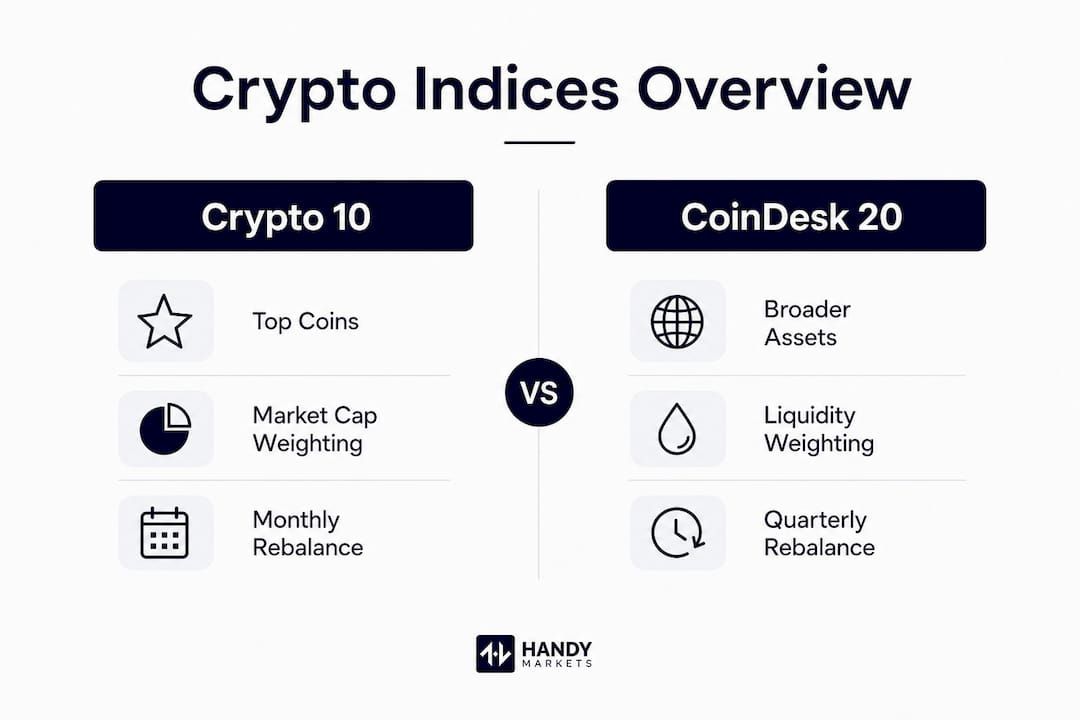
| Crypto 10 Index | 10 | Market-cap weighted | Monthly | Varies by product issuer |
| CoinDesk 20 Index | 20 | Market-cap weighted | Quarterly | CoinDesk Indices, Inc. |
| Nasdaq CME Crypto Indices | Varies by series | Market-cap weighted, capped | Quarterly | Nasdaq / CME Group, regulated US exchanges |
Crypto 10 Index tracks the ten largest cryptocurrencies by market capitalization. Its narrow scope makes it highly sensitive to Bitcoin and Ethereum, which together often represent the majority of the weight. That concentration is a feature for investors who want pure large-cap exposure, but it can feel limiting if you want broader market representation.
CoinDesk 20 Index expands the universe to 20 digital assets, capturing more of the expanding crypto asset class while still applying defined eligibility and weighting rules. CoinDesk Indices, Inc. publishes its methodology openly, which is one reason institutional desks treat it as a credible reference.
Nasdaq CME Crypto Indices are built explicitly for derivatives and institutional strategies. They pull pricing from regulated US trading venues and apply concentration caps to prevent any single asset from dominating the index. For a US investor evaluating futures or structured products, these benchmarks carry the weight of two of the most recognized names in financial infrastructure.
Handy Markets tracks live crypto prices and index data across all major asset classes, making it straightforward to monitor these benchmarks alongside your broader portfolio in real time.
How crypto indices are actually calculated and maintained
Index construction is more nuanced than it looks. The process starts with eligibility screening and ends with a published number that must hold up under scrutiny.
Eligibility criteria typically require a minimum market capitalization, sufficient trading volume across recognized exchanges, and in some cases, regulatory compliance checks. The Nasdaq Crypto US Index, for example, excludes assets linked with fraud or poor liquidity and includes only assets listed on regulated US platforms. That kind of gatekeeping is what separates institutional-grade indices from informal coin rankings.
Weighting is where methodology choices have real consequences. Pure market-cap weighting is considered the most accurate benchmark for reflecting market sentiment, but it creates concentration risk: Bitcoin and Ethereum often represent a large majority of a cap-weighted index. To address this, index providers often apply methodological adjustments such as concentration caps (limiting any single asset to a maximum weight) or factor tilts that tilt toward liquidity or volatility characteristics.
Key steps in the calculation process:
- Define the eligible universe based on market cap, volume, and exchange listing requirements.
- Calculate each asset’s market capitalization at a defined reference point (usually end-of-day pricing from approved sources).
- Assign weights proportional to market cap, then apply any caps or adjustments.
- Compute the index value by summing the weighted prices against a base value.
- Reconstitute periodically to add qualifying assets and remove those that no longer meet criteria.
One challenge unique to crypto: market capitalization is an interpreted metric. Locked tokens, staked coins, and burned supply all affect what counts as “circulating,” and different data providers reach different conclusions. That variability can produce meaningfully different index weights for the same asset, which is why governance and data-source transparency matter so much to index credibility.
Why crypto indices are useful for trading and investment
A crypto index does several jobs at once, and understanding each one helps you decide where it fits in your strategy.

As a benchmark, an index gives you a neutral reference point. If your portfolio returned 40% last year but the Crypto 10 Index returned 65%, you underperformed the market regardless of how good the absolute number looks. That comparison is only possible because the index exists.
As a market proxy, indices let you express a view on the entire crypto market without picking individual winners. Futures contracts and ETFs built on indices let traders go long or short on broad crypto exposure, which is far more capital-efficient than replicating a 10- or 20-coin portfolio manually.
The core benefits of crypto indices for both retail and institutional investors include:
- Diversification across multiple assets, reducing the damage any single coin’s collapse can cause.
- Simplified portfolio management, since one position replaces many individual trades.
- Reduced single-asset risk, particularly relevant in a market where individual tokens can lose 80–90% of their value in a downturn.
- Institutional accessibility, as regulated index-based products meet compliance requirements that direct coin ownership often does not.
Pro Tip: When evaluating any index-based product, check both the tracking error and the expense ratio. Tracking error measures how closely the fund’s return matches the index; even a small, persistent gap compounds into meaningful underperformance over time. The role of index funds in a diversified portfolio follows the same logic whether you are investing in equities or digital assets.
How safe and trustworthy are crypto indices?
Trust in a crypto index comes down to three things: methodology transparency, manipulation resistance, and the regulatory standing of the provider.
Indices that follow IOSCO Principles for Financial Benchmarks commit to governance standards that cover conflict-of-interest management, data quality controls, and accountability mechanisms. These principles were developed for traditional financial benchmarks but apply directly to crypto, and providers who adopt them signal a level of seriousness that matters when institutional capital is involved.
Key attributes that distinguish credible indices from informal rankings:
- Published, auditable methodology that explains every eligibility and weighting decision.
- Price sourcing from regulated or high-integrity venues, not from a single exchange that could be manipulated.
- Exclusion of assets with irregular trading patterns, fraud history, or inadequate liquidity.
- Governance structures with independent oversight and clear rules for handling edge cases like exchange delistings or hard forks.
The volatility of the underlying assets is a separate risk that no methodology can eliminate. Crypto markets move fast, and an index that accurately tracks the market will also accurately track a sharp drawdown. What good index design does is prevent the index itself from amplifying that volatility through poor construction choices.
For investors who want to stay ahead of those moves, setting price alerts on key crypto assets through Handy Markets provides real-time notification across Telegram, Discord, Slack, SMS, and email, so you are never caught off guard by sudden shifts.
Crypto index funds and investment vehicles available in the US
A crypto index is a mathematical benchmark. A crypto index fund is the investment product that attempts to replicate it, and the distinction matters because the gap between the two is where your actual returns live.
US investors currently have access to several structures:
- Spot crypto ETFs hold the underlying coins in institutional custody and issue shares that trade on a stock exchange. The arbitrage mechanism between share price and net asset value keeps tracking error tight, though the fund’s own trading costs during rebalancing still create some slippage.
- Futures-based ETFs hold derivative contracts rather than coins. They tend to carry roll costs that erode returns over time, making them less suitable for long-term index exposure.
- Centralized index funds (offered by asset managers) hold coins in custody and issue shares through brokerage accounts. Expense ratios and tracking error differentiate their performance from the raw index return.
- Decentralized index tokens hold assets in a smart contract on-chain. They offer on-chain verification of holdings but introduce smart contract risk and dependence on oracle price feeds for accurate valuations.
When evaluating any of these vehicles, focus on four factors: the expense ratio, the tracking error relative to the stated index, the custody arrangement and its insurance or regulatory backing, and the rebalancing methodology. A fund that rebalances quarterly on a published schedule is far easier to analyze than one with discretionary timing.
The US regulatory environment for crypto index products is still evolving. Spot Bitcoin ETFs received SEC approval in January 2024, opening the door for more index-based products, but the framework for multi-asset crypto index ETFs remains under development. Staying current on those regulatory shifts is part of managing any position in this space.
Key Takeaways
A crypto index is a rules-based benchmark that tracks selected cryptocurrencies by market capitalization, forming the foundation for investment products, benchmarks, and trading strategies across both retail and institutional markets.
| Point | Details |
|---|---|
| Crypto index definition | A transparent, rules-based benchmark of selected cryptocurrencies weighted by market cap to track market performance. |
| Major indices to know | The Crypto 10 Index, CoinDesk 20 Index, and Nasdaq CME Crypto Indices are the leading institutional benchmarks. |
| Calculation complexity | Market cap is an interpreted metric in crypto; locked and staked tokens affect weighting precision across providers. |
| Index vs. index fund | Tracking error and expense ratios create a gap between the index’s theoretical return and what investors actually receive. |
| Trust signals | Credible indices follow IOSCO Principles, source prices from regulated venues, and publish auditable methodologies. |