


TL;DR:
- Cryptocurrency prices are driven by real-time supply and demand dynamics, market psychology, derivatives activity, and macroeconomic factors. Long-term value depends on tokenomics, network utility, and adoption, which may diverge from short-term price movements. Understanding these layers helps investors differentiate between noise and meaningful market shifts.
Cryptocurrency prices are defined as the real-time balance point between buyers and sellers in open market auctions, with no earnings reports, dividends, or book value to anchor them. That absence of traditional anchors makes crypto prices uniquely sensitive to sentiment, liquidity, and macroeconomic signals. The total crypto market cap fell from $4.3 trillion in october 2025 to roughly $2.2 trillion by july 2026, a near 50% correction that shows just how fast these markets can move. Understanding what drives those swings is the first step toward making decisions you can stand behind.
How do supply and demand explain cryptocurrency prices?
Cryptocurrency prices rise and fall through continuous real-time auctions on exchanges, where every trade reflects a fresh agreement between a buyer and a seller. When demand outpaces available supply, prices climb. When sellers outnumber buyers, prices drop. The mechanism is the same as any market, but crypto has structural features that make price swings sharper.

Supply in crypto is often fixed or algorithmically controlled. Bitcoin has a hard cap of 21 million coins, and that number never changes. The scarcity goes deeper than the cap alone. Up to 20% of all Bitcoin may be permanently lost or held in long-term cold storage, which tightens the liquid supply even further. Less liquid supply means any surge in demand hits a thinner order book and produces a bigger price move.
Demand shifts are the more volatile side of the equation. News of institutional adoption, a regulatory approval, or a major exchange listing can trigger a rapid demand surge. Conversely, a hack, a government ban, or a high-profile fraud can drain demand overnight. Because crypto trades 24 hours a day, seven days a week, these demand shocks hit prices without the circuit breakers that equity markets use.
- Fixed supply schedules create structural scarcity that amplifies demand-driven price moves.
- Lost or hoarded coins reduce liquid supply below the nominal cap, tightening the market further.
- Adoption events such as ETF approvals or corporate treasury purchases create sudden demand spikes.
- Negative catalysts like exchange failures or regulatory crackdowns can collapse demand just as fast.
- Liquidity depth on exchanges determines how large a trade must be to move the price meaningfully.
Pro Tip: Watch trading volume alongside price. A price move on low volume is far less reliable than the same move on high volume. Volume confirms that real demand, not a thin order book, is driving the change.
What role does market psychology play in short-term price swings?
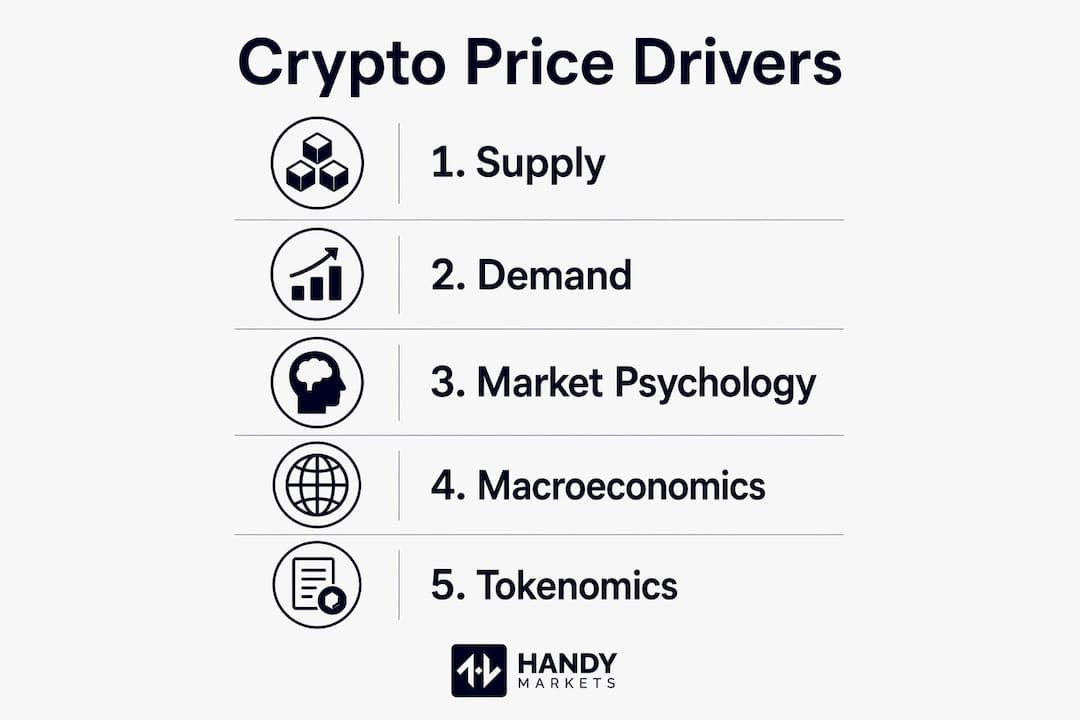
Market psychology drives fear-and-greed cycles that dominate short-term crypto price action far more than fundamentals do. When prices rise, momentum attracts new buyers who fear missing out. When prices fall, panic selling accelerates the drop. These cycles create boom-and-bust patterns that repeat across every market cycle.
Derivatives markets amplify these psychological swings considerably. Derivatives volume in crypto runs nearly nine times higher than spot volume. That ratio matters because leveraged positions can be forcibly closed, or liquidated, when prices move against them. A cascade of liquidations pushes prices further in the same direction, creating moves that have nothing to do with the underlying asset’s value.
Three derivatives concepts every investor should understand:
- Funding rates. In perpetual futures contracts, traders who hold long positions pay a fee to short holders when the market leans bullish, and vice versa. Extremely high positive funding rates signal an overheated long side and often precede sharp corrections.
- Open interest. This measures the total value of outstanding derivative contracts. Rising open interest alongside rising prices suggests new money is entering the trend. Falling open interest during a rally is a warning sign.
- Liquidation cascades. When a large cluster of leveraged positions sits at a similar price level, a move through that level triggers forced closures. Those closures push price further, triggering the next cluster. The result is a waterfall move that looks dramatic but is mechanical in origin.
Understanding investor sentiment cycles helps you separate noise from signal. A sharp price drop driven by a liquidation cascade is structurally different from a drop driven by genuine selling of spot holdings. The first often reverses quickly. The second may not.
Pro Tip: Check the funding rate on major perpetual futures before entering a position. A strongly positive funding rate means you pay a daily fee to hold a long, and it signals the market is already crowded on the bullish side.
How do macroeconomic factors affect crypto price trends?
Macroeconomic conditions shape the environment in which all risk assets, including crypto, trade. Federal Reserve interest rate signals directly influence investor risk appetite. When the Fed signals rate cuts or pauses, capital tends to flow toward higher-risk, higher-reward assets. Bitcoin rebounded above $61,000 in july 2026 following dovish Fed commentary, a clear example of macro forces moving crypto prices. That rebound had nothing to do with Bitcoin’s code or adoption. It reflected a shift in global capital allocation.
The relationship between crypto and broader cryptocurrency market trends is not static. During risk-off periods, when investors flee to safety, crypto often sells off alongside equities. During risk-on periods, crypto can outperform because its upside potential attracts speculative capital. Gold sometimes moves in the opposite direction, serving as a benchmark for comparing crypto’s safe-haven narrative against a proven one.
Key macro factors that move crypto prices:
- Fed policy signals. Dovish language lifts risk appetite. Hawkish signals tighten it.
- Global liquidity conditions. Periods of monetary expansion historically correlate with crypto bull runs.
- Jobs and inflation data. Strong jobs reports can delay rate cuts, pressuring risk assets including crypto.
- Cross-asset correlations. When the S&P 500 drops sharply, crypto often follows within hours.
- Dollar strength. A stronger U.S. dollar typically pressures Bitcoin and other crypto assets priced in dollars.
Tracking liquidity flows across currencies gives investors an early read on where capital is moving before it shows up in crypto prices. Macro awareness does not replace crypto-specific analysis, but ignoring it leaves a major driver of price action unaccounted for.
What is the difference between crypto price and crypto value?
Price and value are not the same thing in crypto, and confusing them is one of the most common mistakes new investors make. Price is what a buyer pays at any given moment on an exchange. Value relates to the utility, scarcity, and network strength of the underlying asset. Price and value often diverge temporarily, but over longer time horizons they tend to converge.
Tokenomics is the structural mechanism that connects price to value over time. It covers inflation rates, vesting schedules, token utility, and the rules governing supply changes. Many altcoins carry high inflation rates that continuously dilute existing holders unless demand grows fast enough to absorb new supply. Bitcoin’s fixed supply and predictable issuance schedule make its tokenomics unusually transparent and deflationary over time.
A useful framework for thinking about crypto value comes from the concept of “monetary gravity,” the idea that value accrues to projects that attract and retain capital through network activity, liquidity, and ecosystem growth. This replaces traditional cash flow analysis with a focus on capital retention and network momentum.
| Dimension | Price | Value |
|---|---|---|
| Definition | What buyers pay right now on an exchange | Utility, scarcity, and ecosystem strength |
| Time horizon | Immediate, changes by the second | Long-term, shifts with adoption and fundamentals |
| Key drivers | Sentiment, liquidity, derivatives activity | Tokenomics, network effects, real-world use |
| Reliability | Highly volatile, easily manipulated | More stable but slower to reflect in price |
| Investor use | Entry and exit timing | Asset selection and long-term conviction |
Key Takeaways
Cryptocurrency prices are determined by the intersection of fixed supply, shifting demand, market psychology, derivatives activity, and macroeconomic conditions, and understanding each layer gives investors a meaningful edge.
| Point | Details |
|---|---|
| Supply scarcity amplifies moves | Bitcoin’s 21 million cap and lost coins tighten liquid supply, making demand surges hit harder. |
| Derivatives drive short-term volatility | Crypto derivatives volume runs nearly nine times spot volume, creating liquidation cascades that move prices fast. |
| Macro conditions set the backdrop | Fed signals and global liquidity conditions shape risk appetite and capital flows into or out of crypto. |
| Price and value diverge regularly | Short-term price is driven by sentiment; long-term value reflects tokenomics, utility, and network strength. |
| Tokenomics determines sustainability | Inflation rates and vesting schedules in altcoins can erode value even when prices temporarily rise. |
The part most investors skip
At Handy Markets, we track price data across thousands of assets every day, and the pattern we see most often is investors reacting to price as if it were value. A coin doubles in a week and suddenly it has “proven itself.” A coin drops 40% and suddenly it is “dead.” Neither conclusion follows from the price move alone.
The investors who navigate crypto markets well treat short-term price action as noise until it is confirmed by volume, open interest, and macro context. They check funding rates before entering leveraged positions. They look at Bitcoin dominance as a gauge for whether capital is rotating into altcoins or retreating to the relative safety of Bitcoin. They read tokenomics before buying an altcoin, because a 20% annual inflation rate erodes gains that look impressive on a price chart.
The uncomfortable truth is that most short-term crypto price moves are driven by derivatives mechanics and sentiment cycles, not by any change in the underlying asset’s utility or adoption. That does not make price moves meaningless. It means you need a second layer of analysis to know whether a move reflects real change or just market mechanics playing out. Patience and context beat reaction every time.
Real-time data makes the difference
Knowing what drives crypto prices is only useful if you can act on it when it matters. Handy Markets gives you live crypto prices and charts for hundreds of assets in one place, updated in real time so you never miss a critical move.
You can set price alerts across multiple channels including Telegram, Discord, Slack, SMS, and email, so the market comes to you instead of the other way around. Whether you are watching Bitcoin for a macro-driven entry or tracking an altcoin’s tokenomics play out in real time, Handy Markets keeps you informed without requiring you to stare at a screen all day. Visit Handy Markets to set up your first alert in minutes.
FAQ
What exactly determines a cryptocurrency’s price?
Cryptocurrency prices are set by real-time supply and demand on exchanges, where every trade reflects a buyer and seller agreeing on a price. Sentiment, liquidity, derivatives activity, and macroeconomic conditions all shift that balance continuously.
Why do crypto prices change so fast compared to stocks?
Crypto markets trade 24 hours a day with no circuit breakers, and derivatives volume runs nearly nine times spot volume, meaning leveraged liquidations can move prices dramatically within minutes.
What is the difference between Bitcoin’s price and its value?
Bitcoin’s price is what buyers pay on an exchange at any moment, while its value reflects its fixed supply, digital scarcity, and network adoption. The two often diverge in the short term but tend to align over longer periods.
How do Federal Reserve decisions affect crypto prices?
Fed rate signals influence investor risk appetite globally. Dovish signals encourage capital flows into risk assets like crypto, while hawkish signals pull capital toward safer instruments, pressuring crypto prices lower.
What are tokenomics and why do they matter for price?
Tokenomics covers the rules governing a crypto asset’s supply, inflation rate, and utility. High inflation tokenomics dilute existing holders over time, which can suppress price even when short-term demand looks strong.