


TL;DR:
- A diversification workflow is a structured, repeatable process aimed at reducing portfolio risk while maintaining returns. It involves six phases, including setting objectives, establishing asset allocation, diversifying across dimensions, rebalancing systematically, and monitoring costs continuously. Successful implementation depends on clear objectives, correlation awareness, disciplined rebalancing, and real-time data supported by advanced technology.
A workflow for diversification strategies is a structured, repeatable process that guides investors through building and maintaining portfolios that reduce risk without sacrificing expected returns. Portfolio diversification, the recognized industry term for this practice, works by spreading capital across assets with low or negative correlations so that losses in one position do not cascade across the whole portfolio. Done well, it is one of the most reliable tools in professional portfolio management. Done poorly, it creates the illusion of safety while quietly adding cost and complexity.
What is the workflow for diversification strategies?
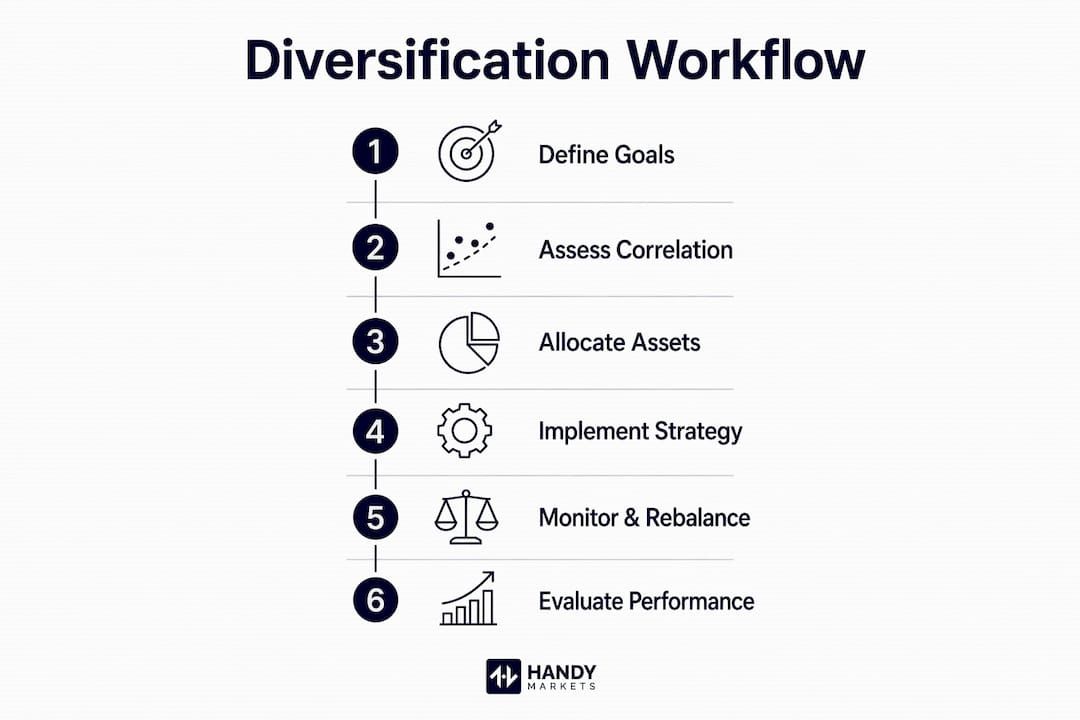
A diversification strategy workflow is not a one-time setup. It is a living process with six core phases: defining investment objectives, establishing strategic asset allocation, diversifying within and across asset classes, layering geographic and factor exposures, applying rule-based rebalancing, and monitoring liquidity and costs on an ongoing basis. Each phase feeds the next, and skipping any one of them creates gaps that compound over time.

The process begins with clarity on what you are trying to achieve. A retirement portfolio targeting capital preservation has a fundamentally different risk tolerance than a growth-oriented fund with a 20-year horizon. Without that clarity upfront, every subsequent decision is built on a shaky foundation.
Asset diversification is also grounded in correlation, not just variety. Correlation drives risk reduction by determining how assets move relative to each other. Two assets that rise and fall together offer no real protection, even if they belong to different sectors or geographies.
What are the essential components of a diversification workflow?
Before executing any diversification plan, investors need to establish several foundational elements. Skipping this preparation phase is the single most common reason diversification workflows fail in practice.
Core prerequisites include:
- Investment objectives: Define your target return, time horizon, and income needs in writing before selecting any asset.
- Risk tolerance: Quantify how much drawdown you can absorb, both financially and behaviorally, using metrics like standard deviation and maximum drawdown.
- Strategic asset allocation (SAA): Set target weights for each asset class based on your goals and constraints. SAA is the anchor that keeps the portfolio from drifting into unintended risk territory.
- Correlation mapping: Identify how your chosen assets move relative to each other. Assets that move in lockstep eliminate diversification benefits entirely.
- Rebalancing thresholds: Decide upfront at what point drift triggers a rebalance. Predetermined thresholds of 5–10% combined with calendar triggers are standard practice in professional portfolio management.
- Data and technology requirements: Confirm you have access to real-time position data, risk models, and execution tools before you begin.
Pro Tip: Write your investment policy statement (IPS) before touching any allocation. The IPS forces you to commit to your objectives, constraints, and rebalancing rules in advance, which is the only reliable defense against emotional decision-making during drawdowns.
How to execute a step-by-step diversification strategy process
Building a diversified portfolio follows a clear sequence. Each step below builds directly on the previous one, so the order matters.
- Define investment goals and risk tolerance. Specify your target return, time horizon, liquidity needs, and the maximum loss you can tolerate in a single year. This step produces the constraints that govern every allocation decision that follows.
- Select asset classes and diversification dimensions. Choose across at least four dimensions: asset class (equities, fixed income, real assets, alternatives), geography (domestic, developed international, emerging markets), sector, and factor (value, momentum, quality, low volatility). Each dimension adds an independent source of return and risk reduction.
- Choose portfolio optimization methods and set allocation constraints. Mean-variance optimization, risk parity, and equal-weight approaches each have different assumptions and failure modes. Set minimum and maximum weights per asset class to prevent concentration from creeping back in.
- Apply diversification across all selected dimensions. Execute allocations systematically, not opportunistically. Buying an asset because it looks cheap today is not diversification. It is speculation dressed up as process.
- Set rule-based rebalancing triggers. Rebalancing with discipline uses both calendar triggers (quarterly or semi-annual) and deviation bands (5–10 percentage points) to control drift while keeping transaction costs manageable. Automating these triggers removes the temptation to delay rebalancing during volatile markets.
- Monitor liquidity, costs, and performance continuously. Track bid-ask spreads, fund expense ratios, tax drag, and total transaction costs alongside return metrics. A position that looks good on a gross return basis can destroy value once all costs are accounted for.
The table below maps each step to its primary risk control and key output.
| Step | Primary risk control | Key output |
|---|---|---|
| Define goals and risk tolerance | Behavioral anchoring | Written investment policy statement |
| Select asset classes and dimensions | Correlation management | Approved asset class universe |
| Choose optimization method | Concentration risk | Target allocation weights |
| Apply diversification | Execution discipline | Funded, diversified portfolio |
| Set rebalancing triggers | Drift control | Automated rebalancing rules |
| Monitor liquidity and costs | Cost and liquidity risk | Performance and cost dashboard |
Pro Tip: Treat your first allocation into any new asset class as a qualification phase, not a routine transaction. Test execution quality, liquidity, and operational fit under real conditions before committing full target weight. This approach catches problems that backtests never reveal.
What common pitfalls occur when implementing diversification workflows?
Most diversification failures are not caused by bad asset selection. They are caused by process breakdowns that were predictable and preventable.
- Diversifying into weak or unrelated assets. Adding assets without leveraging core competencies adds cost without adding return. Every new position should connect to an existing strength or a clearly defined return thesis.
- Over-diversification. Holding 60 positions does not mean you have 60 independent sources of return. If those positions are highly correlated, you have complexity without protection.
- Set-and-forget rebalancing. Portfolios drift. A 60/40 equity-bond split can become 75/25 after a strong equity rally. Without active rebalancing, the portfolio no longer reflects the investor’s intended risk profile.
- Underestimating total costs. Lower initial prices often mask operational risks that negate cost savings. The same logic applies to portfolio assets: transaction costs, liquidity premiums, and tax drag must be part of every allocation decision.
- Skipping stress testing. Scenario analysis and stress tests reveal how a portfolio behaves during tail events, not just normal market conditions. Running these tests quarterly is standard practice in institutional portfolio management.
“The biggest behavioral risk in diversification is abandoning the process during drawdowns. Rebalancing into falling assets feels wrong in the moment, but it is precisely when the mechanical contrarian advantage of disciplined rebalancing is most powerful. Investors who pause rebalancing during stress periods lose the benefit they built the workflow to capture.”
The portfolio management checklist approach is one practical way to guard against these pitfalls. Checklists force you to verify each step before moving to the next, reducing the chance that urgency or emotion causes you to skip a critical control.
How does technology support effective diversification workflows?
Technology is not optional in a modern diversification workflow. It is the infrastructure that makes the workflow repeatable and scalable across multiple asset classes.
Multi-asset portfolio management integrates holdings, risk, profit and loss, and trading into one system. That integration eliminates fragmentation, reduces data latency, and makes it possible to see your true exposure across all positions in real time. Without a unified view, reconciliation errors accumulate and the portfolio’s actual risk profile diverges from the intended one.
The table below compares what a fragmented approach looks like versus an integrated platform approach across key workflow functions.
| Workflow function | Fragmented approach | Integrated platform approach |
|---|---|---|
| Position tracking | Manual spreadsheet updates | Real-time automated feeds |
| Risk monitoring | End-of-day snapshots | Intraday exposure and P&L |
| Rebalancing execution | Manual order entry | Rule-based automated triggers |
| Compliance checks | Separate system, manual review | Embedded in execution workflow |
| Cost tracking | Estimated post-trade | Real-time transaction cost analysis |
Unified real-time data across asset classes is the foundation of operationalizing diversification at scale. Without it, even a well-designed workflow breaks down at the execution layer. Investors evaluating technology options can review portfolio management tool alternatives to understand the range of capabilities available across entry-level and enterprise platforms.
Real-time price alerts are a practical, underused part of this technology layer. Setting alerts for specific deviation thresholds across equities, fixed income, commodities, and foreign exchange gives you an early warning system that triggers review before drift becomes a problem. Handy Markets supports this kind of monitoring across all major asset classes, with alerts delivered through Telegram, Discord, Slack, SMS, and email.
What I have learned about diversification workflows after years of watching them succeed and fail
Diversification is not a destination. It is a discipline that requires active maintenance, and the operational costs of that maintenance are almost always underestimated at the start.
The workflows that succeed share one trait: they treat rebalancing as non-negotiable. Explicit rebalancing bands and calendar triggers defined upfront are what separate portfolios that maintain their intended risk profile from those that quietly drift into concentration. The investors who skip this step almost always regret it after the next market dislocation.
The workflows that fail usually do so for behavioral reasons, not analytical ones. Overconfidence in backtests is the most common trap. A strategy that looks clean across 10 years of historical data has been fitted to that specific period. Real markets introduce conditions that no backtest anticipated, and the workflow needs to be simple enough to execute under pressure.
My honest recommendation: keep the workflow as simple as it can be while still covering all six phases. Complexity is not sophistication. A workflow you actually follow during a drawdown is worth more than a theoretically perfect process you abandon when markets get uncomfortable.
Real-time market data to support your diversification workflow
Maintaining a diversification workflow requires current data across every asset class you hold. Stale prices and delayed alerts are not just inconvenient. They create blind spots that undermine the rebalancing discipline the whole workflow depends on.
Handy Markets aggregates live prices across stocks, ETFs, commodities, forex, and crypto in one place, so you can monitor all your positions without switching between platforms. Setting up price alerts across asset classes takes minutes and delivers notifications through Telegram, Discord, Slack, SMS, or email the moment a threshold is crossed. That kind of real-time visibility is what keeps a diversification workflow running between scheduled rebalancing reviews, not just on the days you remember to check.
FAQ
What is a diversification strategy workflow?
A diversification strategy workflow is a structured, repeatable process covering six phases: defining objectives, setting strategic asset allocation, selecting diversification dimensions, applying optimization methods, executing rule-based rebalancing, and monitoring costs and liquidity continuously.
How often should you rebalance a diversified portfolio?
Standard rebalancing practice combines quarterly calendar triggers with 5–10 percentage point deviation thresholds. This controls drift while keeping transaction costs manageable.
Why does correlation matter in diversification?
Correlation determines how assets move relative to each other. Assets with high correlation move in lockstep, which eliminates the risk-reduction benefit of holding multiple positions.
What is the biggest mistake in implementing diversification plans?
The most destructive mistake is diversifying into unrelated assets without a clear return thesis or connection to existing strengths. This adds cost and complexity without adding meaningful risk reduction.
How does technology improve a diversification workflow?
Integrated portfolio platforms provide real-time position tracking, automated rebalancing triggers, and unified risk monitoring across asset classes. This eliminates reconciliation errors and ensures the portfolio’s actual risk profile matches the intended one at all times.
Key takeaways
A disciplined diversification workflow built on clear objectives, correlation-aware asset selection, and rule-based rebalancing is the most reliable way to reduce portfolio risk without sacrificing expected returns.
| Point | Details |
|---|---|
| Start with written objectives | Define risk tolerance, time horizon, and return targets before selecting any asset. |
| Correlation drives risk reduction | Assets that move in lockstep offer no diversification benefit regardless of how many you hold. |
| Rebalancing must be rule-based | Use 5–10% deviation bands and calendar triggers to prevent emotional drift from undermining the strategy. |
| Total costs matter | Transaction costs, liquidity premiums, and tax drag must factor into every allocation decision. |
| Technology enables scale | Unified real-time data across asset classes is the foundation for running a diversification workflow at any meaningful scale. |