


TL;DR:
- Effective asset diversification involves spreading investments across different assets to reduce individual risks and improve resilience during market downturns. However, correlations among assets tend to increase during crises, limiting diversification benefits, which underscores the importance of understanding asset behavior in stressed conditions. Regularly monitoring and rebalancing a thoughtfully constructed, dynamic portfolio can help investors maintain true diversification and withstand market turbulence.
Many investors feel confident once they own a mix of stocks and bonds, believing that simple split keeps their portfolio safe. But recent crises, from the 2020 pandemic crash to the 2022 rate shock that sank both equities and fixed income simultaneously, exposed just how fragile that assumption can be. True asset diversification is more nuanced, more dynamic, and frankly more interesting than the old rules suggest. In this guide, we cut through the noise to explain what diversification really means, what the research actually shows, and how you can build a portfolio that holds up when markets get rough.
Table of Contents
- What is asset diversification?
- How diversification works: The mechanics and research
- Common asset classes and alternative strategies
- Building a diversified portfolio: Practical considerations
- The truth about diversification everyone misses
- Take the next step: Track, analyze, and diversify with Handy.Markets
- Frequently asked questions
Key Takeaways
| Point | Details |
|---|---|
| True diversification | Mix assets that react differently to market changes to smooth out your returns and manage risk. |
| Asset choices matter | Choosing assets with low correlations is more important than the number of holdings in your portfolio. |
| Crisis performance | Diversification is less effective when markets crash, making ongoing review even more important. |
| Go beyond basics | Consider including alternatives such as gold or oil for broader and more resilient diversification. |
What is asset diversification?
Asset diversification means spreading your investments across different types of assets to reduce your exposure to any single source of risk. Think of it like not placing every bet on one horse. If that horse stumbles, you still have others running. The goal is not to eliminate risk entirely (that is impossible) but to reduce the chance that one bad event wipes out your entire portfolio.
The principle behind diversification is surprisingly elegant. Different assets do not always move in the same direction at the same time. When stocks are falling sharply, for example, government bonds often rise as investors seek safety. When inflation spikes, commodities like oil and gold may hold their value or gain while paper assets lose purchasing power. By holding a mix of assets that respond differently to the same economic forces, you smooth out the peaks and valleys of your returns over time.
The practical benefits are real and measurable:
- Smoother returns over market cycles, reducing the emotional toll of watching your portfolio swing wildly
- Lower portfolio volatility, which research consistently links to better long-term investor behavior
- Resilience during sector-specific shocks, so a tech selloff or an energy crisis does not define your entire year
- Reduced reliance on timing, because a well-diversified portfolio rewards patience rather than perfect market calls
The most common asset categories include stocks (ownership stakes in companies), bonds (loans to governments or corporations), commodities (physical goods like gold, oil, and agricultural products), cash and cash equivalents (money market funds, T-bills), and alternative investments (real estate, private equity, and even cryptocurrency). Research supports the real value of combining these thoughtfully. A Springer Journal of Asset Management study found that a cross-asset portfolio combining the S&P 500, gold, oil, and U.S. 10-year Treasury Notes delivers substantial diversification benefits for U.S. investors, regardless of whether weights are equally distributed or optimized statistically.
Understanding these benefits can also help you choose smarter investment strategies for 2026 and think more carefully about vehicles like ETFs and diversification, which bundle multiple assets in one tradeable security.
Pro Tip: The variety of assets matters far more than the sheer number. Holding 20 technology stocks instead of 10 does not meaningfully reduce your risk. Including gold alongside equities does.
How diversification works: The mechanics and research
With this foundation, we can explore how diversification functions at a deeper level and what the numbers actually reveal about when it works and when it doesn’t.
The core mechanic is correlation, a statistical measure of how two assets move relative to each other. A correlation of +1 means two assets move perfectly in sync. A correlation of -1 means they move in opposite directions. A correlation near 0 means their movements are essentially unrelated. For diversification to work, you want assets with low or negative correlations in your portfolio. The lower the correlation, the more one asset can offset losses in another.

Here is a simplified look at how different portfolio mixes have historically compared:
| Portfolio type | Approximate annual return | Approximate volatility | Diversification benefit |
|---|---|---|---|
| 100% U.S. stocks | High | High | Minimal |
| 60% stocks / 40% bonds | Moderate-high | Moderate | Moderate |
| Cross-asset (stocks, bonds, gold, oil) | Moderate-high | Lower | Strong |
| 100% cash | Very low | Very low | None (but safe harbor) |
This table illustrates a key insight: adding genuinely different asset classes can reduce overall volatility without necessarily sacrificing meaningful returns.
However, diversification is not a fixed, guaranteed shield. Research published in the Journal of Asset Management highlights a critical limitation: correlations are time-varying and tend to spike during market stress, meaning diversification’s effectiveness can be regime-dependent. In other words, when panic sets in and investors rush to sell everything, the correlations between assets that normally move independently can converge sharply. This is sometimes called the “correlation breakdown” effect, and it has been observed in nearly every major market crisis since the 1987 Black Monday crash.
“The cross-asset portfolio offers substantial diversification benefits regardless of portfolio construction method, but investors must remain vigilant about how correlations shift in stressed markets.”
Some key factors that influence how well diversification works include:
- Market regime: Bull markets and bear markets behave differently, and so do correlations within them
- Asset liquidity: During a crisis, even assets that normally behave independently may sell off together simply because investors need cash
- Geographic concentration: Owning only U.S. assets, or only European assets, limits your exposure to diversifying global cycles
If you want to monitor how correlations evolve across market conditions, keeping a close eye on mastering market trends and tracking real-time stock market trends in 2026 can give you early signals before correlations converge dangerously.
Common asset classes and alternative strategies
Now, let’s make diversification practical by mapping the typical and less obvious assets you can use, and how different strategies compare.
Traditional asset classes include stocks, bonds, real estate investment trusts (REITs), commodities, and cash. These are well understood, widely accessible, and form the backbone of most retail portfolios. Alternative assets go further: gold and other precious metals, oil futures, cryptocurrencies, private equity, hedge fund strategies, infrastructure, and even fine art or collectibles have all been studied as diversifiers.
Here is a comparison of key asset classes for diversification purposes:
| Asset class | Diversification strength | Liquidity | Typical correlation to stocks | Risk level |
|---|---|---|---|---|
| U.S. government bonds | Strong | High | Low to negative | Low |
| Gold | Strong | High | Low | Moderate |
| Oil/energy commodities | Moderate | Moderate | Low to moderate | High |
| Real estate (REITs) | Moderate | High | Moderate | Moderate |
| Cryptocurrencies | Variable | High | Variable (often rising) | Very high |
| Private equity | Strong (long-term) | Very low | Low | High |
Research noted in the Journal of Asset Management confirms that some researchers now focus on alternative diversification objectives that go beyond simple mean-variance optimization. These include risk parity approaches (where each asset contributes equally to portfolio risk), minimum volatility strategies, and factor-based models that target specific risk premiums like momentum or value.
Dynamic diversification takes this further. Instead of fixing allocations permanently, dynamic portfolios adjust their weights when market signals change. For example, a portfolio might shift more weight to gold and bonds when volatility indicators (like the VIX) spike above a certain threshold, then rotate back to equities when conditions stabilize.
Pro Tip: Don’t chase the latest alternative asset because it’s trending. Evaluate any new addition to your portfolio using three filters: its historical correlation to your existing assets, its liquidity (can you exit quickly if needed?), and how much of your total portfolio it represents.
Follow these steps when adding an alternative asset to your portfolio:
- Research the asset’s historical return, volatility, and correlation to your current holdings
- Determine allocation size, typically no more than 5 to 15% of total portfolio value for any single alternative
- Run a stress test by simulating how the asset behaved during past crises (2008, 2020, 2022)
- Set entry criteria based on price levels or market conditions rather than emotional impulse
- Monitor and reassess at least quarterly to confirm the asset is still serving its intended diversification role
You can explore more frameworks and ideas across our investment articles to support your research process.
Building a diversified portfolio: Practical considerations
Once you know the assets and strategies, it’s time to tackle the steps and best practices of actually building and maintaining a robust, diversified portfolio.
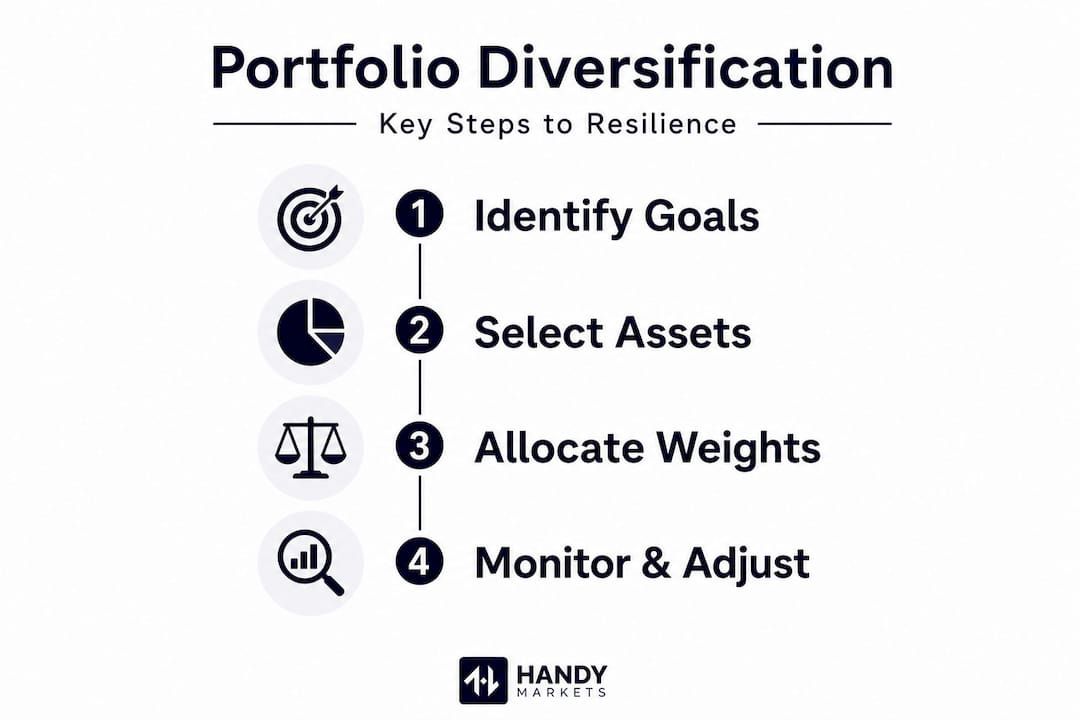
First, understand that diversification is not a one-time event. It is an ongoing process. Markets shift, asset correlations evolve, and your personal financial goals change over time. A portfolio that was well-diversified in 2022 might be dangerously concentrated by 2026 if one asset class has grown disproportionately. Rebalancing, or periodically returning your portfolio to its target weights, is how you maintain genuine diversification over the long run.
Diversification benefits can vary over time and across crises, making consistent portfolio review not just wise but necessary. History shows that cross-asset portfolios have consistently reduced overall risk for U.S. investors, but only when investors actively maintain those allocations rather than letting drift erode the structure.
Watch out for these common pitfalls:
- Overdiversification: Owning 50 similar mutual funds adds administrative complexity without meaningfully reducing risk
- Hidden correlations: Assets that look different on paper (a real estate fund and a bank stock, for example) may move together during a credit crisis
- Neglecting rebalancing: After a strong equity bull run, your 60/40 portfolio may have drifted to 80/20 without you noticing
- Ignoring costs: Diversifying into illiquid or high-fee alternatives can erode returns faster than they add protection
Here is a practical step-by-step process for reviewing and maintaining your portfolio:
- Set a schedule: Review your portfolio at least once per quarter and after major market events
- Audit current allocations: Calculate what percentage of your portfolio sits in each asset class today
- Compare to targets: Identify where drift has occurred and which positions have grown outside their intended range
- Research rebalancing options: Determine whether to trim overweight positions, add to underweight ones, or use new contributions to rebalance
- Check correlations: Use available data tools to confirm your assets are still behaving as expected relative to each other
- Document your decisions: Keep a simple log of why you made each change, so you can review your reasoning objectively next quarter
Pro Tip: Set calendar reminders for quarterly portfolio reviews and connect to price alert systems so you are notified when any single asset moves sharply. This kind of structure removes emotion from rebalancing decisions. You can pair this habit with a practical market volatility checklist to stay proactive rather than reactive.
The truth about diversification everyone misses
Having walked through the practicalities, here is an insider’s perspective on what most diversification advice leaves out, and why even experienced investors get tripped up.
The most seductive myth in portfolio management is that more assets automatically means more safety. We see investors holding 40, 50, even 100 different positions, convinced that sheer quantity creates resilience. But the research tells a different story. The relationships between assets matter infinitely more than the count. Owning 30 assets that all perform similarly during a market downturn provides almost no protection. Owning just five assets that genuinely behave differently during stress can protect you far more effectively.
There is also a complacency trap hiding in past performance. Investors look at historical data showing their stocks and bonds behaved differently and conclude their portfolio is safe. But those correlations are calculated during “normal” conditions. The uncomfortable truth is that in genuine crisis periods, correlations between nearly all risk assets tend to spike toward +1. Equities, high-yield bonds, real estate, and even some commodities can all fall together when fear dominates markets. The advanced market analysis framework we advocate specifically accounts for these stress-period behaviors, not just average conditions.
As we say at Handy.Markets: “Diversification is not about how many assets you own. It’s about how differently they behave when it counts.”
This reframes the whole exercise. True diversification requires understanding asset behavior during specific market regimes, crises, inflation spikes, rate cycles, and geopolitical shocks, not just plugging numbers into a spreadsheet.
Pro Tip: Run scenario analysis on your portfolio using at least three historical stress events (2008 financial crisis, 2020 pandemic crash, 2022 rate shock). If your portfolio would have lost more than you are comfortable with in all three, your diversification strategy needs rethinking.
Take the next step: Track, analyze, and diversify with Handy.Markets
Diversification is only as good as the information behind it. You need live data, cross-asset visibility, and timely alerts to make the strategy work in practice, not just in theory.
At Handy.Markets, we built the platform precisely for investors who want to see all their asset classes in one place without the friction. You can track real-time stock data alongside live commodity market alerts for gold, oil, and more, then layer in crypto price alerts for your alternative allocations, all from a single dashboard. Price notifications arrive via Telegram, Discord, Slack, SMS, Webhook, or Email, so you never miss a critical move. Whether you are monitoring a five-asset cross-asset portfolio or tracking a complex multi-class strategy, Handy.Markets gives you the real-time intelligence to stay ahead and act with confidence.
FAQ
Why does diversification sometimes fail during market crises?
Because correlations rise sharply during stress events, assets that normally move independently tend to fall together, which significantly reduces the protection that diversification is supposed to provide.
How often should I rebalance my diversified portfolio?
Review and rebalance at least once per quarter, and conduct an unscheduled review any time a major market event causes significant shifts in your allocation weights.
Do I need international assets to be diversified?
International assets can add meaningful diversification, but research shows the benefits may shrink over time as global markets become increasingly correlated, especially during periods of worldwide economic stress.
What’s the biggest mistake investors make with diversification?
Holding too many similar assets under the assumption that quantity equals safety, when in reality true risk reduction comes from including assets that behave differently from each other under pressure.
Can adding commodities like gold really improve diversification?
Yes. Research confirms that a cross-asset portfolio combining equities, gold, oil, and bonds delivers substantial risk-reduction benefits for U.S. investors compared to stock-only or stock-bond-only approaches.
Recommended
- Top Investment Strategies To Maximize Returns In 2026 | Handy.Markets
- Financial Assets: A Comprehensive Guide For Beginners | Handy.Markets
- Market Volatility Checklist: Strategies For Traders | Handy.Markets
- Mastering Volatility In Investing: A Beginner’s Guide To Navigating Market Swings In 2025 | Handy.Markets