

TL;DR:
- Forex trading involves buying one currency and selling another to profit from exchange rate changes. It is the world’s largest market, operating 24 hours five days a week with high liquidity during the London-New York overlap, making it ideal for beginners. Effective risk management and starting small with regulated brokers are essential for long-term success.
Forex trading is defined as the simultaneous buying of one currency and selling of another, with the goal of profiting from changes in their relative exchange rates. Known formally as foreign exchange trading, or FX trading, it is the largest financial market globally, with an average daily trading volume of approximately $7.5 trillion as of march 2025. That scale dwarfs the stock market by a wide margin. The market runs 24 hours a day, five days a week, and includes participants ranging from central banks and multinational corporations to individual retail traders sitting at home. Understanding the basics of forex trading gives you a real edge before you place your first trade.
What is forex trading and how does it work?
Forex trading functions by pairing two currencies against each other. Every trade involves a currency pair, such as EUR/USD or GBP/JPY. The first currency listed is the base currency, and the second is the quote currency. The exchange rate tells you how much of the quote currency you need to buy one unit of the base currency.
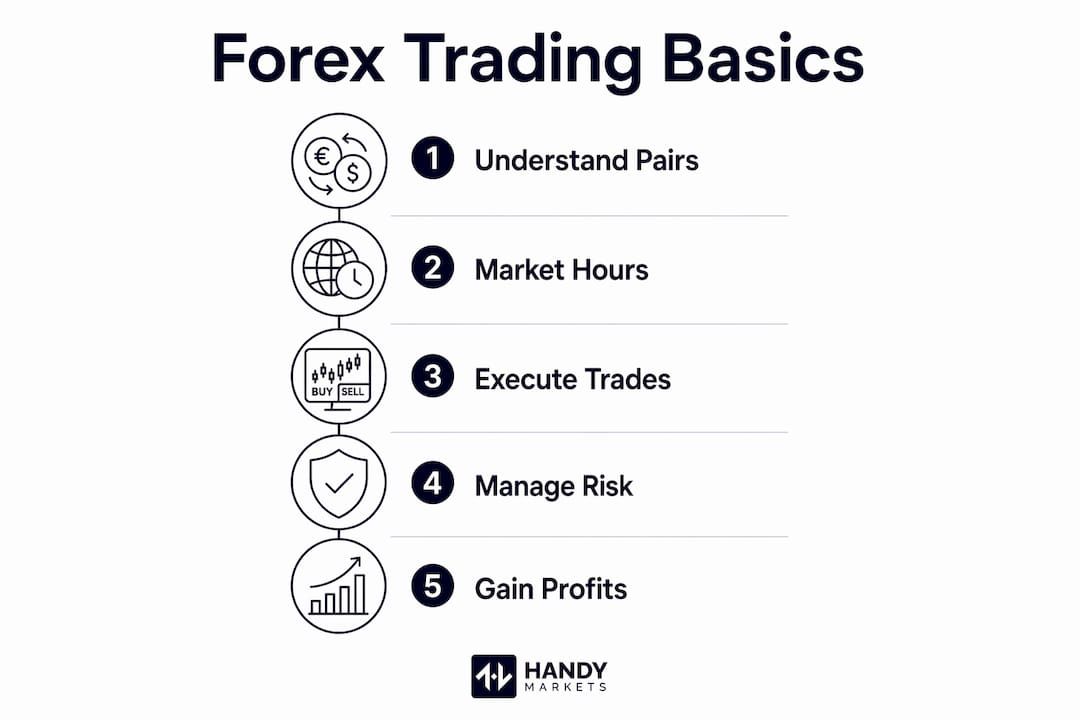
When you trade a currency pair, you are making a bet on relative strength. If you believe the euro will strengthen against the US dollar, you buy EUR/USD. If the euro rises, you profit. If it falls, you lose. Forex trading is fundamentally comparative, focusing on the relative strength of currencies rather than their absolute values.
Key terms every beginner needs to know
- Bid price: The price at which the market will buy the base currency from you.
- Ask price: The price at which the market will sell the base currency to you.
- Spread: The difference between the bid and ask price. This is the main transaction cost for traders and the primary source of broker revenue.
- Pip: The smallest standard price movement in a currency pair, typically the fourth decimal place (0.0001). A move from 1.1050 to 1.1051 equals one pip.
- Lot size: The standardized quantity of a currency trade. A standard lot is 100,000 units of the base currency.
Brokers and liquidity providers sit between you and the broader interbank market. They execute your trades, provide pricing, and often offer leverage. Choosing a regulated broker is the single most important structural decision you make as a beginner.
When and where does the forex market operate?
The forex market operates 24 hours a day, 5 days a week, cycling through three major financial centers. Each center represents a trading session with its own liquidity profile and price behavior.
| Session | Major Centers | Approximate Hours (EST) |
|---|---|---|
| Asia-Pacific | Tokyo, Sydney, Singapore | 7:00 PM – 4:00 AM |
| European | London, Frankfurt, Zurich | 3:00 AM – 12:00 PM |
| North American | New York, Chicago | 8:00 AM – 5:00 PM |
Liquidity shifts as sessions open and close. The Asian session tends to be quieter, with tighter ranges on pairs like USD/JPY. The European session brings a surge in volume, particularly for EUR and GBP pairs. The North American session adds another wave of activity, especially around US economic data releases.
The most active window is the London-New York overlap, running roughly from 8:00 AM to 12:00 PM EST. Trading during this overlap typically delivers peak liquidity, tighter spreads, and better trade execution. For beginners, this window is the most forgiving environment to practice live trading.
Pro Tip: Set your trading schedule around the London-New York overlap. You will see more price action, tighter spreads, and cleaner chart patterns than during off-peak hours.
What are the risks and rewards of forex trading?
Leverage is the defining feature of retail forex trading. It lets you control a large position with a small amount of capital. A 50:1 leverage ratio means a $1,000 deposit controls a $50,000 position. Leverage amplifies both profits and losses, making rigorous risk management vital for long-term survival.
Volatility is the heartbeat of the forex market, pulsing with opportunities and risks. Market moves are primarily driven by global news releases and macroeconomic indicators: interest rate decisions, inflation data, employment reports, and geopolitical events. A single central bank announcement can move a currency pair by hundreds of pips in minutes.

Beginners often misinterpret forex as a path to quick wealth. Forex requires education, patience, and managing losses as a normal part of the process. The traders who survive long-term treat losses as tuition, not failure.
Core risk management principles
- Limit risk per trade. Effective risk management means exposing no more than 1–2% of your trading account on any single trade. This keeps a losing streak from wiping out your account.
- Use stop-loss orders. A stop-loss automatically closes your trade at a predetermined price, capping your downside before emotions take over.
- Maintain margin buffers. Beginner traders often underestimate costs beyond spreads, including swap fees and margin calls. Keeping extra capital in your account prevents forced liquidations during volatile swings.
- Avoid overleveraging. High leverage feels attractive when you are winning. It becomes catastrophic when the market moves against you.
Pro Tip: Before you risk real money, calculate your maximum loss per trade in dollar terms, not just percentages. Seeing “$20 at risk” is more psychologically concrete than “2% of account.”
For a deeper look at how global news shapes price swings, the forex volatility drivers guide from Handy Markets breaks down the mechanics clearly. Pairing that knowledge with smart forex risk management principles gives you a solid foundation before you trade with real capital.
How do you start forex trading as a beginner?
Starting forex trading does not require a large bankroll. Many brokers offer cent accounts that allow entry with as little as $100, making the market genuinely accessible to individual beginners. The key is starting small, learning consistently, and scaling only after you prove your approach works.
Here are the practical steps to get started:
- Choose a regulated broker. Look for brokers regulated by recognized authorities such as the CFTC (US), FCA (UK), or ASIC (Australia). Regulation protects your deposited funds and ensures fair pricing.
- Open a demo account first. Demo trading lets you practice executing trades, reading charts, and testing strategies without any financial risk. Spend at least four to eight weeks on a demo account before going live.
- Learn to read charts. Candlestick charts are the standard tool for forex analysis. Understanding support and resistance levels, trend lines, and basic chart patterns gives you a framework for making trade decisions.
- Follow economic news. An economic calendar tracks scheduled data releases like Non-Farm Payrolls, CPI reports, and central bank meetings. These events move markets predictably and are worth monitoring every week.
- Start with major currency pairs. Pairs like EUR/USD, GBP/USD, and USD/JPY carry the highest liquidity and the tightest spreads. They are the most beginner-friendly instruments in the market.
- Keep a trading journal. Record every trade: the reason you entered, the outcome, and what you learned. Patterns in your journal reveal both strengths and recurring mistakes faster than any course.
Understanding market liquidity is also worth your time early on. Liquidity determines how easily you can enter and exit positions at the price you want, and it varies significantly across currency pairs and trading sessions.
Key Takeaways
Forex trading rewards disciplined risk management far more than prediction skill, and beginners who internalize this truth early avoid the most common and costly mistakes.
| Point | Details |
|---|---|
| Forex market scale | The forex market trades $7.5 trillion daily, making it the largest and most liquid market in the world. |
| Currency pair mechanics | Every trade involves buying one currency and selling another; the spread is your primary transaction cost. |
| Best trading window | The London-New York overlap offers peak liquidity, tighter spreads, and better execution for beginners. |
| Risk management rule | Limit each trade to 1–2% of your account to survive losing streaks and stay in the game long-term. |
| Starting capital | Cent accounts let beginners start with as little as $100, removing the barrier of large minimum deposits. |
The honest truth about learning forex
At Handy Markets, we have watched countless beginners enter the forex market with the same misconception: that reading enough charts will eventually reveal a pattern that “always works.” It does not work that way. The traders who last are not the ones with the best predictions. They are the ones who lose the least when they are wrong.
The advice we give every beginner is this: focus your energy on the London-New York overlap, keep your position sizes small enough that a loss does not sting emotionally, and treat your first six months as paid education. The market will teach you things no course can.
One more thing that rarely gets said: your trading journal is more valuable than any indicator or strategy. Reviewing 50 of your own trades reveals your actual edge, your actual weaknesses, and the specific conditions where you perform best. That self-knowledge compounds over time in a way that copying someone else’s system never will.
Patience is not a soft skill in forex. It is a performance variable. The traders who wait for high-probability setups during peak liquidity hours consistently outperform those who trade out of boredom or anxiety. Build the habit of waiting early, and it will pay dividends for years.
Track live forex rates with Handy Markets
Staying informed is half the battle in currency trading. Handy Markets gives you live forex exchange rates and real-time price data across all major and minor currency pairs, so you always know where the market stands before you act.
You can also set free price alerts across Telegram, Discord, Slack, SMS, and email through the Handy Markets alerts tool. When a currency pair hits your target level, you get notified instantly, no matter where you are. For beginners building their market awareness, tracking live prices and setting alerts on Handy Markets is one of the most practical habits you can build from day one.
FAQ
What is forex trading in simple terms?
Forex trading is the buying of one currency and selling of another to profit from changes in their exchange rate. It is the world’s largest financial market, with $7.5 trillion traded daily.
How does forex trading work for beginners?
Beginners trade currency pairs through a regulated broker, speculating on whether one currency will rise or fall against another. The spread between the bid and ask price is the main cost of each trade.
Is forex trading safe?
Forex trading carries significant risk, especially when leverage is involved. Traders who apply strict risk management, such as limiting exposure to 1–2% per trade and using stop-loss orders, reduce the probability of large losses.
How much money do I need to start forex trading?
Many brokers offer cent accounts that allow beginners to start with as little as $100. Starting small while on a demo account first is the most responsible approach.
What is the best time to trade forex?
The London-New York session overlap, roughly 8:00 AM to 12:00 PM EST, delivers the highest liquidity and tightest spreads. Experienced traders concentrate their activity during this window for the best execution conditions.