
TL;DR:
- The risk management process in 2026 is an ongoing cycle of identifying, assessing, prioritizing, responding to, and monitoring risks. Organizations should embed this process into daily operations using frameworks like ISO 31000 and COSO ERM. Continuous monitoring with real-time data and clear risk ownership improves response effectiveness and risk mitigation.
The risk management process in 2026 is defined as a structured, continuous lifecycle that organizations use to identify, assess, prioritize, respond to, and monitor risks before they threaten business objectives. Leading frameworks including ISO 31000 and COSO ERM treat this process not as a one-time audit but as an ongoing governance discipline embedded in daily operations. A hazard is a source of potential harm; risk is the likelihood and impact of that harm actually occurring. That distinction matters because it shapes where you focus resources. This guide walks risk management professionals and corporate leaders through each step, the tools that support them, and the monitoring practices that keep the process alive in 2026’s fast-shifting environment.
What are the five essential steps in the risk management process for 2026?
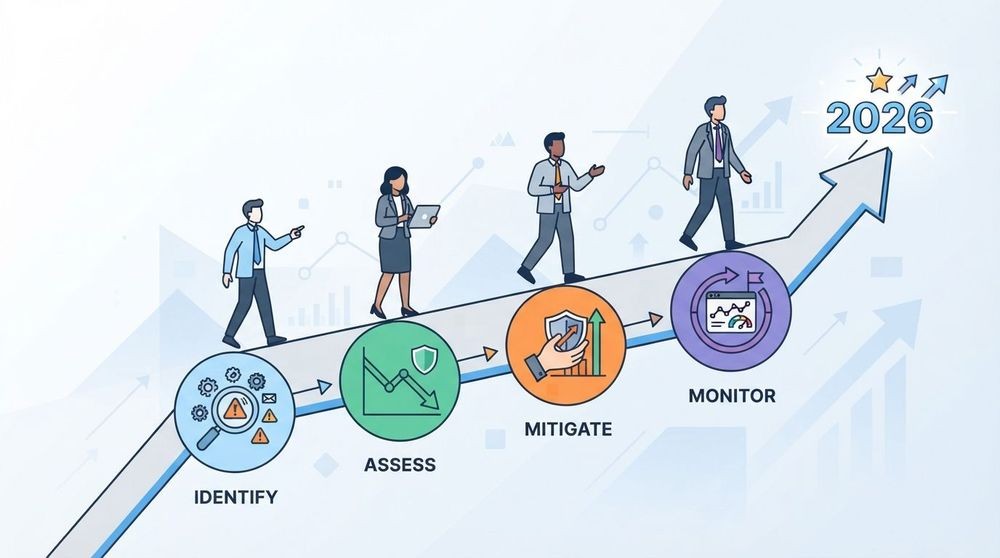
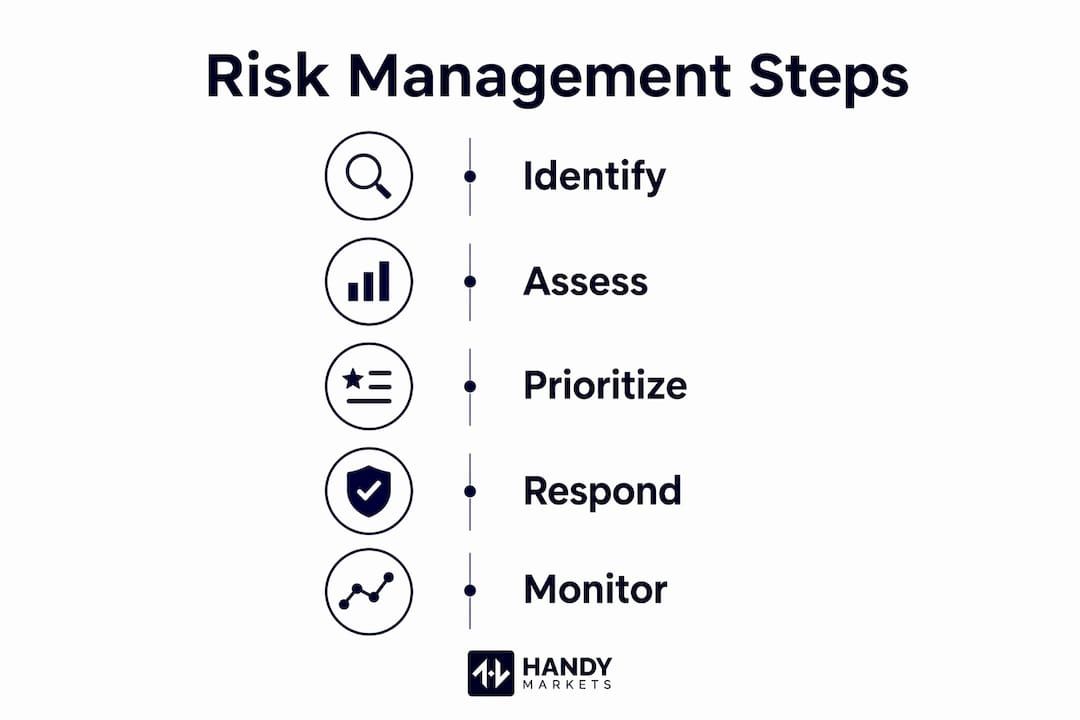
The five-step risk lifecycle is the backbone of every credible risk program in 2026. Each step feeds the next, and skipping one creates blind spots that compound over time.
Step 1: Risk identification
Risk identification is the process of discovering every threat that could affect your objectives. Effective methods include structured workshops, process mapping, historical incident reviews, and interviews with frontline staff. The goal is a complete inventory, not just the obvious threats. Emerging risks in 2026, including AI-driven supply chain disruptions and geopolitical volatility, require teams to look beyond traditional categories.
Step 2: Risk assessment
Assessment evaluates each identified risk by scoring its likelihood and its potential impact. Risk matrices such as 3x3, 4x4, or 5x5 grids plot likelihood against consequence severity to produce a consistent priority score. A 5x5 matrix, for example, generates 25 possible score combinations, giving large organizations the granularity they need. Quantitative tools like Monte Carlo simulations add statistical depth for high-stakes decisions.

Step 3: Risk prioritization
Prioritization converts assessment scores into a ranked list that directs resources to the highest-exposure items first. A risk with a high likelihood but low impact may rank below one with low likelihood but catastrophic impact. This step prevents teams from spreading attention too thin across dozens of minor issues while a critical threat goes unmanaged.
Step 4: Risk response
Effective risk responses use four core strategies: avoidance, reduction, transfer, and acceptance, each chosen based on cost-benefit analysis and organizational risk tolerance. Avoidance eliminates the activity that creates the risk. Reduction applies controls to lower likelihood or impact. Transfer shifts financial exposure through insurance or contracts. Acceptance acknowledges the risk and monitors it without active intervention.
Step 5: Continuous monitoring and review
Monitoring tracks whether controls are working and whether the risk environment has changed. Static annual reviews no longer meet the pace of 2026’s risk landscape. A living risk register, updated in real time, gives leaders the current picture they need to act decisively.
Pro Tip: Assign a named risk owner to every item in your risk register. Without ownership, monitoring becomes nobody’s job, and risks quietly escalate past their thresholds.
What tools and frameworks support the 2026 risk management process?
The right tools and frameworks turn a five-step process into a repeatable, auditable system. Three international standards dominate in 2026.
ISO 31000 provides principles and guidelines applicable to any organization regardless of size or sector. It emphasizes that risk management must be integrated into governance, not bolted on as a compliance exercise. COSO ERM adds a strategy layer, connecting risk appetite directly to business objectives. NIST RMF (Risk Management Framework) is the standard of choice for technology and government contexts, with defined preparatory and monitoring steps that ensure comprehensive oversight.
Risk matrix categories
Risk matrices remain the most widely used 2026 risk assessment technique for scoring and communicating risk. The table below shows how matrix size affects granularity:
| Matrix size | Likelihood levels | Impact levels | Score combinations | Best for |
|---|---|---|---|---|
| 3x3 | 3 | 3 | 9 | Small teams, simple risk profiles |
| 4x4 | 4 | 4 | 16 | Mid-size organizations |
| 5x5 | 5 | 5 | 25 | Complex, multi-unit enterprises |
Likelihood is typically categorized across four or five levels, from rare to almost certain, enabling consistent prioritization across business units.
Governance, Risk, and Compliance (GRC) tools
Automated GRC platforms aggregate risk data across the organization and flag threshold breaches in real time. They replace spreadsheet-based registers with dynamic dashboards that connect risk scores to control status and audit trails. For professionals tracking financial and market risks, platforms that deliver real-time market data add a critical external data layer to internal GRC systems.
- Risk ownership: Every risk item needs a named individual accountable for monitoring and escalation.
- Escalation triggers: Define the score or event that automatically routes a risk to senior leadership.
- Documented controls: Each control must have a test date, a result, and a next review date.
- Integration with strategy: Risk appetite statements must connect to business unit objectives, not sit in a separate governance document.
Pro Tip: When selecting a GRC tool, prioritize one that integrates with your existing data sources. A tool that requires manual data entry will be abandoned within six months.
How do organizations select the right risk response strategies in 2026?
Choosing a response strategy is a governance decision, not just a technical one. The four options each carry different cost, control, and accountability implications.
Avoidance is the right choice when the potential loss from a risk outweighs any benefit the activity provides. A company might exit a market or cancel a product launch if the regulatory or reputational exposure is too high. Avoidance is decisive but sometimes costly in foregone opportunity.
Reduction applies when the activity is worth keeping but the risk level is unacceptable. Controls such as staff training, process redesign, or technology safeguards lower either likelihood or impact. Most operational risks land in this category.
Transfer shifts the financial consequence of a risk to a third party through insurance, contracts, or outsourcing. The critical misconception here is that transferring a risk removes it entirely. It does not. The underlying operational threat remains, and the organization still needs to monitor it to protect business continuity. A supplier failure, for example, is still your problem even if a contract assigns financial liability elsewhere.
Acceptance is a deliberate, documented decision to carry a risk without active mitigation. Formal risk acceptance processes are essential to distinguish controlled acceptance from simply ignoring a problem. Without clear authorization, governance accountability breaks down and accepted risks become invisible liabilities. You can explore a practical breakdown of these four strategies in the context of trading and investment in this risk management workflow guide.
Factors that drive strategy selection include the organization’s documented risk tolerance, the cost of the control relative to the potential loss, regulatory requirements, and the speed at which the risk could materialize. Leaders who define these parameters in advance make faster, more consistent decisions when a risk event occurs.
What are best practices for continuous monitoring in the 2026 risk management process?
Continuous monitoring replaces traditional annual reviews because risk profiles shift faster than a once-a-year cycle can capture. A cyberattack, a regulatory change, or a commodity price spike can materialize in days. Organizations that review risks only at year-end are always reacting, never anticipating.
A living risk register is the operational center of continuous monitoring. Leaders update it in real time as new information arrives, controls are tested, or risk scores change. This approach supports agility rather than static annual reporting.
- Set quantitative escalation triggers: Define the exact score or event that moves a risk from the register to a leadership agenda item.
- Assign risk owners with authority: Owners must have the access and authority to act, not just report.
- Schedule rolling reviews: High-rated risks warrant monthly review; medium risks, quarterly; low risks, semi-annually.
- Incorporate external data: Market movements, regulatory updates, and industry incident reports all feed into risk score changes.
- Test controls regularly: A control that has not been tested is an assumption, not a safeguard.
Documented risk ownership and clear escalation ensure that risks crossing thresholds reach leadership attention promptly. Without this structure, risks sit in a register while the organization operates blind to their growth. For professionals managing financial exposure, tools that provide portfolio risk insights complement internal monitoring by surfacing market-level signals that internal data alone cannot capture.
Pro Tip: Build your escalation triggers into your GRC tool as automated alerts. Manual escalation processes fail under pressure because people assume someone else has already flagged the issue.
Leadership commitment is the non-negotiable ingredient. Risk management professionals can build the best process in the world, but without executive sponsorship and board-level review cycles, the program loses authority and eventually becomes a compliance checkbox.
Key Takeaways
The most effective risk management process in 2026 combines a structured five-step lifecycle with real-time monitoring, named risk ownership, and governance-backed response strategies aligned to organizational risk tolerance.
| Point | Details |
|---|---|
| Five-step lifecycle | Identification, assessment, prioritization, response, and monitoring form one continuous cycle. |
| Framework alignment | ISO 31000, COSO ERM, and NIST RMF provide the governance structure every program needs. |
| Response strategy choice | Select avoidance, reduction, transfer, or acceptance based on cost-benefit analysis and risk tolerance. |
| Transfer does not eliminate risk | Transferred risks still require active monitoring to protect operational continuity. |
| Continuous monitoring wins | A living risk register with named owners and escalation triggers outperforms any annual review. |
What risk professionals have learned the hard way in 2026
Risk management must be embedded in everyday organizational activities, not treated as a standalone annual project. That sounds obvious until you watch a well-funded risk program collapse because it only surfaces at the quarterly board meeting. The real work happens in the daily decisions that never reach a formal agenda.
The gap I see most often is the absence of a formal risk acceptance process. Teams avoid, reduce, or transfer risks with reasonable discipline. But when a risk does not fit neatly into those three boxes, it gets quietly ignored rather than formally accepted. That is not risk management. That is wishful thinking dressed up as governance.
The other lesson worth naming is the hazard-versus-risk distinction. A wet floor is a hazard. The risk is a customer slipping and the organization facing a liability claim. Conflating the two leads teams to catalog hazards endlessly without ever scoring the actual risks. Resources get spread across dozens of low-probability items while a high-impact threat sits underweighted in the register.
The future of risk management belongs to organizations that treat their risk register as a living document, not a filing cabinet. Real-time data, clear ownership, and leadership that actually reads the escalation reports. That combination is rare, and it is exactly what separates organizations that manage risk from those that merely document it.
Real-time market data as part of your risk monitoring toolkit
Risk management professionals tracking financial and market exposure need external data as much as internal controls. Price movements in commodities, currencies, and equities can shift your organization’s risk profile overnight.
Handy Markets aggregates live prices and alerts across cryptocurrencies, stocks, commodities, indices, and foreign exchange in one place. You can set custom price alerts through Telegram, Discord, Slack, SMS, Webhook, or Email so you never miss a threshold breach. For professionals who need to act on market signals as part of their risk response cycle, Handy Markets delivers the real-time intelligence that keeps your monitoring process current. You can also set up price alerts for free and configure them in minutes, making it a practical addition to any risk monitoring workflow.
FAQ
What is the risk management process in 2026?
The risk management process in 2026 is a continuous five-step lifecycle covering identification, assessment, prioritization, response, and monitoring, aligned with frameworks like ISO 31000 and COSO ERM.
What is the difference between a hazard and a risk?
A hazard is a source of potential harm; a risk measures the likelihood and impact of that harm actually occurring. Treating them as the same leads to misallocated resources and incomplete assessments.
Why is continuous monitoring better than annual risk reviews?
Risk profiles shift faster than an annual cycle can capture. A living risk register updated in real time allows organizations to respond to new threats before they escalate, rather than discovering them after the fact.
What does risk transfer actually mean?
Risk transfer shifts the financial consequence of a risk to a third party through insurance or contracts. It does not eliminate the underlying operational threat, which still requires active monitoring.
How do you choose between the four risk response strategies?
The choice between avoidance, reduction, transfer, and acceptance depends on the risk’s cost-benefit ratio, the organization’s documented risk tolerance, regulatory requirements, and how quickly the risk could materialize.