

TL;DR:
- Market price movements are driven by structured order interactions, not random noise.
- Understanding market mechanics and order flow gives traders a measurable edge.
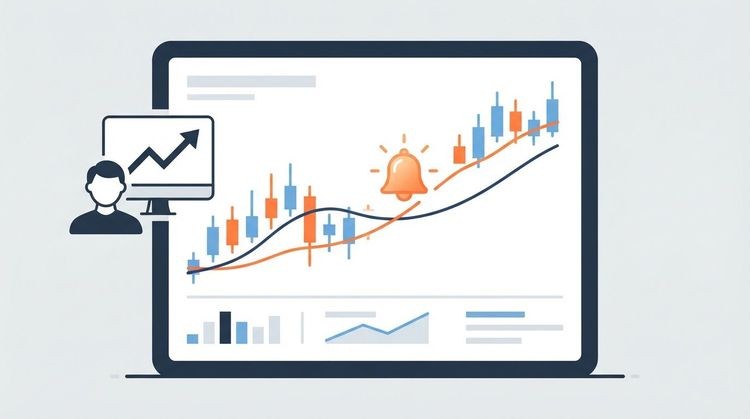
- Tools like real-time data and alerts enhance trading decisions beyond chart analysis.
Most traders assume price movements are random noise, reacting emotionally to every tick. The truth is more structured: every price move reflects a web of orders, mechanisms, and participants interacting in predictable ways. Understanding how financial markets actually work gives you a measurable edge over traders who rely purely on instinct. This guide breaks down the core mechanics behind price formation, trading structures, and market behavior, from order books to dark pools to the 24/5 forex world. By the end, you’ll see markets not as chaotic storms but as living systems with patterns you can read, anticipate, and act on with real confidence.
Table of Contents
- What are financial markets and why do they matter?
- How trading works: Market structures and order mechanisms
- Order books, auctions, and price formation
- Market nuances: Dark pools, HFT, and risks
- Global view: Forex and around-the-clock markets
- A trader’s perspective: What really matters in market mechanics
- Level up your trading with market tools
- Frequently asked questions
Key Takeaways
| Point | Details |
|---|---|
| Market structures matter | Understanding different market mechanisms gives traders and investors a strategic edge when making decisions. |
| Order books drive price | Order types and auctions directly shape how prices move and where volatility appears. |
| Nuance creates opportunity | Knowing about dark pools, HFT, and specialized risks can help you trade smarter and avoid common pitfalls. |
| Global markets never sleep | Decentralized markets like forex require special strategies for 24/5 trading and constant liquidity. |
| Tools amplify insights | Leverage market tracking tools and alerts to turn structural knowledge into actionable trading success. |
What are financial markets and why do they matter?
Now that you know price moves aren’t just noise, let’s ground your understanding with what financial markets actually are and why they matter.
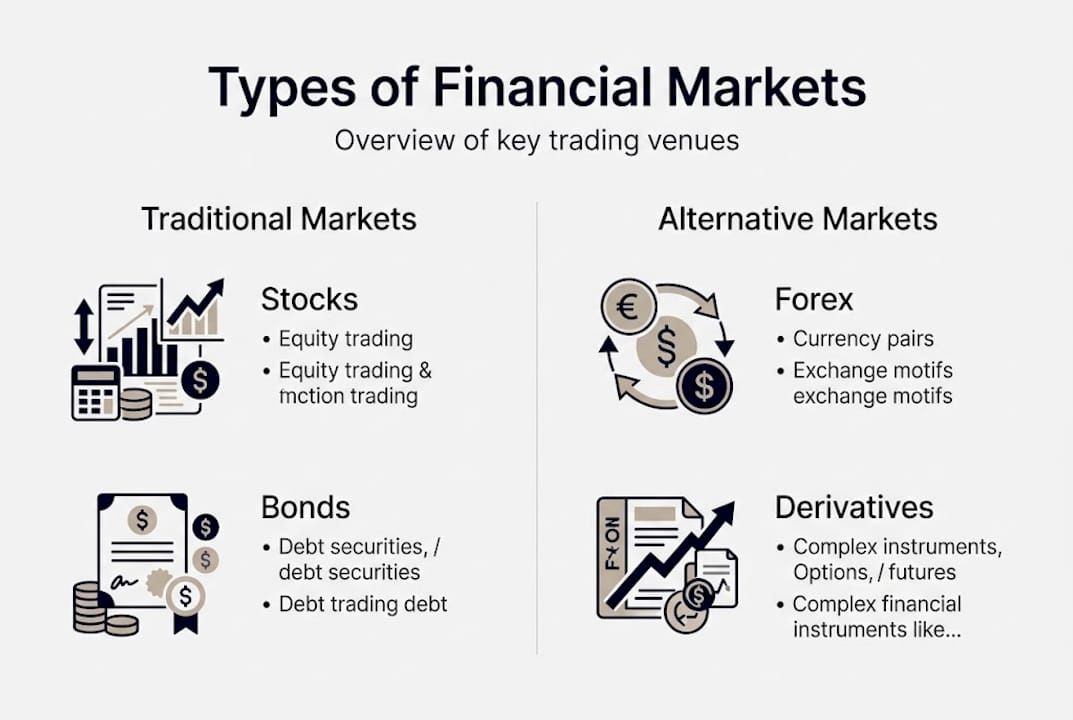
Financial markets are marketplaces where buyers and sellers trade financial instruments like stocks, bonds, forex, derivatives, and commodities, facilitating capital allocation, liquidity, and price discovery. Think of them as the circulatory system of the global economy, moving capital from those who have it to those who need it, while setting prices along the way.
When you buy a stock, you’re not just speculating. You’re participating in a system that funds companies, helps governments borrow, and allows businesses to hedge against risk. That’s a powerful role, and understanding it changes how you approach every trade.
Financial markets serve several core functions that every trader and investor should know:
- Connect buyers and sellers across the globe in real time
- Enable investment by channeling savings into productive assets
- Price discovery: markets aggregate information to reflect fair value
- Provide liquidity, so you can enter or exit positions efficiently
- Transfer risk through instruments like derivatives and options
Primary types include stock markets (equities), bond markets (debt), money markets (short-term debt), forex (currencies), derivatives, and commodities markets. Each serves a different purpose and attracts different participants, from retail traders to central banks.
When you compare financial markets, you quickly see that structure, liquidity, and risk profiles vary dramatically. A bond market operates very differently from a commodity futures exchange, even though both involve buyers and sellers. Getting an overview of financial markets early in your trading journey is one of the highest-leverage moves you can make.
How trading works: Market structures and order mechanisms
Armed with an understanding of what financial markets are, the next step is to see exactly how trading plays out within these marketplaces.
Not all markets work the same way. The two dominant models are quote-driven and order-driven markets, and the difference matters enormously for execution quality, cost, and transparency.

| Feature | Quote-driven (OTC) | Order-driven (exchange) |
|---|---|---|
| How prices are set | Dealers post bid/ask quotes | Orders matched by price-time priority |
| Examples | NASDAQ (historically), forex | NYSE, CME futures |
| Liquidity source | Market makers | Participants’ limit orders |
| Transparency | Lower (negotiated) | Higher (public order book) |
| Best for | Large blocks, illiquid assets | Standardized, high-volume assets |
Trading occurs via quote-driven dealer markets where market makers provide bid/ask quotes, and order-driven markets using centralized order books that match bids and asks by price-time priority. Understanding which model governs your asset helps you anticipate costs and execution behavior.
Here’s how a typical trade flows from intent to completion:
- Place an order: You submit a market or limit order through your broker or platform.
- Routing: Your order is routed to the relevant exchange or dealer network.
- Matching: The order is matched against a counterparty using price-time priority or dealer quotes.
- Execution: The trade is confirmed at the agreed price.
- Settlement: Ownership transfers, typically T+1 for US equities in 2026.
Pro Tip: Use limit orders in quote-driven or low-liquidity markets to avoid paying wide spreads. In deep, order-driven markets during peak hours, market orders are often fine for small positions.
Exploring how trading mechanisms work in detail will help you choose the right order type for every situation. You can also study order-driven vs. quote-driven markets to sharpen your execution strategy.
Order books, auctions, and price formation
Understanding the overall market structure raises a deeper question: What actually happens under the hood when you hit “buy” or “sell”?
Order books organize limit orders by price levels, while market orders execute immediately at the best available price. Opening and closing auctions on exchanges like the NYSE aggregate orders to find a single clearing price, which is why you often see dramatic moves at those times.
The data behind US markets tells a compelling story. US equity ADV runs roughly 17 to 20 billion shares daily, with average daily value traded between $800 billion and $1 trillion. Options ADV sits around 55 to 66 million contracts. Off-exchange trading accounts for approximately 50% of volume, and intraday volatility follows a distinct U-shape, spiking at open and close.
Common order types every trader should understand:
- Market order: Executes immediately at the current best price; fast but exposed to slippage
- Limit order: Executes only at your specified price or better; controls cost but may not fill
- Stop order: Triggers a market order once a price threshold is crossed; useful for risk management
- Stop-limit order: Combines a stop trigger with a limit price; more control, but can miss execution
- Iceberg order: Shows only part of the total order size; used by institutions to hide intent
Price is formed through the continuous aggregation of these orders. When buy pressure outweighs sell pressure at a given level, prices rise. When sellers dominate, prices fall. This is why monitoring the stock market order book gives you a real-time window into supply and demand dynamics.
Slippage, the difference between your expected price and your actual fill, is a direct result of order book depth. Thin books mean more slippage. Learning to read stock market indicators alongside order flow helps you time entries more precisely and apply strategies for volatile markets when conditions shift.
Market nuances: Dark pools, HFT, and risks
So far, we’ve covered standard market operations. Next, let’s examine what actually complicates these systems and how savvy traders navigate those waters.
Not all trading happens on lit exchanges. Dark pools account for roughly 40 to 50% of total volume, and high-frequency trading (HFT) represents 50 to 60% of exchange activity. These forces shape prices in ways most retail traders never see coming.
Dark pools are private venues where large institutions trade without revealing their intentions to the public order book. The benefit is reduced market impact for big orders. The downside is reduced transparency, which can widen spreads and distort price discovery for everyone else.
HFT firms provide tighter spreads and deeper liquidity on most days. But they also introduce systemic risks, including flash crashes and edge-case manipulation through tactics like spoofing (placing fake orders to move prices) and layering (stacking orders to create false depth). Common risks traders face include:
- Spoofing and layering: Artificial order book signals that vanish before execution
- Gap fades at open: Prices that overshoot at the open and reverse sharply
- Volatility spikes at close: Auction-driven price swings that trap late traders
- Liquidity illusions: Apparent depth that disappears when you need it most
Intraday volatility follows a U-shaped curve, with the highest risk concentrated at the open and close. Opening and closing auctions frequently overshoot and reverse, catching reactive traders off guard.
Bid-ask spread compensates market makers for adverse selection and inventory risk, meaning spreads widen when uncertainty rises. Order flow imbalance is one of the most reliable short-term price predictors available.
Pro Tip: Avoid placing large orders in the first and last 15 minutes of a session. Mid-session liquidity is deeper and spreads are tighter, giving you better fills and less exposure to auction-driven whipsaws.
For deeper context on analyzing market fluctuations, including how to track off-exchange activity, tools like those tracking dark pool volume can give you additional signal.
Global view: Forex and around-the-clock markets
Beyond traditional exchanges, let’s examine the world’s largest, most active market: Forex.
Forex stands apart from every other market in structure and scale. Forex is OTC, decentralized, trades 24 hours a day five days a week, and processes roughly $7.5 trillion in daily volume as of 2022. It operates through a network of banks, brokers, and dealers rather than a central exchange, which means liquidity and pricing can vary significantly depending on where and when you trade.
This decentralized structure creates both opportunity and risk. There’s no single price for any currency pair at any moment, only the best available quote from your liquidity provider. High leverage, often 50:1 or more for retail traders, amplifies both gains and losses rapidly.
Key characteristics and challenges of forex trading:
- 24/5 access: Markets move across Asian, European, and US sessions continuously
- High leverage: Magnifies returns but also dramatically increases risk exposure
- News sensitivity: Economic releases can move prices by hundreds of pips in seconds
- Decentralized liquidity: Spreads and depth vary by broker and time of day
- Overlap windows: The London/New York overlap (8 AM to 12 PM ET) offers the deepest liquidity
For retail traders, the most practical edge in forex comes from understanding global order flow and session timing. Avoid trading major pairs during thin overnight sessions when spreads widen and moves can be erratic. Applying structured market analysis methods helps you filter noise from genuine directional moves.
A trader’s perspective: What really matters in market mechanics
After breaking down the technicals, here’s what most guides miss entirely.
Conventional trading education focuses on chart patterns and indicators, but the real edge lives in understanding when and how orders interact. Most retail traders lose not because their analysis is wrong, but because they execute at the worst possible moments, right at the open or close, exactly when institutional flows and auction mechanics distort prices most aggressively.
The uncomfortable truth is that HFT and large institutional players have structural speed advantages you cannot match. Trying to compete on their terms is a losing game. Your real advantage is patience and timing. Mid-session executions, when order flow is more balanced and liquidity is genuine, consistently produce better fills than chasing open gaps or reacting to closing prints.
Reading order flow imbalance, even at a basic level, tells you more about short-term direction than most indicators. Adapting your position size to current liquidity conditions reduces slippage and protects you from volatility spikes. A solid volatility strategy checklist keeps you disciplined when markets get noisy. Play to your slow advantages, not their fast ones.
Level up your trading with market tools
With this new perspective, you’re ready to put market insights into action, and Handy.Markets offers the tools to help you do it.
Understanding market mechanics is only half the equation. The other half is having real-time data at your fingertips when opportunities appear. Handy.Markets lets you track all markets in one place, from equities and forex to crypto and commodities, so you’re never flying blind across asset classes.
You can also set up free price alerts across Telegram, Discord, Slack, SMS, Webhook, and Email, so critical market moves reach you instantly, wherever you are. Whether you’re monitoring order flow signals or watching for breakout levels, Handy.Markets keeps you connected to the data that drives smarter decisions. Stop reacting and start anticipating.
FAQ
What are the main types of financial markets?
Financial markets include stock, bond, money, forex, derivatives, and commodities markets, each serving different trading and investment needs.
How does an order-driven market differ from a quote-driven market?
Order-driven markets match trades via order books using price-time priority, while quote-driven markets rely on dealers setting bid and ask prices directly for participants.
Why does volatility often spike at market open and close?
Volatility is highest at open and close due to large auction flows and new information, creating price gaps and rapid moves. Intraday U-shape volatility with a VIX averaging 15 to 19 confirms this pattern consistently.
How do dark pools impact traders and investors?
Dark pools provide access to large trades with less price impact, but reduce transparency and can affect overall price discovery. They account for roughly 40 to 50% of total trading volume.
What makes forex markets unique?
Forex markets are decentralized, trade 24/5, process around $7.5 trillion in daily volume, and offer significant leverage, attracting global participants and enabling rapid price changes around the clock.