
TL;DR:
- Live data is essential for timely risk management, order execution, and reacting to market news.
- Monitoring frequency should match your trading style, with active traders needing constant updates and long-term investors fewer checks.
- Using real-time alerts reduces slippage and costly mistakes, improving overall trading performance.
Missing a single market move by just a few minutes can cost you more than you’d expect. Many retail investors assume that checking prices once or twice a day is enough, but the market doesn’t wait. Earnings surprises, Federal Reserve announcements, and sudden geopolitical events can shift stock prices by 5% or more within seconds. The traders who act on live data have a real advantage over those working with delayed information. In this article, we’ll walk through why real-time stock monitoring is essential, how it reduces costly mistakes, and how to match your monitoring habits to your actual investing style.
Table of Contents
- The role of real-time data in modern stock trading
- Reducing risk and avoiding costly mistakes
- How transaction costs and slippage eat away returns
- Active traders vs. long-term investors: How much should you monitor?
- What most stock guides miss about live monitoring
- Simplify your live stock monitoring with Handy.Markets
- Frequently asked questions
Key Takeaways
| Point | Details |
|---|---|
| Real-time data is critical | Immediate access to live market information enables smarter, faster trading decisions. |
| Reduces costly mistakes | Monitoring live stocks helps prevent losses caused by market shocks or delayed trades. |
| Slippage impacts returns | Not using live data can cost you up to 5% of your profits due to transaction drag. |
| Different styles, different needs | Active traders require constant monitoring; long-term investors can avoid daily checks. |
The role of real-time data in modern stock trading
Live stock data refers to price quotes, volume figures, and order flow information that update continuously throughout the trading day, typically with zero or minimal delay. Retail investors access this data through brokerage platforms, financial news sites, and dedicated market monitoring tools. Active traders often pay for direct market feeds to shave milliseconds off their data latency. The difference between live and delayed data may seem small, but in fast-moving markets, it can be the gap between a profitable trade and a painful loss.
So what does live data actually power? Quite a lot. Real-time data importance shows it is essential for risk management, enabling the dynamic calculation of Value at Risk (VaR), profit and loss (P&L), and margin requirements in volatile conditions. When prices move sharply, these figures change instantly, and your risk exposure changes with them. Without live prices, your risk calculations are already outdated the moment you look at them.
For everyday traders, live monitoring enables a set of core functions that simply aren’t possible with delayed data:
- Immediate reaction to breaking news: When a company announces a surprise earnings beat or a regulatory decision drops, live data lets you act before the crowd reprices the stock.
- Executing trades at optimal moments: Limit orders and stop orders depend on accurate, current prices. Stale data means your orders may trigger at the wrong levels.
- Dynamic portfolio rebalancing: If one position surges or drops sharply, live data lets you rebalance in real time to maintain your target allocation.
- Monitoring market depth: Seeing the bid and ask sizes helps you judge whether a price move has real conviction behind it or is just a temporary blip.
We also know that real-time market strategies depend heavily on having accurate price feeds at the right moment. A well-timed entry or exit can make the difference between a 2% gain and a 2% loss on the same trade idea. The guide to real-time data is a solid starting point if you want to understand how professional and retail traders structure their data access.
Key insight: Live data is not just a convenience. It is the foundation of every risk control, order type, and market reaction that keeps your portfolio from taking unnecessary hits.
Reducing risk and avoiding costly mistakes
Understanding its importance is one thing; let’s see how live monitoring actively reduces risk and error.
When your data lags, your decisions lag with it. Imagine you’re holding a position in a tech stock and a major index suddenly drops 1.5% on unexpected inflation data. With delayed data, you might not see the move until it’s already 2% against you. By then, your stop-loss hasn’t triggered, your margin cushion has shrunk, and you’re making an emotional decision instead of a planned one.
“Real-time data enables dynamic risk controls, allowing traders to react to volatility spikes before they become portfolio-damaging events.”
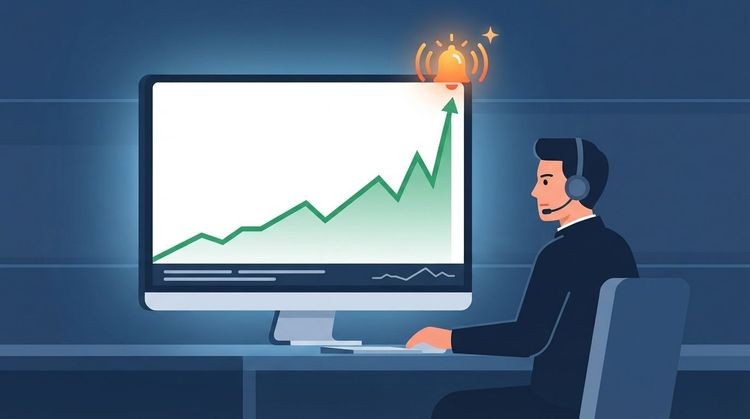
This is where market monitoring alerts become genuinely powerful. Alerts tied to live prices mean you don’t have to stare at a screen all day. You set the conditions, and the system notifies you the moment something important happens.
Here’s a practical approach to implementing risk controls with live data:
- Set price alerts at key levels. Define support and resistance zones in advance and place alerts just above or below them so you’re notified before a breakout or breakdown.
- Review your stop-loss orders regularly. As a stock moves in your favor, trail your stop-loss upward to lock in gains. Live data makes this adjustment timely and precise.
- Monitor position-level P&L in real time. Don’t wait for end-of-day summaries. Knowing your live P&L helps you stay within your planned risk limits.
- Watch volatility indicators. Metrics like the VIX or a stock’s intraday range can signal when conditions are becoming dangerous, prompting you to reduce exposure.
- Adjust position sizes quickly. If a stock’s volatility spikes unexpectedly, live data lets you scale down before your risk grows beyond your comfort zone.
Pro Tip: Most costly trading mistakes happen when data lags or trades are placed without current price context. Even a 15-minute delay can mean executing at a price that’s already moved significantly against you.
Consider two quick scenarios. First, a company reports earnings after hours, and the stock gaps up 8% at the open. Without live data, you might miss the initial move entirely or buy in at the peak of the gap. Second, a sudden news event causes a sharp sell-off. Traders with live alerts can exit quickly; those relying on delayed data absorb the full drop before they even realize what happened. Good volatility management strategies always start with having the right data at the right time.

How transaction costs and slippage eat away returns
Beyond risk, live data also affects your returns. Let’s dig into the hidden costs most overlook.
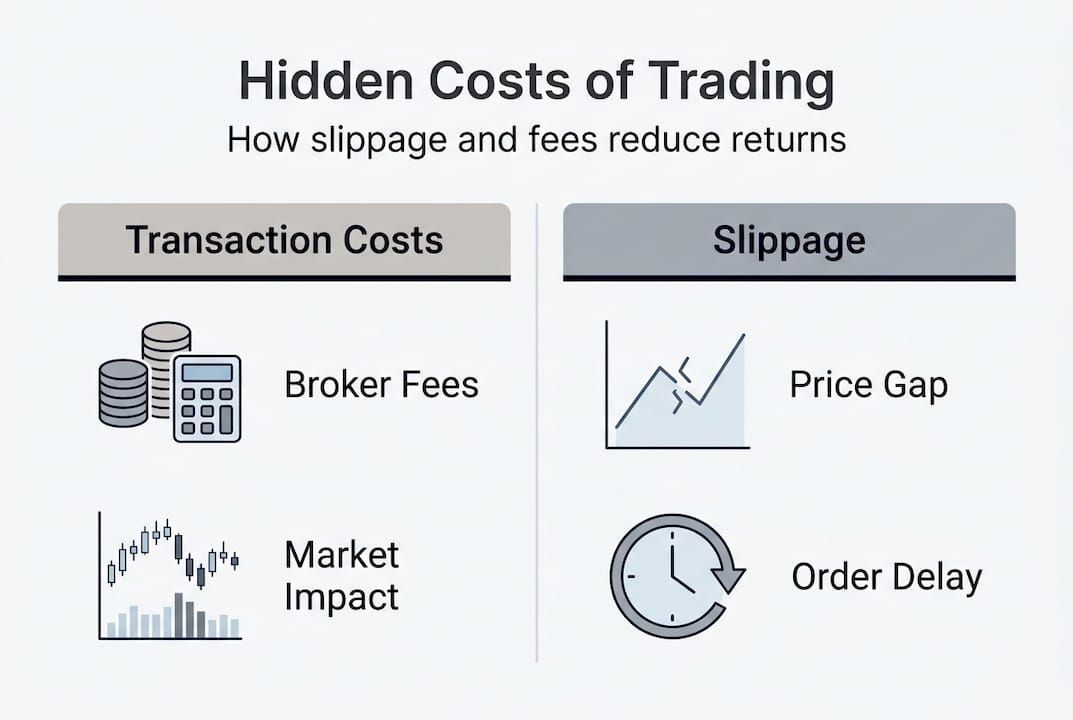
Slippage is the difference between the price you expected to pay (or receive) and the price your trade actually executed at. It happens because markets move between the moment you place an order and the moment it fills. For a small retail trade, slippage might seem trivial. But over dozens or hundreds of trades per year, it adds up fast.
Research shows that transaction costs and slippage can reduce strategy returns by 3 to 5% annually, with market impact accounting for 60 to 80% of total trading costs. That’s a significant drag, especially when you consider that many retail investors are targeting annual returns in the 8 to 12% range.
Here’s a simple comparison to illustrate the difference:
| Factor | With live monitoring | With delayed data |
|---|---|---|
| Execution price accuracy | High | Low to moderate |
| Average slippage per trade | Minimal | 0.2% to 0.5% or more |
| Reaction to news events | Immediate | 5 to 20 minutes late |
| Annual cost drag (estimated) | Less than 1% | Up to 3 to 5% |
| Order placement confidence | High | Uncertain |
The numbers tell a clear story. A retail investor who consistently lags the market by even a few minutes ends up paying more for every buy and receiving less on every sell. Over a full year of active trading, that gap compounds into a meaningful performance disadvantage.
Live monitoring helps reduce slippage in several concrete ways:
- Timely execution: Placing orders when you can see the current bid/ask spread means fewer surprises at fill time.
- Price comparison: Watching the live order book lets you choose the best moment to enter, avoiding thin liquidity windows.
- Market depth awareness: Understanding how many shares are available at each price level helps you size your orders to avoid moving the market against yourself.
Tracking key indicators to watch alongside live prices gives you the full picture. Indicators like volume, average true range, and bid/ask spread width all tell you something about the cost of executing a trade at any given moment.
Active traders vs. long-term investors: How much should you monitor?
Not all traders and investors need the same level of vigilance. Here’s how to find the right balance for you.
The honest answer is that your monitoring frequency should match your strategy, not your anxiety level. Active day traders and long-term buy-and-hold investors have fundamentally different relationships with live data.
| Dimension | Active traders | Long-term investors |
|---|---|---|
| Monitoring frequency | Continuous during market hours | Weekly or monthly reviews |
| Key data needed | Tick-by-tick prices, order flow, volume | Fundamentals, earnings, macro trends |
| Risk from over-monitoring | Overtrading, emotional decisions | Minimal |
| Risk from under-monitoring | Missed entries/exits, large losses | Very low for diversified portfolios |
| Best use of live data | Entry/exit timing, stop management | Earnings announcements, major news |
Research on market monitoring frequency highlights a key contrast: active traders need live data for their edge, while long-term retail investors risk being overwhelmed by short-term noise. Daily price moves of 1 to 2% sound dramatic but represent only about 0.016% of the annual earnings yield for a diversified portfolio. Reacting to that noise often does more harm than good.
For long-term investors, checking index tracking advice and reviewing your portfolio during earnings seasons or major macro events is usually sufficient. You don’t need to watch every tick. For active traders, live data is non-negotiable. Missing a 30-second window on a breakout trade can mean the difference between a clean entry and chasing a stock that’s already moved.
Pro Tip: Match your monitoring habits to your actual investing style. If you’re a long-term investor copying the habits of a day trader, you’re adding stress without adding returns. Define your strategy first, then decide how often live data actually helps you.
Specific moments when live prices matter most for each type:
- Active traders: Pre-market gaps, intraday breakouts, news-driven volatility, and end-of-day position management.
- Long-term investors: Quarterly earnings releases, Fed announcements, and major geopolitical events that could affect sector allocations.
Exploring investment strategy tips can help you clarify which category you fall into and build a monitoring routine that fits.
What most stock guides miss about live monitoring
We’ve covered the mechanics. Now let’s challenge some traditional thinking.
Most beginner guides treat live stock monitoring as a simple binary: either you watch the market constantly or you ignore it. That framing misses the point entirely. The real skill is knowing when live data matters and when it’s just noise dressed up as signal.
Beginners often fixate on tick-by-tick price movement, watching numbers flicker up and down without understanding the context behind the moves. That habit builds anxiety, not insight. The traders who genuinely benefit from live data use it for specific, rule-based purposes: risk alerts, stop-loss triggers, and position sizing adjustments. They’re not reacting to every 0.3% wiggle.
Here’s the contrarian truth: over-monitoring hurts long-term investors, while under-monitoring is genuinely dangerous for active traders. The solution isn’t to pick one extreme. It’s to build a clear set of rules for when you check live data and what you do with it. Checking market trends for 2026 periodically is far more useful for most investors than watching a live ticker all afternoon.
The best investors we observe don’t monitor out of fear. They monitor with purpose. That distinction is everything.
Simplify your live stock monitoring with Handy.Markets
If you’re ready to monitor live stocks efficiently, here’s a simple solution.
Handy.Markets brings live stock prices, real-time percentage changes, and instant alerts together in one clean dashboard. You don’t need multiple tabs or separate apps to stay informed.
With free price alerts delivered via Telegram, Discord, Slack, SMS, Email, or Webhook, you can set your conditions once and let the platform do the watching for you. It’s a set-and-forget approach that keeps you informed without keeping you glued to a screen. Whether you’re an active trader or a long-term investor, you can track all financial markets including stocks, crypto, commodities, indices, and forex from a single place. Start monitoring smarter today.
FAQ
What is live stock data, and why is it important for trading?
Live stock data provides continuously updated prices and market activity, giving you the real-time information needed to make informed decisions. As real-time data shows, it enables dynamic calculation of VaR, P&L, and margin, which are critical for managing risk in fast-moving markets.
How often should long-term investors monitor live stocks?
Long-term investors generally benefit from limiting their checks to major market events like earnings releases or Fed announcements, since daily monitoring can overwhelm useful signals with short-term noise that has little bearing on long-term outcomes.
How does slippage impact retail traders who don’t use live data?
Without live data, trades execute at prices that may have already moved, creating slippage that compounds over time. Research shows slippage and costs can reduce annual returns by 3 to 5%, a significant drag for any active retail trader.
Can I automate live stock price monitoring?
Yes, platforms like Handy.Markets let you set up price alerts across multiple channels so you receive instant notifications when key price levels are hit, removing the need to watch markets manually throughout the day.