
TL;DR:
- Market signals are data-driven cues indicating potential buy or sell opportunities, not guarantees.
- Traders use technical, fundamental, and order flow signals, filtered by market context and discipline.
- Success depends on execution, risk management, and patience rather than relying on perfect indicators.
Market signals sit at the center of every great trade and every costly mistake. Yet most beginners treat them like mystical omens, waiting for some perfect indicator to flash before acting. The truth is simpler and more empowering: a trade signal is an indication or trigger suggesting a potential buy or sell opportunity for assets like stocks, cryptocurrencies, or commodities. Once you understand what signals actually are, where they come from, and how to filter out the noise, you stop guessing and start trading with genuine clarity. This guide walks you through everything you need to know.
Table of Contents
- Understanding market signals: Definition and importance
- Types of market signals: Technical, fundamental, and order flow
- Manual vs. automated signals: Human insight and algorithmic speed
- Critical nuances: Filtering, risk, and behavioral edges
- Why mastering market signals is about discipline, not prediction
- Enhance your trading: Real-time alerts and market tracking
- Frequently asked questions
Key Takeaways
| Point | Details |
|---|---|
| Market signal basics | A market signal is a data-based trigger that suggests a buy or sell opportunity in trading. |
| Signal types | Technical, fundamental, and order flow signals each offer different insights for stocks, crypto, and commodities. |
| Signal creation methods | Traders can use manual analysis, automated systems, or hybrid approaches to generate and act on signals. |
| Importance of filtering | Filtering signals by context and risk management is key to reducing false positives and improving results. |
| Discipline over prediction | Consistent discipline and strategy matter more than finding the perfect indicator or prediction model. |
Understanding market signals: Definition and importance
Having established the article’s value, let’s pinpoint what market signals actually are and why they matter so deeply to every type of trader.
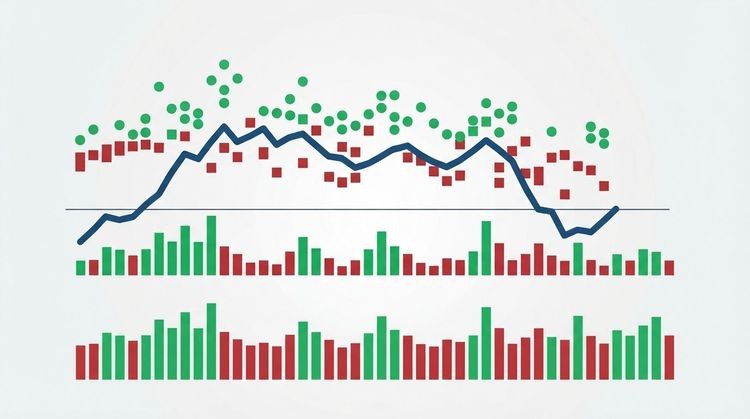
A market signal is an indication or trigger suggesting a potential buy or sell opportunity in any tradable asset. Think of it as a nudge from the data itself. Prices, volume, news, and economic reports all generate signals continuously. The job of a trader is to read those nudges, filter the meaningful ones, and act with discipline.
Signals matter because financial markets are pulsing with opportunities and risks at every moment. Without a structured way to interpret that movement, you are essentially reacting emotionally instead of strategically. Signals give you an objective framework, a reason based on evidence rather than gut instinct, to enter or exit a position.
Here are common examples of market signals and where they show up:
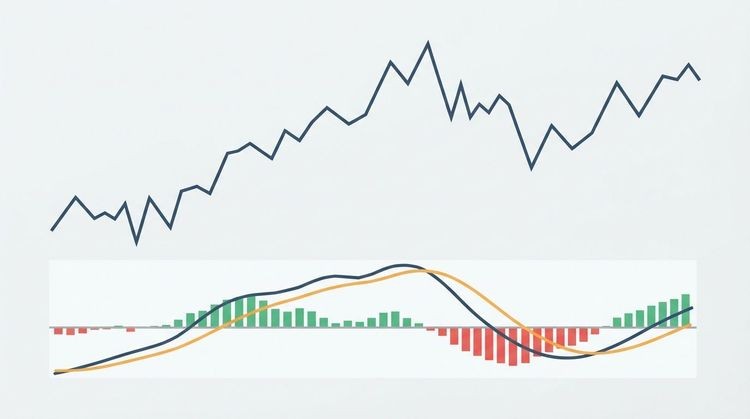
- Technical trigger: A moving average crossover on a stock chart suggests momentum has shifted direction
- Earnings surprise: A company reports profits far above analyst expectations, triggering a bullish fundamental signal
- Volume spike: A sudden surge in trading volume on a cryptocurrency often precedes a major price move
- Sentiment extreme: When retail traders are overwhelmingly bullish, contrarian signals may point to a coming reversal
- Commodity supply shock: An unexpected drop in oil inventory levels generates a fundamental signal for energy traders
You can apply real-time market alerts to catch these signals the moment they emerge, which is especially critical in fast-moving markets like crypto.
Market signals are not magic; they reflect patterns in price, volume, or news, and become powerful when used as part of a plan.
The most important thing to understand is that a signal is only as useful as the context around it and the discipline of the trader using it. A moving average crossover that works brilliantly in a trending market can produce endless false signals during a choppy, sideways period. Learning market trend strategies helps you match the right signal to the right market condition. And exploring market fluctuation analysis methods gives you the tools to evaluate whether a signal deserves your attention or your skepticism.
Types of market signals: Technical, fundamental, and order flow
With the basics set, the next step is knowing exactly what types of signals traders use and how they differ from one another.
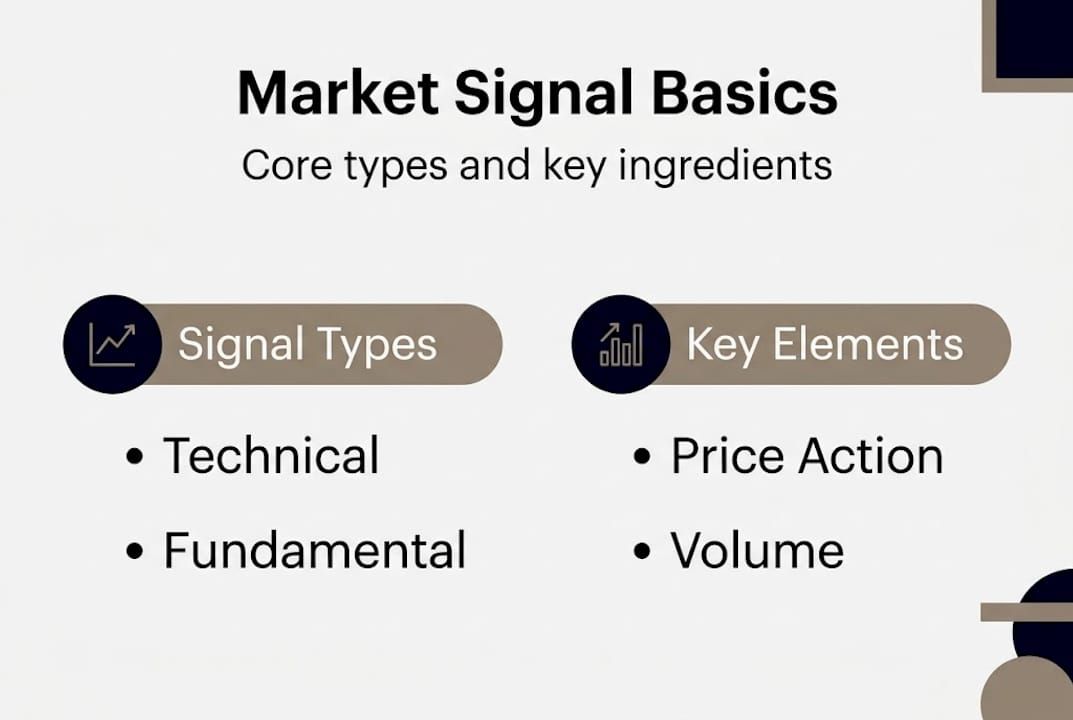
Signal mechanics are wide-ranging. Technical indicators like moving averages, RSI, and MACD, combined with fundamental data such as earnings surprises and insider trades, plus advanced order flow patterns, all represent distinct categories of signals with different strengths.
| Signal type | Definition | Data source | Example | Typical asset use |
|---|---|---|---|---|
| Technical | Price or volume pattern on a chart | Historical price, volume data | Moving average crossover | Stocks, crypto, forex |
| Fundamental | News or data about underlying value | Earnings reports, macro data | Earnings beat by 20% | Stocks, commodities |
| Order flow | Real-time buyer vs. seller pressure | Level 2 data, order books | Large bid stacking at support | Crypto, futures |
Here is how each signal type is identified in practice:
- Choose your market and understand its primary drivers (price patterns for crypto, earnings cycles for stocks, supply data for commodities)
- Select your indicator or trigger based on that market’s behavior, not what’s trending on social media
- Confirm with a second layer such as a volume check or a news filter, to reduce false positives
- Set a clear action rule before the signal appears, so you are not making emotional decisions in real time
- Review the outcome after each trade to learn whether the signal performed as expected in that specific context
In practice, a stock trader might watch for a 50-day moving average crossover above the 200-day average, a classic bullish signal. A crypto trader might monitor order book delta, the difference between buy and sell pressure, to anticipate short-term price direction. A commodity trader might respond to an unexpected inventory report that fundamentally shifts supply expectations.
Pro Tip: Start simple. Master one signal type before mixing approaches. Combining too many signals too early creates confusion, not clarity. Explore key market indicators to find the ones that fit your style, then use market tracking tools to monitor them in real time.
Manual vs. automated signals: Human insight and algorithmic speed
Now that you know the main signal types, let’s examine how traders generate them, whether by careful human analysis or with advanced algorithmic tools.
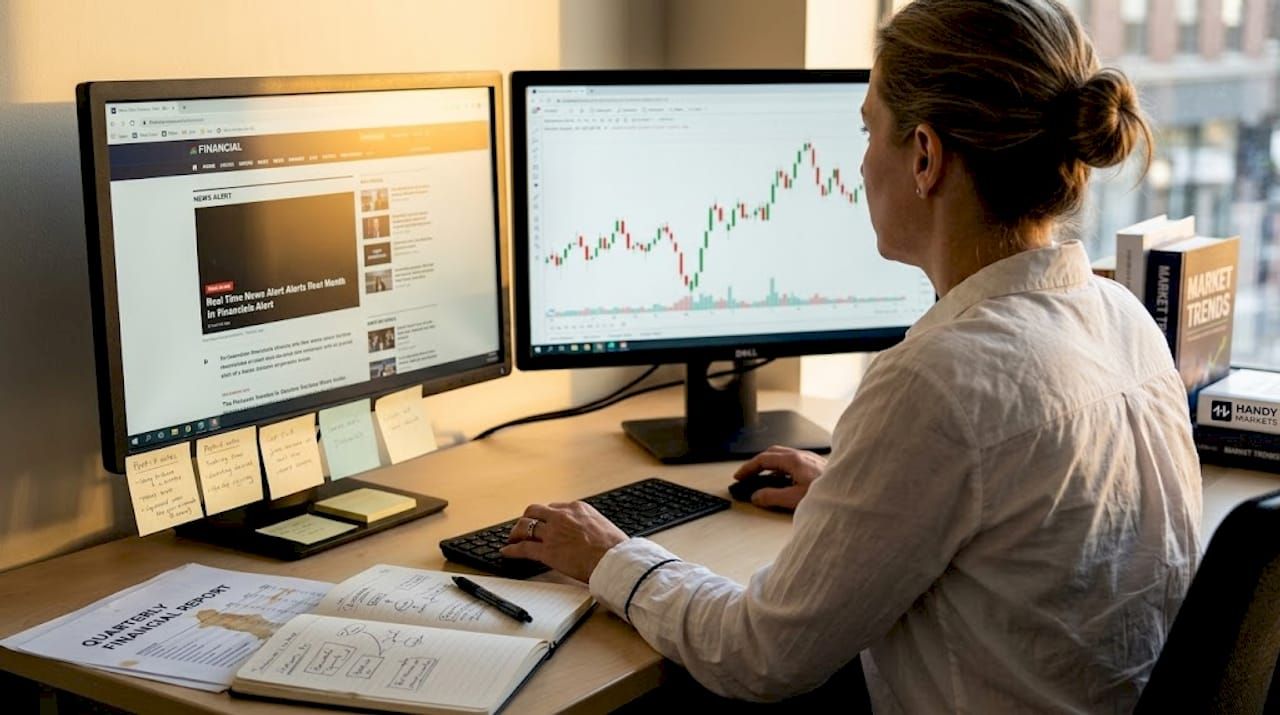
The method you use to generate signals has a massive impact on your results. Signal methodologies can be manual (human analysis), automated (algorithms and AI), or hybrid, and each approach applies differently across stocks, crypto, and commodities.
| Method | Latency | Adaptability | Overfitting risk | Ease of use | Cost |
|---|---|---|---|---|---|
| Manual | Seconds to minutes | High (context-aware) | Low | Moderate | Low |
| Automated | Milliseconds | Low (rule-based) | High | Low (setup complex) | Medium to high |
| Hybrid | Near real-time | Moderate | Moderate | Moderate | Moderate |
Each approach has real trade-offs:
- Manual signals: A trader watching earnings reports can interpret nuance that an algorithm misses. However, human reaction time is slow, and emotional bias is always a risk.
- Automated signals: Bots react to price moves in milliseconds. They never sleep and never panic. But they can’t read a surprise geopolitical headline the way a human can, and poorly backtested algorithms will blow up accounts.
- Hybrid approach: Combining algorithmic scanning with human confirmation brings together speed and judgment. Many professional traders use algorithms to surface candidates and then apply manual filters before acting.
Consider a real scenario. Breaking news hits that a major central bank is raising rates unexpectedly. A human trader can immediately grasp the broad implications across sectors. An automated system tuned only to price data may lag or misfire. Conversely, when Bitcoin breaks through a key resistance level at 3 a.m., a bot executes in milliseconds while a human is asleep.
The key insight here is that even the best automated strategies require human oversight and rigorous backtesting. No algorithm runs perfectly forever. Markets evolve, and strategies that worked in 2024 may fail in 2026. Staying current with trader data trends helps you understand when to retune your approach.
Critical nuances: Filtering, risk, and behavioral edges
Knowing how signals are produced isn’t enough. Success comes from how you adapt, filter, and protect yourself from false positives.
The quality of a signal depends heavily on the filters you apply around it. Timing overlays, volume confirmation, market regime awareness (trending vs. ranging), and news context all improve the reliability of any given signal. A bullish crossover in a bear market is far less reliable than the same signal during a confirmed uptrend.
Signal filtering is where most traders underperform. Expert practitioners keep signals simple, filter by current market condition, and always combine signals with structured risk management. One striking data point: order flow leads price by 5 to 90 seconds in crypto markets, with historical hit rates of 58 to 71%, a meaningful edge if used correctly, but still far from a guaranteed outcome.
Interestingly, while some research around the Efficient Market Hypothesis (EMH) questions whether any signal can reliably predict returns, non-linear and machine learning approaches continue to find real edges, particularly when price pressure from order flows is incorporated. Markets are not perfectly efficient, but those inefficiencies are small, fleeting, and rapidly competed away.
Common pitfalls to avoid:
- Overcomplicating your setup by stacking too many indicators until they contradict each other
- Chasing every alert without verifying whether it fits your strategy or current market regime
- Ignoring risk management and treating signals as certainties rather than probabilities
- Curve-fitting a backtest to historical data so tightly that the strategy fails immediately in live trading
- Letting one win convince you a signal is infallible
Pro Tip: Backtest every strategy and use signals as confirmation, not guarantees. A signal that confirms what your broader analysis already suggests is far more valuable than a lone indicator flashing in isolation. Pair your signals with volatility strategies to protect your downside on every trade.
Why mastering market signals is about discipline, not prediction
Let’s bring this together with a candid look at what really determines success with market signals.
The biggest myth in trading is that someone, somewhere, has discovered the perfect indicator. The holy grail signal. The one that is always right. Decades of market research tell a different story. Most edges are small, context-dependent, and surprisingly fragile. They evaporate when overused, when market regimes shift, or when too many traders pile into the same strategy.
Real success with signals is not about prediction. It’s about process. The traders who consistently perform well are not the ones with the most complex systems. They are the ones who execute a simple, tested approach with iron discipline, who cut losses without hesitation and resist the urge to override their rules when emotions flare.
We believe the biggest behavioral edge you can develop is knowing when not to trade. Most signal-generated losses come from overtrading, forcing signals where they don’t exist. Learning to wait for high-quality setups, backed by multiple confirming factors, separates professionals from the crowd. Explore a range of trading strategies to find the framework that resonates with your risk tolerance, and use comparing global markets to understand how signals behave differently across asset classes.
Enhance your trading: Real-time alerts and market tracking
With practical knowledge in hand, you’re ready to upgrade your trading with trusted real-time signals and market tools.
Understanding market signals is only the first step. Acting on them quickly and consistently is where Handy.markets gives you a real advantage. The platform lets you track all financial markets in one place, covering stocks, crypto, commodities, forex, and indices with live prices and percentage changes updated in real time.
You can also set up free price alerts across Telegram, Discord, Slack, SMS, Webhook, and Email so you never miss a critical market movement. For digital asset traders, crypto price notifications keep you ahead of fast-moving opportunities without needing to watch screens all day. The right tools make signal-based trading far more practical and far less stressful.
FAQ
What is a market signal in simple terms?
A market signal is any indicator or trigger that suggests it might be a good time to buy or sell an asset, such as a stock, cryptocurrency, or commodity. It is a data-driven nudge, not a guarantee.
How do traders generate market signals?
Traders use technical indicators, fundamental data, and order flow tools to spot patterns in price, volume, or news that suggest likely market moves. The best traders combine at least two methods for confirmation.
Is there a single ‘best’ market signal?
No. Simple signals filtered by market condition consistently outperform complex systems, but success ultimately depends on the trader’s market, time frame, strategy, and discipline.
Can market signals guarantee profits?
Market signals do not guarantee profits. They inform trades, but strong risk management and adaptation to changing market conditions are always required to avoid over-reliance on any single indicator.
What are examples of market signals for crypto trading?
Popular crypto signals include moving average crossovers, order book imbalances, and abrupt volume surges. Notably, order flow leads price by 5 to 90 seconds in crypto markets, with historical hit rates between 58 and 71%.