

TL;DR:
- Markets are driven by collective emotions, making sentiment crucial for predicting price moves.
- Various tools like VIX and social media sentiment help measure investor mood across different assets.
- Incorporating sentiment analysis with technicals enhances trading accuracy and risk management.
Most traders spend hours studying candlestick patterns, earnings reports, and economic indicators, yet they still get blindsided by sudden price swings they never saw coming. The uncomfortable truth is that markets are not purely rational machines responding to data. They are living systems driven by the collective emotions of millions of participants, each making decisions colored by fear, greed, and hope. Understanding market sentiment basics is not a soft skill or a bonus layer of analysis. It is often the missing piece that explains why a stock surges on bad news or why crypto collapses despite strong fundamentals.
Table of Contents
- Defining market sentiment and why it matters
- How market sentiment is measured
- Market sentiment across asset classes
- Incorporating sentiment analysis into your trading strategy
- Why market sentiment is your edge—if you use it correctly
- Streamline your market monitoring with Handy.Markets
- Frequently asked questions
Key Takeaways
| Point | Details |
|---|---|
| Sentiment drives markets | Investor emotions can cause significant price swings beyond what data predicts. |
| Multiple ways to measure | Tools like VIX, put/call ratios, and news analysis help gauge market mood. |
| Asset class differences | Stocks, crypto, and Forex each require unique sentiment approaches. |
| Integrate, don’t isolate | Sentiment analysis works best when combined with technical and fundamental methods. |
| Stay adaptable | Successful traders update their view of sentiment as market conditions shift. |
Defining market sentiment and why it matters
Now that we’ve set the stage for why numbers alone aren’t enough, let’s clarify what market sentiment really means and why it matters for your trades.
Market sentiment refers to the overall attitude of investors toward a particular security or the market as a whole. Think of it as the collective mood of everyone participating in a market at a given moment. When that mood is optimistic, buyers push prices higher even when valuations seem stretched. When fear takes hold, sellers can drive prices far below what any reasonable fundamental analysis would suggest they’re worth.
The influence of emotional trends in markets is well documented. Investor psychology and collective emotions regularly produce price movements that pure data models fail to predict. A great example: in early 2021, GameStop shares surged over 1,700% in a matter of weeks. The company’s fundamentals had not changed dramatically. What changed was the mood of a coordinated group of retail investors, amplified by social media momentum. Sentiment, not data, drove that historic move.
“Markets can remain irrational longer than you can remain solvent.” — John Maynard Keynes
Here are the key ways sentiment shifts show up in market behavior:
- Price trends: Persistent upward or downward moves that extend far beyond what fundamentals justify
- Trading volume: Unusual spikes in volume often signal strong emotional reactions from market participants
- Volatility: Rapid, erratic price swings indicate heightened fear or excitement, functioning like the market’s elevated heartbeat
- Bid-ask spreads: Widening spreads can signal uncertainty and declining confidence among traders
Pro Tip: Most retail traders dramatically underestimate the power of crowd psychology. Before dismissing a price move as “irrational,” ask yourself what emotion might be driving it. That question alone can save you from costly counter-trend trades.
How market sentiment is measured
Once you understand why sentiment matters, the next step is knowing how traders actually measure and monitor it.
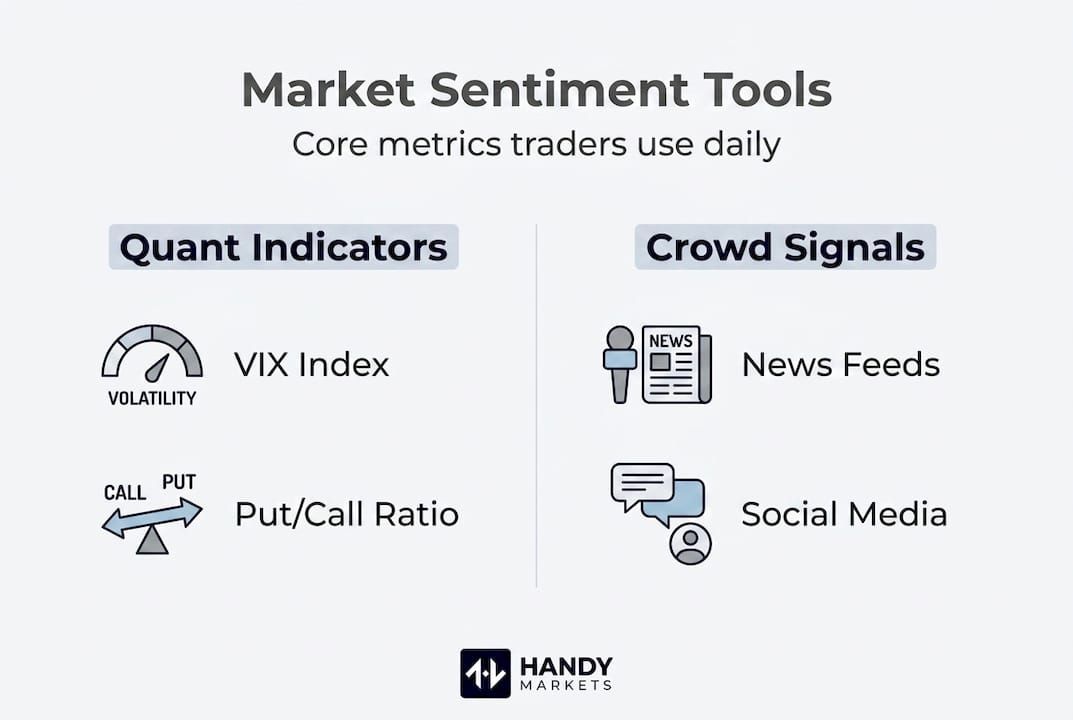
Sentiment is not invisible. Professionals have developed a solid set of tools to quantify it, and many of these are accessible to everyday traders. An overview of sentiment indicators reveals a range of financial tools and metrics designed to track market mood with real precision.
| Indicator | What it measures | Where it’s best used |
|---|---|---|
| VIX (Volatility Index) | Expected market volatility over the next 30 days | U.S. equity markets, options trading |
| Put/Call ratio | Balance of bearish vs. bullish options bets | Stocks and ETFs |
| AAII Sentiment Survey | Weekly retail investor bullish/bearish outlook | Long-term equity positioning |
| Fear & Greed Index | Composite score of 7 market factors | General market timing |
| Social media sentiment | Real-time public mood from Twitter/X, Reddit | Crypto, meme stocks, short-term trades |
| News sentiment analysis | Tone of financial news articles | All asset classes |
Each of these tools captures a different slice of market psychology. The VIX, often called the “fear gauge,” rises sharply when investors are nervous and falls when complacency sets in. A reading above 30 traditionally signals elevated anxiety, while a reading below 15 suggests the market is feeling calm, perhaps too calm.
Here is a simple numbered process to start monitoring sentiment in your own trading:
- Pick two primary indicators that match your asset class (for example, VIX and put/call ratio for equities)
- Set a daily review routine, ideally before your trading session begins, to check current readings
- Establish baseline ranges so you can spot readings that are unusually high or low for that indicator
- Cross-reference with price action using market analysis methods to see if sentiment confirms or contradicts the technical picture
- Use alerts to notify you when indicators cross critical thresholds, which you can set up easily through real-time market monitoring platforms
Pro Tip: Never rely on a single sentiment indicator. Each one has blind spots. Combining at least two tools gives you a far more reliable read on the market’s emotional state, and cross-referencing them with price action dramatically reduces false signals.
Market sentiment across asset classes
Armed with the measurement tools, you might wonder: does sentiment behave the same across every market? The answer is surprisingly nuanced.

Different asset classes respond to entirely different sentiment triggers. What moves stocks rarely moves currencies in the same way. Data trends in 2026 highlight how sentiment analysis in currency and digital asset markets is increasingly being shaped by finance-specific tools and real-time social monitoring, reflecting just how distinct these environments are. When tracking multiple markets simultaneously, recognizing these differences is essential to avoiding costly misreadings.
| Asset class | Main sentiment drivers | Primary sources of sentiment data |
|---|---|---|
| Stocks | Earnings surprises, CEO commentary, analyst upgrades | News feeds, AAII surveys, VIX |
| Crypto | Regulatory announcements, whale wallet activity, social buzz | Twitter/X, on-chain analytics, Fear & Greed Index |
| Forex | Central bank decisions, inflation data, geopolitical events | Economic calendars, central bank statements |
| Commodities | Weather events, supply disruptions, geopolitical tension | EIA reports, COT (Commitments of Traders) data |
| ETFs | Flows, sector rotation, broader equity sentiment | Fund flow data, VIX, sector performance |
The unique sentiment signals that matter most for each asset include:
- Stocks: Watch for unusual options activity and sudden spikes in short interest, which can indicate institutional sentiment shifts before the broader crowd reacts
- Crypto: Whale wallet movements, where large holders transfer significant amounts to exchanges, often precede major sell-offs
- Forex: Central bank tone in official statements, sometimes called “hawkish” (favoring rate hikes) or “dovish” (favoring cuts), can flip currency sentiment instantly
- Commodities: Commitments of Traders (COT) reports reveal whether large speculators are increasingly long or short, offering a window into professional sentiment
- ETFs: Fund flow data showing rapid inflows or outflows from sector ETFs reflects where institutional money is emotionally gravitating
Adapting your sentiment analysis to the specific asset class you’re trading is critical. Applying stock market sentiment tools to crypto, for example, can generate false signals because the participant base, information sources, and reaction times are entirely different. Mastering market trends across multiple asset classes means building a customized sentiment toolkit for each one rather than applying a one-size-fits-all approach.
Incorporating sentiment analysis into your trading strategy
With a clear understanding of sentiment and the ways it shifts across markets, the vital next step is putting that knowledge to work in your own planning.
Traders who incorporate sentiment into their decision-making consistently report better-timed entries and exits. Research across quantitative trading studies suggests that strategies combining sentiment signals with technical analysis show measurably improved risk-adjusted returns compared to those relying on price data alone. The reason is straightforward: sentiment often leads price, meaning crowd psychology shifts before the chart patterns confirm the move.
Here is a practical, step-by-step process for integrating sentiment into your existing strategy:
- Start with fundamentals or technicals to identify a potential trade setup. This is your baseline case.
- Check the relevant sentiment indicators for your asset class. Is the broader mood aligned with or working against your thesis?
- Look for sentiment extremes as potential contrarian signals. Extreme fear can signal buying opportunities; extreme greed can warn of overextension.
- Validate with volume and volatility data to confirm that sentiment readings are backed by actual market participation.
- Adjust your position sizing based on sentiment clarity. When sentiment strongly confirms your setup, you might size up. When it conflicts, reduce risk or wait.
- Review and track your sentiment-informed trades separately to measure whether this layer of analysis is actually adding value over time.
A brief real-world example: imagine you are watching a stock that has broken above a key resistance level on strong volume. Technicals look bullish. You then check the put/call ratio and find it has dropped to an unusually low reading, meaning most options traders are betting heavily on continued upside. This is a warning sign, not confirmation. Extreme one-sided positioning can precede a reversal. Armed with this sentiment data, you might wait for a pullback before entering, or reduce your initial position size to manage the risk of a sudden sentiment shift.
When handling volatility during fast-moving markets, sentiment analysis becomes even more valuable because it helps you distinguish between a healthy pullback within an uptrend and the beginning of a genuine sentiment-driven reversal.
Pro Tip: Use sentiment to confirm or challenge your existing setup, never as a standalone reason to enter a trade. A strong technical setup with aligned positive sentiment is far more reliable than sentiment alone pointing in a direction with no technical backing.
Why market sentiment is your edge—if you use it correctly
Now that you know how to apply sentiment, let’s explore why it gives savvy traders an edge that goes beyond traditional analysis.
Here is something that most trading content won’t tell you directly: the majority of traders who claim to use sentiment analysis are actually misusing it. They treat it as a lagging confirmation tool rather than a forward-looking signal. They check the Fear & Greed Index after a rally is already well underway and interpret it as validation to keep buying, when in reality an extreme greed reading should trigger caution, not confidence.
The counter-intuitive truth is that sentiment extremes often represent the highest-probability opportunities. When the market is pulsing with near-universal fear, the crowd has already sold. There are few sellers left to push prices lower. When greed peaks, there are few buyers left to sustain the rally. The phrase “buy the fear, sell the greed” is simple, but executing it requires discipline and a genuine understanding of what sentiment readings actually mean at their extremes.
Conventional wisdom says “trade the trend,” and that is sound advice most of the time. But contrarian sentiment strategies recognize that emotions can eventually invalidate even the strongest technical setups. A trend supported by moderate, healthy sentiment is robust. A trend sustained by euphoria and maximum one-sided positioning is fragile.
The habit we’d encourage you to build is this: every single trading session, spend five minutes checking two or three key sentiment indicators before you look at your charts. Do this consistently for 30 days, and you will start to develop an intuitive feel for what “normal” sentiment looks like for your markets, making abnormal readings far easier to spot and act on.
“The market is a device for transferring money from the impatient to the patient.” — Warren Buffett
Patience, grounded in a clear read of both the data and the crowd’s emotional state, is what separates traders who build lasting returns from those who chase every signal.
Streamline your market monitoring with Handy.Markets
Ready to put sentiment insights into action? Here’s how you can stay ahead of market mood swings with minimal effort.
Tracking sentiment across multiple asset classes manually takes serious time and energy. Handy.Markets simplifies the process by bringing real-time data from stocks, crypto, Forex, commodities, and indices into a single, personalized dashboard. When the market mood shifts suddenly, you want to know immediately, not an hour later.
With Handy.Markets, you can monitor crypto prices and alerts alongside traditional assets, so you never miss a sentiment-driven spike or crash. Our all-in-one market dashboard lets you view percentage changes and live prices across every major asset class in one place. Set up custom price alerts through Telegram, Discord, Slack, SMS, Email, or Webhook, and let the platform do the watching while you focus on making smarter, more confident trading decisions. Sentiment gives you the insight; Handy.Markets gives you the speed.
FAQ
What is a real-world example of market sentiment affecting prices?
A sudden surge of optimism after positive earnings reports can drive stock prices higher, even beyond what fundamentals justify, as investor psychology overrides rational valuation in the short term.
Which indicators are best for measuring market sentiment?
Put/call ratios, VIX, and social media sentiment tools are among the most widely used; a solid overview of sentiment indicators can help you choose the right combination for your asset class.
Does market sentiment analysis work for all asset types?
Yes, but each market reacts to different triggers, so sentiment tools must be tailored to the specific asset; market data trends show that one-size-fits-all approaches frequently generate misleading signals.
Is market sentiment more important than technical analysis?
Neither is more important on its own; incorporating both gives you a fuller, more reliable picture, with sentiment often leading price and technicals confirming the direction of the move.