
TL;DR:
- Personalized market data tailors financial information to match a trader’s strategy, improving decision quality.
- It reduces information overload, speeds up strategy refinement, and enhances risk management through tailored alerts.
Personalized market data is the delivery of tailored financial information that matches a trader’s unique strategy, asset preferences, and risk tolerance, directly shaping the quality of every decision they make. In professional finance, this practice is also called adaptive data delivery or contextual market intelligence. The role of personalized market data goes far beyond convenience. Algorithmic trading now accounts for 60–80% of total trading volume in U.S. and European equity markets, which means the edge no longer comes from access alone. It comes from how well your data is structured, filtered, and aligned to your specific approach. Platforms like Handy are built around this principle, giving traders a single, configurable view across crypto, stocks, forex, commodities, and indices.
How personalized market data shapes trading decisions
Customized data delivery changes how traders interact with markets at a fundamental level. When a platform surfaces only the assets, signals, and timeframes that match your strategy, you spend less time filtering noise and more time acting on signal. Personalization acts as a digital concierge, reducing search costs and helping users manage information overload in complex markets while preserving meaningful user control and autonomy. That is not a small benefit in an environment where dozens of correlated assets move simultaneously.

The impact on engagement is measurable. About 25% of users interact with personalized recommendations shortly after deployment in financial news and data contexts. That figure tells us traders are actively seeking guided market exploration, not just raw feeds. When data is framed around your portfolio, your risk parameters, and your preferred asset classes, the cognitive load drops and decision speed increases.
The benefits of personalized data in a trading context include:
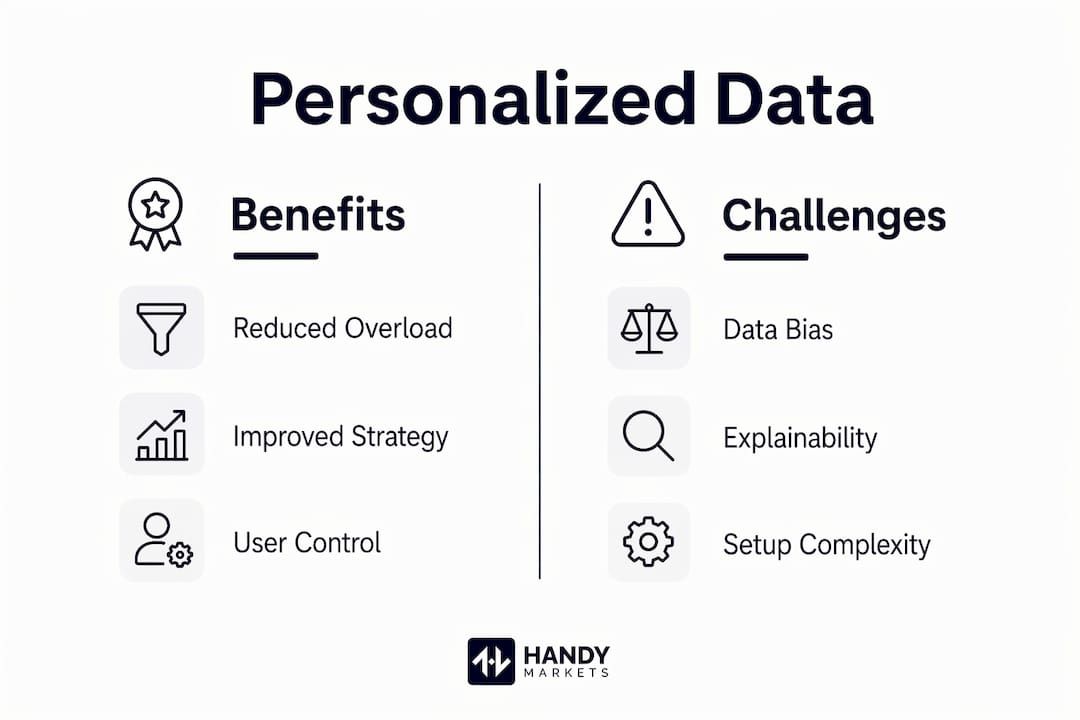
- Reduced information overload: Filtering by asset class, sector, or volatility threshold cuts the number of irrelevant signals a trader must process each session.
- Faster strategy refinement: When your data feed reflects your actual positions and watchlists, backtesting and forward testing become more targeted and efficient.
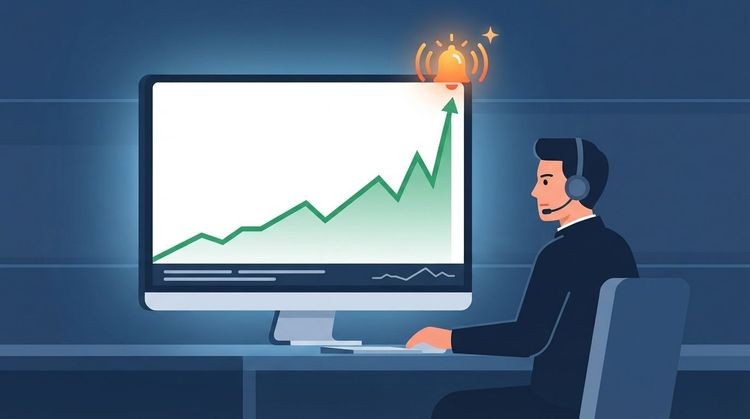
- Improved risk management: Personalized alerts tied to specific price levels, percentage moves, or correlation shifts let you respond to risk events before they compound.
- Better pattern recognition: Seeing only the markets relevant to your strategy trains your analytical instincts more effectively than scanning a generic global feed.
Pro Tip: Set up asset-specific alerts for each position in your portfolio rather than relying on broad market notifications. Granular alerts tied to your actual exposure give you a meaningful head start on risk events.
The importance of market data quality compounds when personalization is involved. A well-structured, contextualized feed aligned to your strategy is a strategic asset impacting execution quality. Firms that treat data as a managed resource rather than a commodity consistently outperform those that do not.
What are the key challenges in using personalized data?
Personalized market data is not without its pitfalls. The most dangerous risks are invisible ones, built into the data itself before you ever act on it.
Data biases are the first line of concern. Survivorship bias, look-ahead bias, and data snooping can turn theoretically profitable strategies into real-world losses. Survivorship bias occurs when historical datasets exclude assets that failed or were delisted, making past performance look cleaner than it was. Look-ahead bias happens when a model uses information that would not have been available at the time of the trade. Data snooping occurs when a strategy is over-fitted to historical patterns that do not repeat. All three biases are more dangerous in personalized systems because they can be reinforced by the trader’s own preferences.
The following challenges deserve direct attention from any financial professional using adaptive data tools:
- Explainability gaps: AI-driven personalization must adjust framing of market facts to match a trader’s preferences without overriding judgment or pushing narratives. When a system cannot explain why it surfaced a particular insight, you cannot assess whether to trust it.
- Ownership ambiguity: True data ownership in personalized AI is rare on major platforms. Most systems retain your behavioral data and use it to train shared models, not just your personal feed.
- Accuracy decay from over-surveillance: AI personalization accuracy drops when users feel over-surveilled, leading them to supply misleading inputs that skew model outputs. A trader who senses excessive tracking may deliberately alter their behavior, which corrupts the system’s ability to serve them accurately.
“Personalization should be viewed as a digital concierge that manages complexity and search costs rather than a surveillance tool, enabling empowered decision-making with transparency.” — ITIF, 2026
The practical takeaway is clear. Personalization works best when it is transparent, explainable, and controlled by the user. Any system that obscures its logic or claims your behavioral data as its own introduces risk that no amount of signal quality can offset.
Platform-controlled vs. user-governed personalization
Not all personalization models are equal. The distinction between platform-controlled and user-governed approaches has direct consequences for privacy, data quality, and trading effectiveness.
| Feature | Platform-Controlled | User-Governed |
|---|---|---|
| Data ownership | Platform retains behavioral data | User controls what is shared |
| Explainability | Often opaque, black-box logic | Transparent, user-defined rules |
| Privacy exposure | Higher, data used for model training | Lower, client-side or encrypted context |
| Functional coverage | Broad but generic | Targeted to individual strategy |
| Accuracy risk | Vulnerable to over-surveillance decay | Stable, user inputs are deliberate |
| Adoption friction | Low setup, lower control | Higher setup, higher control |
User-governed personalization covers 80% of functional needs while enabling effective domain awareness and personality consistency without sacrificing data control. That figure is significant. It means you do not need to surrender your data to a platform’s black box to get a highly relevant experience.
Context-aware personalization, as described in the Minara AI framework, takes this further by adjusting risk framing and analysis style to match individual trading rhythms. The system adapts to how you think, not just what you watch. This approach protects sensitive strategy data while still delivering the tailored insights that improve decision-making.
Pro Tip: When evaluating any market data platform, ask specifically how your behavioral data is stored, who owns it, and whether the personalization logic is visible to you. Platforms that cannot answer those questions clearly are not built with your interests as the priority.
The comparison above shows that user-governed models require more deliberate setup but deliver more reliable and trustworthy personalization over time. For professional traders, that trade-off is almost always worth making.
How to integrate personalized market data into your workflow
Putting personalized market insights to work requires more than selecting a platform. It requires building a workflow where data, alerts, and analysis tools reinforce each other. Here is a practical sequence for financial professionals:
- Define your data scope. List the asset classes, sectors, and instruments you actively trade or monitor. This becomes the foundation of your personalized feed. A portfolio manager focused on U.S. equities and crypto does not need a full commodities feed cluttering their view.
- Set layered price alerts. Use threshold-based alerts tied to specific price levels, percentage changes, and volatility spikes for each position. Platforms like Handy support delivery across Telegram, Discord, Slack, SMS, Webhook, and Email, so you receive alerts through the channel you actually monitor. Learn more about setting up real-time alerts to match your trading rhythm.
- Align your data feed with your algorithmic models. For quant traders, the feed structure matters as much as the content. High-quality structured market data is the primary competitive advantage in algorithmic trading. Feed your personalized data directly into backtesting environments to validate that the signals you receive are consistent with your strategy logic.
- Audit for bias regularly. Schedule a monthly review of your data sources to check for survivorship and look-ahead bias. If your historical data excludes delisted assets or uses future-dated information, your strategy performance metrics are unreliable.
- Demand explainability from your tools. Before acting on any AI-generated insight, confirm you understand why the system surfaced it. If the logic is opaque, treat the signal as unverified. Explainable personalization, as outlined in the Minara AI framework, is the standard worth holding your tools to.
- Review your personalization settings quarterly. Markets evolve, and so do trading strategies. A feed calibrated for a momentum strategy in a bull market will underserve you in a high-volatility, mean-reverting environment. Adjust your watchlists, alert thresholds, and data filters as your strategy shifts.
Transparency and user control are the two factors that most determine whether personalized data adoption succeeds or stalls. Traders who treat their data configuration as a living document rather than a one-time setup consistently extract more value from their platforms.
Key takeaways
Personalized market data delivers its full value only when it is structured, explainable, and controlled by the trader rather than the platform.
| Point | Details |
|---|---|
| Personalization reduces overload | Tailored feeds cut irrelevant signals, letting traders focus on what actually affects their positions. |
| Data biases are the hidden risk | Survivorship, look-ahead, and snooping biases corrupt personalized strategies before they are ever tested live. |
| User-governed models outperform | Trader-controlled personalization covers 80% of functional needs while protecting sensitive strategy data. |
| Explainability is non-negotiable | Any AI-driven insight you cannot trace back to a clear logic chain should be treated as unverified. |
| Alert configuration is a workflow asset | Layered, asset-specific alerts across multiple channels convert personalized data into real-time decision support. |
Where personalized data is heading: our view at Handy
We have watched the conversation around personalized market data shift considerably over the past few years. The early focus was almost entirely on coverage, getting more assets, more feeds, more data points into one place. That race to breadth has largely been won. The new competition is about depth and trust.
What we see now is that the traders who get the most from personalized data are not the ones with the most complex setups. They are the ones who have been deliberate about what they include and why. They know exactly which signals matter to their strategy, and they have configured their tools to surface those signals without noise.
The explainability trend is real and accelerating. Traders are increasingly unwilling to act on black-box recommendations, and that skepticism is healthy. A personalized feed that cannot explain its own logic is not a tool. It is a liability dressed up as convenience.
We also think the ownership question will become a defining issue in financial data platforms over the next few years. Right now, most traders do not think carefully about who retains their behavioral data or how it is used. As AI personalization becomes more sophisticated, that data becomes more valuable, and the platforms that give users genuine control over it will earn lasting trust.
Our advice is to treat your data configuration the same way you treat your portfolio. Review it regularly, audit it for bias, and never let it run on autopilot indefinitely. The market changes. Your tools should change with it.
Track every market that matters to you with Handy.Markets
Handy is built for traders and investors who want personalized market monitoring without the complexity of managing multiple platforms. You can track cryptocurrencies, stocks, forex, commodities, indices, and ETFs in one place, with a setup that takes minutes rather than hours.
The alert system is where Handy earns its place in a professional workflow. You can configure price alerts across six channels including Telegram, Discord, Slack, SMS, Webhook, and Email, so critical market movements reach you wherever you are. Whether you are monitoring a single asset or a multi-asset portfolio, Handy gives you the real-time market data and notification coverage to stay ahead of the moves that matter. Start personalizing your market view today.
FAQ
What is personalized market data in finance?
Personalized market data is a tailored delivery of financial information filtered to match a trader’s specific assets, strategy, and risk preferences. It reduces information overload and improves decision speed by surfacing only the signals relevant to your approach.
How does personalized data improve trading strategy?
Personalized data improves strategy by aligning your information feed with your actual positions and trading logic, which makes backtesting more targeted and real-time decisions faster. Platforms that deliver context-aware insights help traders refine their approach without processing irrelevant market noise.
What are the biggest risks of personalized market data?
The biggest risks are data biases such as survivorship and look-ahead bias, explainability gaps in AI-driven recommendations, and accuracy decay when users feel over-surveilled and begin providing misleading inputs to personalization systems.
What is the difference between platform-controlled and user-governed personalization?
Platform-controlled personalization retains your behavioral data and uses opaque logic to generate recommendations. User-governed personalization lets you define what data is shared and how insights are generated, covering 80% of functional needs while protecting sensitive strategy information.
Why does explainability matter in personalized financial data tools?
Explainability matters because a recommendation you cannot trace back to a clear logic chain cannot be reliably acted upon. Context-aware AI personalization that adjusts framing to your trading style without overriding your judgment is the standard that professional traders should require from their tools.