

TL;DR:
- Market insights transform raw data into actionable intelligence that helps investors understand market movements. They reduce ambiguity and improve decision-making under uncertainty by focusing on layered analysis rather than headlines alone. Utilizing structured routines and AI tools enhances accuracy, confidence, and emotional discipline across asset classes.
Investors who act on raw data alone are essentially flying blind. The reason why market insights matter goes far beyond having access to numbers: 42% of startups fail due to lack of market need, and the same information gap quietly drains institutional and retail portfolios every day. The difference between reacting to price movements and actually understanding them comes down to one thing: converting data into interpreted, decision-ready intelligence. This article walks you through what genuine market insight looks like, how it shapes decisions under pressure, and how to build a routine that transforms volatile markets into a source of confident opportunity.
Table of Contents
- Key Takeaways
- Why market insights matter: beyond data
- How insights shape decisions under uncertainty
- Technology reshaping market intelligence
- A practical framework for applying insights
- Insights across asset classes
- My perspective on what most investors get wrong
- Track every market move with Handy
- FAQ
Key Takeaways
| Point | Details |
|---|---|
| Insights beat raw data | Market insights are interpreted intelligence, not just numbers. They tell you what data means for your next move. |
| Uncertainty can be managed | Structured insight frameworks reduce cognitive biases and help you make rational decisions even during high volatility. |
| AI is reshaping intelligence | Advanced AI models improve prediction accuracy by 40.9%, giving investors a measurable edge in forecasting. |
| Source hierarchy matters | Anchoring decisions in primary research rather than headlines dramatically reduces emotional reactivity and poor timing. |
| Asset context is everything | Equities, crypto, commodities, and ETFs each require different insight types and signals for effective decision-making. |
Why market insights matter: beyond data
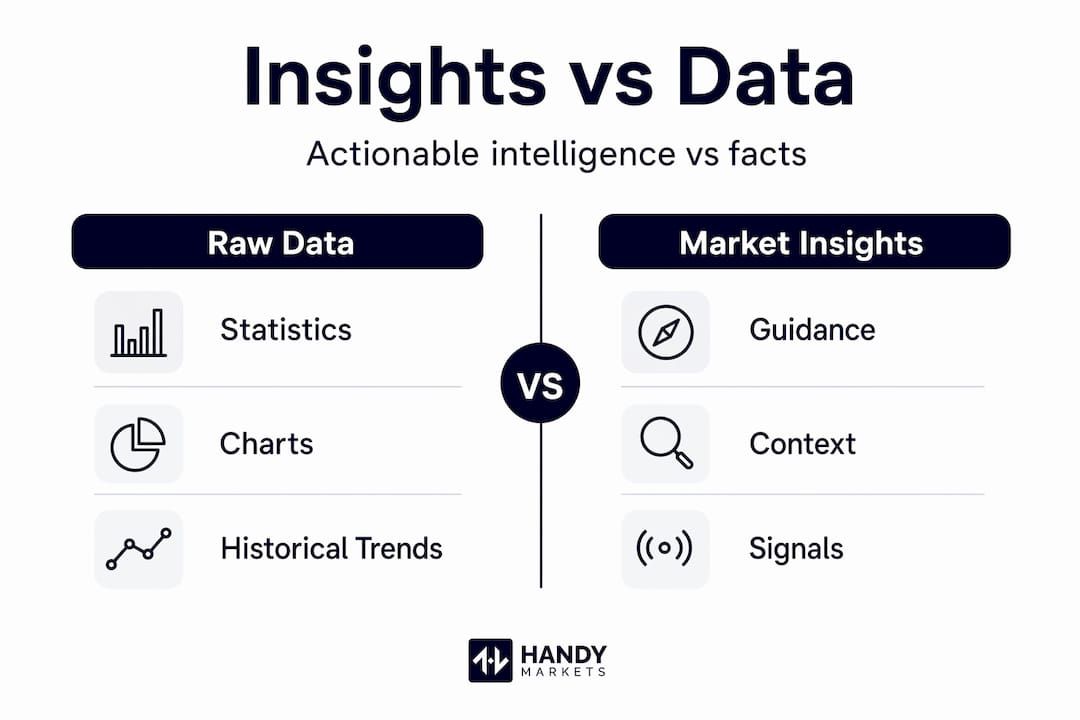
There is a widespread misconception that having more data automatically leads to better decisions. It does not. Data is raw. Information organizes that data. Insight interprets what it means for a specific decision you are about to make. That distinction is where most investors lose their edge.
A true market insight is an interpreted, actionable understanding derived from layered analysis. It answers not just “what happened” but “why it happened and what it signals next.” Consider three examples that separate genuine insight from mere observation:
- Sentiment layers: When institutional positioning shifts before a Federal Reserve announcement, that is not just a price movement. It is a signal about expected policy direction, and investors who read it correctly can reprice risk ahead of the crowd.
- Predictive analytics: Machine-readable sentiment provides a repeatable framework to interpret volatility regimes before traditional economic data adjusts. That is an insight. A stock price declining is just data.
- Competitive intelligence: Tracking where institutional capital is rotating, which sectors are accumulating, and where smart money is exiting gives you a structural map of market intent. That is intelligence, not noise.
The importance of market insights comes down to this: they compress uncertainty into clarity. Every professional trader or portfolio manager is really in the business of resolving ambiguity faster and more accurately than their competition.
Pro Tip: When evaluating any piece of market information, ask yourself one question: does this tell me what to do, or does it just tell me what happened? Only the first qualifies as a real insight.
How insights shape decisions under uncertainty
Uncertainty is the natural state of financial markets. The question is never how to eliminate it. The question is how to make better decisions inside it. Intolerance to uncertainty pushes investors toward irrational decision styles, including avoidance, overreaction, and anchoring on recent price history rather than structural signals.
This is where the benefits of market research become most visible. Structured intelligence reduces ambiguity. When you understand why oil prices are moving, not just that they moved, you make a different decision about energy equities. When you track sentiment ahead of earnings season, you manage position sizing differently than someone reacting to a headline after the fact.
Several dynamics make this even more critical:
- Financial literacy as a moderator: Research shows that financial literacy moderates how effectively investors translate advisor guidance into performance. The more you understand market structure, the more useful your intelligence sources become.
- Report readability and confidence: Poor readability of financial reports directly increases uncertainty, reduces investor confidence, and causes abnormal price volatility. Institutional investors mitigate this through analytical skills, which is a structural edge that retail investors can close with the right tools and habits.
- Feedback and amplification: Market prices contain information that can amplify small shocks in fundamental values. When information production declines in a market, even minor shocks can cascade into investment collapses. Continuous, quality insight generation is not optional. It is a structural necessity.
“Sophisticated investors reduce ambiguity and risk by anchoring on quality financial data and systematic analysis rather than rumors or market noise.” — Market Intelligence Research
The role of market intelligence here is fundamentally psychological as much as analytical. A well-structured insight framework does not just improve your analysis. It protects you from yourself.
Technology reshaping market intelligence

The generation and use of market insights has changed more in the last three years than in the previous decade. AI-driven tools are no longer a luxury for quant funds. They are becoming standard equipment for any serious investor.
| Capability | Traditional Approach | AI-Enhanced Approach |
|---|---|---|
| Price forecasting | Historical chart analysis | 40.9% improvement in prediction errors using advanced models |
| Sentiment analysis | Manual news reading | Machine-readable narrative parsing across thousands of sources |
| Competitive intelligence | Periodic analyst reports | Real-time tracking; market estimated to reach $19.18B by 2035 |
| Decision execution | Delayed post-analysis action | Real-time connected decisions driven by dynamic insight platforms |
The system of insight market is growing at a 20.3% CAGR and is projected to reach $9.25B by 2030. That growth rate reflects how seriously professional investors are treating structured intelligence infrastructure.
The integration of sentiment into analytical frameworks is particularly significant. Treating sentiment as a standalone signal leads to noise-chasing. Embedding it into a structured model alongside fundamentals and technical data creates a far more reliable decision trigger. Tools like AI-driven SEC filings analysis now allow investors to extract material signals from earnings reports and regulatory disclosures in minutes rather than hours.
Pro Tip: The most valuable market data trends in 2026 are not necessarily the newest. They are the ones connected to your specific asset class and time horizon. Knowing which signals apply to your strategy matters more than consuming every available data point. Explore current market data trends to identify which ones match your approach.
A practical framework for applying insights
Knowing that market insights matter is only useful if you build a system to apply them consistently. Here is a framework that professional investors actually use, as opposed to the idealized routines described in most finance books.
- Build a source hierarchy. Primary research sits at the top: earnings reports, central bank minutes, economic data releases. Below that, contextual analysis from sector specialists and credible market analysts. General news headlines sit at the bottom, useful for awareness but dangerous as a decision trigger. Investors anchored in primary research make more informed decisions than those reacting to headlines alone.
- Develop an intelligence rhythm. Daily scanning takes 15 to 20 minutes: check overnight price movements, scan major alerts, review any significant news in your sectors. Weekly review takes 30 to 45 minutes: assess whether your thesis on each position still holds. Monthly rebalancing sessions incorporate macro data, sentiment shifts, and positioning data to adjust portfolio weighting.
- Use alerts to filter noise. Price alert systems that notify you across Telegram, SMS, or Slack let you stay informed without being glued to a screen. The goal is not constant monitoring. It is deliberate, timely awareness. A well-structured real-time alert system gives you the signal without the noise.
- Pre-plan your responses. This is the step most investors skip. Before a major data release or earnings call, write down what you will do if the outcome is above expectations, in line, or below. Pre-commitment reduces the emotional reactivity that costs investors real returns.
Pro Tip: Treat your intelligence routine the same way you treat risk management: as non-negotiable. Skipping it during busy weeks is exactly when it matters most, because markets move faster on compressed timelines.
Insights across asset classes
How market insights drive decisions looks very different depending on what you are trading or investing in. Understanding these differences is itself a form of market intelligence.
| Asset Class | Primary Insight Drivers | Key Signal Types |
|---|---|---|
| Equities | Earnings, macro policy, sector rotation | EPS revisions, institutional flows, analyst upgrades |
| Cryptocurrencies | On-chain data, regulatory news, adoption metrics | Wallet activity, exchange inflows, developer activity |
| Commodities | Supply/demand cycles, geopolitical events | Inventory reports, weather data, shipping rates |
| ETFs | Fund flows, index rebalancing, sector momentum | Inflow/outflow data, tracking error, constituent changes |
A few observations worth internalizing:
- Crypto markets are particularly sensitive to sentiment-driven signals. On-chain data and social volume often lead price by 24 to 72 hours, making real-time intelligence a genuine edge for digital asset investors.
- ETFs function as a kind of intelligence aggregator. When significant capital flows into a sector ETF, it reflects institutional conviction about that sector’s near-term trajectory. Reading ETF flows is a way of reading institutional intent.
- Commodities insight often lives outside financial data entirely. A drought forecast in the American Midwest is as relevant to corn futures as any economic report. Context-specific intelligence means knowing where to look for each asset class.
Learning how to compare financial markets across these asset classes helps you recognize when a signal in one market has implications for another, which is where multi-asset investors gain their real structural advantage.
My perspective on what most investors get wrong
I have watched a lot of investors get burned not because they lacked access to information, but because they confused volume of data with quality of insight. More alerts, more subscriptions, more charts. None of it helps if the framework for interpreting signals is missing.
What I have learned is that the investors who perform consistently are not the ones with the most data feeds. They are the ones with the most disciplined intelligence routines. They know which signals they trust, which sources they prioritize, and exactly what conditions would change their thesis. Everything else is tuned out.
The uncomfortable truth is that emotional reactivity and poor insight frameworks cause the same damage. Both lead to panic selling, premature exits, and chasing momentum at the wrong time. Building a structured market intelligence habit does not just improve your analysis. It rewires how you experience market volatility. Instead of feeling like a threat, a volatile session becomes a set of signals to interpret calmly.
I also want to be direct about platform choice. Not all market data tools are built the same. The ones worth using are those that aggregate across asset classes, deliver timely alerts through channels you actually monitor, and reduce friction in your daily intelligence routine. Complexity is not a feature.
Track every market move with Handy.Markets
For investors who want structured, real-time market intelligence without the noise, Handy.Markets was built precisely for that purpose.
Handy aggregates live prices, percentage changes, and alerts across crypto, stocks, forex, indices, and commodities in one place, so you are never switching between platforms to get a complete picture. Price alerts fire through Telegram, Discord, Slack, SMS, Webhook, or Email the moment a threshold is hit. Whether you are managing a multi-asset portfolio or focusing on a single sector, the platform gives you the signal infrastructure to execute on your intelligence routine without distraction. Professional investors using AI-powered wealth platforms alongside real-time alert tools consistently report faster, calmer decision-making. Setup takes minutes. The edge it gives you compounds daily.
FAQ
What exactly is a market insight?
A market insight is an interpreted, decision-ready understanding derived from layered data analysis. It goes beyond stating what happened to explaining why it matters for a specific investment or trading decision.
Why do market insights matter more than raw data?
Raw data tells you what occurred. Market insights tell you what that occurrence means for your portfolio. Investors who act on structured intelligence make more consistent decisions than those reacting to price movements alone.
How does market sentiment function as an intelligence tool?
Sentiment analysis parses machine-readable narratives across news, social media, and filings to identify shifts in market mood before they appear in price. Integrated into an analytical framework, it helps investors reprice risk ahead of traditional economic data releases.
What role does financial literacy play in using market insights?
Financial literacy directly determines how effectively you translate insights into action. Research shows that literacy moderates advisor impact on performance. The better you understand market structure, the more value you extract from every intelligence source you use.
How often should investors review their market insights?
A practical rhythm includes daily scanning of alerts and overnight movements, a weekly thesis review per position, and a monthly macro reassessment. Consistency matters more than frequency. A disciplined weekly review outperforms daily reactive monitoring in most market conditions.