


TL;DR:
- Systematic investment strategies use clearly defined, repeatable rules to remove emotional bias from decision-making. These methods include dollar-cost averaging, fixed-allocation portfolios, and factor-based investing, providing consistency and discipline. Success depends on simple rules, proper execution, a written plan, and accurate real-time market data to navigate market fluctuations effectively.
Systematic investment strategies are investment approaches that follow clearly defined, repeatable rules to guide decisions, removing guesswork and emotional bias from the process. Known in institutional circles as “rules-based investing,” these methods range from simple dollar-cost averaging to advanced quantitative models used by professional portfolio managers. The core promise is consistency. By replacing gut reactions with transparent, evidence-driven logic, systematic methods give you a repeatable edge across different market conditions. Whether you are building your first portfolio or refining an existing one, understanding the types of systematic investment strategies available is the clearest path to better decisions.

What are the main types of systematic investment strategies?
Systematic investing replaces emotional, biased decision-making with transparent, repeatable rules. This approach is sometimes called “glass box” investing because the logic behind every decision is visible and testable. Strategies span a wide spectrum, from automatic monthly contributions to institutional quantitative models running across thousands of securities. The right starting point depends on your experience level, time commitment, and risk tolerance.
1. Dollar-cost averaging
Dollar-cost averaging (DCA) is the practice of investing a fixed dollar amount at regular intervals, regardless of price. You buy more shares when prices are low and fewer when prices are high. Over time, this lowers your average cost per share compared to investing a lump sum at a single price point.
DCA works because it removes the pressure of timing the market. You set the rule once and follow it automatically, which is exactly what systematic investing demands. This method suits investors who receive regular income and want a low-maintenance entry point into equities, ETFs, or index funds.
- Frequency: Weekly, biweekly, or monthly contributions work best.
- Asset types: Broad market ETFs and index funds are the most common targets.
- Risk: DCA does not protect against prolonged bear markets, but it reduces the damage of buying at a single peak.
Pro Tip: Set up automatic transfers from your bank account on payday. Automating the contribution removes the temptation to skip months when markets feel uncertain.
2. Fixed-allocation portfolios
A fixed-allocation portfolio assigns a set percentage of capital to each asset class and holds those percentages over time. The classic example is the 60/30/10 rule: 60% equities, 30% bonds, and 10% alternatives or cash. Every allocation decision is made upfront, and the portfolio runs on autopilot until a rebalancing trigger is hit.
This method works because it forces you to buy low and sell high automatically. When equities surge, they exceed their target weight, so you trim them. When bonds fall, you add to them. The discipline is built into the structure, not into your willpower.
The main risk is drift. Without rebalancing, a 60/30/10 portfolio can become 75/20/5 after a strong equity rally, exposing you to more risk than you intended.
3. Portfolio rebalancing rules
Rebalancing is the act of returning a drifted portfolio back to its target allocation. Systematic rebalancing uses clear thresholds, typically 5–10% drift from target, to trigger action. This removes the judgment call of “is now a good time to rebalance?” from the equation entirely.
Two common rebalancing methods exist. Calendar rebalancing triggers action on a fixed schedule, such as quarterly or annually. Threshold rebalancing triggers action when any asset class drifts beyond its set band. Threshold rebalancing tends to be more responsive to fast-moving markets, while calendar rebalancing is simpler to maintain.
The discipline required here is underrated. Rebalancing often means selling your best performers and adding to your worst, which feels counterintuitive. That discomfort is precisely why a written rule matters more than a mental note.
4. Factor-based investing
Factor-based investing selects securities based on specific, measurable characteristics that academic research links to long-term outperformance. The five most widely recognized factors are:
- Value: Securities trading below their intrinsic worth based on price-to-earnings or price-to-book ratios.
- Momentum: Securities with strong recent price performance, typically measured over 3–12 months.
- Quality: Companies with high return on equity, low debt, and stable earnings growth.
- Size: Smaller companies that have historically outperformed large caps over long periods.
- Low volatility: Securities with below-average price swings that tend to deliver better risk-adjusted returns.
Each factor is applied as a systematic screen. You define the criteria, rank the universe of securities, and select the top tier. The portfolio updates on a fixed schedule, not based on opinion.
Factor strategies carry tracking error risk. Your portfolio will diverge from the broad market index for extended periods, sometimes years. Investors who abandon the strategy during underperformance miss the eventual recovery. Staying the course requires understanding why the factor works, not just that it has worked historically.
Most robust systematic strategies are those with simple, transparent rules supported by academic research on alternative beta and risk premia. Factor investing sits squarely in that category.
5. Momentum and trend-following strategies
Momentum strategies buy assets that have risen recently and avoid or short assets that have fallen. The rule is straightforward: assets that outperformed over the past 3–12 months tend to continue outperforming over the next 1–3 months. This pattern holds across equities, commodities, currencies, and bonds.
Trend-following is a related but distinct approach. Rather than ranking assets against each other, trend-following looks at whether an asset is above or below a moving average, such as its 200-day average. If above, you hold or buy. If below, you exit or reduce exposure.
Both methods are fully rules-based and require no fundamental analysis. Their strength is in bear markets, where they can exit positions before large drawdowns. Their weakness is in choppy, sideways markets, where frequent signals generate losses from repeated entries and exits.
6. Systematic ETFs
Systematic ETFs use rules-based processes to refine broad investment universes, aiming for consistent, risk-adjusted returns with broad diversification. They sit between traditional passive index ETFs and actively managed funds in terms of cost and complexity.
A systematic ETF does not simply track a market-cap-weighted index. It applies quantitative screens, such as factor tilts or volatility filters, to select and weight holdings. Portfolio management teams monitor the rules and adjust holdings on a defined schedule, but no discretionary calls are made.
Key characteristics of systematic ETFs:
- They maintain diversification across stocks, sectors, and industries similar to core portfolio holdings.
- They apply incremental tilts for potential outperformance rather than making high-conviction concentrated bets.
- Their expense ratios are higher than plain index ETFs but lower than actively managed funds.
- They do not guarantee outperformance over their benchmark index.
Systematic ETFs work well as a core holding for investors who want more than market-cap exposure but are not ready to build their own factor screens from scratch. You can track live ETF prices and holdings on Handy Markets ETFs to monitor how these instruments move relative to their benchmarks.
7. Adaptive systematic allocation strategies
Adaptive allocation strategies adjust holdings based on quantitative signals regularly, often monthly, to maintain effective risk-adjusted returns across diversified asset pools. Unlike fixed-allocation portfolios, adaptive strategies change the weights of each asset class based on current market signals, not a static target.
A typical adaptive strategy draws from a pool of 4–10 assets, which might include equity ETFs, bond ETFs, gold, and currency instruments. Each month, a quantitative model scores each asset on momentum, volatility, and correlation. The model then allocates more capital to assets with favorable scores and reduces exposure to those with poor scores.
| Feature | Fixed allocation | Adaptive allocation |
|---|---|---|
| Rebalancing trigger | Calendar or drift threshold | Quantitative signal, typically monthly |
| Asset weights | Static target percentages | Dynamic, signal-driven |
| Complexity | Low | Moderate to high |
| Monitoring required | Quarterly or annual | Monthly |
| Best suited for | Beginners and long-term investors | Experienced investors with time to monitor |
Pro Tip: Before running an adaptive strategy, back-test it on at least 10 years of data including a bear market period. A strategy that only works in bull markets is not a strategy. It is luck.
Smart diversification across asset classes is the foundation that makes adaptive allocation work. Without genuine diversification, the signals lose their power to reduce drawdowns.
8. Common pitfalls in systematic investing
Overfitting to historical data is the most common failure mode in systematic investing. A strategy tuned to perform perfectly on past data often falls apart in live markets because it has learned noise, not signal. Robust strategies use out-of-sample testing and resist excessive complexity.
The second major pitfall is abandoning the strategy during drawdowns. Every systematic method goes through periods of underperformance. Investors who override their rules during these periods destroy the statistical edge the system was designed to capture.
Key mistakes to avoid:
- Overcomplicating rules: Effective systematic investing balances simplicity with effectiveness. Straightforward, logical rules are easier to maintain under stress.
- Skipping a written Investment Policy Statement (IPS): A written IPS formalizes your rules on allocation, rebalancing, contributions, and tax considerations. It serves as a psychological anchor during volatile markets.
- Ignoring data quality: Poor data quality leads to flawed signals and poor execution. Data cleaning and infrastructure matter as much as the strategy logic itself.
- No risk management layer: A systematic strategy without a risk management framework is incomplete. Position sizing, stop-loss rules, and drawdown limits belong in the system, not as afterthoughts.
Key takeaways
The most effective systematic investment strategies combine clear, testable rules with disciplined execution and a written Investment Policy Statement to remove emotional decision-making from the process.
| Point | Details |
|---|---|
| Start simple | Dollar-cost averaging and fixed allocation are the most reliable entry points for new systematic investors. |
| Use rebalancing thresholds | A 5–10% drift trigger keeps your portfolio aligned without requiring constant attention. |
| Factor investing needs patience | Factor strategies underperform for extended periods; understanding the logic prevents premature abandonment. |
| Systematic ETFs reduce complexity | Rules-based ETFs offer factor exposure without requiring you to build your own quantitative screens. |
| Write an IPS | A formal Investment Policy Statement reduces emotional overrides and keeps your strategy intact during market stress. |
What we have learned from years of watching systematic strategies play out
The investors who succeed with systematic methods are rarely the ones with the most sophisticated models. They are the ones who picked a strategy they genuinely understood and stuck with it through two or three uncomfortable years. That is the real test.
We have seen factor-based portfolios abandoned in month 18 of underperformance, right before the factor cycle turned. We have seen adaptive strategies tweaked mid-run because the signals “felt wrong,” which is exactly the behavior the system was designed to prevent. The pattern repeats constantly.
The most underrated tool in systematic investing is the Investment Policy Statement. Writing down your rules before markets get volatile is the difference between a strategy and a good intention. When your equity allocation is down 20% and every headline says the world is ending, your IPS is the only thing standing between you and a decision you will regret.
Our honest view: start with the simplest strategy you can fully explain to someone else. If you cannot explain why the rule works, you will not follow it when it stops working temporarily. Complexity is not sophistication. Discipline applied to a simple rule beats brilliance applied inconsistently, every time.
Real-time data to support your systematic investing
Systematic strategies live and die on timely, accurate market data. Knowing when your portfolio has drifted past its rebalancing threshold, or when a momentum signal has flipped, requires live prices across multiple asset classes.
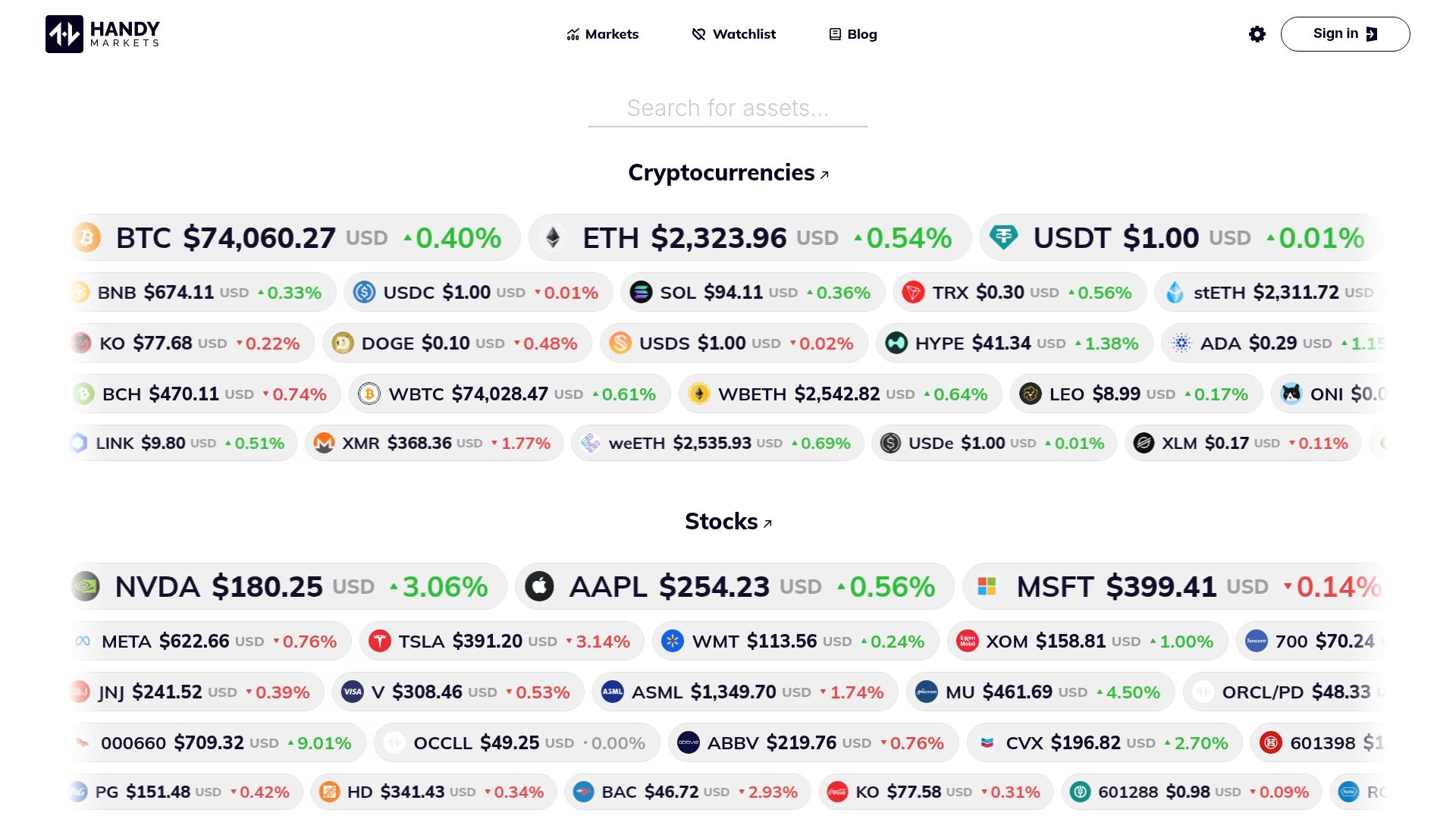
Handy Markets aggregates live prices across stocks, ETFs, commodities, indices, forex, and cryptocurrencies in one place. You can track ETF prices and holdings in real time to monitor your rules-based instruments as they move. For rebalancing triggers and momentum signals, set price alerts across Telegram, Discord, Slack, SMS, or email so you never miss a threshold breach. The platform is built for investors who want clean, fast market data without the noise, making it a natural fit for anyone running a disciplined, rules-based approach.
FAQ
What is a systematic investment strategy?
A systematic investment strategy is a rules-based, repeatable framework for making investment decisions that removes emotional bias. Examples include dollar-cost averaging, factor-based investing, and adaptive allocation models.
How do systematic strategies differ from active investing?
Active investing relies on human judgment and discretionary calls. Systematic strategies follow predefined, quantitative rules that apply consistently regardless of market sentiment or short-term news.
What is the easiest systematic investment method for beginners?
Dollar-cost averaging is the most accessible starting point. It requires only a fixed contribution amount and a regular schedule, with no need for quantitative modeling or factor analysis.
How often should a systematic portfolio be rebalanced?
Rebalancing thresholds of 5–10% drift from target are standard practice. Adaptive strategies typically rebalance monthly based on quantitative signals, while simpler fixed-allocation portfolios rebalance quarterly or annually.
Why do systematic strategies sometimes underperform?
Every systematic method goes through cycles of underperformance tied to market regimes. Overly complex models fitted too tightly to historical data are especially fragile in live markets. Simpler, academically grounded rules tend to recover and persist over full market cycles.