
TL;DR:
- Beginner investing mistakes such as lack of planning, emotional decisions, poor diversification, and ignoring costs reduce long-term returns.
- These mistakes are common among new investors and can be prevented through proper habits and disciplined behavior.
Beginner investing mistakes to avoid are well-documented errors that consistently reduce long-term returns: no investment plan, emotional decision-making, poor diversification, chasing past performance, and ignoring costs. These are not rare edge cases. They are the default behavior of most new investors, and they compound quietly until the damage is hard to reverse. Experts at Investopedia, Fidelity, and Dimensional Fund Advisors agree that awareness alone closes most of the gap between average and successful investors. The good news is that every mistake on this list is preventable with the right habits in place from the start.
1. What investment planning mistakes should beginners avoid?
A defined investment plan is the single most important tool a beginner investor can have. Without one, every market swing becomes a decision point, and most of those decisions are driven by fear or excitement rather than logic. Nathan Sebesta, CFP, notes that the absence of a plan is the root cause of reactive investing, where beginners take on risks that do not match their actual goals.

Your plan does not need to be complex. It needs three things: a goal (retirement, home purchase, wealth building), a time horizon (5 years, 20 years), and a risk tolerance (how much loss you can stomach without selling). These three inputs determine everything else, from asset allocation to how often you check your portfolio.
Understanding your financial assets and how they behave under different market conditions is part of building that plan. Beginners who skip this step often end up with portfolios that feel fine in bull markets and terrifying in downturns.
- Set a specific goal. “Grow my money” is not a goal. “Save $50,000 for a home down payment in 7 years” is.
- Write your risk tolerance down. If a 20% portfolio drop would cause you to sell, you are overexposed to equities.
- Review your plan annually. Life changes. Your plan should reflect that.
Pro Tip: Start with a simple three-fund portfolio: a U.S. total market index fund, an international index fund, and a bond fund. Adjust the bond percentage to match your risk tolerance.
2. How does failing to diversify and rebalance harm beginner investors?
Diversification is the practice of spreading investments across multiple asset classes, sectors, and geographies to reduce the impact of any single loss. A concentrated portfolio, where most of your money sits in one stock or one sector, exposes you to risks that diversification eliminates for free. Dimensional Fund Advisors research consistently shows that diversified portfolios produce more consistent risk-adjusted returns than concentrated ones over long periods.
Beginners often chase “hot” stocks or sectors after reading about them online. This is concentration risk in disguise. When that sector corrects, the undiversified beginner takes the full hit while a diversified investor absorbs only a fraction of it.
Rebalancing is the other half of this equation. Over time, winning assets grow to represent a larger share of your portfolio than you intended. That shifts your risk profile upward without you noticing. Rebalancing, typically once or twice a year, brings your allocation back to its target.
| Portfolio Type | Risk Level | Return Consistency | Recovery Speed |
|---|---|---|---|
| Concentrated (1–3 stocks) | Very high | Unpredictable | Slow |
| Sector-focused (1 industry) | High | Moderate | Moderate |
| Diversified (broad index ETFs) | Moderate | Consistent | Faster |
| Global diversified (multi-asset) | Lower | Most consistent | Fastest |
Pro Tip: A single broad-market ETF like one tracking the S&P 500 or a global index gives you instant diversification across hundreds of companies at a low cost. It is one of the most effective starting points for any beginner.
3. Why is trying to time the market a critical mistake for beginners?
Market timing is the attempt to buy low and sell high by predicting short-term price movements. It sounds logical. It almost never works. Missing brief growth windows drastically reduces lifetime wealth accumulation, and those windows are impossible to predict in advance.
Dimensional Fund Advisors research shows that missing even a small number of the market’s best trading days can cut long-term returns significantly. The problem is that the best days often follow the worst days, meaning investors who sell during a crash frequently miss the recovery entirely. This is the core reason why staying invested through volatility outperforms trying to dodge it.
Fidelity and UBS both advise measuring investment success by adherence to your system, not by how well you predicted last month’s market move. The beginner who stays invested through a 30% drawdown and recovers with the market will almost always outperform the one who sold at the bottom and waited for the “right time” to re-enter.
“The stock market is a device for transferring money from the impatient to the patient.” — Warren Buffett
Reacting to financial headlines is one of the most common triggers for bad timing decisions. Headlines are written to generate clicks, not to guide portfolio strategy. A disciplined investor reads the news and does nothing.
4. What emotional investing errors should beginners recognize and avoid?
Emotional investing is the pattern of making portfolio decisions based on fear, greed, or boredom rather than your original plan. It is the leading cause of the gap between market returns and the actual returns individual investors receive. Panic selling during downturns and chasing high-performing assets after a run-up are the two most destructive forms.
Behavioral finance identifies several emotional traps that hit beginners hardest:
- Panic selling. Selling during a market drop locks in losses and removes you from the recovery.
- Performance chasing. Buying last year’s top fund is one of the most reliable ways to underperform. Only about 20% of top-performing equity funds maintain top-tier status over the next five years.
- Overconfidence. A few early wins can lead beginners to take on far more risk than their plan allows.
- Boredom trading. Fidelity research notes that “boredom” causes beginners to tinker with portfolios unnecessarily, generating costs and errors.
The antidote to emotional investing is automation. Setting up automatic monthly contributions removes the decision of whether to invest this month. Establishing rebalancing rules in advance removes the emotion from that process too. QuantRoutine research confirms that consistent investing habits build the discipline that protects beginners from their own worst instincts.
Pro Tip: Set a personal rule: you cannot make a portfolio change within 48 hours of a major market move. This cooling-off period eliminates most panic-driven decisions before they happen.
5. How do fees, expenses, and trading mistakes silently reduce returns?
Fees are the most underestimated threat to long-term investment returns. An expense ratio higher than 0.4% is generally expensive, yet many actively managed funds charge over 1.0%. That difference compounds against you every single year, reducing the capital that would otherwise be growing.
Trading costs add another layer of drag. Many beginners use market orders when buying ETFs, which means they accept whatever price the market offers at that moment. During volatile periods, spreads widen and market orders fill at unfavorable prices. QuantRoutine advises using limit orders for ETF trades and avoiding the first and last 10 minutes of the trading session, when spreads are widest.
Foreign exchange conversion costs are a hidden fee that catches beginners off guard. Repeated FX conversions when buying foreign-currency assets accumulate significant costs over time. Using base-currency-denominated ETFs reduces this drag without sacrificing international exposure.
| Mistake | Cost Type | Solution |
|---|---|---|
| High expense ratio fund (over 1%) | Annual drag on returns | Switch to index ETFs under 0.2% |
| Market orders during volatility | Unfavorable fill price | Use limit orders instead |
| Repeated FX conversions | Hidden transaction cost | Use base-currency ETFs |
| Overtrading | Commissions and spreads | Avoid overtrading with a set rebalancing schedule |
Pro Tip: Check the expense ratio of every fund before you buy. A fund charging 0.03% versus one charging 1.0% on a $10,000 investment saves you nearly $100 per year, and that gap widens as your portfolio grows.
6. Why does waiting to invest cost beginners more than a bad trade?
Procrastination is a primary financial mistake because compound growth requires time above all else. Every month you delay is a month of compounding you cannot recover. Experts advise starting with as little as $50 to $100 per month rather than waiting until you have a “significant” amount to invest.
The math is unforgiving. A beginner who starts at 25 and invests consistently will accumulate far more than one who starts at 35 with twice the monthly contribution. The early investor’s gains compound for an extra decade, and that decade is worth more than any amount of catch-up investing later.
Waiting for the “perfect” entry point is a form of market timing in disguise. There is no perfect entry point. The best time to start is now, and the second best time is next month. Consistent monthly contributions, regardless of market conditions, average out your entry price over time through a process called dollar-cost averaging.
7. How does chasing past performance mislead new investors?
Past performance is the most seductive and least reliable signal in investing. Funds and stocks that topped the charts last year attract the most new money, but the data tells a different story. Only about 20% of top-performing equity funds maintain their top-tier status over the following five years. For fixed-income funds, only 33% of top performers sustain that ranking over the same period.
This means that buying last year’s winner is statistically more likely to produce average or below-average results than buying a consistent, low-cost index fund. The fund that ranked first last year often ranked there because of a specific market condition that no longer exists.
The practical lesson is to evaluate funds on cost, consistency, and fit with your plan, not on recent returns. A fund that returned 40% last year by concentrating in one sector is not a better fund. It is a riskier one that got lucky.
Key takeaways
Avoiding beginner investing mistakes requires a written plan, consistent behavior, low-cost diversified funds, and the discipline to ignore short-term noise.
| Point | Details |
|---|---|
| Plan before you invest | Define your goal, time horizon, and risk tolerance before buying anything. |
| Diversify from day one | Use broad index ETFs to spread risk across hundreds of assets at low cost. |
| Stay invested through volatility | Missing the market’s best days destroys long-term returns more than any single bad trade. |
| Keep fees below 0.4% | High expense ratios compound against you every year and silently erode gains. |
| Automate to remove emotion | Automatic contributions and rebalancing rules eliminate most panic-driven decisions. |
What we have learned from watching beginners invest
The most consistent pattern we see at Handy is not the dramatic blowup from a bad stock pick. It is the slow erosion caused by perfectly avoidable habits: checking the portfolio daily, switching funds after a bad quarter, and paying 1% expense ratios on funds that underperform their benchmarks.
The beginners who do well share one trait. They are boring. They set up a plan, automate their contributions, rebalance once a year, and spend almost no time thinking about their portfolio. They do not confuse activity with progress. The investors who struggle are the ones who treat their portfolio like a project that needs constant attention.
Fees and impatience are the two biggest silent killers. A 1% expense ratio does not feel painful in year one. Over 20 years, it represents a substantial portion of your potential wealth transferred to a fund manager who likely underperformed the index anyway. And impatience, the urge to do something when markets move, costs more than most bad trades ever will.
The advice we give consistently is this: measure your success by how closely you followed your plan, not by how exciting your portfolio feels. Automation is not laziness. It is the most disciplined thing a beginner investor can do.
Stay ahead of the market with Handy,Markets
Avoiding common investing errors gets easier when you have clear, real-time data at your fingertips. Handy gives beginner investors live prices, holdings data, and instant alerts across ETFs, stocks, and other asset classes, all in one place.
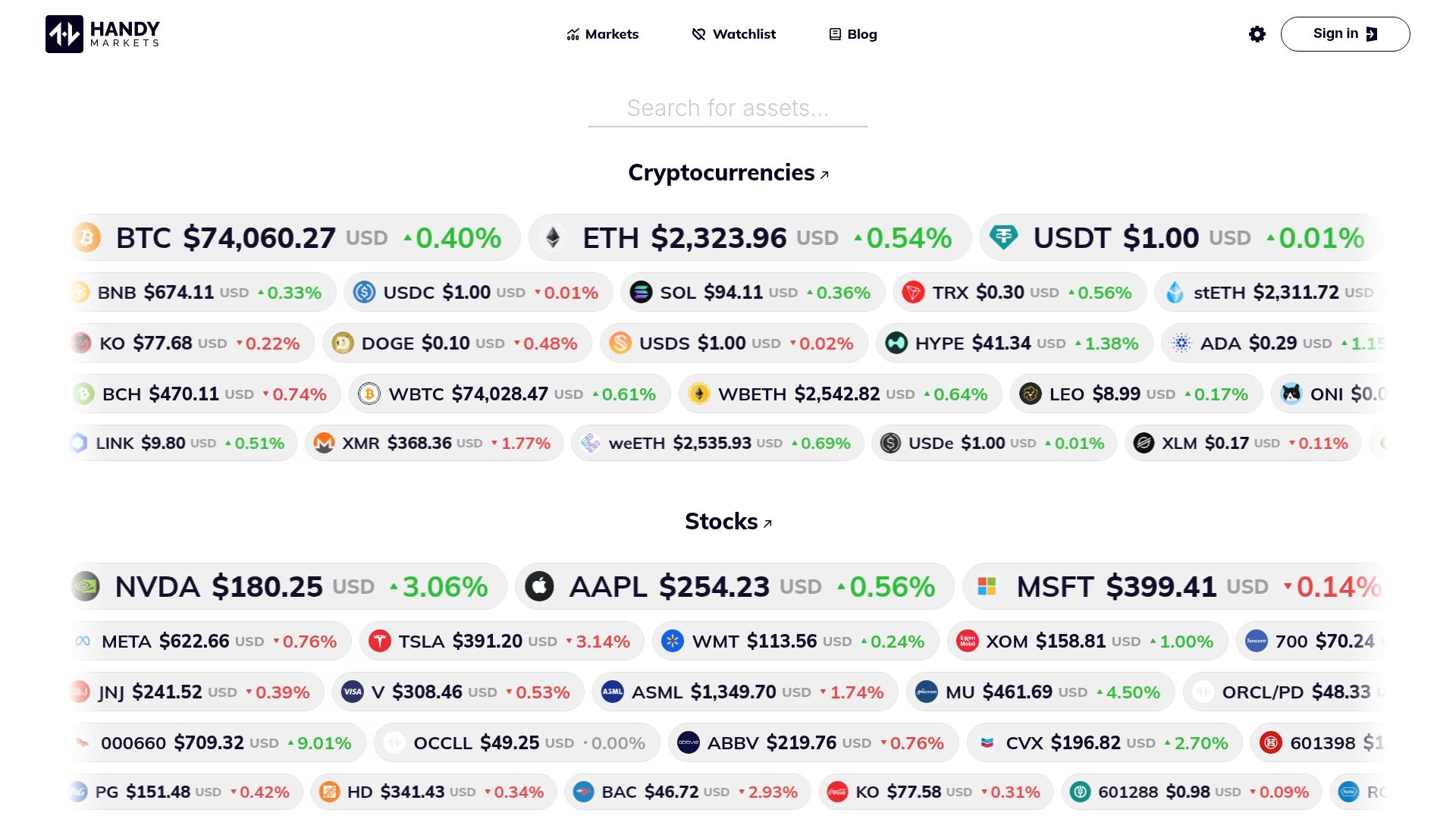
Track ETF prices and holdings to compare expense ratios and monitor your diversification in real time. Set price alerts across Telegram, Discord, Slack, SMS, or email so you know when an asset moves, without needing to check the market every hour. That kind of passive awareness reduces the urge to react impulsively, which is exactly the habit that separates successful beginners from frustrated ones. Handy does not trade for you. It gives you the information to make calm, informed decisions instead of emotional ones.
FAQ
What is the biggest beginner investing mistake?
Not having a written investment plan is the most damaging mistake. Without one, every market move becomes an emotional decision point rather than a non-event.
How much does a high expense ratio actually cost?
An expense ratio above 0.4% is considered expensive by Investopedia standards. On a growing portfolio, the difference between a 0.03% and a 1.0% fund compounds into thousands of dollars in lost returns over a decade.
Why does market timing fail for most investors?
Missing even a small number of the market’s strongest trading days reduces long-term returns significantly, according to Dimensional Fund Advisors. Those best days are unpredictable and often follow the worst days, meaning sellers miss the recovery.
How do I avoid emotional investing decisions?
Automate your monthly contributions and set rebalancing rules in advance. A 48-hour waiting rule before making any portfolio change after a major market move eliminates most panic-driven errors.
When should a beginner start investing?
Start as early as possible, even with $50 to $100 per month. Compound growth rewards time more than contribution size, and every month of delay is compounding potential you cannot recover.
Recommended
- Top Investment Strategies To Maximize Returns In 2026 | Handy.Markets
- Mastering Volatility In Investing: A Beginner’s Guide To Navigating Market Swings In 2025 | Handy.Markets
- Bonds: A Safe Way To Invest For Beginners | Handy.Markets
- Key Stock Market Trends Driving Investment Moves In 2026 | Handy.Markets