
TL;DR:
- Effective stock monitoring involves building a focused watchlist, using appropriate data tools, and following a disciplined daily routine. Limiting your watchlist to 10-20 stocks and regularly reviewing your tiers ensures proactive decision-making and minimizes emotional reactions. Utilizing alerts and scheduled reviews helps execute strategies efficiently without constant screen watching.
A structured stock monitoring process is the difference between reactive guessing and disciplined portfolio management. Most investors treat monitoring as watching price tickers all day. That misses the point entirely. Effective stock monitoring, known formally as portfolio surveillance, means building a focused watchlist, choosing the right tracking tools, and following a consistent daily review routine. This stock monitoring process guide walks you through each step so you spend less time staring at screens and more time making confident, well-prepared decisions.
How to build a focused stock watchlist
A watchlist is your first filter against market noise. Limiting your watchlist to 10–20 stocks gives you the depth of knowledge needed to act decisively on each position. Spreading attention across 50 or 100 tickers dilutes your edge and increases emotional decision-making.
Selecting stocks that match your strategy
Stock selection starts with your investment style. A swing trader prioritizes momentum stocks with clear technical setups. A dividend investor focuses on yield, payout history, and earnings stability. Filtering by strategy keeps your watchlist aligned with your actual goals and removes the temptation to chase unrelated opportunities.
Use these criteria to evaluate each candidate:
- Liquidity: Average daily volume above 500,000 shares reduces slippage risk.
- Volatility fit: Beta should match your risk tolerance. High-beta stocks suit active traders; low-beta suits long-term holders.
- Catalyst presence: Earnings reports, FDA decisions, or product launches create tradeable events.
- Technical setup: Look for stocks near key support, resistance, or breakout levels.
- Sector alignment: Group stocks by sector to spot macro-level trends quickly.
Organizing by tier
Tier your watchlist by readiness. Tier 1 holds your top 5 stocks with active setups ready to trade today. Tier 2 holds 5–10 stocks approaching a setup within the next few days. Tier 3 holds 5–10 longer-term candidates you monitor weekly. This structure prevents you from treating every stock with equal urgency, which is one of the most common focus killers in active investing.

Pro Tip: Review your Tier 1 list every evening. If a stock no longer has a clear setup, move it to Tier 2 or drop it entirely. Fresh setups beat stale ones every time.
Daily 15–30 minute watchlist reviews and evening scanning sessions keep your list current and your setups actionable. Consistency here is what separates prepared investors from reactive ones.
What tools work best for real-time stock monitoring?
The right tool depends on how active you are and how much data precision you need. Here is a breakdown of the main options available in 2026:
| Tool | Data Type | Best For | Cost |
|---|---|---|---|
| Google Sheets + GOOGLEFINANCE | Delayed (up to 20 min) | Casual tracking, long-term investors | Free |
| MarketXLS + Excel | Live and on-demand | Active traders, professionals | Paid subscription |
| Stock Monitor (open-source) | Live charts, auto-refresh | Portfolio tracking without cloud costs | Free |
| Handy.Markets | Real-time quotes, alerts | Multi-asset monitoring with notifications | Free |
Why GOOGLEFINANCE falls short for active traders
GOOGLEFINANCE functions delay data by up to 20 minutes. For a long-term investor checking positions weekly, that lag is acceptable. For a swing trader watching a breakout, 20 minutes of delay can mean the difference between a good entry and a missed trade. Know your data source before you trust it.
MarketXLS and excel for professional tracking
MarketXLS formulas pull live prices, technical indicators, and dividend yields directly into Excel and Google Sheets. Functions like =Last() and =Stream_Last() give you both on-demand snapshots and continuously updating prices in the same workbook. Streaming data should be limited to 3–5 active stocks to keep spreadsheet performance stable. Use on-demand data for the rest of your watchlist.
Free alternatives worth knowing
The open-source Stock Monitor application supports live charts, multi-asset portfolios, and auto-refresh without requiring a cloud subscription. It runs as a standalone desktop program, which suits investors who prefer keeping data local rather than cloud-dependent.
Pro Tip: Use real-time market data tools for your Tier 1 stocks and delayed or on-demand data for Tier 2 and 3. This approach balances accuracy where it matters most against system performance.
What does a daily stock monitoring routine look like?
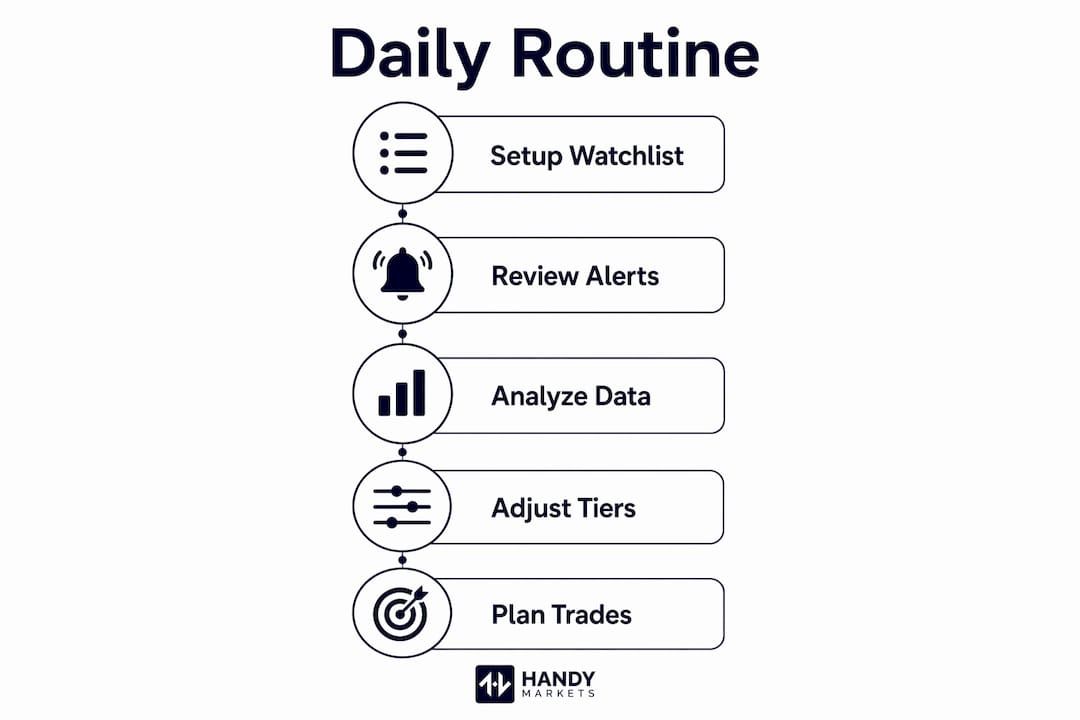
Preparation mode is the core habit of successful investors. Writing your trade plan before the market opens removes the pressure of making decisions in real time. Here is a practical daily routine built around that principle:
Evening pre-market prep (30 minutes)
- Scan your watchlist for stocks that moved significantly during the day.
- Check earnings calendars for any upcoming reports on your watchlist stocks.
- Identify new setups by reviewing charts for stocks approaching key technical levels.
- Update your tiers. Move stocks that have broken down out of Tier 1. Add fresh setups from Tier 3.
- Write trade plans. For each Tier 1 stock, note your entry trigger, stop loss, and profit target before you close your computer.
Morning pre-market checks (15 minutes)
- Review overnight news for any watchlist stocks. Earnings surprises, analyst upgrades, or macro events can invalidate your plan.
- Check pre-market price action. Large gaps up or down change your entry logic.
- Confirm your stops and targets are still valid given the new information.
- Set price alerts for your entry triggers so you do not need to watch the screen continuously.
During market hours
Alerts do the heavy lifting once the market opens. Automating trade alerts based on predefined price targets maintains discipline and frees you from continuous screen monitoring. Set alerts at your entry trigger, your stop level, and your profit target. When an alert fires, you execute the plan you already wrote. You do not improvise.
This routine takes roughly 45 minutes per day outside market hours. That is a manageable commitment that produces far better results than watching tickers for six hours straight.
Common mistakes that undermine effective stock monitoring
Most investors know what to do in theory. The breakdown happens in practice. These are the most common errors and how to fix them:
- Overcrowding the watchlist. Adding stocks without removing others creates a list too large to act on. The main purpose of a watchlist is filtering noise, not collecting tickers.
- Monitoring continuously instead of strategically. Watching price action all day triggers emotional responses. Alerts replace the need for constant screen time.
- Holding stale setups. Rotating stocks out quickly when setups fail avoids emotional attachment and keeps your list fresh with real opportunities.
- Ignoring data delays. Trusting delayed data for active trades is a structural error. Know whether your tool provides live or delayed prices before acting on it.
- Skipping the written trade plan. Verbal intentions are not plans. Writing stops and targets before the open creates accountability and reduces impulsive decisions.
“Most investors mistakenly think monitoring means watching price action continuously. It is preparation and strategy execution.” — FinWiz
Pro Tip: Set a hard rule: if a stock has been on your Tier 1 list for more than five trading days without triggering your entry, move it down or remove it. Waiting indefinitely on a setup that never fires is a hidden cost to your focus and capital.
For investors building a broader framework, reviewing top investment strategies alongside your monitoring routine creates a more complete picture of how watchlist management fits into long-term portfolio goals.
Key takeaways
Effective stock monitoring requires a focused watchlist, the right data tools, and a written daily routine executed before the market opens.
| Point | Details |
|---|---|
| Limit your watchlist | Keep 10–20 stocks maximum to maintain deep knowledge of each position. |
| Match tools to your activity level | Use live data feeds for active trades; delayed data is acceptable for long-term tracking. |
| Write plans before market open | Set stops and targets the evening before to remove in-session emotional decisions. |
| Use alerts, not continuous watching | Automated price alerts maintain discipline and free attention for analysis. |
| Rotate stale setups out fast | Remove stocks that fail to trigger within a defined window to keep your list actionable. |
What we have learned running a market data platform
Stock monitoring is one of those skills that looks simple from the outside and reveals its depth only after you have done it wrong a few times. At Handy, we have watched investors fall into the same trap repeatedly: they build a watchlist of 40 or 50 stocks, feel productive because the list is long, and then freeze when it is time to act because they cannot prioritize.
The investors who use our platform most effectively do the opposite. They keep tight lists, set specific alerts, and treat the pre-market window as their most important work session of the day. They are not glued to live quotes during market hours. They set their triggers and let the alerts do the work.
We have also noticed that the tool matters less than the routine. A disciplined investor using a free spreadsheet with delayed data will outperform an undisciplined one using expensive live feeds. The data is only as good as the process around it. What actually moves the needle is the evening review, the written trade plan, and the willingness to cut a setup that is not working.
The one thing we would tell every investor starting this process: treat your watchlist like a curated portfolio, not a collection. Every stock on that list should earn its place every single day.
Track stocks smarter with Handy.Markets
Building a disciplined monitoring routine is only half the equation. You also need a platform that delivers the data when you need it, without the setup friction.
Handy gives you live stock quotes and charts alongside real-time price alerts you can route to Telegram, Discord, Slack, SMS, or email. Setup takes minutes. You can monitor stocks and ETF prices and alerts from a single dashboard, with no spreadsheet formulas required. For investors who want to spend their prep time on analysis rather than data plumbing, Handy is the direct path from watchlist to alert to execution.
FAQ
What is a stock monitoring process?
A stock monitoring process is a structured routine for tracking selected stocks using watchlists, data tools, and scheduled reviews. The goal is disciplined, strategy-aligned decision-making rather than reactive price watching.
How many stocks should be on a watchlist?
An effective watchlist holds 10–20 stocks. This limit lets you maintain deep knowledge of each position and act decisively when a setup triggers.
What is the difference between streaming and on-demand stock data?
Streaming data updates continuously in real time, while on-demand data refreshes only when you request it. Active traders need streaming data for Tier 1 positions; on-demand data works well for longer-term monitoring.
How do i avoid emotional trading during market hours?
Write your trade plan, including entry trigger, stop loss, and profit target, before the market opens. Then set price alerts so you execute the plan rather than react to price movement in the moment.
Is free software enough for stock monitoring?
Free tools like Google Sheets and the open-source Stock Monitor application work well for long-term investors. Active traders benefit from paid platforms like MarketXLS that provide live data feeds and automatic formula updates.