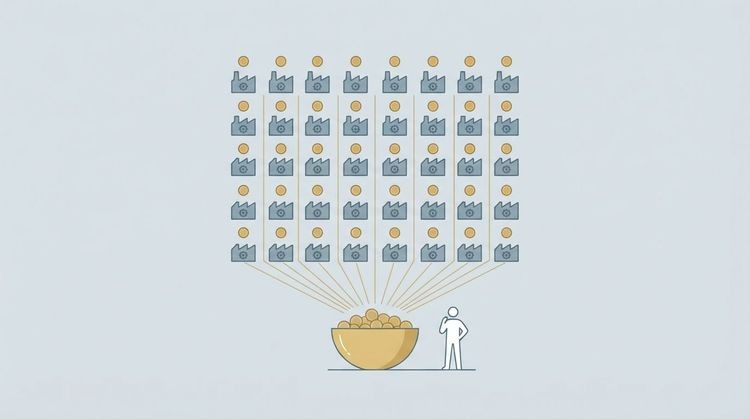

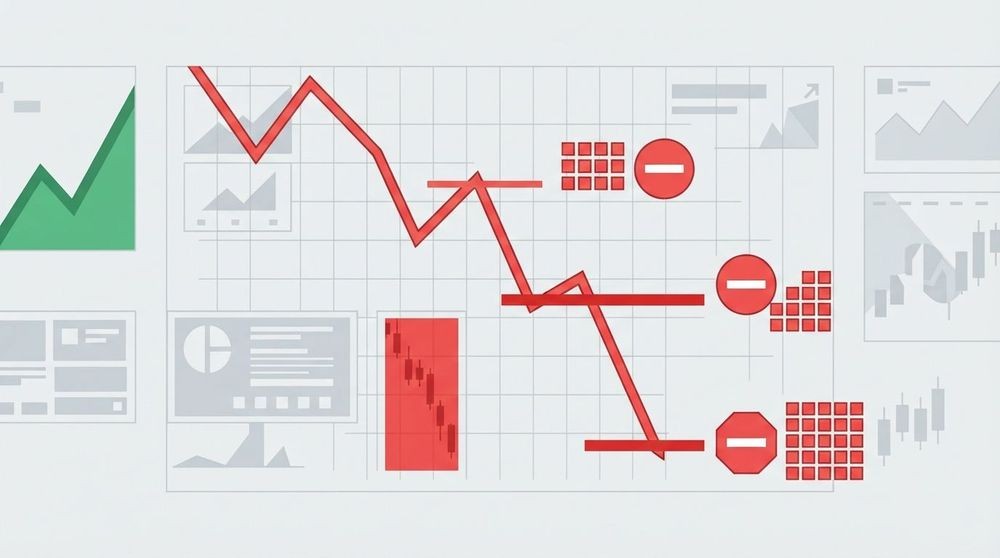
The U.S. stock market has two primary types of circuit breakers: Market-Wide Circuit Breakers (MWCBs), which halt all trading when the S&P 500 Index drops sharply, and the Limit Up-Limit Down (LULD) mechanism, which pauses trading in individual stocks and ETFs when prices move outside a calculated band. Think of them as the market’s built-in pressure relief valves, designed to slow things down before panic takes over.
Here is a quick snapshot of how both categories work:
- Market-Wide Circuit Breakers (MWCBs): Triggered by S&P 500 single-day declines of 7% (Level 1), 13% (Level 2), or 20% (Level 3), causing cross-market trading halts.
- LULD (Single-Stock Circuit Breakers): Pause trading in one security when its price moves outside a dynamic band for more than 15 seconds, with halts typically lasting 5 minutes.
- Timing rules: Level 1 and Level 2 MWCBs only trigger before 3:25 p.m. ET; Level 3 closes the market for the rest of the day, regardless of the time.
- Scope: MWCBs affect every exchange simultaneously; LULD targets one security at a time.
How market-wide circuit breakers actually work
MWCBs are the most visible stock exchange safeguards in the U.S. They coordinate a simultaneous halt across all major equity and futures markets when the S&P 500 falls far enough in a single session. The trigger points are calculated each morning using the prior day’s closing price of the S&P 500 Index, so the exact point levels shift daily.
| MWCB Level | S&P 500 Decline | Halt Duration | Time Restriction |
|---|---|---|---|
| Level 1 | 7% decline | 15 minutes | Only before 3:25 p.m. ET |
| Level 2 | 13% decline | 15 minutes | Only before 3:25 p.m. ET |
| Level 3 | 20% decline | Rest of trading day | Any time |
One detail most investors miss: each level can only trigger once per trading day to provide a singular cooling-off period. If the S&P 500 drops 7%, triggers a Level 1 halt, and then falls another 7% after trading resumes, that second drop does not cause a second Level 1 halt. It would need to reach the 13% Level 2 threshold to trigger the next pause. This design prevents the market from being locked in a loop of repeated short halts.
Both NYSE and NASDAQ participate in these coordinated halts. The rules are uniform across exchanges by design, so there is no scenario where NYSE stops trading while NASDAQ keeps going. Cboe futures and options markets also coordinate their reopening procedures, though their queuing and re-opening times vary by product type.
“Market-wide circuit breakers provide for cross-market trading halts during a severe market decline as measured by a single-day decrease in the S&P 500 Index.” — SEC Investor Alert on Circuit Breakers
The goal is straightforward: give every participant, from a retail investor in Ohio to a hedge fund in Manhattan, the same window to absorb information and reconsider positions. Liquidity tends to evaporate fastest when fear peaks, and a 15-minute pause can meaningfully slow that spiral.
What the LULD mechanism does for individual stocks
The Limit Up-Limit Down mechanism operates at the single-security level, and its logic is more dynamic than a simple percentage threshold. Rather than waiting for a trade to occur at an extreme price, LULD prevents those trades from happening in the first place by establishing a live price band around each stock.
That band is set at a percentage above and below the stock’s average price over the immediately preceding five-minute trading period. If the price touches the band and does not return within 15 seconds, trading pauses for five minutes. The band widths depend on two variables: the stock’s tier classification and its price.
- Tier 1 NMS stocks include all S&P 500 and Russell 1000 securities, plus select Exchange Traded Products. These get the tightest bands.
- Tier 2 NMS stocks cover all other National Market System securities, excluding rights and warrants.
- Band widths: 5%, 10%, 20%, or the lesser of $0.15 or 75%, depending on tier and price level.
- Near market close: During the last 25 minutes of the regular trading day, price bands double for all Tier 1 stocks and for Tier 2 stocks priced at or below $3.00.
- Direction: LULD applies to both upward and downward price moves, unlike MWCBs, which only respond to declines.
- Coverage hours: Regular trading hours, 9:30 a.m. ET through 4:00 p.m. ET.
The doubling of bands near the close is a deliberate design choice. End-of-day order imbalances are common, and tighter bands during that window would trigger unnecessary halts. Widening them gives the market room to find its natural close without artificial interruption.
Pro Tip: If you trade lower-priced stocks, pay close attention to the LULD band widths. A stock priced below $3.00 can have its band double in the final 25 minutes, meaning price moves that would have triggered a halt earlier in the day may not do so near the close. Tracking live stock quotes in real time helps you stay ahead of these shifts.
LULD also differs from MWCBs in a fundamental way: it is fully automated and directionally neutral. A stock that surges 15% in two minutes faces the same pause mechanism as one that crashes 15%. MWCBs, by contrast, only respond to broad market declines.

The history behind circuit breakers and what they have taught us
Circuit breakers did not appear out of nowhere. They were a direct response to the crash of october 1987, when the Dow Jones Industrial Average fell over 22% in a single session with no mechanism to slow the freefall. The first rules, adopted in 1988, used fixed point thresholds on the Dow Jones Industrial Average. That approach worked for a while, but as market values grew, a 250-point drop became far less significant than it once was.
The shift to percentage-based triggers tied to the S&P 500 Index came in 2013, replacing the old 10%, 20%, and 30% Dow-based thresholds. This change made the rules scale with the market rather than becoming irrelevant over time.
Key milestones in U.S. circuit breaker history:
- 1988: First market-wide circuit breakers introduced using Dow Jones point thresholds, following the 1987 crash.
- 2010 (may): The “Flash Crash” exposed gaps in single-stock protections, prompting the SEC to approve pilot single-stock circuit breakers for S&P 500 stocks.
- 2011: Single-stock circuit breakers extended to all National Market System securities on a pilot basis.
- 2012: SEC approved the LULD mechanism to replace single-stock circuit breakers, addressing the problem of halts triggered by erroneous trades.
- 2013 (february): Revised MWCBs using S&P 500 percentage thresholds took effect.
- 2013 (april/october): LULD rolled out in two phases, first for S&P 500 and Russell 1000 stocks, then for all remaining NMS securities.
- march 2020: MWCBs triggered multiple times during the COVID-19 market selloff, the first real-world test of the 2013 rules at scale.
The march 2020 activations were the most significant test of modern circuit breaker rules. Level 1 halts triggered on multiple consecutive trading days as the S&P 500 fell sharply amid pandemic uncertainty. The pauses gave markets time to process incoming economic data and policy announcements, and trading resumed in an orderly fashion each time.
For retail investors, circuit breaker halts can feel disorienting, especially if a limit order is sitting in the queue. Institutional traders, who often have direct market access and more sophisticated order management systems, are generally better positioned to adjust during a halt. Retail investors benefit most from the breathing room these pauses create, since panic selling during a freefall often locks in losses that a calmer market would have partially recovered.

Globally, the U.S. approach is not universal. Many European exchanges use volatility interruptions, which switch from continuous trading to a call auction rather than halting entirely. Asian markets often apply static price limits that cap daily moves. The international variation reflects different market structures and regulatory philosophies, but the underlying goal is the same: prevent disorderly conditions from becoming permanent damage.
One more distinction worth knowing: regulatory halts are not circuit breakers. A news-pending halt, for example, is triggered manually by an exchange when a company is about to release material information. Circuit breakers are automatic, triggered by price movement alone, with no human decision required.
How to monitor circuit breakers and volatility in real time
Knowing the rules is one thing. Knowing the moment a threshold is approaching is what separates a prepared investor from a reactive one. Real-time data and alert systems are the practical layer that makes circuit breaker knowledge useful during a fast-moving session.
Handy Markets is built for exactly this kind of monitoring. The platform aggregates live prices, percentage changes, and charts across stocks, indices, crypto, forex, and commodities in one place, so you are not switching between tabs when volatility spikes.
The alert system on Handy Markets covers the channels most traders actually use:
- Telegram for instant mobile notifications
- Email for a logged record of alerts
- Slack for team-based trading environments
- SMS for direct text alerts without needing an app open
- Webhooks for connecting alerts to custom workflows or trading tools
Setting a price alert tied to a key S&P 500 level, for instance, can give you a heads-up before a Level 1 MWCB threshold is reached. You can also set alerts on individual stocks to track when prices approach LULD band edges, giving you time to review open positions before a pause hits. The market volatility strategies guide on Handy Markets walks through how to build a practical monitoring routine around these tools.
Key Takeaways
U.S. stock market circuit breakers fall into two categories: market-wide halts tied to S&P 500 declines and single-stock LULD pauses tied to dynamic price bands, each with distinct thresholds and timing rules.
| Point | Details |
|---|---|
| Two main circuit breaker types | MWCBs halt all markets; LULD pauses individual securities based on price band breaches. |
| MWCB thresholds | S&P 500 declines of 7%, 13%, and 20% trigger Level 1, 2, and 3 halts respectively. |
| Timing restrictions | Level 1 and 2 halts only activate before 3:25 p.m. ET; Level 3 closes the market at any time. |
| LULD band doubling | Price bands double in the last 25 minutes for Tier 1 stocks and Tier 2 stocks priced at or below $3.00. |
| Each level triggers once daily | A second breach of the same MWCB threshold in one session does not cause a repeat halt. |