
TL;DR:
- Derivatives are contracts whose value depends on underlying assets like stocks or commodities.
- They are widely used for hedging, speculation, and managing financial risks across markets.
- Proper understanding and discipline are essential to manage their significant benefits and risks effectively.
The global derivatives market is staggeringly large. With $846 trillion notional outstanding as of June 2025, derivatives are not a niche corner of finance reserved for Wall Street insiders. They touch virtually every portfolio, every pension fund, and every multinational company on the planet. Yet most individual traders and investors treat them like forbidden territory, assuming derivatives are too complex for anyone without a finance degree. That assumption is costing you opportunities. This guide cuts through the noise to give you a clear, practical understanding of what financial derivatives are, how they work, and how you can use them to manage risk and build smarter strategies.
Table of Contents
- What are financial derivatives?
- How do derivatives work in modern markets?
- Benefits and risks of using derivatives
- How professionals use derivatives for risk management
- Why most investors misjudge the power—and risk—of derivatives
- Track the markets and manage risk with Handy.Markets
- Frequently asked questions
Key Takeaways
| Point | Details |
|---|---|
| Derivatives defined | Derivatives are financial contracts whose value comes from an underlying asset like stocks, currencies, or commodities. |
| Market role | Derivatives help manage risk, provide leverage, and are essential in global financial markets. |
| OTC market size | The global OTC derivatives market reached a notional value of $846 trillion in June 2025. |
| Benefits and risks | Derivatives offer major risk management opportunities but also carry significant complexity and potential for losses. |
What are financial derivatives?
A financial derivative is a contract between two parties whose value is derived from an underlying asset. The derivative itself has no intrinsic value on its own. Instead, it moves up or down based on the price behavior of whatever it references, whether that is a stock, a currency pair, a commodity, or an index.
Think of it this way: a derivative is like a bet on the future price of something you may not even own. If you and a friend agree that you will pay each other based on whether oil prices rise or fall next month, you have created a crude derivative. Real derivatives are more structured and legally binding, but the core logic is the same.
The BIS reports that $846 trillion notional outstanding exists in OTC derivatives markets globally, which tells you just how central these instruments are to modern finance. That figure includes contracts spanning interest rates, currencies, equities, and credit.
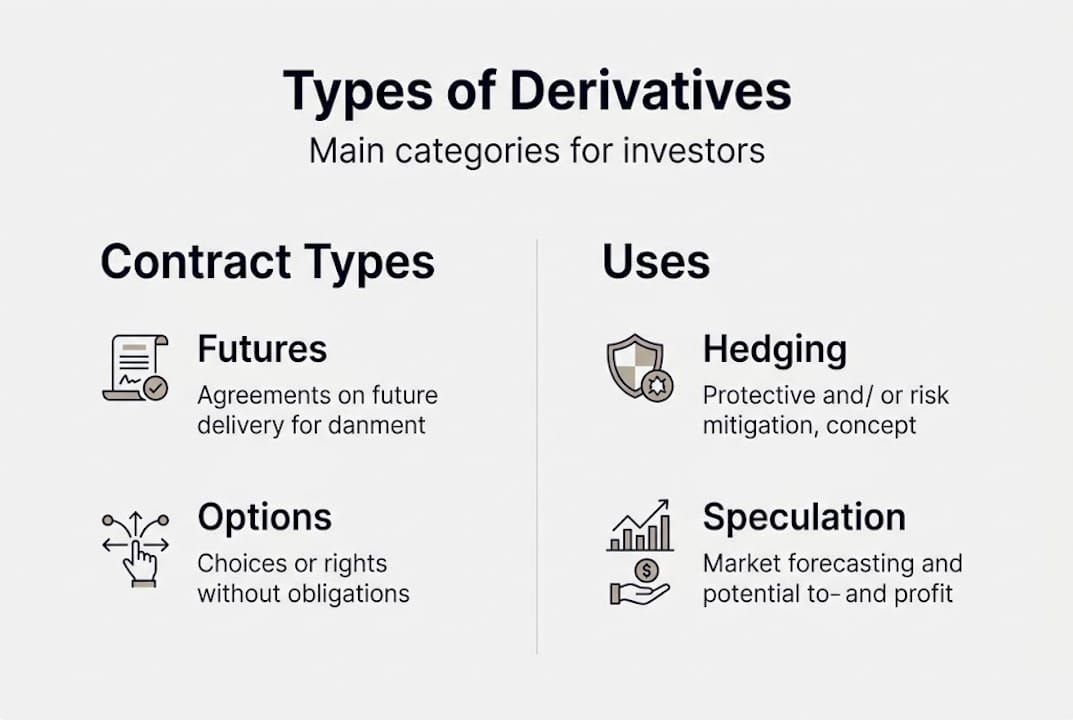
The four main categories of derivatives:
| Type | How it works | Common use |
|---|---|---|
| Forwards | Custom contract to buy/sell at a set future price | Currency hedging, commodities |
| Futures | Standardized forward traded on an exchange | Commodities, indices, interest rates |
| Options | Right (not obligation) to buy/sell at a set price | Equity speculation, protection |
| Swaps | Exchange of cash flows between two parties | Interest rate management, currency risk |
Derivatives can reference a wide range of underlying assets, including:
- Equities: individual stocks or stock indices like the S&P 500
- Currencies: forex pairs such as EUR/USD or GBP/JPY
- Commodities: oil, gold, wheat, natural gas
- Interest rates: government bond yields, LIBOR replacements like SOFR
- Credit: corporate or sovereign debt performance
Understanding these categories is your first step. Once you know what each type does, connecting them to real strategies becomes much more natural.
How do derivatives work in modern markets?
Derivatives are traded in two main environments: over-the-counter (OTC) markets and exchanges. Each has a distinct structure, risk profile, and purpose.

OTC derivatives are privately negotiated between two parties, often with customized terms. Exchange-traded derivatives are standardized contracts cleared through a central exchange, which reduces some risks but limits flexibility. When comparing different financial markets, you quickly notice how OTC markets dominate in volume but carry more counterparty risk.
| Feature | OTC Derivatives | Exchange-Traded Derivatives |
|---|---|---|
| Standardization | Customizable | Standardized contracts |
| Counterparty risk | Higher | Lower (central clearing) |
| Transparency | Lower | Higher |
| Examples | Currency swaps, credit default swaps | S&P 500 futures, stock options |
| Regulation | Less regulated | Heavily regulated |
Three distinct groups of participants drive the derivatives market:
- Hedgers use derivatives to reduce existing exposure. An airline buying oil futures to lock in fuel costs is a classic example.
- Speculators take on risk intentionally to profit from price movements, often using leverage.
- Arbitrageurs exploit price differences across markets or instruments to generate near-risk-free profits.
Here is how a typical derivatives transaction unfolds:
- Two parties identify a need: one wants protection, the other wants exposure.
- They agree on contract terms: underlying asset, price, expiration date, and notional size.
- Collateral (called margin) is posted, especially in exchange-traded markets.
- The contract is priced using models that factor in time, volatility, interest rates, and the current asset price.
- Both parties monitor and manage the position as markets move, sometimes posting additional margin.
- The contract settles at expiration, either through physical delivery or cash settlement.
Pricing is influenced by financial market data such as volatility readings, spot prices, and yield curves. For those interested in going deeper, advanced analysis techniques can sharpen your ability to evaluate derivative pricing in real time.
Noteworthy: Euro-denominated interest rate derivatives were a primary driver of OTC market growth in 2025, signaling where institutional attention is focused.
Pro Tip: Most new investors underestimate counterparty risk. Always know who is on the other side of your trade. In OTC markets especially, the financial health of your counterparty matters just as much as your market view.
Benefits and risks of using derivatives
Derivatives are powerful precisely because they are flexible. But that flexibility cuts both ways.
Key benefits:
- Hedging: Lock in prices or rates to protect against adverse moves. A wheat farmer selling futures protects revenue even if prices fall.
- Price discovery: Futures markets often reflect future expectations more accurately than spot prices, giving you valuable insight.
- Leverage: Control a large notional position with a smaller upfront capital outlay, amplifying potential gains.
- Access to markets: Trade exposure to assets you cannot easily buy outright, such as interest rate products or international indices.
- Income generation: Selling options (like covered calls) can generate steady income on existing holdings.
Main risks:
- Leverage danger: The same leverage that magnifies gains amplifies losses just as fast. A 5% move in the underlying can wipe out your entire margin.
- Market risk: Prices can move suddenly and sharply, especially during periods of understanding volatility risks.
- Complexity: Mispricing your own position because you misunderstood the contract terms is more common than most admit.
- Liquidity risk: Some OTC contracts are hard to exit before expiration.
- Counterparty risk: As discussed, the other party’s ability to honor the contract is never guaranteed in OTC markets.
“The gross market value of OTC derivatives increased 29% year-over-year to $21.8 trillion in 2025, signaling increased market volatility and the rising cost of replacing those contracts at current prices.”
That 29% jump is not just a statistic. It reflects genuine stress in global markets and a growing need for hedging tools. When volatility rises, the cost of protection rises too. Reviewing market volatility strategies before entering derivatives positions gives you a real edge.
Practical hedging example: Imagine you hold $100,000 in a diversified equity portfolio. You are concerned about a short-term market correction but do not want to sell your holdings. You buy put options on the S&P 500 index. If the market drops 10%, your put options gain value, partially offsetting your portfolio losses. Your cost is the option premium paid upfront, which is your maximum loss on that hedge.
Pro Tip: Never let complexity mask risk. Always analyze the leverage ratio and total exposure of any derivatives position before entering, not after.
How professionals use derivatives for risk management
With benefits and risks clear, let’s see how professionals actually put derivatives to work in structured, disciplined ways.
Institutional investors do not approach derivatives casually. They follow defined frameworks that you can adapt at your own scale.
Typical institutional hedging strategy, step by step:
- Identify the exposure: Define the specific risk you face. Is it currency risk, interest rate risk, or equity market risk?
- Quantify the exposure: Calculate the notional size of what you need to protect. Be precise.
- Select the right instrument: Match the derivative type to the risk. Currency risk often calls for forwards or swaps; equity risk might call for index put options.
- Determine hedge ratio: Decide what percentage of your exposure to hedge. Full hedges reduce risk but also cap upside.
- Execute and monitor: Enter the position, then actively track it as markets move. Derivatives are not set-and-forget tools.
- Adjust or unwind: As the underlying exposure changes, revise the hedge accordingly.
The fact that notional outstanding sits at $846 trillion tells you that derivatives span every sector globally, from emerging market sovereign debt to consumer staples equity portfolios.
Currency swap case example: A European fund manager holds significant U.S. equity exposure. As the dollar strengthens against the euro, returns shrink when converted back. The manager enters a currency swap, exchanging dollar cash flows for euro cash flows at a fixed rate. The currency risk is neutralized, and the manager can focus on stock selection rather than FX fluctuation.
Euro-denominated interest rate derivatives drove OTC market growth in 2025 precisely because European institutions needed to manage rising rate uncertainty across the eurozone.
For individual investors navigating investing volatility, borrowing these institutional frameworks and scaling them down is not only possible, it is practical. Explore more at investment strategies to find approaches that fit your portfolio size and risk tolerance.
Pro Tip: Borrow proven institutional frameworks for your own portfolio, scaled to your size. The logic behind a $10 billion hedge and a $10,000 hedge is identical. Only the notional amount differs.
Why most investors misjudge the power - and risk - of derivatives
Here is something most guides will not say directly: the biggest danger with derivatives is not complexity. It is overconfidence dressed up as understanding.
Conventional advice tends to fall into one of two camps. Either it scares you away entirely with horror stories about blowups, or it glosses over real risks with promises of leverage-fueled returns. Neither extreme serves you well.
Real expertise in derivatives is contextual. It means knowing when to hedge, why a specific instrument fits your situation, and how much exposure is appropriate given your overall portfolio. Using derivatives without that contextual discipline is genuinely dangerous, not because the instruments are evil, but because they amplify whatever decisions you make, good and bad alike.
We have seen traders use simple options strategies to protect portfolios during corrections with excellent results. We have also seen the same strategies misapplied, creating losses larger than the risk they were meant to offset. The difference was not the tool. It was the discipline and structured learning behind the decision.
If you want to use derivatives sustainably, build your knowledge systematically, not through dabbling. Revisit managing risk during volatility as a regular part of your investing practice.
Track the markets and manage risk with Handy.Markets
Knowing how derivatives work is only half the equation. The other half is having the right real-time information to act when it matters. When the market is moving fast and your derivative position depends on precise price levels, delays are costly.
At Handy.Markets, we make it easy to track financial markets across crypto, stocks, forex, commodities, and indices in one place. Whether you are monitoring the underlying asset of an options position or watching a currency pair tied to a swap, our platform keeps you informed. You can also set price alerts via Telegram, Discord, Slack, SMS, Email, or Webhook, so critical market moves never catch you off guard. Real-time data and instant alerts are not a luxury for derivatives traders. They are a necessity.
FAQ
What is a financial derivative in simple terms?
A financial derivative is a contract whose value depends on an underlying asset’s price, such as a stock, currency, or commodity, without requiring direct ownership of that asset.
Why are derivatives important for investors and traders?
Derivatives allow investors to hedge existing risk, access leverage, and capitalize on both rising and falling markets. They are central to hedging and risk management in virtually every asset class.
What’s the difference between OTC and exchange-traded derivatives?
OTC derivatives are privately negotiated with customizable terms but carry higher counterparty risk. Exchange-traded derivatives use standardized contracts and structure cleared through a regulated marketplace, reducing that risk.
How big is the global derivatives market?
As of June 2025, the OTC derivatives notional outstanding was approximately $846 trillion globally, making it one of the largest financial markets in existence.
Recommended
- How To Compare Financial Markets: A Guide For Investors | Handy.Markets
- Mastering Volatility In Investing: A Beginner’s Guide To Navigating Market Swings In 2025 | Handy.Markets
- What Is Market Volatility? A Practical Guide For Traders | Handy.Markets
- Understanding Market Fluctuations: A Guide For Traders | Handy.Markets