

TL;DR:
- Market aggregators consolidate real-time prices and liquidity from multiple trading venues, improving trade execution. They evaluate venue data using smart order routing, order splitting, and liquidity mapping to reduce slippage and costs. These tools are most beneficial for large, volatile, or cross-asset trades, allowing traders to access deeper liquidity and better prices.
Market aggregators are platforms that consolidate real-time pricing, liquidity, and order flow from multiple financial venues into a single, unified interface. For investors and traders, this matters more than most realize. Market fragmentation is the biggest invisible tax in trading, more costly than fees or latency, yet most traders absorb it silently by staying loyal to one exchange. Understanding why use market aggregators starts with understanding what that fragmentation is actually costing you on every trade you place.
Why does market fragmentation cost traders so much?
Financial markets do not exist in one place. Stocks trade across NYSE, Nasdaq, and dozens of alternative trading systems. Crypto moves through Binance, Coinbase, Kraken, and hundreds of decentralized exchanges simultaneously. Forex liquidity spreads across banks, ECNs, and retail brokers. Each venue carries its own prices, spreads, and liquidity depth at any given moment.
That fragmentation creates real, measurable losses. Traders lose approximately 2%–5% of their capital per trade by not using aggregators. On a single $500 swap, that translates to $11–$25 lost purely because of price differences between venues. Multiply that across dozens of trades per week and the number becomes significant.
Here is what fragmentation looks like in practice:
- Price gaps of 4%–5% observed simultaneously across exchanges for the same asset
- Manual platform checks requiring traders to visit 5–6 separate venues before executing
- Time decay during manual comparison, meaning prices shift before the trade is placed
- Liquidity gaps that force large orders to fill at worse prices on a single exchange
Without aggregation, users must manually check multiple platforms, losing time and risking unfavorable price moves before execution. That is not a minor inconvenience. It is a structural disadvantage that compounds over time.
How do market aggregators work?
Market aggregators function as intelligent engines that map liquidity, provide execution intelligence, and identify arbitrage opportunities in real time. The mechanism behind this involves three core processes working together.

1. Real-Time Price Aggregation
Aggregators pull live quotes from multiple venues simultaneously. They do not simply display all prices side by side. Advanced aggregators normalize raw data by filtering out stale and outlier quotes within milliseconds before displaying prices to the user. This noise removal is what separates a reliable aggregator from a basic price comparison tool.
2. Smart Order Routing (SOR)
Smart order routing is the technical heart of any serious aggregator. SOR evaluates venue latency, historical fill rates, and liquidity depth to optimize trade execution beyond the cheapest quoted price. The system does not just find the lowest ask. It calculates where your order is most likely to fill completely, at the best net price, with the least market impact. This is execution intelligence, not just data delivery.
3. Order Splitting and Liquidity Mapping
For larger trades, aggregators go further. Order splitting across multiple venues lowers price impact by accessing deeper liquidity pools across exchanges simultaneously. Instead of dumping a large order into one venue and moving the market against yourself, the aggregator slices the order and fills it across several sources at once.
Pro Tip: Multi-venue execution with simultaneous smart routing improves fill rates significantly compared to sequential failover methods that only react after an order is rejected at the first venue.
Platforms like FORS demonstrate how unified orderbooks combine fragmented liquidity from multiple sources into one interface, giving traders interaction with one large market rather than several disconnected ones. The result is deeper liquidity, tighter spreads, and better price discovery on every trade.
What are the real benefits of market aggregators?
The advantages of market aggregators go well beyond convenience. They translate directly into better trade outcomes and lower costs. Here is how they deliver value across four key dimensions.
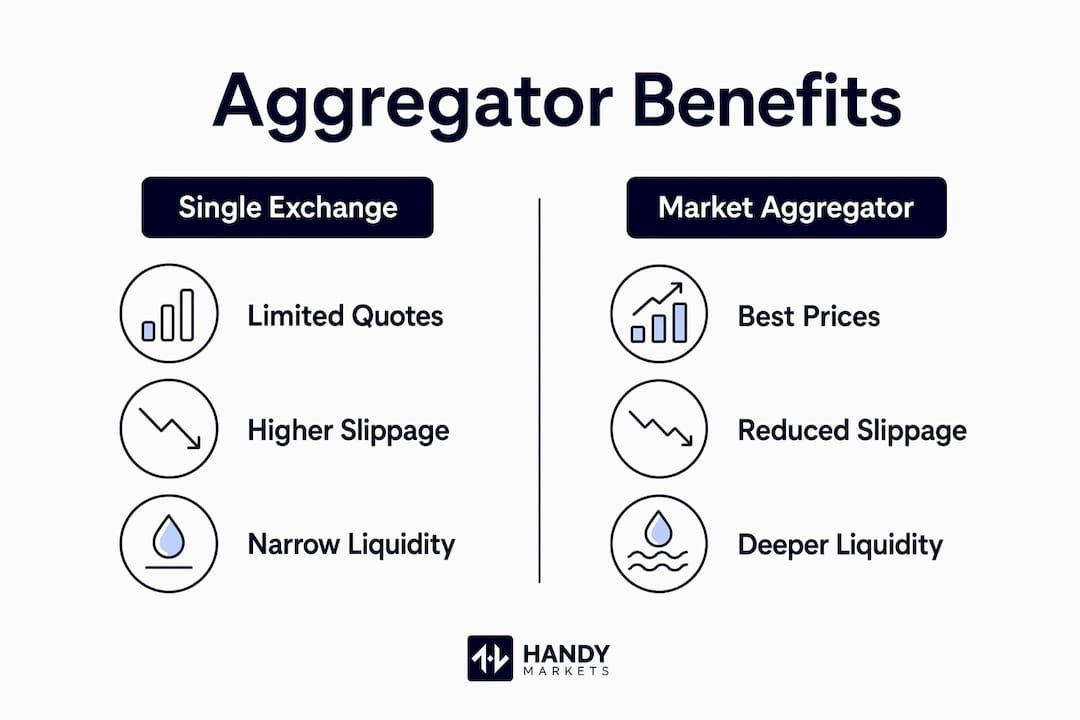
| Benefit | Single Exchange | Market Aggregator |
|---|---|---|
| Price discovery | Limited to one venue’s quotes | Best price across all connected venues |
| Liquidity depth | Capped by one orderbook | Combined depth from multiple sources |
| Large order execution | High slippage risk | Order splitting reduces price impact |
| Spread quality | Wider during volatility | Tighter via multiple liquidity paths |
| Manual effort | High, requires checking multiple platforms | Automated, real-time routing |
Reduced Slippage on Every Trade
Slippage is the gap between the price you expect and the price you actually get. Aggregators minimize this by routing to the venue with the best available fill at the moment of execution. For active traders, even a 0.5% improvement in average execution quality compounds into meaningful gains over a full trading year.
Access to Deeper Liquidity
Without aggregation, brokers rely on single liquidity providers, leading to wider spreads, slower execution, and higher order rejection rates during volatile periods. Aggregators solve this by maintaining multiple liquidity paths simultaneously. When one venue dries up, the router shifts volume to the next best source without any action from you.
Opportunity Detection
Aggregators surface arbitrage opportunities that are invisible when you watch only one exchange. Price discrepancies between venues exist for seconds or minutes before the market corrects. An aggregator that maps liquidity across venues in real time gives you the visibility to act on those gaps before they close. You can learn more about comparing prices across markets to understand how this advantage compounds over time.
Time Savings Through Automation
Manually checking five or six platforms before every trade is not a trading strategy. It is a workflow problem. Aggregators automate that entire process, freeing you to focus on analysis and decision-making rather than data collection.
Aggregators vs. single platforms: when does it matter most?
Not every trade benefits equally from aggregation. Understanding when to rely on an aggregator versus a single platform helps you use both tools correctly.
Single exchanges work well for small, routine trades in highly liquid markets where price differences between venues are negligible. If you are buying a small position in a major stock during normal market hours, the execution quality difference between a single broker and an aggregator may be minimal.
Aggregators deliver their clearest advantage in three specific scenarios:
- Large orders where a single venue cannot absorb the full size without moving the price against you
- Volatile markets where spreads widen and liquidity thins on individual exchanges
- Cross-asset or cross-venue strategies where you need consistent pricing across crypto, forex, and equities simultaneously
A common misconception is that aggregators simply display parallel price feeds. They do not. Traders using aggregators shift from platform-centric to information-centric trading, seeking the best global market price rather than relying on one exchange’s data. That shift in mindset is as important as the technology itself.
Pro Tip: When evaluating any aggregator, check whether it uses simultaneous multi-venue routing or sequential failover. Simultaneous routing fills your order across venues at once. Sequential failover only moves to the next venue after a rejection, which costs time and often results in worse prices.
One technical detail worth knowing: orderbook aggregation must verify market equivalence across venues to avoid execution errors caused by differing settlement rules or resolution logic. A well-built aggregator handles this verification automatically. A poorly built one does not, and the errors show up in your fills. Understanding order flow signals helps you evaluate whether an aggregator’s routing decisions align with actual market conditions.
The 2026 trading environment makes aggregators more relevant, not less. As markets fragment further across decentralized protocols, regional exchanges, and new asset classes, the gap between aggregated and non-aggregated execution will widen. Traders who build aggregator use into their workflow now will hold a structural edge as that fragmentation deepens.
Key takeaways
Market aggregators deliver better prices, deeper liquidity, and faster execution by consolidating fragmented venues into a single intelligent routing system.
| Point | Details |
|---|---|
| Fragmentation has a real cost | Traders lose 2%–5% per trade without aggregation due to price gaps across venues. |
| SOR goes beyond price comparison | Smart order routing evaluates latency, fill rates, and liquidity depth to optimize execution. |
| Order splitting protects large trades | Aggregators slice large orders across venues to reduce slippage and price impact. |
| Aggregators shift trader mindset | Moving from platform loyalty to information-centric trading captures better global prices. |
| Volatile markets amplify the advantage | Aggregators maintain tighter spreads and multiple liquidity paths when single venues thin out. |
The invisible cost most traders never calculate
At Handy, we have watched traders obsess over brokerage fees while ignoring a cost that often dwarfs them. Fragmentation is quiet. It does not show up as a line item on your statement. It shows up as a slightly worse fill, a slightly wider spread, a slightly larger order rejection rate during the moments when markets move fastest. Those “slightlys” add up to real money.
What we find most striking is how quickly trader behavior changes once they see consolidated data. The instinct to stay loyal to one exchange fades almost immediately when you can see, in real time, that the same asset is priced 3% differently two venues over. Platform loyalty is not a trading strategy. It is a habit that costs you.
The aggregator space is also maturing fast. The early tools were blunt instruments, pulling prices from a handful of sources with limited routing logic. Today’s aggregators, built on intelligent SOR and real-time normalization, are genuinely sophisticated. We expect the gap between aggregated and non-aggregated execution to keep widening as more asset classes and venues come online. Traders who follow live market prices across multiple sources will consistently outperform those who do not, and the margin will grow.
See every market move before you miss it
Handy gives you real-time prices across crypto, stocks, forex, commodities, indices, and ETFs in one place, so you are never working from incomplete data. Setting up your personalized market view takes minutes, and price alerts reach you instantly through Telegram, Discord, Slack, SMS, Webhook, or Email.
You can track all your markets from a single dashboard and configure alerts the moment a price crosses your threshold. Whether you are monitoring a volatile crypto position or watching for a breakout in equities, Handy keeps you informed without the manual effort. Start monitoring smarter at Handy.Markets.
FAQ
What is a market aggregator in simple terms?
A market aggregator is a platform that pulls real-time pricing and liquidity from multiple financial exchanges into one unified interface. It automates price comparison and trade routing so you always access the best available execution.
How do market aggregators reduce trading costs?
Aggregators reduce costs by routing orders to the venue with the best price and fill probability, splitting large orders to minimize slippage, and maintaining multiple liquidity paths to keep spreads tight even during volatile periods.
Are market aggregators only useful for crypto trading?
No. Market aggregators operate across crypto, forex, equities, and commodities. Any market with multiple trading venues benefits from aggregation, particularly when liquidity is fragmented or spreads vary significantly between platforms.
What is smart order routing and why does it matter?
Smart order routing (SOR) is the technology aggregators use to evaluate venue latency, historical fill rates, and liquidity depth before directing your order. It improves fill probability and net pricing beyond what any single exchange can offer.
When should i use an aggregator instead of a single exchange?
Use an aggregator for large orders, volatile market conditions, or any strategy requiring consistent pricing across multiple asset classes. For small, routine trades in highly liquid markets, the execution difference may be minimal.