
TL;DR:
- Commodities markets are venues where raw materials like oil, gold, and wheat are traded and price discovery occurs. They operate through spot and derivatives markets, with prices influenced by supply, demand, geopolitics, and weather events. Investors use these markets for hedging, speculation, diversification, and inflation protection within a well-balanced portfolio.
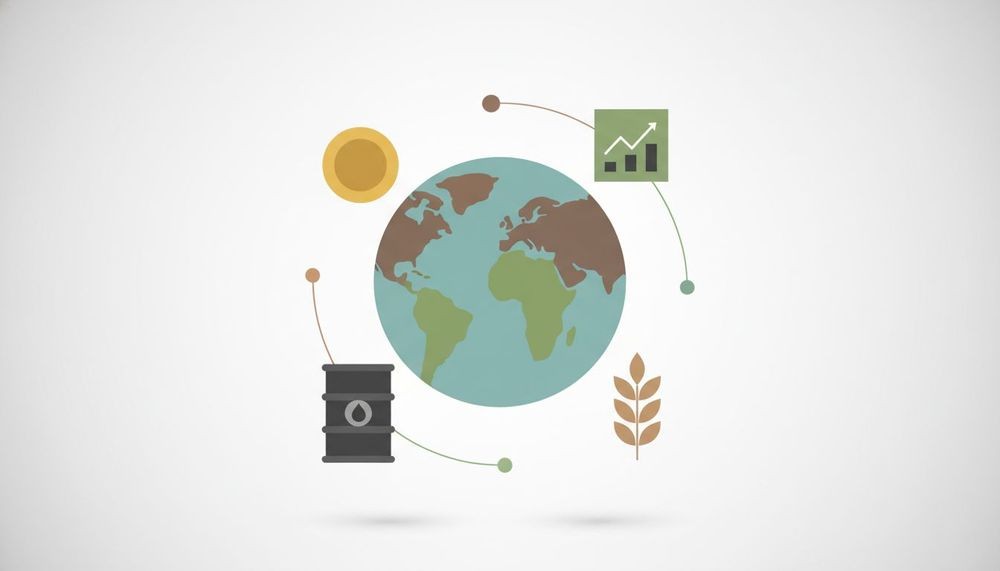
Commodities markets are defined as physical or virtual venues where raw materials and primary products are bought, sold, and traded, serving as the global economy’s price discovery engine. The St. Louis Fed defines commodities as raw materials grouped into energy (oil, natural gas), metals (copper, nickel), and agriculture (grain, dairy cattle). Understanding commodity markets is foundational for any investor who wants to grasp how the real economy connects to financial trading. These markets set the prices that ripple through supply chains, consumer goods, and investment portfolios worldwide.
What are commodities markets and how are they categorized?
Commodities markets trade two broad classes of goods: hard commodities and soft commodities. Hard commodities are extracted or mined, while soft commodities are grown or raised. This distinction matters because each class responds to different supply shocks, seasonal cycles, and geopolitical pressures.

Here is a breakdown of the main commodity categories and common examples:
| Category | Type | Examples |
|---|---|---|
| Energy | Hard | Crude oil, natural gas, coal |
| Metals | Hard | Gold, copper, silver, nickel |
| Agriculture | Soft | Wheat, corn, soybeans, coffee |
| Livestock | Soft | Live cattle, lean hogs |
Beyond these primary categories, secondary commodities also exist. These are processed or refined versions of raw materials, such as gasoline refined from crude oil or flour milled from wheat. Secondary commodities still trade in relation to their raw inputs, so price movements in crude oil directly affect gasoline futures.
Understanding commodities trading at this categorical level helps you recognize why a drought in Brazil sends coffee prices higher, or why a conflict in a major oil-producing region immediately moves energy markets. Each commodity category has its own supply chain, seasonal pattern, and set of price drivers. Knowing which category you are watching is the first step toward reading price movements with confidence.
How do commodities markets work?
Commodities markets operate through two distinct structures: spot markets and derivatives markets. Spot markets involve the immediate purchase and delivery of a physical commodity at the current market price. Derivatives markets, by contrast, trade contracts whose value is derived from an underlying commodity, with futures and options allowing participants to buy or sell at a specified price on a future date.
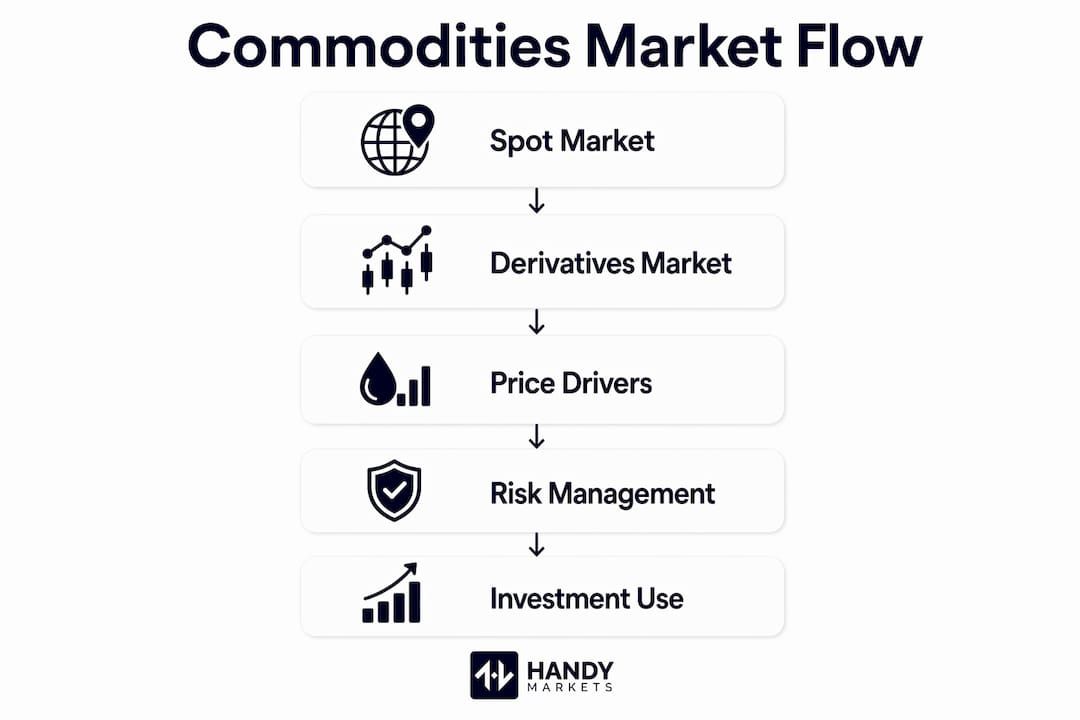
Price in both structures is driven by supply and demand, but the forces shaping that balance are complex. The St. Louis Fed identifies weather events, geopolitical risks, trade conditions, and investor sentiment as the primary drivers of commodity prices. A drought cuts wheat supply and pushes prices up. A trade deal opens new export markets and pulls prices down. Geopolitical tension in an oil-producing region can spike energy prices within hours.
The table below summarizes key price volatility factors across commodity sectors:
| Factor | Affected Sector | Price Direction |
|---|---|---|
| Drought or flood | Agriculture | Upward |
| Geopolitical conflict | Energy, metals | Upward |
| New trade agreements | Agriculture, energy | Downward |
| Rising investor demand | Metals, energy | Upward |
| Technological supply gains | Metals, energy | Downward |
One nuance worth understanding: commodity prices adjust slowly through the supply chain. A spike in crude oil does not instantly raise gasoline prices at the pump. Sustained and substantial price shifts are usually required before cost changes pass through to end consumers. This lag matters for investors timing trades around macroeconomic events.
Pro Tip: Always clarify whether you are looking at a spot price or a futures price for any commodity. Spot prices reflect today’s physical market. Futures prices reflect market expectations for a future date. Confusing the two is one of the most common mistakes beginners make.
What is the practical value of commodities markets for investors?
Commodity markets serve less as traditional stock markets and more as platforms for price discovery of critical inputs that affect the entire real economy. For investors, this creates two primary opportunities: hedging and speculation.
Hedging means using commodity derivatives to reduce risk. An airline, for example, buys crude oil futures to lock in fuel costs and protect against price spikes. A grain processor buys wheat futures to stabilize input costs. Retail investors can apply the same logic, using commodity derivatives for risk management to offset inflation exposure in a broader portfolio.
Speculation means taking a directional position on price movement without any intention of taking physical delivery. Most retail investors in commodities markets are speculators. They use futures and options to profit from anticipated supply-demand shifts, geopolitical developments, or seasonal price patterns.
Here are the core benefits and risks of commodities investing:
Benefits:
- Portfolio diversification, since commodities often move independently of stocks and bonds
- Inflation protection, because commodity prices tend to rise when consumer prices rise
- Exposure to global macroeconomic trends, including energy transitions and food security
- Liquidity in major markets like crude oil and gold, with deep trading volumes daily
Risks:
- High price volatility driven by weather, politics, and sentiment
- Leverage in futures contracts can amplify losses as well as gains
- Contract expiration and rollover costs can erode returns for long-term holders
- Physical delivery obligations if contracts are not closed before expiration
For a broader view of how commodities fit into a diversified investment portfolio, pairing commodity exposure with equities and fixed income can reduce overall portfolio volatility. Commodities are not a standalone strategy. They are a complement to a well-structured financial plan.
Pro Tip: If you are new to commodities, consider starting with exchange-traded funds (ETFs) that track commodity indices rather than trading futures directly. ETFs give you price exposure without the complexity of contract management, margin requirements, or expiration risk.
How do commodity exchanges and benchmark products work?
Commodity exchanges are regulated marketplaces where standardized contracts are listed, traded, and cleared. CME Group, based in Chicago, is the world’s largest commodity exchange operator, listing benchmark products across energy, agriculture, and metals. Other major exchanges include the Intercontinental Exchange (ICE) and the London Metal Exchange (LME).
Standardization is what makes commodity exchanges function as financial markets. Physical commodities are standardized by grade, quality, quantity, and delivery terms so that a futures contract for West Texas Intermediate (WTI) crude oil means the same thing to every buyer and seller on the exchange. This fungibility creates liquidity, which in turn creates tighter bid-ask spreads and more accurate price discovery.
Here are some of the most actively traded benchmark commodities and their primary exchanges:
| Benchmark Commodity | Exchange | Sector |
|---|---|---|
| WTI Crude Oil | CME Group (NYMEX) | Energy |
| Brent Crude Oil | ICE | Energy |
| Gold | CME Group (COMEX) | Metals |
| Copper | LME, CME Group | Metals |
| Corn | CME Group (CBOT) | Agriculture |
| Wheat | CME Group (CBOT) | Agriculture |
Clearinghouses play a critical role in making large-scale derivatives trading possible. CME Clearing acts as a neutral counterparty to every futures and options trade, guaranteeing contract performance and eliminating bilateral credit risk between buyers and sellers. This means you do not need to worry about whether the other side of your trade can fulfill its obligation. The clearinghouse stands between both parties and absorbs that risk.
Understanding how futures trading software and exchange infrastructure work together gives you a clearer picture of why commodity markets are considered among the most transparent and liquid in the world. The combination of standardized contracts, regulated exchanges, and central clearing creates a system where price information is reliable and trade execution is consistent.
Key takeaways
Commodities markets are the global economy’s price-setting mechanism, and understanding their structure, from spot markets to derivatives to clearinghouses, gives investors a meaningful edge in building and protecting wealth.
| Point | Details |
|---|---|
| Two market structures | Spot markets handle immediate delivery; derivatives markets trade futures and options for future dates. |
| Price drivers are complex | Weather, geopolitics, trade conditions, and investor sentiment all move commodity prices. |
| Standardization creates liquidity | Contracts defined by grade, quality, and delivery terms allow fungible, large-scale trading. |
| Clearinghouses reduce risk | CME Clearing guarantees contract performance, eliminating bilateral credit risk for all participants. |
| Investors have multiple entry points | ETFs, futures, and options each offer different levels of exposure, complexity, and risk. |
Our take on learning commodities markets as a beginner
The single most important distinction a new investor can make is between the spot market and the derivatives market. Most beginners assume they are the same thing. They are not. Spot prices tell you what a commodity costs right now. Futures prices tell you what the market expects it to cost at a specific point in the future. Treating them as interchangeable leads to misread signals and poor timing.
We have also seen many beginners underestimate how much oil price volatility in energy markets can cascade into equities, inflation expectations, and currency movements. Commodities are not isolated. They are the raw inputs of the entire economy, and their price movements are early signals of broader economic shifts.
The other pitfall we see consistently is ignoring contract mechanics. Many derivatives traders never intend to take physical delivery, yet they get caught by expiration dates, rollover costs, or margin calls because they did not read the contract specifications carefully. Before you trade any futures product, understand the contract size, the expiration cycle, and the margin requirements.
Our honest advice: start by watching commodity prices regularly before you trade them. Track crude oil, gold, and wheat for a few weeks. Notice what news events move them. Notice how spot and futures prices diverge and converge. That observational habit builds the intuition that no textbook can fully replace.
Track commodities markets in real time with Handy.Markets
Building your understanding of commodities markets is one thing. Watching them move in real time is where that knowledge becomes useful.
Handy gives you live prices, percentage changes, and customizable alerts across energy, metals, and agricultural commodities, all in one place. You can set up price alerts for commodities through Telegram, Discord, Slack, SMS, or email so you never miss a significant market move. Whether you are tracking crude oil ahead of a geopolitical event or monitoring gold during an inflation spike, Handy puts the data where you need it. Explore the full financial markets dashboard and start monitoring the commodities that matter to your portfolio today.
FAQ
What are commodities markets in simple terms?
Commodities markets are venues where raw materials like crude oil, gold, and wheat are bought and sold. They set prices for the physical inputs that drive the global economy.
What is the difference between spot and futures markets?
Spot markets involve immediate purchase and delivery at the current price. Futures markets trade standardized contracts for delivery at a specified future date, allowing participants to lock in prices or speculate on price direction.
Do I need to take physical delivery when trading commodity futures?
No. Most retail investors and speculators never take physical delivery and instead close their positions before contract expiration. Understanding contract expiration dates is critical to avoiding unintended delivery obligations.
What drives commodity prices up or down?
Commodity prices are driven by supply and demand, shaped by weather events, geopolitical risks, trade agreements, and investor sentiment. A single drought or conflict can shift prices significantly within days.
How can commodities fit into an investment portfolio?
Commodities provide portfolio diversification and inflation protection because their prices often move independently of stocks and bonds. Investors access them through futures, options, or commodity ETFs depending on their risk tolerance and experience level.