
TL;DR:
- Portfolio tracking consolidates investment data across multiple accounts to provide real-time insights into value, performance, and allocation. It relies on read-only APIs, wallet addresses, and manual entry to ensure security while enabling accurate monitoring and informed decision-making. Regular reviews, alerts, and automation help investors manage diversification, control risk, and avoid behavioral mistakes.
Portfolio tracking is the practice of gathering, organizing, and monitoring data on your investment holdings across multiple accounts to understand their current value, performance, and allocation. Think of it as a live dashboard for your financial life. Whether you hold stocks on Fidelity, crypto on Coinbase, or commodities through a brokerage, portfolio tracking pulls those scattered positions into one clear picture. Tools like Stock Rover, CoinMarketCap, and Gate provide exactly this kind of consolidated visibility. The result is not just convenience. It is the foundation for smarter decisions, better risk awareness, and disciplined rebalancing.
What is portfolio tracking and how does it work?
Portfolio tracking is the process of aggregating investment data from multiple sources into a single view so you can monitor performance, allocation, and risk in real time. The industry term for this practice is investment portfolio monitoring, though “portfolio tracking” is the phrase most individual investors use when searching for tools and guidance.

The mechanics behind a portfolio tracker depend on three main data sources. First, exchange APIs connect directly to platforms like Coinbase or Interactive Brokers and pull balance and transaction data automatically. Second, wallet address imports allow crypto trackers to read on-chain data from addresses on networks like Ethereum or Solana without requiring login credentials. Third, manual entry lets you record positions that cannot be linked digitally, such as physical gold or private equity stakes.
A critical distinction: portfolio trackers are non-custody tools. They read and organize your data but never hold or control your assets. Custody stays with your exchange or wallet. This means connecting a tracker via API does not give it the ability to move funds. It only reads what you own.
Once data flows in, trackers reconstruct your transaction history as the canonical source of truth. Reliable metrics require consistent transaction capture across every account, because accurate profit and loss calculations depend on knowing your exact cost basis for each position. A tracker that misses even a few transactions will show distorted returns.
The data types a good tracker provides include:
- Current balances across all accounts and asset classes
- Cost basis per position, calculated from your purchase history
- Unrealized and realized profit and loss in both dollar and percentage terms
- Asset allocation breakdown by sector, asset class, or geography
- Historical performance charts showing portfolio growth over time
- Transaction history for auditing and tax preparation
Dashboard features like real-time data updates and multi-chain aggregation make it possible to track crypto holdings across dozens of blockchains alongside traditional equities in one place.
Pro Tip: Always use read-only API keys when connecting a tracker to an exchange. A read-only key gives the tracker access to your data without any ability to place trades or withdraw funds, which eliminates a significant security risk.
How does portfolio tracking differ from portfolio management?
These two concepts are related but distinct, and confusing them leads investors to expect the wrong things from their tools.
| Concept | Definition | Primary Action |
|---|---|---|
| Portfolio tracking | Aggregating and monitoring investment data | Observe, measure, and report |
| Portfolio management | Selecting, adjusting, and rebalancing investments | Decide, execute, and optimize |
| Custody | Holding and controlling assets | Store and secure |
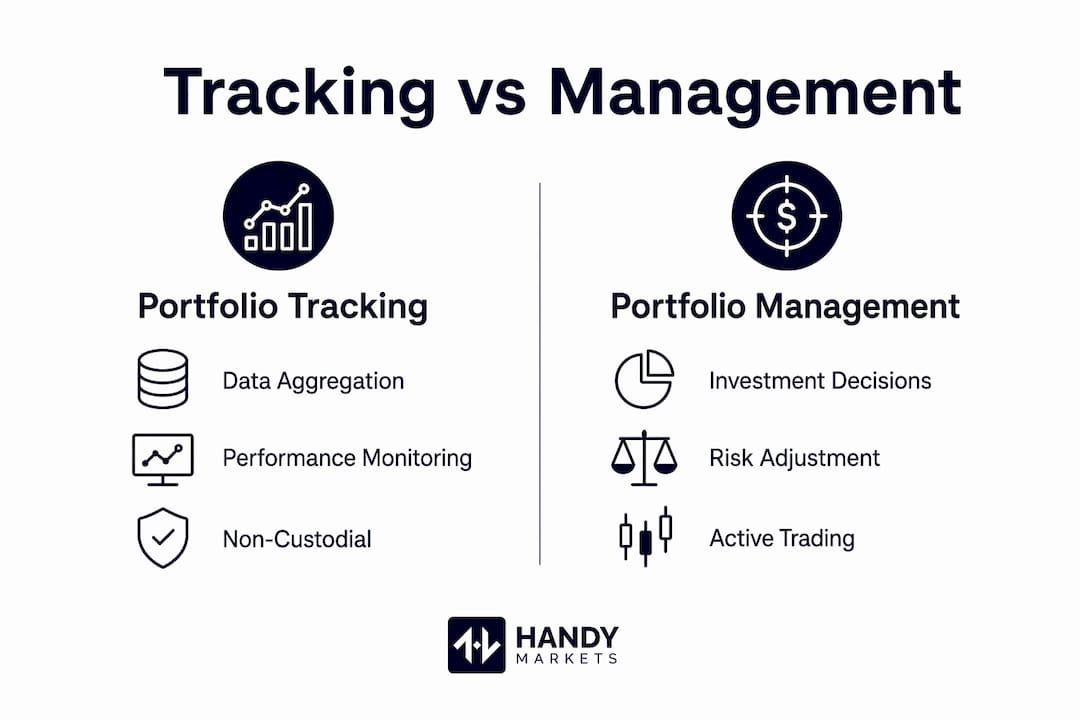
Portfolio management is the active process of deciding what to buy, sell, or hold based on your financial goals, risk tolerance, and market conditions. It includes tasks like setting a target allocation (for example, 60% equities, 30% bonds, 10% alternatives), executing trades, and periodically rebalancing when market movements push your allocation off target.
Portfolio tracking provides the data layer that makes informed management possible. Without accurate, up-to-date tracking, you are managing blind. You might think you hold 20% in tech stocks, but without a tracker reconciling every position, that number could be 28% after a strong rally. Monitoring drift and rebalancing to restore target allocations is one of the most consistent practices among disciplined investors, and it depends entirely on accurate tracking data.
The key distinction is that tracking tools do not make decisions. They surface information. Whether you act on that information manually or through an automated rebalancing service is the management layer. Tools like Stock Rover provide tracking and screening features but still require you to execute trades through a separate brokerage. That separation is intentional and worth understanding before you choose your tools.
Why does portfolio tracking matter for diverse investment portfolios?
Investors who hold assets across multiple platforms face a specific problem: without a unified view, allocation drift goes undetected until it causes real damage.
Consider a scenario where you hold tech stocks, Bitcoin, and a real estate investment trust across three separate accounts. Each account shows you its own slice of the picture. None of them tells you that your combined tech exposure, counting both direct stock holdings and tech-heavy ETFs, has grown to 45% of your total portfolio after a strong quarter. A tracker catches that overconcentration before it becomes a liability.
Here are four concrete reasons why continuous tracking matters:
- Early detection of overconcentration. Trackers provide unified views that reduce manual error and flag when any single position or sector grows beyond your intended weight.
- Smarter rebalancing decisions. When you can see exactly how far each position has drifted from its target, rebalancing becomes a data-driven exercise rather than a gut-feel one.
- Reduced emotional trading. Tracking increases discipline by replacing reactive impulses with systematic monitoring. Seeing a red day in context of your full portfolio performance is far less alarming than watching a single stock drop in isolation.
- Tax and reporting efficiency. Accurate cost basis records and transaction histories make year-end tax preparation significantly faster, especially for investors with frequent trades or crypto activity.
“The investor who tracks consistently does not need to predict the market. They simply need to know where they stand at any given moment.” This is the practical power of financial portfolio tracking: it replaces anxiety with clarity.
Automated data integration reduces the manual workload that makes spreadsheet-based tracking unsustainable for most investors. A spreadsheet requires you to update every position manually after every trade. A linked tracker updates itself. That difference in friction determines whether most people actually maintain their tracking practice over time.
What features and best practices make portfolio trackers effective?
The best portfolio tracking apps share a core set of features, but how you configure and use them determines whether you get real value or just a pretty dashboard.
Alerts are the most underused feature in most trackers. Configurable alerts can notify you when a single asset crosses a price threshold, when your allocation to any sector exceeds a set percentage, or when your portfolio draws down by more than a defined amount. These alerts transform passive monitoring into active awareness without requiring you to check prices constantly. Platforms like Handy deliver these notifications across Telegram, Discord, Slack, SMS, and email, so you receive them wherever you actually pay attention.
Key features to look for when evaluating any tracker:
- Multi-asset support covering stocks, ETFs, crypto, commodities, and forex in one place
- Read-only API integrations that connect automatically without manual data entry
- Cost basis tracking with support for methods like FIFO, LIFO, and average cost
- P&L reports broken down by position, time period, and asset class
- Allocation charts showing current weights versus target weights
- Price and threshold alerts delivered through your preferred channels
Pro Tip: Set a calendar reminder to review your full portfolio allocation once per month, not just individual positions. Monthly reviews catch drift early and prevent the kind of gradual overconcentration that only becomes visible after significant losses.
Linked and automatic updates from read-only connections are far more reliable than manual spreadsheet entry. Manual entry introduces human error and creates gaps whenever you forget to log a trade. The accuracy of your P&L and allocation data is only as good as the completeness of your transaction history.
For tax preparation, trackers that export detailed transaction reports in formats compatible with tax software save hours of reconciliation work. If you trade crypto across multiple wallets and exchanges, this feature alone justifies the time spent setting up a tracker properly.
Security best practices are straightforward. Use read-only API keys exclusively. Never grant withdrawal permissions to a tracking tool. Review which permissions each API key carries before connecting it. For crypto wallets, use public address imports rather than private keys or seed phrases. A tracker needs to see your data, not control it.
Key takeaways
Effective portfolio tracking gives investors the data clarity they need to manage allocation, control risk, and make decisions based on facts rather than instinct.
| Point | Details |
|---|---|
| Tracking is non-custody | Trackers read your data via APIs or addresses but never hold or move your assets. |
| Tracking enables management | Accurate tracking data is the foundation for every informed rebalancing and allocation decision. |
| Alerts prevent drift | Configurable price and allocation alerts catch overconcentration before it becomes a problem. |
| Automation beats spreadsheets | Read-only API connections update automatically and eliminate the manual errors that make spreadsheets unreliable. |
| Consistency is the key habit | Monthly portfolio reviews combined with real-time alerts create the discipline that separates reactive investors from strategic ones. |
Why tracking changed how we think about investing at Handy
The honest truth about portfolio tracking is that most investors underestimate how much their behavior changes once they can actually see their full picture. Before we built Handy around real-time market data and alerts, we watched investors make decisions based on partial information. They knew their crypto was up, but they did not know their overall portfolio had drifted 15 percentage points from its intended allocation. That gap between what they thought they owned and what they actually owned was the source of most of the anxiety and impulsive decisions we observed.
What we have found is that tracking does not just inform decisions. It slows them down in the best possible way. When you receive an alert that a position has crossed a threshold you set yourself, you respond to a plan rather than to emotion. That single shift, from reacting to price movements to responding to your own criteria, is where most of the behavioral improvement comes from.
We also believe that starting early matters more than starting perfectly. A basic tracker with incomplete data is still better than no tracker at all. You can refine your setup over time. What you cannot recover is the time spent managing a portfolio without knowing what you actually hold. The investors we see succeed long-term are not necessarily the ones with the most sophisticated tools. They are the ones who check their allocation regularly, set alerts for meaningful thresholds, and treat tracking as a non-negotiable part of their investment practice.
Start tracking smarter with Handy.Markets
If you are ready to put these principles into practice, Handy makes it straightforward to monitor multiple financial markets in one place, covering crypto, stocks, forex, commodities, and indices with live price data and percentage changes updated in real time.
You can set up price alerts across Telegram, Discord, Slack, SMS, Webhook, and Email in minutes, so you never miss a threshold crossing that matters to your portfolio. Whether you are tracking a single stock position or a diversified multi-asset portfolio, Handy gives you the visibility layer that turns scattered market data into a clear, organized picture. Start with the assets you already hold and build your monitoring setup from there.
FAQ
What is portfolio tracking in simple terms?
Portfolio tracking is the process of monitoring all your investment holdings in one place to see their current value, performance, and allocation. It uses tools that connect to your accounts via APIs or wallet addresses to keep your data current automatically.
Is portfolio tracking the same as having a brokerage account?
No. A brokerage account holds and executes your investments. A portfolio tracker only reads and organizes data from your accounts without holding assets or placing trades. Tracking is about visibility, not custody.
How often should I review my portfolio?
Most disciplined investors review their full allocation monthly and set real-time alerts for significant price or threshold changes. Periodic monitoring and rebalancing keeps your portfolio aligned with your risk and return objectives without requiring daily attention.
What data does a portfolio tracker actually collect?
A tracker collects balances, transaction history, cost basis, unrealized and realized profit and loss, and asset allocation data from connected accounts. It does not collect passwords or private keys when configured correctly with read-only API access.
Can I track crypto and stocks in the same portfolio tracker?
Yes. Multi-asset trackers support stocks, ETFs, crypto, commodities, and forex in a single dashboard. Handy covers all of these asset classes with live prices and alerts across multiple notification channels.