
TL;DR:
- Market aggregation consolidates prices, liquidity, and account data across multiple venues to improve trading efficiency and decision-making. It enhances execution quality with tighter spreads and deeper market depth, while streamlining portfolio management through unified views of financial accounts. However, reliance on third-party aggregators introduces operational and regulatory risks that require ongoing review and technological vigilance.
Financial markets are fragmented by nature. Prices for the same asset can differ across dozens of venues simultaneously, and portfolio data often lives scattered across multiple institutions, brokerages, and asset classes. Understanding what is market aggregation and how it addresses these inefficiencies is not optional for serious finance professionals. It is the infrastructure layer that makes modern trading, portfolio management, and real-time decision-making possible. This guide covers both liquidity and account aggregation, the mechanics behind each, the risks you need to know, and where the field is heading.
Table of Contents
- Key Takeaways
- What is market aggregation and how liquidity aggregation works
- Account aggregation for portfolio management
- Technical challenges in market aggregation
- Market aggregation vs. market segmentation
- Practical applications and future trends
- Our perspective on the evolving role of market aggregation
- How Handy helps you track aggregated market data
- FAQ
Key Takeaways
| Point | Details |
|---|---|
| Aggregation unifies fragmented markets | Market aggregation consolidates prices, orders, and account data from multiple sources into one actionable view. |
| Execution quality improves measurably | Liquidity aggregation delivers tighter spreads, deeper order books, and better fill rates than single-venue trading. |
| Account aggregation aids planning | Consolidating brokerage, savings, and debt accounts into one dashboard supports clearer financial decision-making. |
| Operational risks are real | Dependence on third-party aggregators introduces coupling risk, where uptime failures can stall trading or reporting. |
| Regulation is tightening | Antitrust enforcement around aggregated data sharing is increasing, with direct implications for data-driven investment strategies. |
What is market aggregation and how liquidity aggregation works
At its core, market aggregation in finance refers to two distinct but related practices: liquidity aggregation and account aggregation. Liquidity aggregation consolidates bid/ask quotes from multiple trading venues into a single composite order book, while account aggregation compiles data from diverse financial accounts into one unified view for analysis and planning.
Liquidity fragmentation is the central problem that liquidity aggregation solves. In global forex markets, for example, a currency pair like EUR/USD trades across interbank networks, electronic communication networks (ECNs), dark pools, and retail brokers simultaneously. Each venue has its own pricing, depth, and execution quality. Without aggregation, a trader sees only a fraction of available liquidity and may execute at an inferior price.
The mechanics of liquidity aggregation involve several steps. An aggregator collects live quotes from multiple providers, normalizes them by aligning timestamps and filtering anomalous data, and builds a composite order book. Smart Order Routing (SOR) then routes each trade to the venue offering the best available price and fill probability. Normalization aligns timestamps and filters outliers in milliseconds, protecting traders from executing against stale or toxic liquidity.
The performance differences between single-source and aggregated liquidity are significant in practice:
| Metric | Single-source liquidity | Aggregated liquidity |
|---|---|---|
| Bid/ask spread | Wider, venue-dependent | Tighter, competitively priced |
| Market depth | Limited to one provider | Combined across multiple venues |
| Execution reliability | Vulnerable to single-venue outages | Resilient, reroutes on failure |
| Coverage of asset pairs | Dependent on provider | Broader, especially for less common pairs |
| Price competitiveness | Static | Dynamic, best-of-book pricing |
In cryptocurrency markets, the benefit is even more pronounced. Aggregation combines multiple sources improving rate competitiveness, breadth of asset coverage, and resilient execution during volatility. When a major exchange experiences congestion during a market shock, aggregators automatically route to alternative venues, protecting execution quality.
Pro Tip: Most traders focus on headline spread but overlook order book depth. A tight spread on a thin book fills partially at the quoted price and the rest at a worse level. Check both when evaluating any aggregated liquidity provider.
Account aggregation for portfolio management
While liquidity aggregation focuses on trade execution, account aggregation serves a different purpose. It answers the question: where do I actually stand, across all my accounts, right now?

Account aggregation consolidates data from savings, checking, brokerage, debt, and assets into a unified view, streamlining financial management and planning. For an individual investor with a 401(k), a taxable brokerage account, a mortgage, and a savings account at different institutions, this means seeing net worth, asset allocation, and cash flow in one place rather than logging into four separate platforms.
For financial advisors, account aggregation is operationally transformative. Rather than manually pulling data from each custodian before a client meeting, an advisor can access a real-time consolidated view of a household’s full financial picture. This supports more accurate rebalancing recommendations, tax-loss harvesting decisions, and holistic risk assessment.
The key features of account aggregation include:
- Read-only access to linked accounts, protecting security by preventing transactions through the aggregation layer
- Householding, where family member accounts are linked together for collective financial goal tracking
- Multi-asset class visibility spanning equities, fixed income, real estate, and alternative investments
- Debt and liability integration, giving a true net worth figure rather than just gross assets
- Automated data refresh, eliminating manual data entry and reducing human error in reporting
Pro Tip: When evaluating account aggregation platforms, confirm how they handle credential storage. The most secure services use tokenized connections through open banking APIs rather than storing your login credentials directly. This matters significantly for both individual investors and advisor-client relationships.
Technical challenges in market aggregation
Understanding what financial market aggregation looks like in practice means confronting some genuine operational complexity. The benefits are real, but so are the engineering and risk management challenges that sit underneath them.
API integration is the most immediate hurdle. Financial data providers use different schemas, authentication protocols, and update frequencies. When a provider updates its API, any aggregation layer built on top of it faces version drift. Third-party aggregators reduce operational overhead by managing connectors and API drift across multiple channels, which is why many firms outsource this layer rather than building it in-house.
The bigger concern, though, is operational coupling. When your trading system, reporting workflow, or client dashboard depends on a third-party aggregator, failures or API changes at the aggregator level can stall downstream workflows, impacting trade execution or reporting at exactly the wrong moment. This is not a theoretical risk. During periods of peak volatility, aggregators face their highest load precisely when traders need them most.
The regulatory dimension adds another layer of complexity. Algorithmic pricing systems that operate on aggregated data can produce synchronized price movements across competing vendors, even without explicit coordination. Identical items show a 13% average high-low price difference, up to 23%, due to pricing algorithms intermediating market information. Regulators are paying attention. The DOJ and FTC have tightened scrutiny on aggregation, withdrawing lenient guidance on competitor data-sharing collaboration.
| Challenge | Description | Mitigation strategy |
|---|---|---|
| API version drift | Provider API updates break integrations | Use third-party aggregation layers with managed connectors |
| Stale data execution | Outdated quotes lead to poor fills | Real-time normalization and timestamp filtering |
| Aggregator downtime | Single point of failure in workflow | Redundant providers and fallback routing rules |
| Regulatory exposure | Synchronized pricing triggers antitrust concern | Legal review of data-sharing agreements and pricing models |
| Schema translation | Different data formats across venues | Standardized normalization pipelines |
Innovation is also reshaping this space. Prediction market platforms like agg.market now use AI-powered multi-LLM matching achieving less than 0.1% false positives, aggregating six leading venues into one interface with smart order routing. That level of precision is becoming a baseline expectation, not a differentiator, across aggregated market infrastructure.
Market aggregation vs. market segmentation
Finance professionals sometimes conflate market aggregation with market segmentation, but they represent opposite strategic philosophies. Understanding the distinction clarifies when each approach serves investors best.
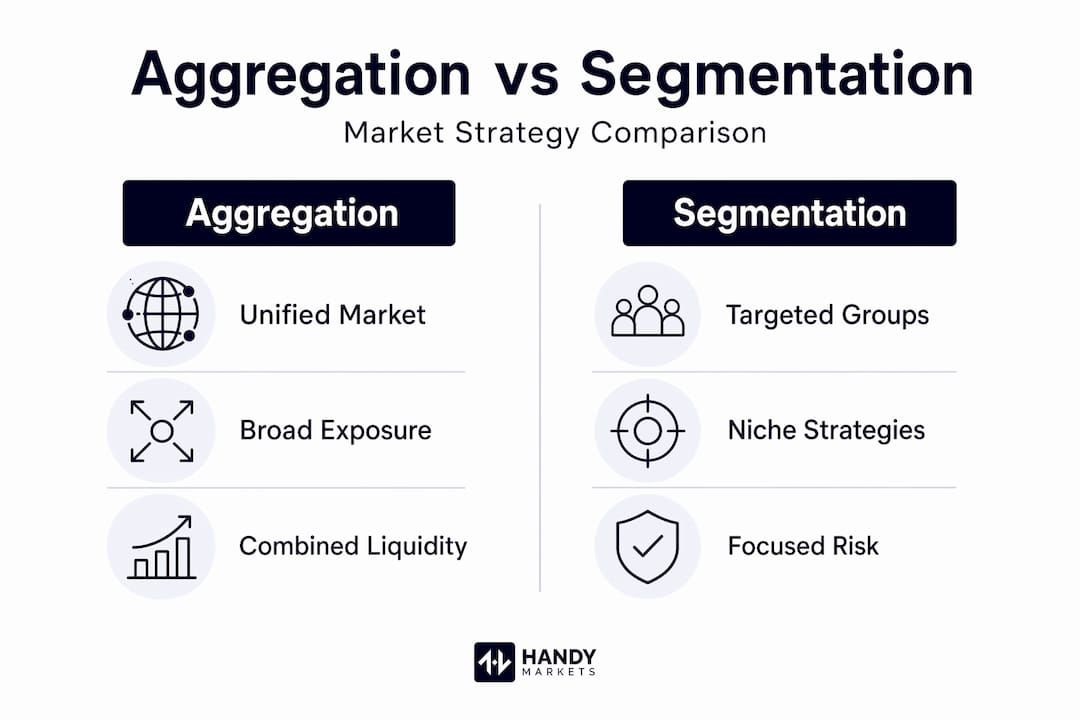
Market segmentation divides a broad market into distinct subgroups based on characteristics like asset class, risk profile, geography, or investor type. A fund that targets only small-cap growth equities in emerging markets is practicing segmentation. Market aggregation does the opposite. It treats a broad market as a unified whole, pursuing economies of scale, wider exposure, and operational efficiency across segments rather than within one.
For investors, aggregation as a strategy supports cross-asset and multi-venue positioning. A macro investor who wants exposure to currency moves, commodity prices, and equity volatility simultaneously benefits from aggregated market data that shows these relationships in real time. Segmentation would force them to analyze each piece in isolation.
Here is how the two approaches compare in practice:
Advantages of market aggregation:
- Broader market exposure and diversification across asset classes
- Economies of scale in execution and data processing
- Better liquidity through consolidated order books
- Simplified monitoring with unified data views
Limitations of market aggregation:
- May obscure nuances within specific market segments
- Aggregators can develop structural power over participants (more on this below)
- Regulatory complexity increases with scale and data sharing
Advantages of market segmentation:
- Precision targeting of specific opportunities or risk factors
- Clearer attribution of performance to segment-specific factors
- Simpler regulatory exposure in some cases
Controlling the consumer search interface gives aggregators leverage over suppliers, impacting fees and compliance. This is a structural reality that professionals must factor into any relationship with a dominant aggregation platform. It is not inherently problematic, but it is worth understanding before you become operationally dependent on a single aggregator.
Practical applications and future trends
The most immediate application of market aggregation for active investors is improving real-time market data quality and trade execution. When you route orders through an aggregated system rather than a single venue, you consistently access better prices and deeper liquidity, particularly during volatile sessions. For large institutional trades, even a few basis points of improvement in execution quality compounds significantly over time.
Portfolio management is the second major application. Aggregated data across asset classes gives you a live view of correlations, concentration risk, and overall portfolio behavior that simply is not possible when you monitor each position in isolation. The best market analysis techniques now rely on aggregated feeds as their primary data layer.
Looking ahead, three trends will reshape how professionals interact with market aggregation. First, AI-driven routing optimization is becoming standard. Systems that adapt order routing in real time based on historical fill quality, latency, and current market conditions are replacing static SOR logic. Second, cross-chain aggregation in crypto markets is growing rapidly, with protocols that unify liquidity across dozens of blockchains and decentralized exchanges into a single execution layer. Third, regulatory pressure will force greater transparency in how aggregators handle and monetize data.
Emerging market data trends in 2026, including open banking expansion and real-time settlement initiatives, are also pushing aggregation capabilities further. Professionals who understand these shifts will be better positioned to select platforms and tools that align with both their execution needs and their compliance obligations.
Pro Tip: When choosing an aggregation platform or tool, ask two questions before anything else: Where does the data come from, and what happens if the aggregator goes down? Vendors who cannot answer both clearly are not ready for professional use.
Our perspective on the evolving role of market aggregation
I’ve spent enough time watching professionals adopt aggregation tools to know that the benefits are genuine and the risks are underappreciated in equal measure.
What I’ve learned is that the biggest mistake firms make is treating aggregation as a solved problem once a platform is in place. In my experience, the aggregation layer is actually a living dependency that requires ongoing review. API drift, provider consolidation, and regulatory shifts can quietly erode the value of a system that worked perfectly two years ago.
My take on the regulatory dimension is that it deserves more attention than most investment professionals give it. Antitrust enforcement is increasingly rigorous on firms sharing aggregated competitive data that may coordinate pricing or employment terms. If your data-sharing arrangements have not been reviewed recently, they probably should be.
On the future, I’m genuinely encouraged by AI-powered routing and cross-chain aggregation. These technologies are expanding access to institutional-quality execution for a much broader range of investors. But I’d caution against adopting any new aggregation technology without stress-testing its behavior during volatile sessions. Performance during calm markets tells you very little about how a system behaves when it actually matters.
How Handy helps you track aggregated market data
Staying on top of fragmented markets across multiple asset classes is exactly the problem Handy was built to solve. The platform aggregates live prices, percentage changes, and real-time data across cryptocurrencies, stocks, commodities, forex, and indices, giving you a unified view without the complexity of stitching together multiple data sources yourself.
With Handy’s financial markets tracking, you can monitor all major asset classes in one place, personalize your watchlists, and set up price alerts across Telegram, Discord, Slack, SMS, Webhook, and Email so you never miss a critical move. Whether you are monitoring live crypto prices or tracking equity positions, Handy gives you the aggregated market intelligence to act with confidence, not guesswork.
FAQ
What is market aggregation in finance?
Market aggregation in finance refers to the process of consolidating data, prices, or liquidity from multiple sources into a unified view. It encompasses both liquidity aggregation, which combines order books from multiple trading venues, and account aggregation, which unifies financial account data across institutions.
How does liquidity aggregation improve trade execution?
Liquidity aggregation improves execution by combining bid/ask quotes from multiple venues into a composite order book, giving traders access to tighter spreads, deeper market depth, and more reliable fills than any single venue can provide independently.
What is the difference between market aggregation and market segmentation?
Market aggregation treats a broad market as a unified whole, pursuing scale and broad exposure, while market segmentation divides markets into specific subgroups for targeted analysis. Aggregation prioritizes efficiency and coverage; segmentation prioritizes precision.
What are the main risks of relying on a market aggregator?
The primary risks include operational coupling, where aggregator downtime can disrupt trading or reporting, API version drift that breaks data integrations, and regulatory exposure if aggregated data sharing is found to coordinate pricing in ways that attract antitrust scrutiny.
How is AI changing market aggregation?
AI is improving aggregation by enabling smarter order routing based on real-time execution quality signals, powering multi-LLM market matching with very low false-positive rates, and optimizing pricing decisions across aggregated data feeds with greater speed and accuracy than rule-based systems.