
TL;DR:
- The cryptocurrency market is a decentralized, 24/7 global network where digital currencies are bought, sold, and traded without central regulation.
- It operates on blockchain technology, with trades happening on centralized or decentralized exchanges, affecting prices through supply, demand, and sentiment.
The cryptocurrency market is a decentralized, global network where digital currencies are bought, sold, and traded across multiple platforms 24 hours a day, 7 days a week, without any central authority controlling prices or access. Unlike the New York Stock Exchange or Nasdaq, no single institution sets the rules. 67 million Americans now trade cryptocurrencies, roughly 1 in 4 adults. That scale reflects how far this market has moved from a niche experiment to a mainstream financial system. The cryptocurrency market explained simply is this: it is a living, pulsing network of buyers, sellers, exchanges, and algorithms operating without pause.
How does the cryptocurrency market work?
The cryptocurrency market runs on blockchain technology. A blockchain is a shared digital ledger that records every transaction across thousands of computers simultaneously. No single party can alter the record. This structure removes the need for banks or clearinghouses to verify trades.

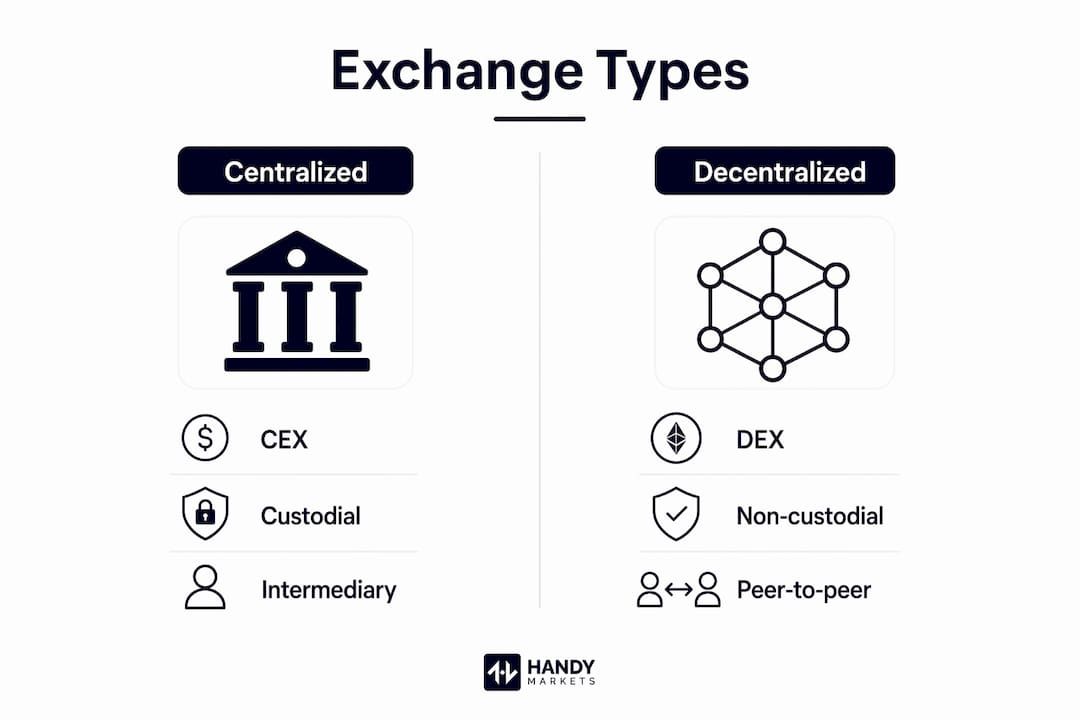
Trades happen on exchanges. Centralized exchanges (CEXs) like Coinbase and Binance act as intermediaries. They hold your funds, match your orders, and provide liquidity. Decentralized exchanges (DEXs) like Uniswap operate through smart contracts. They let you trade directly from your own wallet without depositing funds on a platform.
Every exchange runs an order book: a live list of buy orders (bids) and sell orders (asks). When a buyer’s bid matches a seller’s ask, the trade executes. A market order fills immediately at the current price. A limit order waits until the market reaches your target price. Trading mechanics also involve hidden fees that can affect your actual execution price, so always check the fee schedule before placing an order.
Trading pairs define what you are exchanging. In the pair BTC/USDT, Bitcoin (BTC) is the base asset and Tether (USDT) is the quote asset. The price tells you how many USDT you need to buy one BTC.
| Feature | Centralized Exchange (CEX) | Decentralized Exchange (DEX) |
|---|---|---|
| Custody of funds | Exchange holds your assets | You hold your assets |
| KYC required | Yes | Usually no |
| Liquidity | Generally higher | Varies by protocol |
| Ease of use | Beginner friendly | More technical |
| Counterparty risk | Higher | Lower |
Pro Tip: Start on a centralized exchange for simplicity, then explore DEXs once you understand wallet management and gas fees.
What drives cryptocurrency prices and market trends?
Cryptocurrency prices move on supply and demand, just like any other market. But the crypto market amplifies those moves because of thin liquidity, speculative behavior, and the absence of a central regulator to slow sharp swings. The market is the heartbeat of digital finance, and that heartbeat can race without warning.
Bitcoin dominance is one of the most reliable indicators of market direction. When Bitcoin’s share of total market capitalization rises, capital is flowing into Bitcoin and away from altcoins. When dominance falls, investors rotate into altcoins like Ethereum, Solana, or smaller tokens. Tracking this metric gives you a read on where the broader market cycle stands. You can follow Bitcoin dominance trends to anticipate these rotations before they fully play out.
Crypto prices are highly sensitive to social sentiment, news, and community expectations, often moving before fundamentals change. A single tweet from a prominent figure or a regulatory headline can shift prices by double digits in hours. This is not irrational behavior. It reflects the reality that in a market with no earnings reports or dividend yields, narrative and expectation carry enormous weight.
The main drivers of cryptocurrency price movements include:
- Supply mechanics: Bitcoin has a fixed supply of 21 million coins. Scarcity drives value when demand rises.
- Market sentiment: Fear and greed cycles push prices above and below fair value regularly.
- News and regulation: Government announcements, exchange hacks, or ETF approvals move markets fast.
- Speculation: Many participants trade on momentum rather than fundamentals.
- Institutional flows: Large fund purchases or sales create outsized price moves.
Pro Tip: Monitor platforms like X (formerly Twitter) and crypto news aggregators daily. Investor sentiment shifts fast in crypto, and being early to a narrative shift is one of the few real edges available to individual investors.
What are the main ways to trade and invest in crypto?
Understanding how to invest in cryptocurrency starts with knowing the difference between trading and investing. Trading means buying and selling frequently to profit from short-term price moves. Investing means buying and holding assets over months or years based on long-term conviction. Your time horizon and risk tolerance determine which approach fits you.
Spot trading is recommended for beginners because it is simpler and less risky than derivatives. In spot trading, you buy the actual asset and own it outright. There is no leverage, no expiry date, and no margin call risk. You can lose only what you put in.
Derivatives like futures and options let you speculate on price direction without owning the underlying asset. Futures contracts obligate you to buy or sell at a set price on a future date. Options give you the right, but not the obligation, to do so. Both instruments use leverage, which multiplies both gains and losses. These are not beginner tools.
Custodial wallets hold your private keys for you but carry counterparty risk. If the exchange is hacked or goes bankrupt, your assets may be lost. Self-hosted wallets like Ledger hardware wallets give you full control but require you to secure your own private keys. Losing your seed phrase means losing your funds permanently.
| Method | Risk level | Complexity | Best for |
|---|---|---|---|
| Spot trading | Medium | Low | Beginners |
| Futures trading | Very high | High | Experienced traders |
| Options | Very high | Very high | Advanced traders |
| Crypto ETFs | Medium | Low | Passive investors |
| Index funds | Medium | Low | Long-term investors |
Crypto ETFs, such as Bitcoin spot ETFs approved in the United States in 2024, let you gain exposure to Bitcoin’s price through a traditional brokerage account. You never hold the actual asset. This removes wallet management complexity and suits investors who want crypto market exposure without the technical overhead.
How can beginners enter the crypto market safely?
The safest entry point for new investors is spot trading on a regulated, reputable exchange. Regulated exchanges in the United States, such as Coinbase and Kraken, are required to follow anti-money laundering laws and maintain reserve standards. KYC verification on these platforms requires a government-issued ID, proof of residence, and a selfie. This process protects both the platform and you.
Security practices matter as much as market knowledge. Enable two-factor authentication (2FA) on every account. Never share your private keys or seed phrases with anyone. Use a hardware wallet for any amount you would not want to lose if an exchange were compromised. These steps are not optional precautions. They are the baseline for participating safely.
Common beginner mistakes to avoid:
- Investing more than you can afford to lose. Crypto is volatile. Allocate only a portion of your portfolio you are comfortable seeing drop significantly.
- Chasing price pumps. Buying after a large rally often means buying at the top. Patience matters.
- Ignoring fees. Trading fees, withdrawal fees, and network fees compound quickly. Always calculate total costs.
- Skipping research. Many tokens have no real use case. Verify the project, team, and technology before buying.
- Neglecting tax obligations. In the United States, crypto gains are taxable events. Keep records of every trade.
Pro Tip: Read through crypto investing tips and review beginner investing mistakes before placing your first trade. Preparation reduces costly errors.
The cryptocurrency market value was $2.3 billion in 2023 and is projected to reach $5.5 billion by 2033. That growth trajectory means more participants, more products, and more complexity ahead. Getting the fundamentals right now puts you ahead of the majority who enter without preparation.
Key Takeaways
The cryptocurrency market is a 24/7 decentralized system where understanding market mechanics, price drivers, and safe entry practices is the foundation of every sound investment decision.
| Point | Details |
|---|---|
| Market structure | Crypto trades on centralized and decentralized exchanges using order books and trading pairs. |
| Price drivers | Bitcoin dominance, sentiment, news, and speculation move prices more than fundamentals alone. |
| Trading methods | Spot trading is safest for beginners; derivatives require advanced knowledge and high risk tolerance. |
| Wallet security | Self-hosted wallets give full control; custodial wallets carry counterparty risk from the exchange. |
| Safe entry | Start on a regulated exchange, enable 2FA, and allocate only capital you can afford to lose. |
The crypto market rewards patience, not speed
At Handy Markets, we have watched countless beginners enter the crypto market expecting fast returns and exit with hard lessons. The market is not designed to reward urgency. It rewards preparation.
The most common mistake we see is treating crypto like a lottery ticket. Investors buy a token because it moved 40% last week, then panic sell when it drops 30% the following week. That cycle destroys capital and confidence simultaneously. The traders who build lasting results are the ones who understand what they own and why they own it.
Sentiment analysis is underrated by beginners and overused by experienced traders. The truth sits in the middle. Social media moves crypto prices in the short term. Fundamentals determine where prices settle over the long term. Knowing which force is driving a move at any given moment is the real skill.
We also believe the crypto market is still early. The infrastructure, regulation, and institutional participation are all maturing. That creates genuine opportunity, but it also creates genuine risk. The investors who thrive are those who stay curious, keep learning, and never stop questioning the narratives the market feeds them.
Track live crypto prices and set alerts with Handy Markets
Knowing the theory is only half the work. The other half is watching the market move in real time.
Handy Markets gives you live cryptocurrency prices with charts and price change alerts across Telegram, Discord, Slack, SMS, Webhook, and Email. You can monitor Bitcoin, Ethereum, and thousands of altcoins from one place without switching between platforms. Set a price alert for any asset in seconds and get notified the moment the market hits your target. Whether you are tracking your first investment or watching multiple positions, Handy Markets keeps you informed without the noise.
FAQ
What is the cryptocurrency market?
The cryptocurrency market is a decentralized global network where digital currencies like Bitcoin and Ethereum are bought, sold, and traded on exchanges 24 hours a day, 7 days a week, without a central authority.
How many people trade cryptocurrency in the United States?
As of june 2026, 67 million Americans trade cryptocurrencies, representing approximately 1 in 4 adults, an increase of 12 million from 2025.
What is the safest way for beginners to start trading crypto?
Spot trading on a regulated exchange is the safest starting point because you own the actual asset, use no leverage, and can only lose what you invest.
What is Bitcoin dominance and why does it matter?
Bitcoin dominance measures Bitcoin’s share of total crypto market capitalization. When it rises, capital flows into Bitcoin; when it falls, investors rotate into altcoins, signaling a shift in market sentiment.
What is the difference between a custodial and a self-hosted wallet?
A custodial wallet is managed by an exchange that holds your private keys, while a self-hosted wallet gives you direct control of your keys and full responsibility for your own security.