

The fastest way to get real-time crypto price alerts on Telegram is connecting your watchlist through Handy Markets’ Telegram integration, which handles data feeds, delivery retries, and multi-channel fallback so you never rely on Telegram alone. Head to the Handy Markets price alert page, pick an asset, and turn on Telegram delivery in under two minutes.
Prefer more control? Self-hosting an open-source bot is possible, but it means managing API keys, uptime, and a live server yourself.
- Fastest path: Handy Markets’ hosted Telegram integration (no server, no API key management).
- DIY path: self-hosted bot (full customization, more maintenance).
- Either way: you’ll pick a trigger type, an asset, and a delivery channel before your first alert fires.
Key Takeaways
Reliable Telegram crypto alerts depend on persistent delivery, the right trigger type for your strategy, and a fallback channel for anything mission-critical.
| Point | Details |
|---|---|
| Choose the right trigger | Match price, percent-change, or indicator triggers to your specific trading style. |
| Confirm before you trust it | Send a low-threshold test alert to verify your Telegram destination actually receives messages. |
| Guard your keys | Never share private keys or seed phrases with any bot, hosted or self-built. |
| Plan for rate limits | Use cooldowns and fallback channels so a Telegram throttling event doesn’t cost you a signal. |
| Handy Markets simplifies setup | Handy Markets delivers multi-asset alerts across Telegram and five other channels without server management or API key handling. |
Table of Contents
- How Do Telegram Crypto Alerts Work?
- Which Alert Triggers Should You Use?
- How Do You Set Up Telegram Alerts With Handy Markets?
- Should You Self-Host a Telegram Crypto Alert Bot?
- What Commands Create a Telegram Crypto Alert?
- How Do You Avoid Scam Telegram Crypto Bots?
- How Do You Fix Missing or Delayed Telegram Alerts?
- Why Choose Handy Markets for Crypto Alerts?
- What’s the Smartest Way to Combine Hosted and Self-Hosted Alerts?
- Set Up Reliable Telegram Alerts Without the Server Work
- Where Can You Learn More About Telegram Crypto Alerts?
- Frequently Asked Questions
- Sources
How Do Telegram Crypto Alerts Work?
An alert starts as a rule you define. Something like “notify me when Bitcoin crosses $95,000” or “alert me if Ethereum’s RSI drops below 30.” That rule sits in an evaluation engine that continuously checks live data against your condition. The moment the condition is true, the system hands the trigger to a delivery layer, which formats a message and pushes it to your Telegram bot or channel.
The data feeding that evaluation engine usually comes from exchange APIs like Binance, aggregators like CoinGecko or CoinCap, and dedicated indicator providers such as Taapi.io for RSI and MACD calculations. Delivery quality is where good systems separate from fragile ones.
- Alert rules are evaluated continuously against live price and indicator data.
- The delivery layer formats and sends the message once your condition is met.
- Reliable systems persist alerts before sending and retry automatically on failed delivery.
- Rate limits and idempotent writes prevent duplicate or missed notifications.
Hosted services built for production, like the delivery pipeline BlockPing documents for Telegram crypto alerts, persist every alert before dispatch and retry with backoff when Telegram returns a 429 rate-limit response. That single design choice is why some alerts arrive instantly and others vanish into the void.
Which Alert Triggers Should You Use?
Not every trigger fits every trading style, and picking the wrong one is how you end up either missing moves or drowning in noise. Here’s how the main types break down.
Price triggers fire when an asset crosses a fixed level, either above or below. These work best for entry and exit planning, like knowing the moment Bitcoin taps a resistance line you’ve been watching for weeks.
Percent-change triggers track relative movement instead of a fixed number. They’re built for catching momentum and sudden volatility. Open-source bots typically label these as PCTCHG or 24HRCHG parameters, letting you set something like “alert me if Solana moves significantly in 24 hours” without recalculating the dollar value every day.
Technical indicator triggers cover RSI, MACD, Bollinger Bands, and moving averages like SMA or EMA. Traders use RSI alerts to catch overbought or oversold conditions, and MACD crossovers to flag momentum shifts. Bots that support these often pull the calculation from an indicator service and let you define the timeframe and parameters directly in the alert command.
Exchange listing and wallet activity alerts matter more for a narrower group. New listings interest traders hunting early liquidity plays, while wallet-watch alerts flag on-chain movement from whales or specific addresses.
- Combine a price trigger with an indicator confirmation to cut down on false signals.
- Use percent-change triggers for volatile small caps, not blue-chip pairs that barely move.
- Reserve wallet and listing alerts for assets where on-chain behavior actually drives price.
How Do You Set Up Telegram Alerts With Handy Markets?
This is the path most traders should start with, since it skips server setup entirely and gets you receiving alerts the same day.
Before you begin, you’ll need three things: a Handy Markets account, an active Telegram account, and (if you’re posting to a group rather than a direct message) permission to add a bot as an admin.
- Create your Handy Markets account and open the markets dashboard to browse supported assets.
- Link your Telegram destination. Authorize the Handy Markets bot for direct messages, or add it as an admin in a group or channel you control.
- Choose your asset. Search for the exact pair, whether that’s a major coin or something from the full cryptocurrency list.
- Select your trigger type. Pick price, percent-change, or indicator based alerts depending on your strategy.
- Set the timeframe and cooldown. A cooldown period stops the same alert from firing repeatedly during a choppy market.
- Send a test alert. Confirm it lands in your Telegram destination before you rely on it for real trades.
Here’s a concrete example: BTC/USDT, price trigger, above $95,000, no timeframe needed for a static price alert, delivered to your personal Telegram chat. Swap in an indicator trigger and you’d add a timeframe like 1h and a parameter like RSI period, comparison “below,” target at a specified level.
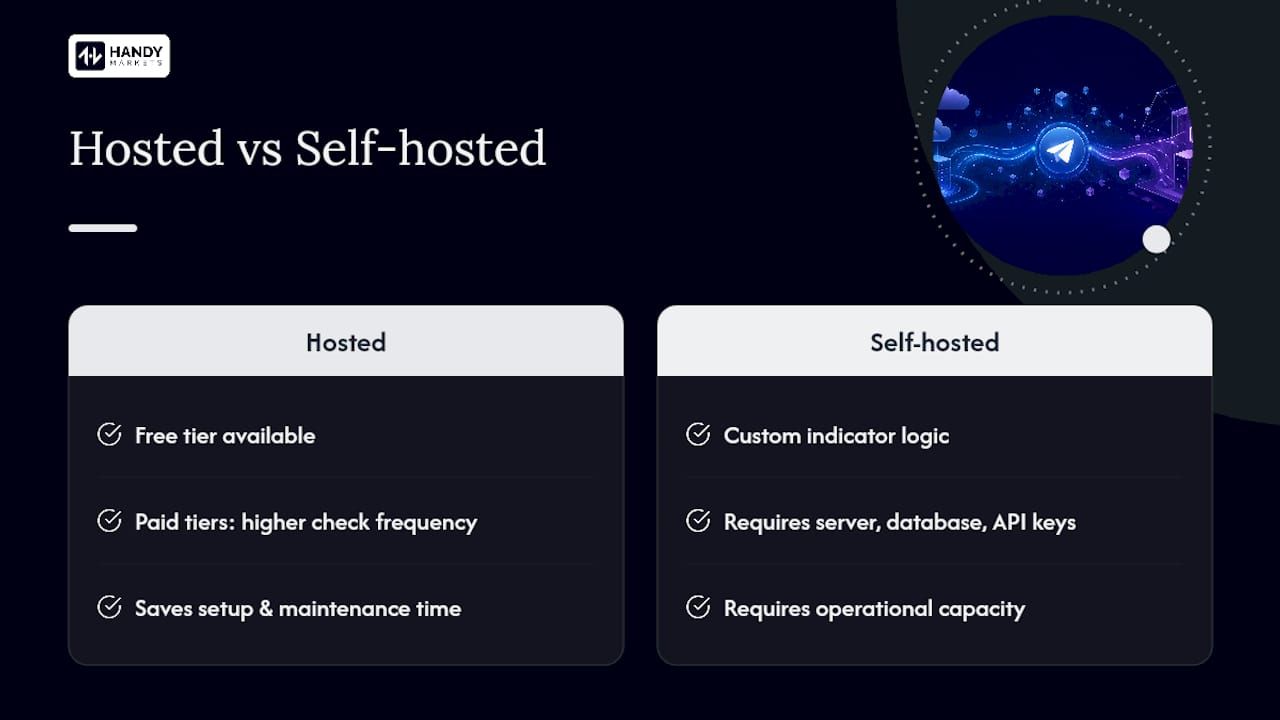
Handy Markets offers a free tier for basic monitoring, with paid tiers unlocking higher-frequency checks and more simultaneous alerts. If you’re tracking dozens of pairs across multiple indicators, the free tier’s refresh rate will feel slow. That’s the point where upgrading makes sense.
Pro Tip: Set up a secondary delivery channel, like email or webhook, for your highest-priority alerts. If Telegram hits a rate limit during a volatile session, that fallback channel becomes your safety net instead of a silent miss.

Should You Self-Host a Telegram Crypto Alert Bot?
Self-hosting appeals to traders who want custom indicators or full control over their data pipeline, but it comes with real operational weight.
A self-hosted setup needs a Telegram bot token, a market-data connection (Binance, CoinCap, or CoinGecko), an indicator provider like Taapi.io or your own calculation logic, a persistent database so alert state survives a restart, and a hosting environment like a VPS or container. You’re also responsible for monitoring uptime and handling API key security yourself.
- Full control over custom logic and indicator combinations.
- No dependency on a third-party platform’s roadmap.
- Constant responsibility for uptime, restarts, and secret management.
- You handle Telegram’s rate limits and retry logic on your own.
If you go this route, use a process supervisor to auto-restart crashed processes, a persistent queue so alerts aren’t lost mid-evaluation, idempotent write logic to prevent duplicate messages, and environment variables or a secrets manager instead of hardcoded API keys.
| Factor | Hosted (Handy Markets) | Self-hosted bot |
|---|---|---|
| Ease of setup | Minutes, no code required | Hours to days, requires deployment knowledge |
| Alert types supported | Price, percent-change, indicator, multi-asset | Depends on the specific project’s feature set |
| Data sources | Aggregated across multiple exchanges and asset classes | Whatever APIs you wire in yourself |
| Delivery channels | Telegram, Discord, Slack, SMS, webhook, email | Typically Telegram only unless custom-built |
| Customization | Template and channel settings | Full code-level control |
| Ongoing maintenance | None required from the user | Uptime, security, and updates are on you |
What Commands Create a Telegram Crypto Alert?
Most bots, hosted or self-built, follow similar command patterns. Knowing the syntax makes setup faster whether you’re using a chat-based interface or a dashboard that mirrors the same logic.
A typical price alert command looks like /new_alert BTC/USDT PRICE ABOVE target_price. Break that down: the pair comes first, then the trigger type, the comparison direction, and the target value. For indicator-based alerts, open-source projects add timeframe and parameter fields, like /new_alert ETH/USDT RSI 1h PERIOD=14 BELOW target_value.
- /new_alert or /set: create a new alert with pair, trigger type, and target value.
- /view_alerts or /list: show every active alert tied to your account.
- /remove: delete a specific alert by ID or pair.
- /p or /value: check a live price without setting an alert.
- /indicators: list which technical indicators the bot supports.
Common timeframe intervals run from 1m up to 1w, and indicator parameters usually include period length and, for Bollinger Bands, standard deviation. Before trusting any new alert, set a temporary low threshold close to the current price so it fires within minutes, confirming your destination actually receives the message.
How Do You Avoid Scam Telegram Crypto Bots?
A legitimate crypto alert bot never asks for your private keys or seed phrase. That single rule filters out most scams before they get anywhere near your funds.
Watch for these red flags: unsolicited direct messages inviting you to “exclusive” trading groups, promises of guaranteed returns tied to an alert service, requests to add unknown accounts as group admins, or login links that redirect to a page mimicking an exchange’s sign-in screen.
- Never share private keys, seed phrases, or exchange login credentials with any bot.
- Check for public documentation, since a real project has a README listing its commands and setup steps.
- Verify the domain matches the platform’s official site before entering any account details.
- Use read-only API keys if you’re connecting exchange data, never keys with withdrawal permissions.
Pro Tip: Create a dedicated Telegram channel just for bot alerts, separate from your personal messages. It keeps your alert history clean and makes it obvious immediately if an unfamiliar bot or account gets added.
How Do You Fix Missing or Delayed Telegram Alerts?
Three problems account for most complaints: alerts that never arrive, duplicates, and delays.
Missing alerts usually trace back to the bot being offline or a wrong chat ID from a botched setup. Duplicate alerts happen when a rule isn’t idempotent, meaning the same condition triggers repeatedly instead of once. Delayed alerts are often a rate-limit issue, since Telegram throttles bots sending high volumes of messages in short windows.
- Test your alert first with a threshold near the current price to confirm delivery works.
- Add a cooldown window so a single price crossing doesn’t spam you repeatedly.
- Combine an indicator confirmation with your price trigger to cut down on noise from low-liquidity pairs.
- Keep a fallback channel like email or webhook active for anything you truly can’t afford to miss.
Why Choose Handy Markets for Crypto Alerts?
Handy Markets covers crypto, stocks, forex, indices, commodities, and ETFs in one dashboard, so your Telegram alert setup doesn’t stop at crypto if your portfolio doesn’t either. Delivery runs across Telegram, Discord, Slack, SMS, webhook, and email, meaning a single alert rule can reach you on more than one channel if Telegram happens to lag.
What traders actually gain: setup that takes minutes instead of a deployment pipeline, retry logic that handles rate limits behind the scenes, and message templates you can adjust without touching code. There’s no requirement to hand over private keys or wallet access at any point in the process.
- Multi-asset coverage in a single alert dashboard, not just crypto.
- Delivery across six channels, reducing the odds a critical alert gets lost.
- No code, no server, no API key management on your end.
What’s the Smartest Way to Combine Hosted and Self-Hosted Alerts?
For anything mission-critical, like a stop-loss trigger on a leveraged position, use a managed service with proven delivery guarantees. Save self-hosting for experimental indicator combinations you’re still testing.
Set Up Reliable Telegram Alerts Without the Server Work
Handy Markets removes the operational burden of self-hosting from Telegram crypto alerts. You get multi-channel fallback across Telegram, Discord, Slack, SMS, webhook, and email built in, so one missed Telegram message doesn’t mean a missed trade.
Every alert rule you build, whether it’s a price threshold on Bitcoin or an RSI trigger on a mid-cap altcoin, comes with customizable message templates and delivery you don’t have to babysit. The platform never asks for private keys, seed phrases, or wallet access, since it works entirely from public market data.
Head to the Handy Markets price alert page to set up your first alert on any asset, from crypto to national currencies, and see how it lands in your Telegram in real time.
Where Can You Learn More About Telegram Crypto Alerts?
- AlexMorganUS/Telegram-Crypto-Alerts for command syntax and developer customization.
- Telegram’s official Bot API for delivery mechanics.
FAQ
Do Telegram crypto alerts cost money?
Many hosted platforms, including Handy Markets, offer a free tier for basic price monitoring. Paid tiers typically unlock higher check frequency and more simultaneous alerts.
Can I get alerts for percentage moves instead of a fixed price?
Yes. Percent-change triggers, sometimes labeled PCTCHG or 24HRCHG in open-source bots, let you set alerts based on relative movement rather than a static price target.
What data sources power crypto price alerts on Telegram?
Most bots pull from exchange APIs like Binance, aggregators such as CoinGecko or CoinCap, and indicator services like Taapi.io for technical calculations.
Is self-hosting a Telegram crypto alert bot worth it?
It’s worth it if you need custom indicator logic and have the operational capacity to manage a server, database, and API keys. Otherwise, a hosted service saves significant setup and maintenance time.
How do I know a Telegram crypto bot isn’t a scam?
Check for public documentation, confirm the domain matches the official platform, and never provide private keys or seed phrases. A legitimate bot only needs read access to public market data.
This article is general information, not a substitute for advice from a qualified financial advisor. Consult a qualified financial professional about your own circumstances before acting on anything here.
Sources