

TL;DR:
- Beginners should start investing with broad-market equity ETFs like VTI due to their low cost and wide diversification. Including a bond ETF such as BND adds stability and reduces overall portfolio volatility. Specialty ETFs carry higher risks and are better suited for advanced investors who understand their complexities.
An exchange-traded fund, or ETF, is an investment fund that holds a basket of assets and trades on a stock exchange like a single share. Understanding the types of ETFs for beginners is the fastest way to build a diversified portfolio without picking individual stocks. Funds like Vanguard Total Stock Market ETF (VTI) and Schwab U.S. Dividend Equity ETF (SCHD) give new investors broad exposure at a fraction of the cost of actively managed funds. The right ETF type depends on your goals, risk tolerance, and how long you plan to stay invested.
1. What are equity ETFs and why beginners should start here?
Equity ETFs, also called stock ETFs, hold shares of publicly traded companies and form the core of most beginner portfolios. They offer instant diversification across dozens or hundreds of stocks in a single purchase. That breadth reduces the damage any one company’s bad quarter can do to your overall returns.
Broad-market ETFs are the most beginner-friendly option. Funds like VTI track the entire U.S. stock market, covering large, mid, and small-cap companies. Low-cost broad-market ETFs carry expense ratios between 0.02% and 0.07%, meaning you keep almost every dollar you invest.
Sector and growth ETFs focus on specific industries like technology or healthcare. The Nasdaq-100 is a popular example, concentrating heavily in large-cap tech. These funds carry more volatility than broad-market options because a single sector downturn hits the whole fund.
Dividend ETFs like SCHD target companies with consistent dividend payments. They suit investors who want regular income alongside long-term growth. International equity ETFs add geographic diversification by holding stocks from Europe, Asia, or emerging markets.
- Broad-market ETFs: Best starting point. Low cost, wide coverage, minimal maintenance.
- Dividend ETFs: Good for income-focused beginners. Steady cash flow with moderate risk.
- Sector ETFs: Higher risk. Best added after you have a broad-market core in place.
- International ETFs: Useful for diversification. Add after U.S. exposure is established.
Pro Tip: Start with one broad-market ETF like VTI or SPDR Portfolio S&P 500 (SPLG). Adding more funds before you understand what you own creates confusion, not safety.
2. How bond ETFs provide stability for your portfolio
Bond ETFs hold fixed-income securities like government or corporate bonds and pay regular interest to investors. Their primary job in a beginner portfolio is to reduce overall volatility. When stocks fall sharply, bonds often hold steady or rise, acting as a counterweight.

Vanguard Total Bond Market ETF (BND) is the most widely cited example for beginners. It holds thousands of U.S. investment-grade bonds across government and corporate issuers. That breadth keeps credit risk low while delivering consistent income.
Key bond ETF categories include:
- Government bond ETFs: Hold U.S. Treasury securities. Lowest credit risk, lower yield.
- Corporate bond ETFs: Hold debt from companies. Higher yield, slightly more risk.
- Investment-grade bond ETFs: Focus on bonds rated BBB or higher. Balanced risk and return.
- Short-term bond ETFs: Less sensitive to interest rate changes. Good for conservative beginners.
Interest rate risk is the main concern with bond ETFs. When rates rise, bond prices fall. Short-term bond ETFs reduce this sensitivity compared to long-term funds. A common beginner allocation places 80% in stock ETFs and 20% in a bond ETF like BND, shifting toward more bonds as retirement approaches.
Popular beginner ETFs like VTI combined with BND cover broad stock market exposure and investment-grade bonds with low fees. That two-fund combination handles most of what a new investor needs.
3. What are specialty ETFs and why beginners should avoid them
Specialty ETFs cover assets and strategies beyond standard stocks and bonds. They include leveraged, inverse, commodity, currency, real estate, sustainable, and factor ETFs. Most carry higher complexity and risk than broad-market funds.
- Leveraged ETFs aim for 2x or 3x the daily return of an index using derivatives. Leveraged ETFs can result in a total loss of capital during volatile periods. Daily resets cause compounding losses that make them unsuitable for buy-and-hold investors.
- Inverse ETFs profit when an index falls. They are designed for short-term hedging, not long-term holding. Beginners who hold them too long often lose money even when they correctly predict a market decline.
- Commodity ETFs track oil, gold, or agricultural products. They add inflation protection but carry higher price swings than equity ETFs.
- Real estate ETFs (REITs) hold shares of property companies and pay high dividends. They behave differently from standard stocks and add sector concentration risk.
- Currency ETFs track foreign exchange rates. They require understanding macroeconomic factors that most beginners have not yet studied.
- Sustainable ETFs screen for environmental, social, and governance criteria. They are a valid long-term option but require research into each fund’s screening methodology.
- Factor ETFs target specific return drivers like value, momentum, or low volatility. They require understanding of factor investing theory before use.
Specialty ETFs serve niche purposes and usually require advanced knowledge. Higher volatility and complexity make them less suitable for beginners.
Pro Tip: Treat specialty ETFs like advanced tools. Learn the basics with broad-market and bond ETFs first. Add specialty funds only after you understand exactly what risk you are taking on.
4. How to choose and combine ETF types for a beginner portfolio
Building a beginner portfolio does not require owning ten different funds. A simple portfolio with 2–3 ETFs is usually sufficient to cover most investor needs. Complexity adds management burden without meaningfully improving returns for most beginners.
The table below shows three sample allocations based on risk tolerance:
| Risk Profile | Stock ETF | Bond ETF | Notes |
|---|---|---|---|
| Aggressive | 90% VTI or SPLG | 10% BND | Long time horizon, comfortable with swings |
| Moderate | 70% VTI or SPLG | 30% BND | Balanced growth and stability |
| Conservative | 50% VTI or SPLG | 50% BND | Closer to retirement or lower risk appetite |
When selecting a specific fund, brokerage availability and commissions matter more than small performance differences between similar ETFs. VOO, IVV, and SPLG all track the S&P 500. The best choice is the one your brokerage offers commission-free.
Key selection criteria for beginners:
- Expense ratio: Target funds below 0.10% annually.
- Assets under management (AUM): Higher AUM means lower closure risk and tighter bid-ask spreads.
- Index tracked: Confirm the fund tracks a broad, well-known index.
- Liquidity: High daily trading volume keeps transaction costs low.
Low expense ratios and high fund AUM help ensure ETFs remain stable choices unlikely to close or consolidate. Many brokerages now offer commission-free ETF trading, so the main ongoing cost is the fund’s expense ratio. Smart portfolio diversification means owning different asset types, not just more ETFs tracking the same index.
Pro Tip: Pick ETFs available on your brokerage platform before comparing funds across platforms. Switching brokerages to access a specific fund rarely makes financial sense for beginners.
5. Common beginner mistakes to avoid when investing in ETFs
The most common mistake beginners make is choosing ETFs based on recent performance. Past returns do not predict future results. A tech ETF that gained 40% last year may lose 30% this year if sentiment shifts.
“Volatility is the heartbeat of markets. Passive broad index ETFs are designed for long time horizons, expecting temporary declines as a normal part of the process.” — 9 Types of ETFs Explained
Other critical mistakes to avoid:
- Confusing ETFs with ETNs: ETFs hold actual underlying assets, while ETNs are unsecured debt obligations with issuer credit risk. Beginners should prefer ETFs to avoid that added layer of risk.
- Ignoring bid-ask spreads: Choosing ETFs based on expense ratio alone ignores liquidity costs. Funds with low trading volume can have higher real transaction costs despite low stated fees.
- Buying overlapping ETFs: Owning VTI and VOO simultaneously means holding two funds that track nearly identical stocks. You pay two expense ratios for essentially one position.
- Using leveraged ETFs as long-term holds: Leveraged ETFs reset daily. Holding them for weeks or months produces results that diverge sharply from the stated multiplier.
- Abandoning the plan during downturns: Market volatility is a natural part of long-term ETF investing. Selling during a correction locks in losses and removes you from the recovery.
Patience and consistency outperform timing in every long-term study of passive investing. Reviewing your investment strategy annually is enough for most beginner portfolios.
Key takeaways
The best approach to ETF investing for beginners is to start with one or two low-cost, broad-market funds and add complexity only after you understand what each fund holds and why.
| Point | Details |
|---|---|
| Start with broad-market equity ETFs | Funds like VTI or SPLG offer wide diversification at expense ratios as low as 0.02%. |
| Add a bond ETF for stability | BND reduces portfolio volatility and balances stock exposure across market cycles. |
| Avoid specialty ETFs early on | Leveraged, inverse, and commodity ETFs carry risks that require advanced knowledge to manage. |
| Keep your portfolio to 2–3 ETFs | Over-diversifying with similar funds adds cost without improving returns. |
| Check liquidity, not just expense ratio | Bid-ask spreads on low-volume ETFs can raise your real trading costs significantly. |
My take on which ETF types actually matter for beginners
At Handy Markets, we track thousands of ETFs daily, and the pattern we see consistently is this: beginners who start simple stay invested longer. The investors who load up on sector ETFs, factor funds, and thematic plays in their first year tend to bail during the first significant correction because they do not fully understand what they own.
Our honest recommendation is to treat broad-market equity ETFs and one bond ETF as your entire portfolio for at least the first year. VTI plus BND covers more ground than most actively managed funds, at a fraction of the cost. Once you understand how those two funds move relative to each other and to the broader market, adding a dividend ETF like SCHD or an international fund makes sense.
The specialty ETF space is genuinely interesting. Gold ETFs, factor ETFs, and sustainable funds all have legitimate uses. But they are tools for investors who already understand the foundation. Using them before you have that foundation is like installing a turbocharger on a car you have not yet learned to drive.
Consistency beats cleverness in long-term investing. Pick low-cost funds, hold them through volatility, and review your allocation once a year. That approach outperforms most active strategies over a decade.
Handy Markets makes ETF tracking simple for new investors
Knowing which ETF types to buy is only half the equation. Staying informed about price movements, fund performance, and market shifts is what keeps your strategy on track.
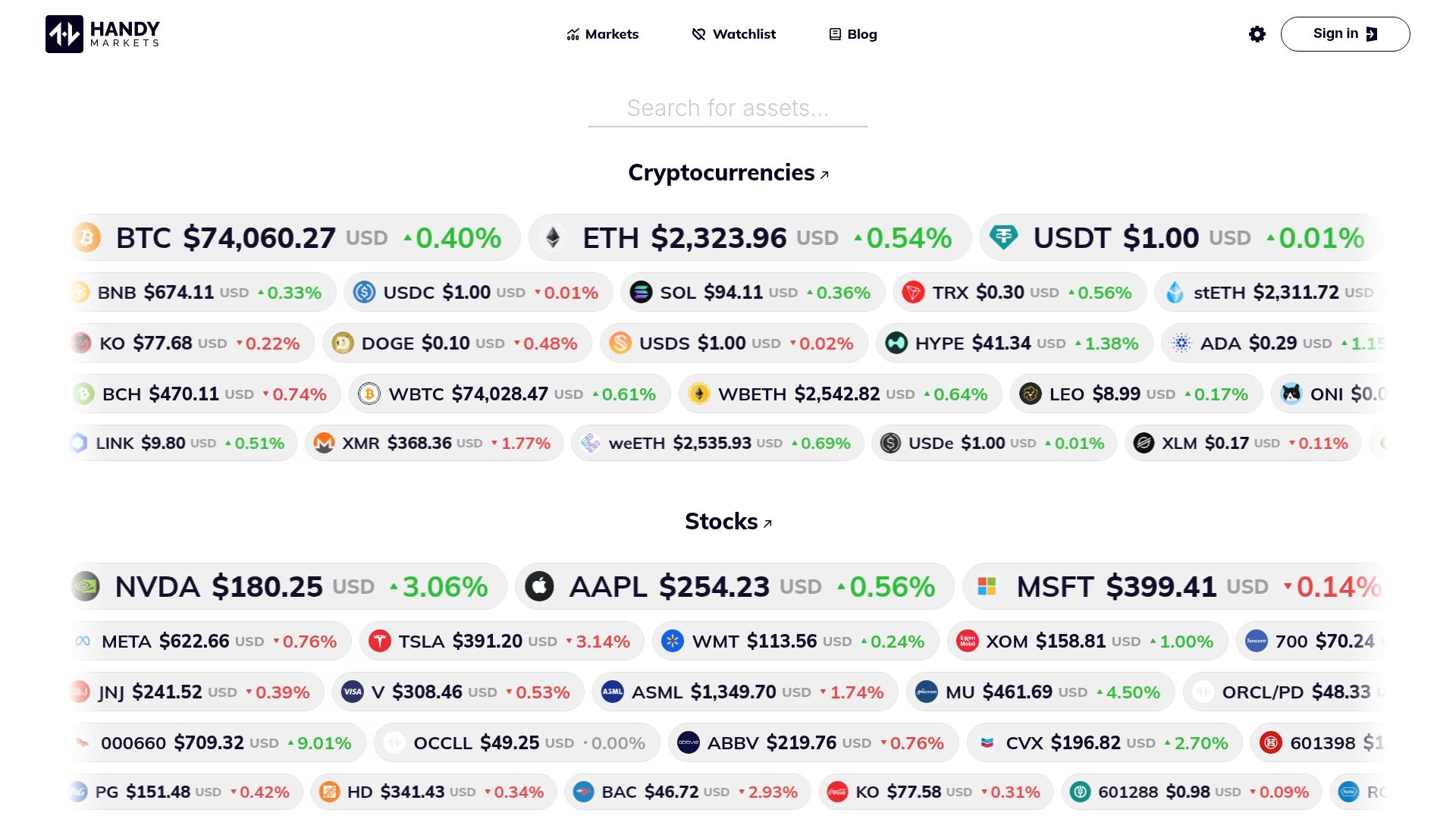
Handy Markets gives you live ETF prices and holdings data across thousands of funds, so you can monitor VTI, BND, SCHD, and any other ETF you hold in one place. The platform covers all major financial markets, from stocks and commodities to forex and indices. You can set custom price alerts via Telegram, Discord, Slack, SMS, or email, so you never miss a significant move in your portfolio. No trading account required. Just clear, real-time data when you need it.
FAQ
What is the best ETF type for a complete beginner?
Broad-market index ETFs like VTI or SPLG are the best starting point. They offer wide diversification, low expense ratios between 0.02% and 0.07%, and require minimal management.
How many ETFs should a beginner own?
A portfolio of 2–3 ETFs covering U.S. stocks and bonds is sufficient for most beginners. Adding more funds that track similar indexes increases cost without improving diversification.
Are ETFs safer than mutual funds for beginners?
ETFs and index mutual funds carry similar market risk, but ETFs typically have lower expense ratios and trade throughout the day like stocks. For cost-conscious beginners, low-cost index ETFs are generally the more efficient choice.
What is the difference between an ETF and an ETN?
ETFs hold actual underlying assets like stocks or bonds, while ETNs are unsecured debt issued by a bank. ETNs carry issuer credit risk, meaning you could lose money if the issuing bank defaults, regardless of market performance.
Should beginners invest in leveraged ETFs?
Beginners should avoid leveraged ETFs. They use derivatives to target 2x or 3x daily returns and can result in total capital loss during volatile periods, making them unsuitable for long-term, buy-and-hold investing.