

TL;DR:
- Index funds passively track market indexes like the S&P 500, offering diversified, low-cost investment options. They carry market risk and require periodic rebalancing to maintain alignment with your goals.
An index fund is a type of mutual fund or ETF that passively tracks a market index like the S&P 500 to match its performance before fees. You do not need to pick individual stocks or time the market. You simply buy one fund and gain exposure to dozens, hundreds, or even thousands of companies at once. For new investors, this combination of low cost and built-in diversification makes index funds one of the most practical starting points in personal finance.
What is an index fund and how does it differ from active investing?
Active investing means a fund manager hand-picks stocks, trying to beat the market. Index investing takes the opposite approach. A passive investment fund simply mirrors a market index, holding the same securities in the same proportions. No guesswork, no expensive research teams, no constant trading.
The S&P 500 is the most recognized benchmark. It tracks 500 large U.S. companies like Apple, Microsoft, and Amazon. An S&P 500 index fund buys shares in all 500 companies, so when the index rises, the fund rises with it. When the index falls, the fund falls too.

This simplicity is the point. Passive management produces lower fees and transaction costs than active funds because the manager does not pick individual stocks. Those savings compound over decades into a meaningful difference in your final balance.
How do index funds work to track market indexes?
Index funds replicate their benchmark by purchasing the constituent stocks or a representative sample of them. The fund manager does not decide what to buy based on opinion. The index itself dictates the holdings.
Here is what happens operationally behind the scenes:
- Rebalancing: When a company leaves an index and a new one enters, the fund adjusts its holdings to match.
- Dividend reinvestment: Dividends paid by companies in the index are collected and reinvested back into the fund.
- Corporate actions: Stock splits, mergers, and spinoffs all require the fund to update its positions.
- Tracking error: Tracking error measures how closely a fund replicates its benchmark. A lower tracking error means the fund is doing its job well.
Tracking error is a key metric that goes beyond the expense ratio. A fund could have a low fee but still drift from its benchmark due to poor execution. Always check both numbers before investing.
The relationship between an index and an index fund is straightforward. The index is a measuring stick, a list of securities with rules for inclusion. The index fund is the actual investment product you buy. The S&P 500 itself is not something you can purchase. An S&P 500 index fund from providers like Vanguard, Fidelity, or BlackRock’s iShares is.
Pro Tip: Check a fund’s tracking error alongside its expense ratio. A fund with a 0.03% expense ratio but high tracking error may underperform a fund with a 0.05% expense ratio and tight tracking.
What are the main types of index funds?
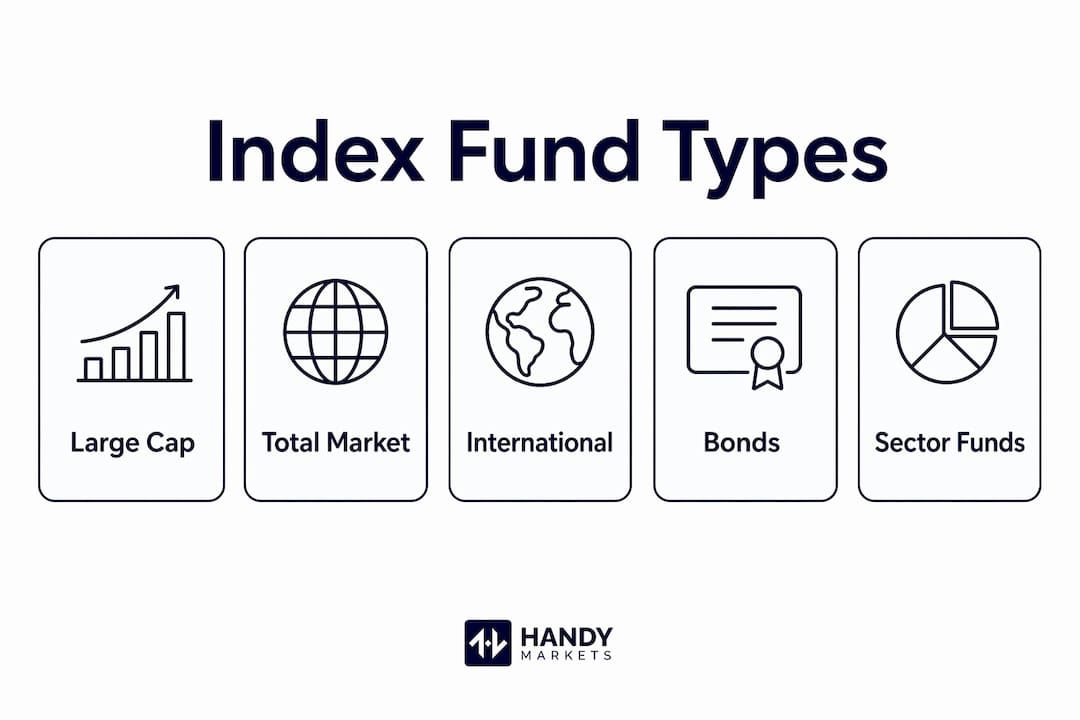
Index funds are broadly categorized into large-cap, total market, international equity, bond, and sector funds. Each type gives you exposure to a different slice of the market.
| Index Fund Type | What It Tracks | Typical Use |
|---|---|---|
| Large-cap (S&P 500) | 500 largest U.S. companies | Core U.S. equity exposure |
| Total U.S. stock market | Nearly all U.S. publicly traded stocks | Broader domestic diversification |
| International equity | Stocks outside the U.S. | Geographic diversification |
| Bond index | Government or corporate bonds | Income and risk reduction |
| Sector/specialty | One industry (tech, healthcare, energy) | Targeted market bets |
Understanding ETFs vs. mutual funds as wrappers matters for how you invest. Both can track the same index, but they behave differently in practice.
- ETFs (Exchange-Traded Funds): Trade throughout the day like stocks. Often more tax-efficient. No minimum investment beyond one share price.
- Mutual funds: Trade once per day at the closing price. Some have minimum investment requirements. Common in 401(k) plans.
The index-tracking strategy is the same in both cases. The wrapper you choose depends on your trading style, tax situation, and where you hold the account. Most new investors access index funds through a brokerage account, a Roth IRA, a traditional IRA, or a workplace 401(k). For a deeper look at how market benchmarks are constructed, the guide to market benchmarks from Handy explains the mechanics clearly.
What are the benefits of index funds and common misconceptions?
The most cited benefit of index funds is cost. Expense ratios for index funds are often below 0.10%, making them far more cost-effective for long-term wealth building than many active funds. That difference matters because fees reduce compounding every single year.
Diversification is the second major benefit. Owning one S&P 500 fund means you own a piece of 500 companies. If one company collapses, it barely moves the needle on your overall portfolio.
“Index funds reduce the stress of stock picking while delivering market returns with low fees and reasonable risk. Experts emphasize simplicity and long-term wealth building over trying to beat the market through active management.” — Investor.gov
Now for the misconceptions. Two in particular trip up new investors.
Misconception 1: Index funds are safe. They are not. Index funds carry market risk just like any equity investment. Broad diversification reduces the risk of any single company failing, but it cannot prevent losses if the entire market declines. In 2008, the S&P 500 fell roughly 38%. Every S&P 500 index fund fell with it.
Misconception 2: Index funds are fully set-and-forget. They require less attention than active trading, but investors still need to monitor their asset allocation over time. As you age or your goals shift, your mix of stock and bond index funds should shift too. Ignoring your allocation for years can leave you overexposed to risk at the wrong time.
For investors curious about the role bonds play in managing that risk, the Handy article on bond investing for beginners is a practical next read.
How can new investors choose the right index funds?
Choosing the right index funds comes down to three factors: expense ratio, diversification, and your investment goals. Start with these steps.
- Open an account. Choose a brokerage account, Roth IRA, or traditional IRA. If your employer offers a 401(k) with index fund options, start there to capture any matching contributions.
- Check the expense ratio. Look for funds with expense ratios below 0.20%. Many major providers offer funds well below 0.10%.
- Consider the three-fund portfolio. The three-fund portfolio strategy combines a total U.S. stock market fund, a total international stock fund, and a total bond market fund. This single approach covers the entire global equity market plus fixed income.
- Match funds to your timeline. Younger investors can hold more stock index funds. Investors closer to retirement typically shift toward bond index funds to reduce volatility.
- Rebalance once or twice a year. Markets move, and your allocation drifts. Rebalancing means selling a little of what grew and buying more of what lagged to return to your target mix.
The ETFs section on Handy lets you track live prices for major index ETFs, which helps you compare options before committing.
Understanding ETFs and mutual funds as wrappers for index-tracking strategies helps you choose based on trading style, tax considerations, and fees. This distinction is worth spending ten minutes on before you buy your first fund.
Pro Tip: Avoid buying multiple funds that track the same index. Owning both a Vanguard S&P 500 fund and a Fidelity S&P 500 fund adds no diversification. You are just duplicating the same holdings.
For a broader view of how different markets interact, the Handy piece on comparing financial markets gives useful context on how indexes fit into the global picture. You can also learn more about why tracking stock indices helps you make better long-term decisions.
Key takeaways
Index funds are the most cost-efficient way for new investors to gain broad market exposure, but they carry real market risk and require periodic rebalancing to stay aligned with your goals.
| Point | Details |
|---|---|
| Index fund definition | A passive fund that tracks a market index like the S&P 500 to match its performance. |
| Low fees matter | Expense ratios below 0.10% preserve more of your returns through compounding over time. |
| Market risk is real | Index funds fall with the market. Diversification reduces company-specific risk, not market-wide risk. |
| Three-fund portfolio | Combining U.S. stock, international stock, and bond index funds covers the full global market. |
| Regular rebalancing | Review your allocation once or twice a year to keep your risk level aligned with your goals. |
Why index funds are the right starting point for most new investors
At Handy, we watch market data flow in real time every day. Prices pulse, sectors rotate, and individual stocks spike and crash. From that vantage point, the appeal of index funds becomes obvious fast.
New investors often feel pressure to find the next great stock. That instinct is understandable, but the data consistently shows that most active fund managers fail to beat their benchmark index over a ten-year period. Chasing individual winners is expensive, time-consuming, and statistically unlikely to pay off.
The investors we see build wealth steadily are not the ones making bold calls. They are the ones who bought a low-cost total market fund, set up automatic contributions, and left it alone. Patience is the actual edge in long-term investing.
The most common mistake we observe is paying too much in fees without realizing it. A 1% annual fee sounds small. Over 30 years on a growing portfolio, it can cost you tens of thousands of dollars in lost compounding. Index funds exist specifically to solve that problem.
One more thing worth saying plainly: index funds are not boring. They are the most rational response to a market that is genuinely hard to predict. Simplicity is not a compromise. It is the strategy.
Track your index fund investments with Handy.Markets
Knowing what to buy is only half the equation. Knowing what your investments are doing right now is the other half.
Handy gives you real-time prices for stocks, ETFs, and major indexes all in one place. You can set up price alerts for free across Telegram, Discord, Slack, SMS, and email so you never miss a significant move. Whether you are monitoring an S&P 500 ETF or watching bond market shifts, the Handy markets dashboard puts live data at your fingertips without requiring you to refresh a dozen tabs. Setup takes minutes, and you can track every asset class your portfolio touches.
FAQ
What is the index fund definition in simple terms?
An index fund is an investment fund that automatically tracks a market index like the S&P 500 by holding the same securities in the same proportions. It requires no active stock picking and typically charges very low fees.
Are index funds safe for beginners?
Index funds are not risk-free. They carry market risk, meaning they fall when the broader market falls. They are beginner-friendly because of their low cost and built-in diversification, not because they guarantee gains.
What are the main types of index funds explained simply?
The main types are large-cap funds (like S&P 500 funds), total U.S. stock market funds, international equity funds, bond index funds, and sector funds. Each type tracks a different segment of the market.
What is the difference between an ETF and a mutual fund index fund?
Both can track the same index, but ETFs trade throughout the day like stocks while mutual funds trade once per day at the closing price. ETFs are often more tax-efficient and have no minimum investment beyond one share.
How do I start investing in index funds?
Open a brokerage account, Roth IRA, or use your workplace 401(k), then select a low-cost index fund with an expense ratio below 0.20%. The three-fund portfolio of U.S. stocks, international stocks, and bonds is a strong starting framework for most new investors.