
If you need a trustworthy replacement for themarketscan.com, the short answer is this: start with real-time alert platforms that offer documented APIs, transparent pricing, and verifiable data provenance. Multiple independent security scanners have flagged themarketscan.com as a high-risk site with suspicious hosting and unrealistic promises, which makes finding a reliable substitute more urgent than it might seem.
Here is a fast shortlist to orient you before we go deeper:
- General-purpose real-time alerts + multi-asset monitoring: Handy Markets — covers stocks, crypto, commodities, indices, ETFs, and forex with multi-channel alerts (Telegram, Discord, Slack, SMS, Webhook, Email) and a clean setup experience.
- Exchange-grade API for developers and quants: Polygon.io or IEX Cloud — direct exchange feeds, documented SDKs, and sandbox environments.
- Niche options flow and dark-pool data: Unusual Whales — congressional trading, dark-pool volume, and options flow in one place.
- Historical and alternative data at scale: Quandl / Nasdaq Data Link or Coresignal — deep historical archives and enterprise-grade data sets.
- Curated research terminal: Tiingo or Alpha Vantage — affordable entry points with solid API access for independent analysts.
Before submitting payment details to any market-data site, cross-check its domain against ScamAdviser and verify that its data sourcing traces back to a recognized feed such as an S&P data license or a direct exchange agreement.
Table of Contents
- How do these themarketscan.com alternatives compare at a glance?
- Short profiles of each platform worth considering
- How to choose the right market-data provider for your workflow
- What does the safety record say about themarketscan.com?
- Which platform should you actually use?
- Key Takeaways
- Why transparency is the only feature that actually protects you
- Real-time alerts and multi-asset monitoring, without the guesswork
- Useful sources for vetting and comparing platforms
How do these themarketscan.com alternatives compare at a glance?
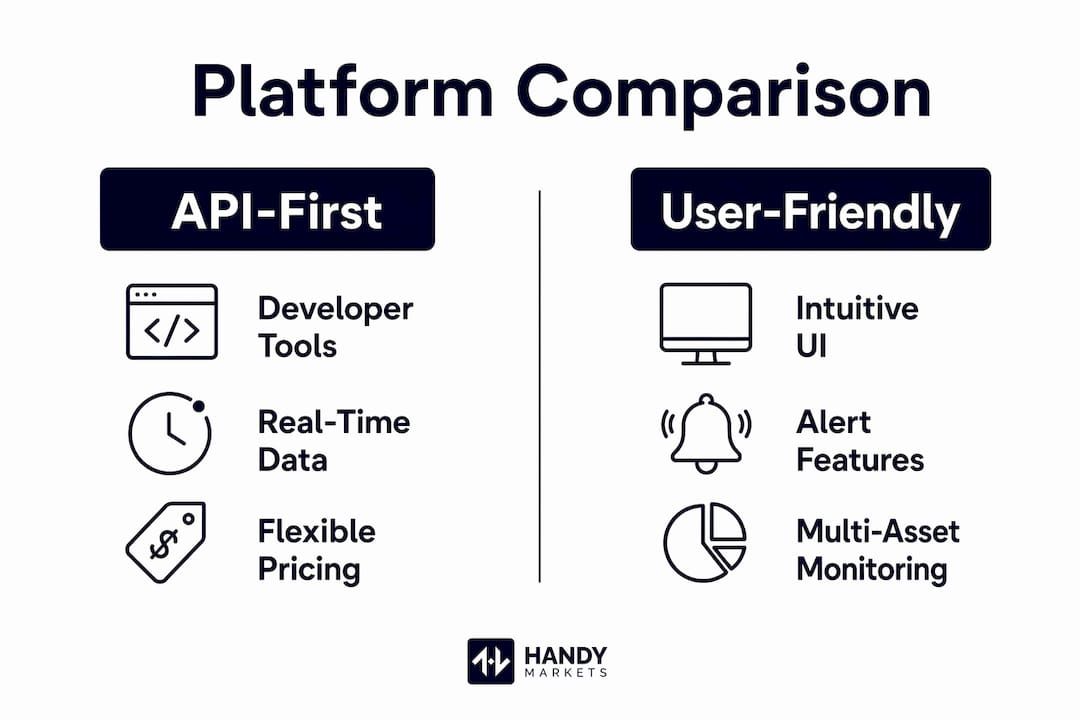
Roundup comparisons consistently show that the best substitutes split into two broad camps: API-first developer platforms and retail-facing alert dashboards. The table below maps each named alternative across the criteria that matter most for US traders.

| Provider | Best for | Primary data types | API access | Real-time vs delayed | Alerts | Pricing model | US exchanges | Setup ease | Trust signals |
|---|---|---|---|---|---|---|---|---|---|
| Handy Markets | Multi-asset monitoring + alerts | Stocks, crypto, commodities, indices, ETFs, FX | Webhook + API | Real-time | Telegram, Discord, Slack, SMS, Webhook, Email | Subscription SaaS; free tier available | Major US exchanges + global | Very easy; no-code dashboard | Transparent pricing page, public privacy policy, documented alert channels |
| Polygon.io | Developer/quant API integration | Equities, options, forex, crypto | Full REST + WebSocket SDK | Real-time (paid) / 15-min delay (free) | Webhook | Freemium to enterprise | NYSE, NASDAQ, OTC | Moderate; developer-first | Documented SDKs, sandbox, clear pricing |
| IEX Cloud | Mid-tier API + fundamentals | Equities, fundamentals, news | REST API + SDKs | Real-time (paid) | Webhook | Pay-as-you-go + plans | IEX, NYSE, NASDAQ | Moderate | IEX exchange backing, documented API |
| Alpha Vantage | Budget API for analysts | Equities, forex, crypto, technicals | REST API | 15-min delay (free) / real-time (paid) | None native | Free + premium tiers | Major US exchanges | Easy | Long-standing free tier, wide community use |
| Unusual Whales | Options flow + dark pool | Options flow, dark pool, congressional trades | Limited API | Near real-time | Email, web alerts | Subscription | US options markets | Moderate | Transparent data sourcing, active community |
| Coresignal | Enterprise alternative data | Firmographic, job postings, web data | REST API | Batch / near real-time | None native | Enterprise contract | US-focused | Complex; enterprise setup | SOC 2 posture, documented data lineage |
| Quandl / Nasdaq Data Link | Historical + alternative data | Financials, macro, alternative sets | REST API + SDKs | Delayed / batch | None native | Freemium + paid | US + global | Moderate | Nasdaq backing, documented sources |
| Tiingo | Affordable research terminal | Equities, crypto, news, fundamentals | REST + WebSocket | Real-time (paid) | Email alerts | Free + paid tiers | Major US exchanges | Easy | Transparent pricing, active API docs |
Reading this table well means understanding two things. First, “real-time” here refers to sub-second or tick-level data from a direct exchange feed, not a 15-minute delayed snapshot. Second, pricing shape matters as much as the headline tier: a free plan with tight API rate limits can become a bottleneck the moment your workflow scales.
Short profiles of each platform worth considering
Handy Markets
Handy Markets is a multi-asset monitoring platform built for traders and investors who want live prices across every major asset class without stitching together five different tools. It covers cryptocurrencies, stocks, commodities, indices, ETFs, and national currencies in a single customizable dashboard. The alert system is its clearest differentiator: you can push notifications to Telegram, Discord, Slack, SMS, Webhook, or Email from the same interface.
- Best for: Retail traders and analysts who need broad market coverage and fast, multi-channel price alerts.
- Primary data types: Crypto, equities, commodities, indices, ETFs, forex.
- API/trial: Webhook support; free tier available; transparent pricing page; public privacy policy.
Polygon.io
Polygon.io targets developers and quantitative analysts who need exchange-grade data delivered through a well-documented REST and WebSocket API. Its free tier provides 15-minute delayed data; paid plans unlock real-time tick data and options chains. The sandbox environment lets you validate response shapes before committing to a production integration.
- Best for: Developers building trading tools or quants running backtests.
- Primary data types: Equities, options, forex, crypto.
- API/trial: Full SDK library, sandbox, documented rate limits.
IEX Cloud
IEX Cloud draws its credibility partly from its parent exchange, IEX, which operates under SEC oversight. The platform offers a pay-as-you-go model alongside fixed plans, making it accessible for independent analysts who want fundamentals data alongside price feeds. Its REST API and SDKs are well-documented, and the company maintains a clear about page and pricing transparency.
- Best for: Independent analysts who need fundamentals, news, and price data in one API call.
- Primary data types: Equities, fundamentals, earnings, news.
- API/trial: REST API + SDKs, free sandbox tier.
Alpha Vantage
Alpha Vantage has been a go-to free API for analysts and students for years, covering equities, forex, crypto, and technical indicators. The free tier is genuinely useful for low-volume research, though it carries a 15-minute delay and strict rate limits. A premium tier unlocks real-time data and higher call volumes. No native alert system exists, so pair it with a notification layer if alerts matter to you.
- Best for: Budget-conscious analysts and developers prototyping a data pipeline.
- Primary data types: Equities, forex, crypto, technical indicators.
- API/trial: Free REST API; premium upgrade available.
Unusual Whales
Unusual Whales built its reputation on options flow transparency, and it has expanded into dark-pool volume and congressional trading data — datasets that most general platforms do not carry. The platform is subscription-based and US-focused, with a community-driven interface that suits active options traders more than passive investors.
- Best for: Options traders and flow-watchers who need dark-pool and congressional trade data.
- Primary data types: Options flow, dark pool, congressional trades, equities.
- API/trial: Limited API; web-based alerts; subscription required.
Coresignal
Coresignal sits at the enterprise end of the spectrum, specializing in alternative data sets like firmographic records, job postings, and web-scraped company signals. It is not a retail trading tool; it is designed for hedge funds and research teams that need data lineage documentation and SOC 2-aligned security posture. Setup is complex, and pricing is contract-based.
- Best for: Institutional researchers and quant funds needing alternative data at scale.
- Primary data types: Firmographic, job postings, web data, company signals.
- API/trial: REST API, enterprise onboarding, documented data lineage.
Quandl / Nasdaq Data Link
Nasdaq Data Link (formerly Quandl) remains one of the most trusted sources for historical financial and macroeconomic data, backed by Nasdaq’s institutional credibility. It offers both free community datasets and premium licensed feeds. The REST API and SDKs are well-maintained, and the platform is a natural fit for researchers who need deep historical archives rather than real-time tick data.
- Best for: Researchers and analysts who need long historical data series and macro datasets.
- Primary data types: Financials, macro, alternative data, commodities.
- API/trial: Free community data; premium licensed feeds; documented SDKs.
Tiingo
Tiingo punches above its price point, offering real-time equities, crypto, and news feeds alongside a clean REST and WebSocket API. Its pricing is among the most transparent in this group, with a free tier that covers basic research needs and paid plans that unlock real-time data and higher limits. Email alerts are available natively, though the alert system is less flexible than dedicated monitoring platforms.
- Best for: Independent researchers and developers who want affordable real-time data with solid documentation.
- Primary data types: Equities, crypto, news, fundamentals.
- API/trial: Free tier; paid real-time plans; active API documentation.
How to choose the right market-data provider for your workflow
Platform fit is driven more by trading methodology than by raw feature lists. An active day trader and a long-term researcher can look at the same comparison table and reach completely different conclusions. Work through these questions before you commit.
- What is your latency requirement? If you need sub-second data for intraday decisions, you need a provider that states direct exchange feeds explicitly. Aggregated free data introduces latency that compounds at scale.
- Which asset classes do you actually trade? A crypto-only trader has different needs than someone monitoring equities, ETFs, and commodities simultaneously. Confirm coverage before signing up.
- Do you need an API, or is a dashboard enough? Developer-first platforms like Polygon.io require code; retail-facing platforms like Handy Markets work out of the box with no technical setup.
- How deep does your historical data need to go? Backtesting a multi-year strategy requires a provider with verified historical archives, not just a live feed.
- Which alert channels fit your workflow? If you live in Telegram or Discord, a platform that only sends email alerts will create friction.
Red flags to watch for when evaluating any provider:
- No documented API or SDK, with no sandbox environment to test.
- Opaque or missing pricing page — legitimate platforms publish their tiers clearly.
- Hosting shared with unrelated or low-trust domains (a signal flagged by reputation scanners).
- Unrealistic return claims or performance guarantees tied to the data product.
- No clear company about page, team information, or verifiable business address.
Priority mapping by archetype:
- Active day trader: Prioritize sub-second latency, Level II data, and real-time alerts.
- Options trader: Prioritize options flow, dark-pool volume, and near-real-time chain data.
- Long-term investor / researcher: Prioritize historical depth, fundamentals, and editorial transparency separating AI aggregation from human-verified analysis.
- Developer / quant: Prioritize documented SDKs, rate limits, sandbox access, and direct exchange feed documentation.
What does the safety record say about themarketscan.com?
Multiple independent scanners have reached the same conclusion about themarketscan.com. GridinSoft’s online scanner assigned it a trust score of 1/100, flagging it as a potential crypto scam site with suspicious hosting. ScamAdviser’s report cites a low Tranco traffic rank and shared hosting with other low-trust domains. A third independent check from EvenInsight flagged suspicious payment methods and recommended against submitting personal or financial data without identity verification.

Statistic callout: Several independent reputation services — including GridinSoft, ScamAdviser, and EvenInsight — flagged themarketscan.com for high-risk indicators such as suspicious hosting, low traffic rank, and unrealistic promises.
Practical vetting steps for any market-data site:
- Run the domain through at least two independent scanners (GridinSoft and ScamAdviser are good starting points).
- Check the Tranco rank: very low-traffic domains with no verifiable business history warrant extra scrutiny.
- Confirm the company has a real about page, a named team, and a verifiable business address.
- Read the pricing page carefully: hidden fees or vague subscription terms are a warning sign.
- Test any demo or sandbox environment using non-sensitive credentials only.
- Ask the provider for direct exchange feed documentation or a sample API payload before paying.
Pro Tip: When a domain name closely resembles a legitimate financial service, always verify the exact URL character by character and cross-reference the company’s LinkedIn profile and SEC or FINRA registration before submitting any payment information. Naming ambiguity is a common tactic in financial fraud.
Understanding digital asset cybersecurity threats is also worth your time if you are evaluating crypto-focused data providers specifically. The risk surface for crypto platforms extends beyond data quality into custody, API key exposure, and phishing vectors.
Which platform should you actually use?
For most retail traders and independent analysts in the US, Handy Markets is the recommended starting point. It covers the broadest asset class range, requires no technical setup, and delivers alerts through the channels you already use. That combination makes it the most practical general-purpose substitute for a market-scan style service.
For specialist needs, here is how the decision breaks down:
- You need exchange-grade API data for a production system: Polygon.io is the cleaner choice, with direct exchange feeds, full SDK documentation, and a sandbox you can test before going live.
- You need options flow and dark-pool data: Unusual Whales is purpose-built for that workflow and carries congressional trading data that most general platforms do not offer.
- You need deep historical archives for backtesting or research: Quandl / Nasdaq Data Link has the institutional credibility and data depth that research-heavy workflows require.
- You are on a tight budget and need a free API to prototype: Alpha Vantage or Tiingo both offer free tiers with solid documentation and active developer communities.
One caveat worth naming: if you are running high-frequency strategies that require co-located exchange feeds and microsecond latency, none of the platforms above will fully serve that need. That use case belongs to institutional-grade infrastructure, not retail-facing data services.
Key Takeaways
The safest and most practical path away from themarketscan.com is a platform with transparent pricing, documented API access, and verifiable data sourcing — Handy Markets fits that description for general-purpose monitoring, while specialist platforms serve niche needs.
| Point | Details |
|---|---|
| themarketscan.com carries real risk | Three independent scanners flagged it for suspicious hosting, low trust scores, and unrealistic promises — avoid submitting payment data. |
| Choose by methodology, not features | Trading velocity (real-time alerts vs. research depth) determines platform fit more reliably than a raw feature checklist. |
| Vetting is a two-step process | Run any new domain through GridinSoft and ScamAdviser, then confirm direct exchange feed documentation before paying. |
| Specialist needs require specialist tools | Options flow (Unusual Whales), exchange-grade APIs (Polygon.io), and historical depth (Nasdaq Data Link) each serve distinct archetypes. |
| Handy Markets for general-purpose monitoring | Multi-asset real-time data, six alert channels, and a no-code dashboard make it the recommended starting point for most US traders. |
Why transparency is the only feature that actually protects you
Most platform comparisons focus on feature lists. We think the more useful lens is transparency: does the provider tell you exactly where its data comes from, what the latency is, and what you are paying for? Those three questions eliminate more bad options than any feature matrix.
The themarketscan.com situation is a useful reminder that a polished interface is not evidence of trustworthy data. Platforms that publish their exchange feed agreements, maintain public API documentation, and offer sandbox environments before asking for payment are signaling something real about how they operate. That is not a nice-to-have. It is the baseline.
Handy Markets approaches this the right way: transparent pricing, multi-channel alert delivery that you can test before committing, and coverage across every major asset class in one place. For traders who want to monitor live crypto prices alongside stocks, commodities, and forex without managing five separate subscriptions, that kind of clarity is genuinely useful.
Real-time alerts and multi-asset monitoring, without the guesswork
If you have been relying on a market-scan style service and want something you can actually trust, Handy Markets covers every major asset class — cryptocurrencies, stocks, ETFs, commodities, indices, and national currencies — with live prices and customizable alerts delivered to Telegram, Discord, Slack, SMS, Webhook, or Email.
Setup takes minutes, not days. You can personalize your monitoring dashboard, set price alerts for free, and start receiving notifications through whichever channel fits your workflow. No opaque pricing, no hidden tiers, and no technical integration required to get started. Visit Handy Markets and set up your first alert today.
Useful sources for vetting and comparing platforms
Use these links to continue your research and validate any platform before committing.
- GridinSoft scanner — themarketscan.com review: The primary independent security scan that assigned themarketscan.com a 1/100 trust score; use it to check any unfamiliar market-data domain.
- ScamAdviser — themarketscan.com check: Cross-references Tranco rank, hosting patterns, and blacklist status; run every new domain through this before paying.
- EvenInsight safety checker — themarketscan.com: A third independent reputation check that flagged suspicious payment methods; useful as a tiebreaker when two other scanners disagree.
- TerminalValue.io — StockMarketScan alternatives: Vendor roundup covering API-first providers, options-flow specialists, and curated research terminals; good for a broader shortlist.
- TradingToolsHub — platform comparison: Methodology-first comparison that maps trader archetypes to platform types; useful when you know your trading style but not which tool fits it.
- DARE Blog — digital asset cybersecurity threats: Practical guide to the security risks specific to crypto-focused data providers, including API key exposure and phishing vectors.
- Handy Markets — more platform alternatives: Additional comparison articles covering similar market-data substitution decisions for US traders.
This article is general information, not financial or legal advice. Confirm platform terms, data sourcing, and regulatory status directly with each provider before making decisions for your own situation.