
TL;DR:
- Most investors underperform due to emotional reactions triggered by market news.
- Filtering information and setting structured alerts helps avoid noise and overtrading.
- Smarter news consumption involves scheduled checks and focus on primary data sources.
Most investors assume that the more market news they consume, the better their results will be. The reality is far more complicated. DALBAR’s 2024 data tells a sobering story: the average equity investor earned just 16.54% while the S&P 500 returned 25.05%, a gap of nearly 848 basis points driven primarily by poor timing decisions triggered by emotional reactions to headlines. This article cuts through the noise to show you what market news actually does to your decision-making, how to separate signal from noise, and what the most effective investors do to stay informed without getting burned.
Table of Contents
- How market news shapes investor behavior
- The difference between news, noise, and actionable signals
- Risks of overreacting to news: What studies reveal
- Making market news work for you: Practical strategies
- The uncomfortable truth: News is often the enemy of steady returns
- Take action: Smarter news, smarter alerts, smarter investing
- Frequently asked questions
Key Takeaways
| Point | Details |
|---|---|
| Headlines trigger overreactions | Emotional responses to news often cause poor market timing and missed returns. |
| Signal vs noise is crucial | Distinguishing meaningful news from distractions leads to better investment decisions. |
| Less is more with news | Filtering out non-essential updates can reduce stress and improve performance. |
| Automate alerts for smart action | Setting up reliable price and news alerts supports clear-headed investing. |
How market news shapes investor behavior
After seeing those performance numbers, the natural question is: why does news have such a powerful grip on investor behavior in the first place? The answer lies in how our brains are wired and how financial media is designed.
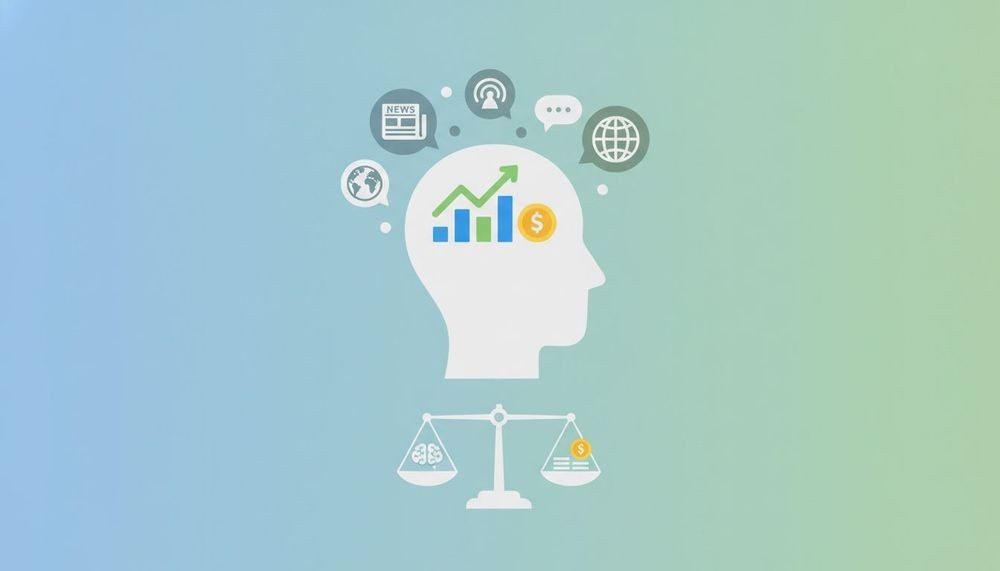
Markets are, at their core, the collective emotions of millions of participants made visible in real time. Every tick up or down tells a story, and news gives that story a narrative. Fear of missing out, also known as FOMO, and outright panic are two emotional states that the financial news cycle reliably triggers. When a headline screams “markets in freefall” or “crypto surges to new high,” it doesn’t just inform. It activates a fight-or-flight response that pushes you toward action, even when staying still is the rational choice.
Here are the key ways market news influences individual investor behavior:
- Attention-driven buying: Headlines pull attention toward specific assets, creating a surge of purchase activity regardless of underlying fundamentals.
- Panic selling: Negative news, especially around economic downturns or rate decisions, pushes investors to liquidate positions at the worst possible times.
- Overconfidence after gains: Positive coverage of a bull run encourages investors to take on more risk right before corrections.
- Anchoring bias: Investors lock onto a recently reported price or valuation and make decisions based on that anchor rather than fresh data.
- Herd behavior: When news spreads that “everyone is buying,” individual investors follow the crowd instead of their own strategy.
“The individual investor’s greatest enemy is not the market itself, but the emotional reactions that headlines provoke.” This truth holds up in decades of behavioral finance research.
Groundbreaking research by Barber and Odean showed that attention-induced trading leads to net buying of high-attention stocks, higher portfolio turnover, and significantly lower returns. The investors in the highest turnover quintile underperformed those in the lowest by 7.1% annually, largely because of transaction costs alone. That’s a devastating drag on compounding wealth over time.
Understanding how market fluctuations ripple through investor psychology is the first step to protecting yourself. Once you see the behavioral pattern, you can start to interrupt it.
Building awareness around your own reactions is essential. Most investors think they’re being rational when they react to news. In reality, they’re responding to emotional triggers designed to generate clicks, not to protect your portfolio. Learning to recognize that distinction is what separates consistent investors from those who perpetually chase performance. Pairing that self-awareness with a solid market trends strategy gives you the dual advantage of emotional discipline and analytical clarity. You can also review how market events influence your personal finance impact to understand just how much is at stake when emotions take the wheel.
The difference between news, noise, and actionable signals
Recognizing how news shapes behavior, the next step is learning to identify what actually matters. Not everything that gets published affects your portfolio in a meaningful way. Sorting through that difference is one of the most valuable skills you can develop.
Let’s start with three clear definitions:
- News: A factual event or announcement with the potential to affect asset prices (for example, a Federal Reserve interest rate decision or a company’s earnings release).
- Noise: Information that generates attention and emotional response but has no lasting effect on the value of an asset (for example, a celebrity endorsing a meme stock, or a pundit’s prediction without supporting data).
- Signal: Specific, verifiable information that has a direct and measurable relationship with an asset’s future value or risk profile (for example, rising inflation data signaling potential rate hikes).
Most of what floods financial media each day is noise. That’s not an opinion. Research consistently shows that excessive news consumption for passive, long-term investors leads to over-trading, anxiety, and underperformance. The cure is structured filtering, not information abstinence.
| Type | Example | Investor action required |
|---|---|---|
| Signal | Fed raises rates by 0.75% | Review bond and rate-sensitive holdings |
| News | Company beats earnings by 3% | Monitor position, assess guidance |
| Noise | Social media buzz about a “hot” stock | No action needed |
| Noise | Market pundit predicts crash | No action needed |
| News | Major index drops 4% in a session | Check fundamentals, not price alone |
Pro Tip: Before acting on any headline, ask yourself three questions: Does this change the fundamental value of my asset? Is this from a primary source (like SEC EDGAR or the Federal Reserve)? Would I have made the same decision without this headline? If you can’t answer yes to the first two questions, it’s probably noise.
Effective investors use a mix of trading techniques and structured filters to evaluate incoming information. The simplest filter is source credibility: official filings, central bank releases, and audited earnings reports carry real weight. Pundit commentary and social media speculation generally do not. If you want a deeper look at how to evaluate different asset classes, our comparing markets guide is a practical starting point.
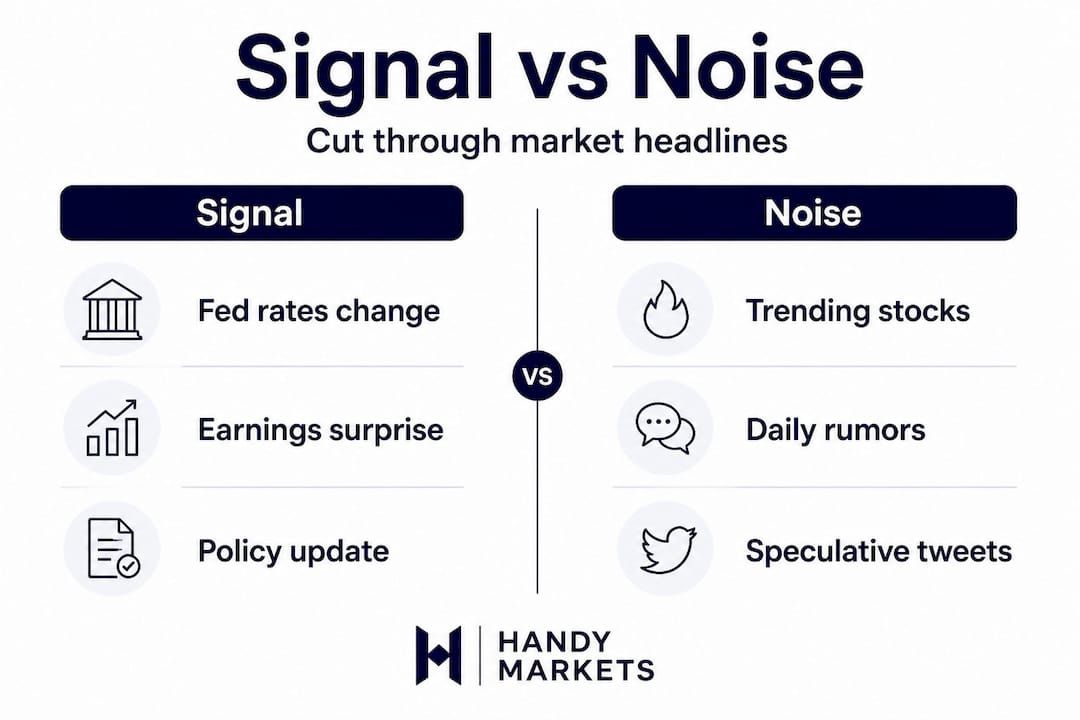
The goal is not to be uninformed. It’s to be selectively informed, which is a very different thing.
Risks of overreacting to news: What studies reveal
With a clearer sense of signal versus noise, let’s look at the concrete damage that overreaction to headlines causes. The evidence is not subtle.
Barber and Odean’s research is among the most cited in behavioral finance. Their studies confirm that attention-driven buying patterns consistently hurt individual investors. The mechanism is straightforward: a stock or asset appears in the news, attention flows to it, retail investors buy in, and the resulting price surge fades quickly, leaving late entrants holding overvalued positions.
Here are the most common overreactions we see from individual investors responding to headlines:
- Panic selling: Liquidating positions during sharp but temporary market drops, locking in losses that would have recovered.
- FOMO buying: Purchasing an asset after it has already rallied substantially, entering at or near the peak.
- Overconcentration: Loading up on a single sector or asset because it dominated the news cycle recently.
- Premature exit: Selling winning positions too early because a negative headline created doubt.
- Paralysis: Failing to invest at all because of a constant sense of uncertainty generated by media coverage.
| Investor behavior | Average annual return impact | Key driver |
|---|---|---|
| Highest turnover quintile | 7.1% lower than lowest turnover | Transaction costs from over-trading |
| Average equity investor 2024 | 16.54% | Behavioral timing errors |
| S&P 500 benchmark 2024 | 25.05% | Passive, disciplined exposure |
“The cost of overreacting is not just one bad trade. It’s the compound effect of dozens of unnecessary trades, each eroding your returns a little more.” This is why even small improvements in behavioral discipline translate into significantly better long-term outcomes.
The market alerts guide we’ve developed outlines a smarter approach: instead of monitoring markets constantly, set specific triggers that only fire when something truly material happens. This removes the temptation to act on noise. For a broader view of how data consumption is evolving for traders in 2026, the market data trends guide is worth reading alongside this article.
You can also explore in-depth stock and crypto analysis to see how systematic evaluation differs from emotionally charged, news-driven reactions. The contrast is striking and instructive.
Making market news work for you: Practical strategies
Armed with that data, the next question becomes practical: how do you use market news as an advantage rather than a liability? The answer is systematic and surprisingly simple once you have the right framework.
The core principle is this: consume information on a schedule you control, not on a schedule the media sets for you.
Here are practical steps to build a healthier news consumption habit:
- Set specific check-in times. Review market news once or twice daily at fixed times, not reactively whenever a notification appears. This creates a buffer between information and action.
- Use price alerts instead of news feeds. Tools that notify you only when a specific asset crosses a price threshold keep you informed without overwhelming you with irrelevant updates.
- Verify primary sources. Financial news outlets often summarize or sensationalize official reports. Always trace claims back to SEC EDGAR, Federal Reserve releases, or official earnings filings. As research confirms, emotional media headlines are designed to drive engagement, not protect your portfolio.
- Limit the number of sources. Following 20 financial media outlets creates an illusion of being informed while actually multiplying noise. Pick two or three reliable, data-focused sources and stick with them.
- Create a decision pause. After reading any market-moving news, wait at least 24 hours before making a portfolio decision. Most of the emotional urgency fades, and the logical case for (or against) action becomes much clearer.
- Track your decisions. Maintain a simple log of every trade you make and what prompted it. Over time, patterns emerge that reveal your own emotional triggers.
Pro Tip: Automate your alerts around price moves, not news cycles. Set alerts for significant percentage moves (for example, an asset rising or falling more than 5% in a session) rather than watching headlines constantly. This way, you only engage with the market when something material has genuinely happened.
Technology makes this easier than ever. A well-designed platform lets you monitor the assets that matter to you, track key market indicators without noise, and receive alerts only when predefined thresholds are crossed. We’ve covered the range of available investment strategies in detail, and the common thread among the most effective ones is discipline over impulse.
If you’re building toward long-term growth, our guide on how to maximize returns in 2026 outlines specific approaches that work in tandem with disciplined news consumption rather than against it.
The uncomfortable truth: News is often the enemy of steady returns
Here’s the perspective most financial guides skip over entirely: the investors who win in the long run are usually the ones consuming less news than their peers, not more.

That’s not a comfortable message in an environment where information feels like power. But the data is unambiguous. A Notre Dame study found that retail investor attention to individual stocks actually predicts lower returns in the following week, while institutional attention to the same stocks correlates with higher returns. Read that again. The more retail investors pay attention to a stock, the worse it tends to perform shortly after.
Why does this happen? Institutions consume information systematically, with analysts, models, and risk frameworks filtering out noise before it reaches a decision-maker. Retail investors consume information emotionally, responding to the same signals that media companies deliberately amplify to maximize engagement. These are fundamentally different processes producing fundamentally different outcomes.
The research confirms that excessive news consumption for passive long-term investors is directly linked to over-trading, anxiety, and underperformance. And yet, most investors keep refreshing their feeds, convinced they’re gaining an edge.
The competitive advantage for you as an individual investor isn’t consuming more information. It’s consuming better information and responding to it more slowly, more deliberately, and with a clear framework in place.
The proven investment strategies that consistently produce results share this common trait: they are news-aware but not news-driven. They use objective data, scheduled reviews, and systematic alerts rather than reactive, emotionally charged decisions.
Institutional investors spend enormous resources building those systems. You don’t need to replicate the infrastructure. You just need to replicate the discipline. And a thoughtful approach to news filtering, combined with reliable alert tools, gets you most of the way there. For broader financial perspectives that complement this approach, the financial insights blog is a valuable resource.
Take action: Smarter news, smarter alerts, smarter investing
If the research in this article resonates with you, the next move isn’t to stop watching markets entirely. It’s to watch them smarter.
Handy.markets is built for exactly this kind of disciplined market monitoring. Instead of drowning in headlines, you can track all financial markets across stocks, crypto, commodities, forex, and indices in one clean view, seeing only what matters to your portfolio. You can monitor crypto alerts and prices in real time without needing to refresh a dozen tabs or follow noise-heavy social channels. Most importantly, you can set up price alerts through Telegram, Discord, Slack, SMS, Webhook, or Email, so you only get notified when a market move is genuinely significant. That’s the practical version of signal over noise, built into a tool that works for you around the clock.
FAQ
Does watching market news improve investment returns?
Most individual investors actually underperform benchmarks when they trade heavily based on news. DALBAR’s 2024 data shows the average equity investor trailed the S&P 500 by nearly 848 basis points due to poor timing driven by emotional reactions.
How can I avoid overreacting to market news?
Set custom alerts for specific price moves, limit your news check-ins to scheduled times, and focus on objective data rather than headlines. Structured filtering of signal from noise is the most effective strategy for passive, long-term investors.
What’s the main risk of following every headline?
Frequent trading triggered by headlines drives up transaction costs and lowers overall returns. Barber and Odean found that high-turnover investors underperformed their lowest-turnover counterparts by 7.1% annually.
Is there a difference between retail and institutional reaction to news?
Yes, a significant one. A Notre Dame study found that retail attention to stocks predicts lower returns in the following week, while institutional tracking of the same information correlates with better performance outcomes.
How do I filter for only actionable market news?
Focus on primary sources like SEC EDGAR and Federal Reserve releases rather than media summaries. Emotional headline language is designed to drive clicks, not portfolio performance, so systemized alerts for large price moves are far more reliable than daily headline monitoring.
Recommended
- Why Track Stock Indices? Smarter Investing In 2026 | Handy.Markets
- Stock Market Indicators: Essential List For Smarter Trading | Handy.Markets
- Market Monitoring Guide: Real-Time Alerts For Traders | Handy.Markets
- How To Compare Financial Markets: A Guide For Investors | Handy.Markets
- Forex coaching: boost trading results with expert guidance
- Why Avoid Risky Crypto Services: Protect Your Investments | Crypto Watchdog