
TL;DR:
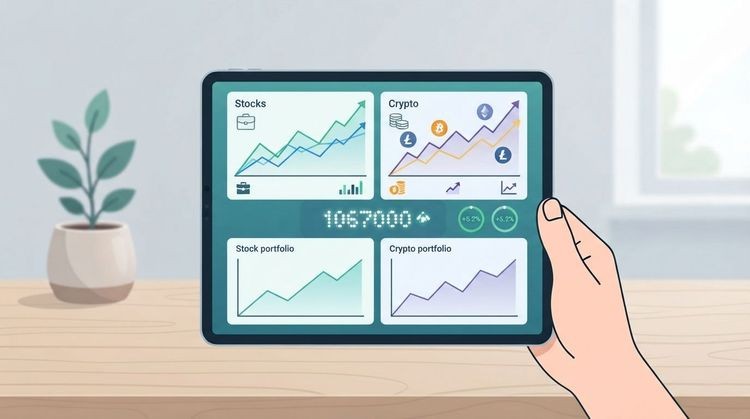
Market indices are essential tools that serve as blueprints and benchmarks behind portfolio decisions and risk management. They aggregate asset performance, influence investment strategies, and provide signals for market health, offering valuable insights for both individual and professional investors. Investing in index-tracking products like ETFs allows for low-cost, diversified exposure, but investors should be aware of hidden concentration risks and construct limitations.
Most investors have seen index numbers flash across the screen during a news broadcast and thought, “that’s useful for analysts, not for me.” That assumption is one of the most expensive misconceptions in personal finance. Market indices are not passive scoreboards. They are the architectural blueprints behind billions of dollars in portfolio decisions, the measuring sticks that separate strong performance from noise, and the early-warning systems that signal when risk is rising or retreating. Once you learn how to read and use them well, your entire approach to investing begins to sharpen.
Table of Contents
- What are market indices and why do they matter?
- How indices drive investment strategy and portfolio decisions
- Indices as tools for market analysis and risk management
- Index products: How ETFs and funds make indices actionable
- What most investors miss about indices
- Track, analyze, and act on indices with Handy.Markets
- Frequently asked questions
Key Takeaways
| Point | Details |
|---|---|
| Indices are benchmarks | Market indices let you compare your portfolio performance to standardized market measures. |
| Strategy and analysis tools | Indices inform everything from high-level asset allocation to technical market signals. |
| Actionable investment options | Index funds and ETFs let you invest directly in broad markets with ease and efficiency. |
| Hidden risks exist | Even diversified index products can carry concentration risk; always check what’s inside. |
What are market indices and why do they matter?
With that foundation, let’s clarify what indices actually are and where they fit in the world of investing.
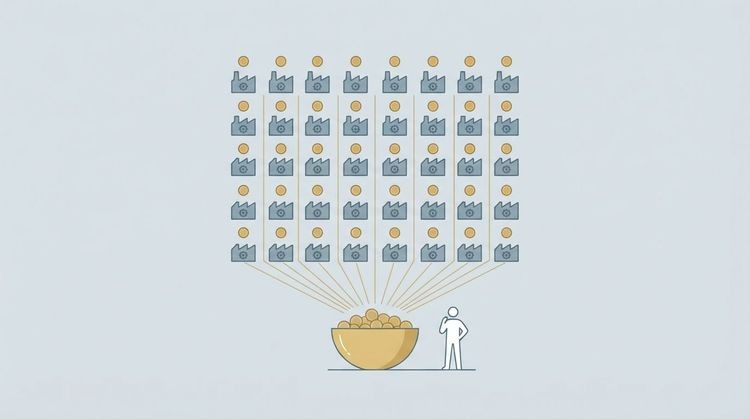
An index measures the price performance of a selected group of stocks, bonds, or other assets. Think of it as a curated playlist that represents a whole genre of music. One song tells you little, but the playlist tells you where the genre is heading. As explained in stock indices explained, indices aggregate performance across multiple companies or assets, providing a barometer for market and trend movement. That aggregate view is what makes them so powerful for investors.
Indices span almost every market imaginable:
- Equity indices like the S&P 500 (500 large U.S. companies), the Dow Jones Industrial Average (30 blue-chip stocks), and the Nasdaq Composite (tech-heavy U.S. stocks)
- Bond indices like the Bloomberg U.S. Aggregate Bond Index, which track fixed-income markets
- Commodity indices covering raw materials such as oil, gold, and agricultural goods
- Crypto indices that track baskets of digital assets, increasingly common since 2020
- Global indices such as the MSCI World or FTSE All-World, offering cross-border snapshots
Each index uses its own construction rules. Some weight companies by market capitalization (bigger companies have bigger influence), others weight equally, and some use price-weighting, where higher stock prices carry more sway. That construction detail matters more than most investors realize, and we will return to it later.
Why should you care? Because indices simplify an overwhelming amount of market data into readable signals, provide benchmarks to measure your own performance against, and form the foundation for thousands of investable products. They are not just for professional fund managers sitting behind Bloomberg terminals.
Pro Tip: When you glance at an index, ask yourself who is inside it and how they are weighted. The S&P 500 may sound like a snapshot of 500 equal companies, but the top 10 holdings can represent over 30% of the entire index. Context changes everything.
How indices drive investment strategy and portfolio decisions
Now that you understand what indices are, let’s see exactly how they influence the way investors, both large and small, build strategies and manage money.
The most practical role an index plays in your investment life is as a performance benchmark. If your portfolio returned 8% last year but the S&P 500 returned 15%, you underperformed the benchmark significantly. That gap tells you something critical: either your stock selection added risk without reward, your fees were too high, or your asset allocation was off. As noted in indices as benchmarks, investors use indices as reference points for both active and passive strategies, making them the common language of performance measurement across the industry.

Indices also shape asset allocation decisions. When a broad equity index like the S&P 500 climbs well above its historical average valuation, many systematic strategies automatically reduce equity exposure and shift toward bonds or cash. Similarly, if a particular sector index such as the Technology Select Sector Index surges dramatically ahead of others, rebalancing schedules get triggered to restore the intended portfolio balance. According to tracking stock indices, indices influence rebalancing schedules and can serve as triggers for strategic portfolio shifts, turning a passive observation tool into an active decision mechanism.
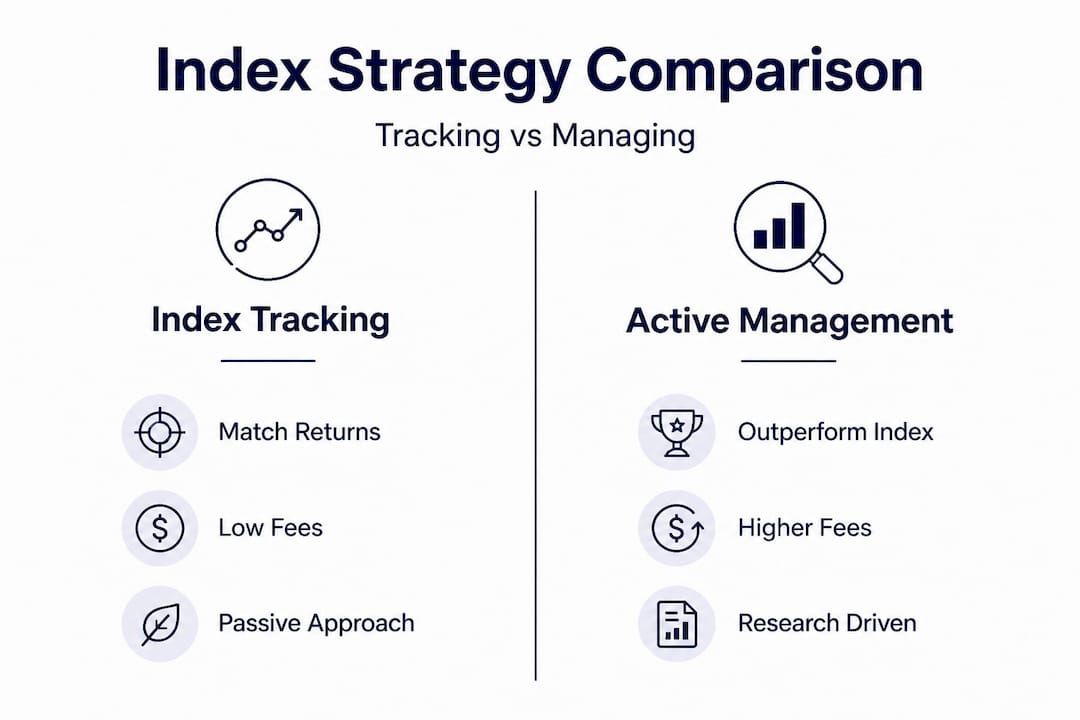
Here is a useful comparison to frame the two major approaches:
| Feature | Index-tracking approach | Actively managed approach |
|---|---|---|
| Primary goal | Match the benchmark return | Beat the benchmark return |
| Average cost (expense ratio) | 0.03% to 0.20% | 0.50% to 1.50% |
| Turnover (tax efficiency) | Low | High |
| Consistency of outcomes | Predictable, tracks index closely | Variable, depends heavily on manager |
| Typical performance vs. index | By design, near-identical | Most underperform over 10+ years |
That last row is the one most investors find surprising. Research consistently shows that most investors underperform major indices over long periods, even professional fund managers with full research teams. This is not a knock on skill. It is a reflection of how competitive and efficient markets really are.
Consider a practical four-step approach for using indices to structure your strategy:
- Choose your benchmark first. Before picking any investment, decide which index represents your target market. U.S. large-cap growth? Use the Russell 1000 Growth. Emerging markets? Use the MSCI Emerging Markets Index.
- Measure your actual returns against it consistently. Use the same benchmark for at least a full market cycle, roughly three to five years, before drawing conclusions.
- Assess whether your approach adds value. If you are paying 1% in fees and your portfolio is not beating the benchmark by at least that margin, you are losing ground.
- Adjust allocation when index signals shift. Extreme valuations or sector rotations visible in index data are legitimate inputs for rebalancing decisions.
“An index is not just a number. It is a mirror. How you look in that mirror, relative to the benchmark, tells you whether your strategy is working or just feeling good.”
Indices as tools for market analysis and risk management
Beyond guiding strategy, indices serve as vital market thermometers. Here is how traders and investors apply them daily.
Market breadth is one of the most telling index-derived signals. When an index like the NYSE Composite rises, but fewer than half of its member stocks are participating in that gain, the rally is considered “narrow” and potentially fragile. Broad participation, where most stocks within an index rise together, suggests healthier momentum. As highlighted in index-based trading indicators, market indices are core inputs for technical, sector, and macro trend analysis, providing signals that go far beyond the headline number.
Here is a simple reference table showing what different index behaviors often signal:
| Index behavior | Possible market signal |
|---|---|
| Index at all-time highs, breadth strong | Broad bull market, risk appetite high |
| Index rising, breadth narrowing | Late-stage rally, selective participation |
| Index falling, volatility (VIX) spiking | Fear event, potential capitulation ahead |
| Multiple sector indices diverging sharply | Sector rotation underway, watch for shifts |
| Index consolidating near support | Market digesting gains, watch for breakout direction |
Before making any major buy or sell decision, run through these practical risk checks using index data:
- Check index trend direction. Is the primary index you are investing within trading above or below its 200-day moving average? Above generally favors buyers.
- Review sector-level indices. Even if the broad market looks healthy, your specific sector may be rolling over. Sector indices tell this story clearly.
- Watch the VIX. The CBOE Volatility Index (VIX) reflects expected short-term market volatility, sometimes called the market’s fear gauge. A VIX above 30 often signals significant uncertainty.
- Look at international indices. Weakness in European or Asian indices can foreshadow U.S. market stress within days.
- Examine bond indices. A sudden spike in bond yields, visible through fixed-income indices, can pressure equity valuations rapidly.
Following market trends 2026 confirms that indices help manage risk by providing signals for overextension or sector shifts, allowing investors to act before a small correction becomes a portfolio emergency.
Pro Tip: Never rely on a single broad index to assess overall market health. Layer your analysis: look at the S&P 500, then drill into a relevant sector index, then check the VIX. Three data points give you a much richer picture than one.
Index products: How ETFs and funds make indices actionable
Knowing how indices shape analysis, it is time to see how you can directly invest in them using today’s most popular products.
An ETF (exchange-traded fund) or index fund takes the concept of an index and makes it ownable. These products replicate an underlying benchmark by buying the actual securities in proportions that match the index’s composition. When you buy a share of the SPDR S&P 500 ETF (SPY), you effectively own a tiny slice of all 500 companies in the S&P 500 simultaneously. That is a remarkable efficiency that would have required enormous capital just 30 years ago.
Key pros and cons of index-based products for individual investors:
- Pro: Low cost. ETFs tracking major indices often charge as little as 0.03% annually, compared to 1% or more for active funds.
- Pro: Instant diversification. One purchase spreads your money across dozens or hundreds of securities.
- Pro: Tax efficiency. Low turnover means fewer taxable events inside the fund.
- Pro: Transparency. You always know what an index holds, unlike many active funds.
- Con: You will never beat the index. You capture market returns, nothing more.
- Con: Hidden concentration. Some indices, particularly market-cap-weighted ones, can be heavily concentrated in a few large stocks.
- Con: No downside protection. If the index falls 30%, your fund falls approximately 30% too.
According to index fund advantages, understanding the differences between index funds, ETFs, and managed funds is key to risk and fee analysis. And with passive investing having surged to reshape global capital flows, making the right product choice matters more than ever.
Here are four steps to evaluate any index-based product before you commit capital:
- Identify the underlying index. Read the fund’s prospectus and confirm exactly which index it tracks. Two funds can both be “S&P 500 ETFs” with different fee structures and tracking precision.
- Check the expense ratio. Even a 0.50% difference compounded over 20 years represents tens of thousands of dollars on a medium-sized portfolio.
- Review tracking error. A well-run index fund should closely mirror its benchmark. Large deviations suggest operational or liquidity issues within the fund.
- Assess the index’s concentration. Look at the top 10 holdings as a percentage of the total fund. Above 40% in the top 10 means less diversification than the name suggests.
What most investors miss about indices
Armed with knowledge of products and strategies, it is worth looking more critically at some of the most common blind spots that can trip up even experienced investors.
Here is something that rarely gets said plainly: many so-called “diversified” index funds are not as diversified as their marketing suggests. Research shows that some index funds concentrate heavily in just a few stocks, creating hidden risks despite being labeled diversified. As of 2026, the top five stocks in the S&P 500 account for a striking portion of the entire index’s weight. That means a broad market downturn triggered by just one or two mega-cap technology companies can hit your “diversified” fund harder than you might expect.
Construction rules also create significant differences between indices that sound nearly identical. The Dow Jones Industrial Average and the S&P 500 are both famous U.S. equity indices, yet they behave differently in the same market environment because one is price-weighted and the other is market-cap-weighted. A single high-priced stock can drag the Dow dramatically while barely affecting the S&P 500. Digging into index construction explained before investing in any index product is time well spent.
We also believe strongly that indices should serve as a starting point for research, not an ending point. Too many investors see a rising index and assume all is well. In reality, a rising headline index can mask serious stress in smaller stocks, specific sectors, or global markets. The most confident investors we follow use index data as the opening chapter of their analysis, not the whole book. Look at what is being left behind while the headline number climbs. That is often where the most meaningful information lives.
Pro Tip: Before you buy any index ETF, search for the fund’s top 10 holdings and calculate their combined weight. If it is above 35%, you are carrying more concentration risk than the word “index” might imply.
Track, analyze, and act on indices with Handy.Markets
Ready to put your index knowledge to work? Here is how to stay a step ahead.
Understanding indices is one thing. Watching them in real time is what turns knowledge into action. At Handy.Markets, you can track financial markets across indices, ETFs, stocks, commodities, and crypto all from a single, clean dashboard. No more toggling between tabs or waiting for a delayed news ticker.
What makes the platform genuinely useful for active investors is the alert system. You can set up price alerts on any index or related asset and receive notifications through Telegram, Discord, Slack, SMS, Webhook, or Email. When the S&P 500 crosses a critical level or a sector ETF breaks below support, you hear about it immediately, not an hour later. Set your parameters once, and let the platform do the watching while you focus on the decision.
FAQ
What is the primary function of a market index for investors?
A market index tracks the performance of a set group of assets, serving as a benchmark for investors’ strategies and results. As demonstrated in stock indices explained, indices aggregate performance across multiple companies or assets, providing a clear barometer for market direction.
How do indices make investing easier?
Indices let investors easily measure market trends, compare returns, and buy index-based funds for broad exposure with a single investment. ETFs and index funds enable investors to own baskets of assets in line with an underlying benchmark, removing the complexity of selecting individual securities.
Can you lose money by investing in an index?
Yes, indices reflect market movements, which means your investment can lose value when markets decline significantly. Beyond general downturns, some index funds carry hidden concentration risks that can amplify losses in volatile conditions.
How do I choose the right market index to follow?
Choose an index that best represents your preferred market, sector, and investment objectives, then verify its construction rules and top holdings before committing. As outlined in index fund advantages, understanding the differences between fund types is essential for matching an index product to your actual risk tolerance and goals.
Recommended
- Why Track Stock Indices? Smarter Investing In 2026 | Handy.Markets
- Understand Market Indices: Guide To Benchmarks And Impact | Handy.Markets
- Stock Indices Explained: Your Essential Guide To Market Benchmarks | Handy.Markets
- Stock Market Indicators: Essential List For Smarter Trading | Handy.Markets
- Comparing Dow Jones to S&P 500 & NASDAQ - My Framer Site
- How to Diversify Trading Strategies for Better Performance