
TL;DR:
- Global commodity prices are projected to surge 16% in 2026 due to geopolitical shocks, with energy leading at 24%. Tracking real-time prices assists investors in making timely decisions, managing risks, and understanding ripple effects across markets. Effective monitoring requires reliable tools, structured processes, and a strategic mindset to turn volatile data into actionable insights.
Commodity markets are rarely quiet, but 2026 has turned the volume up dramatically. Global commodity prices are projected to surge 16% this year due to geopolitical shocks, with energy leading the charge at 24% above prior levels. For investors and market analysts, understanding why track commodities prices matters is not a theoretical exercise. It is a practical edge. Price movements in oil, gold, wheat, and natural gas ripple through equities, currencies, and inflation data with speed and force. Tracking these prices is how you stay ahead of those ripples instead of getting knocked over by them.
Table of Contents
- Key Takeaways
- Why track commodities prices: the fundamentals
- How investors use commodity price tracking
- Tools and platforms for tracking commodity prices
- Challenges in reading commodity price data
- Best practices for integrating commodity price tracking
- My take on commodity tracking in 2026
- Stay ahead with Handy.Markets
- FAQ
Key Takeaways
| Point | Details |
|---|---|
| Volatility is accelerating in 2026 | Geopolitical shocks are driving the steepest commodity price surges since the 2022 Ukraine invasion. |
| Commodity prices affect every asset class | Oil, food, and metals prices influence equities, forex, and inflation data that shape all portfolio decisions. |
| Real-time tracking changes your decision speed | Price alerts and live data allow timely trades and hedges before a market move fully plays out. |
| Linked commodities move with time lags | A 1% oil drop triggers natural gas and fertilizer price shifts up to 12 months later, creating opportunities. |
| Strategy beats reaction | Investors who treat commodity volatility as a signal rather than a surprise consistently manage risk better. |
Why track commodities prices: the fundamentals
Commodity prices are living, breathing signals produced by a constant tug of war between supply, demand, and a long list of external forces. Before you can use price data strategically, you need to understand what is actually moving the needle.
The most foundational driver is supply and demand. When a drought cuts grain harvests in the American Midwest, wheat prices spike almost immediately. When OPEC increases production targets, oil prices typically fall. These dynamics play out across every commodity category, but they are rarely simple because the variables stack on top of one another in ways that are hard to anticipate.
Commodity price volatility is driven by a web of forces including inflation, currency shifts, geopolitical risk, and global economic output metrics like GDP. That interconnectedness is exactly what makes commodity price tracking so rewarding for analysts who invest the time to understand it. Some of the primary drivers include:
- Geopolitical events: Conflict in the Middle East sent food prices up 5% in just two months in early 2026, driven by oils and meals surging 10%.
- Currency fluctuations: Most commodities are priced in US dollars, so a stronger dollar typically pushes commodity prices lower for international buyers, and vice versa.
- Inflation dynamics: Rising production costs feed through to commodity prices, which then feed back into broader inflation figures that central banks watch closely.
- Supply chain disruptions: Port congestion, logistics bottlenecks, and sanctions can restrict supply faster than the market can adjust.
- Speculation and sentiment: Futures markets attract significant speculative capital, which can amplify price moves beyond what fundamentals alone would justify.
Some analysts use the “7 Cs” framework when studying commodity drivers: Cost, Currency, Climate, Conflict, Credit, Consumption, and Capacity. It is a useful mental map for making sure you have not missed a major variable before forming a price outlook.
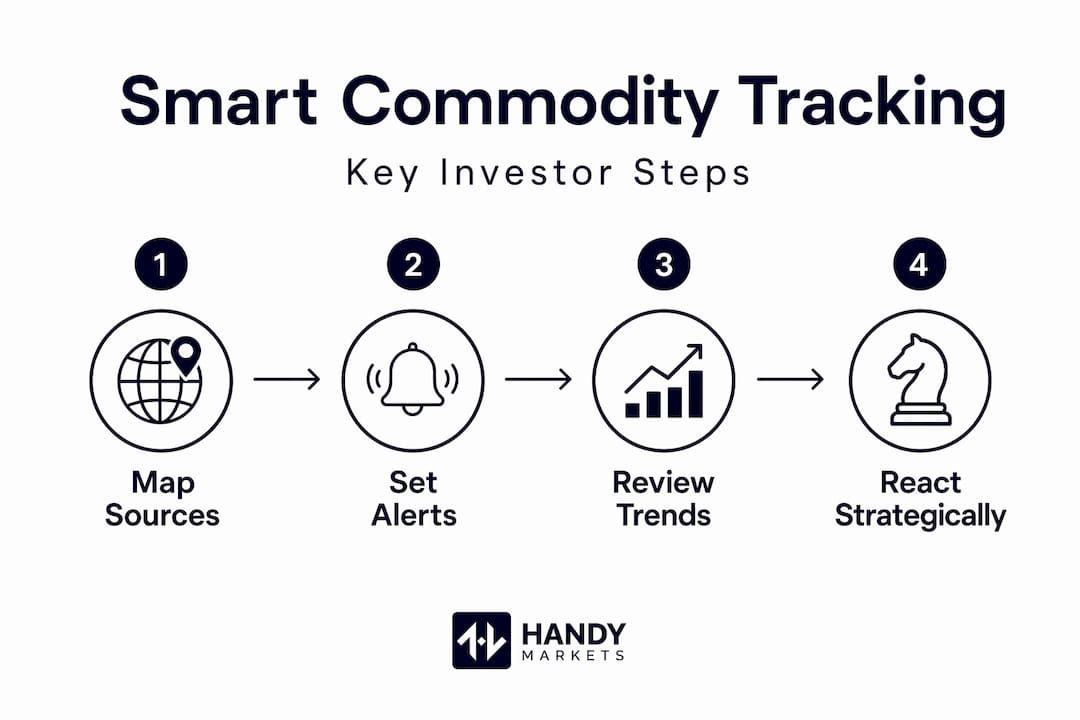
Pro Tip: When monitoring a commodity, map out its 2 or 3 biggest supply sources geographically. Any news event touching those regions deserves your immediate attention.
How investors use commodity price tracking
Knowing the price of crude oil is one thing. Knowing what to do with that information, and when, is where real value is created. Here is how experienced investors and analysts put commodity price tracking to work.
- Executing trades and hedges in real time. Gold’s spot price, for example, moves continuously in response to dollar strength, interest rate shifts, and geopolitical risk. Traders who track this in real time can enter or exit positions with precision. Airlines routinely hedge jet fuel costs by taking long positions in crude oil futures. That only works if you know where prices are and where they are trending.
- Incorporating prices into risk assessment. Commodity prices belong in every portfolio risk model. A portfolio heavy in consumer staples stocks is exposed to rising food and energy input costs. A technology portfolio is exposed to copper and lithium prices through hardware supply chains. Monitoring related commodity prices gives you a sharper picture of where your hidden exposures actually sit.
- Cross-market analysis. Commodity price movements ripple into everyday costs and inflation data that investors monitor closely. When oil rises sharply, transport costs go up, which hits retailer margins, which affects equity valuations, which influences currency values. Tracking commodities is really tracking an early warning system for the rest of your portfolio.
- Using price alerts to time decisions. The importance of tracking commodity prices in real time is amplified when you have alerts set for key levels. You do not need to watch a screen all day. A well-placed alert at a technical support or resistance level, or at a price that triggers a specific risk threshold, means you act on data rather than on gut feeling.
- Scenario analysis and stress testing. When analysts know that a 1% decline in oil production has historically spiked oil prices by 11.5% and triggered delayed increases in natural gas and fertilizer within 12 months, they can model those scenarios before they occur.
Pro Tip: Set alerts not just at round numbers but at the levels that matter technically, like 52-week highs, prior support zones, or percentage moves that would breach your risk thresholds.
Tools and platforms for tracking commodity prices
The right tools make the difference between reacting slowly and acting decisively. The benefits of monitoring commodity prices are fully realized only when your data infrastructure is solid.
| Platform | Strengths | Best For |
|---|---|---|
| Handy.Markets | Live prices, multi-channel alerts, all asset classes in one place | Investors who need cross-market monitoring |
| TradingView | Advanced charting, technical overlays, community scripts | Technical analysts and active traders |
| Barchart | Futures data, options, agricultural commodities focus | Futures-oriented investors |
| Bloomberg Terminal | Institutional-grade data, analytics, news integration | Professional analysts |
Beyond platforms, understanding what type of price to track matters enormously. Spot prices reflect what a commodity trades for right now, for immediate delivery. Futures prices reflect market expectations for delivery at a future date and carry forward costs like storage, financing, and convenience yield built in. For long-term portfolio planning, futures curves tell you more about market sentiment. For short-term trade timing, spot prices are your primary signal.
Real-time commodity price tracking has shifted from institutional-only to widely accessible mobile platforms, allowing individual investors to set price alerts and avoid emotional trading decisions. Key features to look for in any tracking setup include:
- Live spot and futures prices for the commodities you follow
- Customizable price alerts delivered through your preferred channels
- Economic calendar integration so you know when key supply reports drop
- Cross-asset views that let you correlate commodity moves with currency and equity shifts
Pro Tip: Use Handy’s real-time market data guide to understand which data feeds matter most for each asset class. Not all price feeds update at the same frequency, and that gap matters for active traders.
Challenges in reading commodity price data
Understanding the reasons to follow commodity prices is straightforward. Interpreting what those prices actually tell you is where most investors stumble. Commodity data has layers of noise that can mislead even experienced analysts.

The biggest trap is mistaking short-term volatility for a meaningful trend. Crude oil can swing 3% in a single session on a news headline and then completely reverse the next day. Multi-timeframe analysis, looking at daily, weekly, and monthly price action together, helps separate real trend shifts from intraday noise.
Linked commodity delays are another underappreciated complexity. A 1% oil production drop triggers a 7% natural gas price increase and a 5% fertilizer increase, but those effects materialize over roughly 12 months. If you are only watching natural gas today to predict what happened in oil last quarter, you are reading the signal backward.
Macroeconomic events also distort commodity prices in ways that can be confused with supply and demand fundamentals. A surprise Federal Reserve rate decision can move gold prices 2% in minutes, not because gold’s physical supply changed but because dollar-denominated assets repriced instantly.
- Watch volume alongside price moves. A price breakout on thin volume is far less reliable than one backed by heavy trading activity.
- Use correlation analysis. If oil and copper are diverging sharply, one of them is probably responding to a temporary factor rather than a fundamental shift.
- Track the commodity’s specific supply report calendar. The EIA Petroleum Status Report, USDA crop reports, and similar releases move prices predictably and should anchor your analysis schedule.
Pro Tip: For cross-commodity analysis, check our market fluctuation methods breakdown. Understanding how commodity price moves translate across related markets is one of the more underrated skills in portfolio management.
Best practices for integrating commodity price tracking
Knowing how to track commodity prices is only valuable if you build habits and processes around that knowledge. Here are the practices that separate disciplined investors from reactive ones.
- Adopt a strategic mindset. Leading companies in 2026 treat commodity price volatility as a strategic lever, integrating real-time tracking into their systems and automating procurement triggers rather than scrambling to react after a move has already happened. The same principle applies to portfolio management.
- Schedule regular price reviews tied to economic calendars. Ad hoc monitoring creates gaps. Build a weekly review that lines up with the release schedule for key supply and demand reports. Knowing that the EIA crude inventory report drops every Wednesday morning means you are never caught flat-footed.
- Combine price tracking with scenario analysis. For any commodity you are exposed to, maintain two or three price scenarios, bull, base, and bear, and update them monthly. Pair this with practical risk management frameworks to make sure each scenario has a defined response plan.
- Use alerts to remove emotion from timing decisions. Setting a price alert at your planned entry or exit level means the market notifies you when conditions are met. You stop second-guessing and start executing. This is one of the simplest and most impactful commodity price tracking tips you can put into practice immediately.
- Monitor the impact of commodity price trends across asset classes, not just in isolation. A well-maintained watchlist that includes related commodities, relevant currencies, and exposed equities gives you the full picture rather than a fragment of it.
Pro Tip: Review your commodity positions after every major geopolitical event, not just after price moves. The market often takes 24 to 72 hours to fully price in a supply shock, which means attentive investors can position ahead of the crowd.
My take on commodity tracking in 2026
I have watched commodity markets through multiple cycles, and what strikes me most about 2026 is the speed of the feedback loops. Geopolitical news that once took weeks to translate into commodity price moves is now visible in hours. That compression rewards preparation and punishes improvisation.
In my experience, the investors who struggle most are not the ones who lack intelligence. They are the ones who treat commodity price data as something to check after a big move, rather than as an ongoing input that shapes their decisions before the move. Volatility treated as a signal rather than a surprise is a strategic lever. Treated as a surprise, it is just a cost.
What I have found genuinely useful is integrating AI-driven commodity risk tools with live price alerts. The AI does not replace judgment. It surfaces patterns in cross-commodity correlations that would take a human analyst hours to find manually. Pair that with a solid alert system and you have something that actually sharpens your edge rather than just adding more data to scroll through.
My honest advice: start treating your commodity watchlist the way elite traders treat their volatility checklist. Systematic, scheduled, and always tied to a specific decision or threshold. Markets reward structure.
Stay ahead with Handy.Markets
Tracking commodity prices effectively requires more than a good understanding of the market. It requires the right infrastructure, one that delivers live data, sends timely alerts, and keeps all your asset classes visible in a single place.
Handy.Markets gives investors and analysts live commodity prices and alerts across energy, metals, agriculture, and more, all configurable in minutes. Price alerts can be sent directly to Telegram, Discord, Slack, SMS, Email, or Webhook, so you never miss a critical level while managing a busy schedule. For those tracking multiple asset classes, the full markets overview covers crypto, stocks, forex, indices, and commodities in one unified view. Set your first alert for free and start making commodity price moves work for your strategy rather than against it.
FAQ
Why should investors track commodity prices?
Commodity prices signal inflation trends, input cost shifts, and geopolitical pressures that affect equities, currencies, and entire portfolio sectors. Tracking them gives investors an early warning system for broader market moves.
How often should you monitor commodity prices?
For active traders, real-time monitoring with alerts is standard practice. Long-term investors benefit from weekly reviews timed around key supply and demand reports, such as the EIA petroleum status update or USDA crop releases.
What is the difference between spot and futures prices for commodities?
Spot prices reflect the current market price for immediate delivery, while futures prices represent the market’s expectation of what a commodity will cost at a future delivery date, including storage and financing costs.
How do geopolitical events impact commodity prices?
Geopolitical events disrupt supply chains and create uncertainty in production regions. Food prices rose 5% in two months after Middle East conflict in early 2026, illustrating how quickly real-world events translate into commodity market moves.
Can commodity price tracking help reduce emotional trading?
Yes. Setting predefined price alerts removes the pressure of constant monitoring and helps investors act on their pre-set strategy rather than on in-the-moment emotion, which is one of the most practical benefits of monitoring commodity prices.
Recommended
- Why Track Stock Indices? Smarter Investing In 2026 | Handy.Markets
- Financial Markets: Track Crypto, Stocks, Forex, Indices, Commodities & ETFs Prices With Alerts | Handy.Markets
- Commodities: Live Prices, Charts & Market Alerts | Handy.Markets
- How To Follow Live Market Prices: Real-Time Strategies | Handy.Markets