

TL;DR:
- Managing crypto volatility requires a structured workflow to prevent emotional reactions.
- Strategies like grid trading, pairs trading, and risk parity capitalize on market swings effectively.
- Automation and dynamic tools help enforce discipline during high-stress, volatile market conditions.
Crypto markets don’t sleep, and neither does the anxiety that comes with watching your portfolio swing 10% in an hour. Bitcoin averages 4.8% daily ranges while altcoins routinely post 8-15% intraday moves, turning even well-researched positions into emotional rollercoasters. The traders who survive and thrive aren’t the ones with the best gut instincts. They’re the ones with a structured workflow that removes guesswork and replaces panic with process. This guide walks you through exactly that: a practical, step-by-step volatility management workflow built for active crypto traders who want to stop reacting and start executing with confidence.
Table of Contents
- Understand crypto volatility: What you’re dealing with
- Core volatility workflow: Tools, steps, and basic rules
- Grid, pairs, and risk parity: Volatility-driven trading strategies
- Advanced safeguards: Volatility filters, automation, and edge-case handling
- Why most traders underestimate volatility—and what actually works
- Streamline your crypto volatility workflow with Handy.Markets
- Frequently asked questions
Key Takeaways
| Point | Details |
|---|---|
| Workflows beat hunches | A structured crypto volatility workflow removes emotion and improves your odds of trading success. |
| Position size and stops | Keeping risk small and stops tight is key to surviving crypto’s intraday swings. |
| Choose strategy for conditions | Use grid, pairs, or risk parity strategies depending on market volatility and trend. |
| Automate for discipline | Automation tools help you stick to your rules and harvest volatility efficiently. |
Understand crypto volatility: What you’re dealing with
Volatility is the heartbeat of crypto markets, pulsing with both opportunity and risk. Before you can manage it, you need to understand its true scale. Unlike traditional stocks, crypto assets operate 24/7 with no circuit breakers, no market-maker guarantees, and a global retail base that amplifies every rumor and headline.
The numbers are striking. BTC annual volatility runs 44-72%, while ETH sits between 75-98% annually. Smaller altcoins can swing far beyond those ranges in a single session. To put that in perspective, the S&P 500 typically shows annual volatility around 15-20%. Crypto isn’t just more volatile. It’s a different animal entirely.
Here’s a quick comparison of what you’re working with:
| Asset | Daily range (avg) | Annual volatility |
|---|---|---|
| Bitcoin (BTC) | ~4.8% | 44-72% |
| Ethereum (ETH) | ~6-9% | 75-98% |
| Mid-cap altcoins | ~8-15% | 100%+ |
| S&P 500 | ~0.5-1% | 15-20% |
Why does this matter for your workflow? Because mastering market swings starts with accepting that volatility isn’t a bug. It’s the feature that makes crypto tradeable. The danger isn’t the swing itself. It’s reacting emotionally to it.
Emotional trading is the most common volatility trap. You see a 12% drop and panic-sell. You see a 20% spike and chase the move. Both decisions are driven by fear and greed, not data. Understanding what market volatility means in practical terms helps you reframe each swing as a signal to assess, not a trigger to act on instinct.
Research into dynamic grid trading analysis confirms that systematic, rules-based approaches consistently outperform discretionary trading in high-volatility crypto environments. The workflow you build isn’t just a safety net. It’s your edge.
Key insight: Volatility without a workflow is just noise. Volatility with a workflow becomes data you can act on.
Core volatility workflow: Tools, steps, and basic rules
Now that we’ve established what you’re facing, let’s build the actual workflow. Think of this as your pre-flight checklist before every trade. It doesn’t need to take hours. With practice, it takes minutes.
Here are the five core steps every disciplined trader should follow, drawn from a proven volatility management framework:
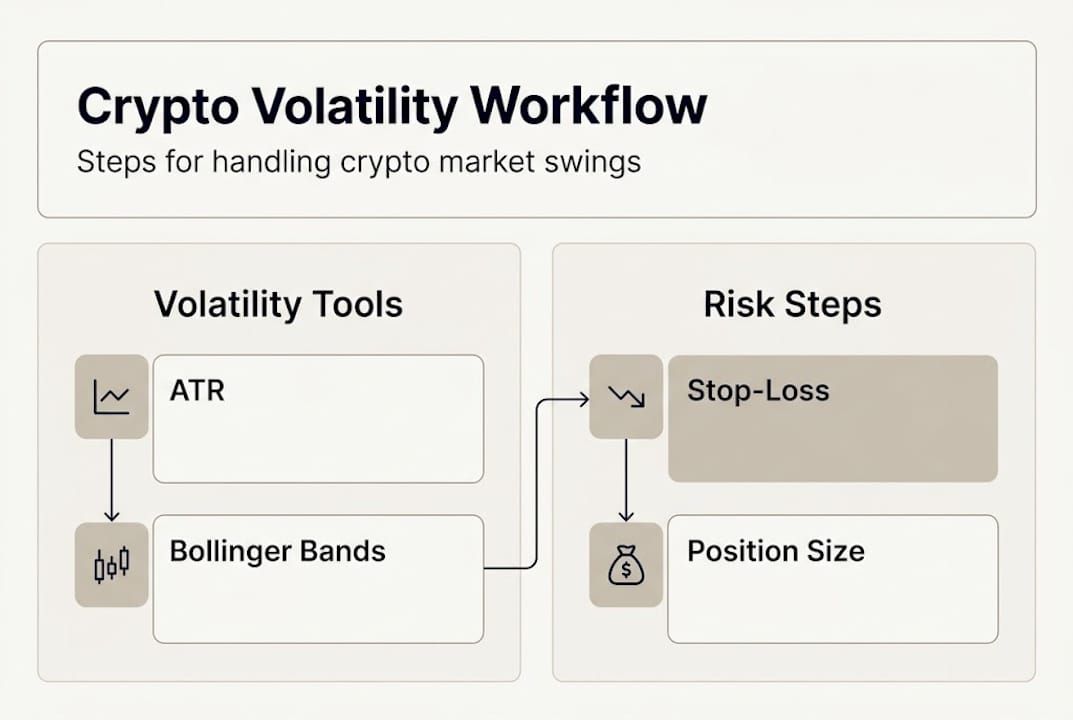
- Assess the volatility regime. Use the Average True Range (ATR) or Bitcoin Volatility Index (BVIV) to gauge current market conditions. Is volatility expanding or contracting? This shapes everything else.
- Size your positions. Risk no more than 0.5-1% of your total capital per trade. In high-volatility regimes, shrink that further. Small, consistent sizing protects you from the inevitable bad trade.
- Set your stops. Place stop-losses based on the asset’s current ATR, not a fixed dollar amount. A stop that ignores volatility will either trigger too early or let losses run too long.
- Diversify and DCA. Spread exposure across uncorrelated assets and use dollar-cost averaging (DCA) to smooth entry prices over time. This reduces the impact of any single bad entry.
- Automate where possible. Bots and conditional orders enforce your rules when emotions run hot. Automation isn’t about removing judgment. It’s about protecting your judgment from yourself.
Here’s a quick comparison of key tools in this workflow:
| Tool | Purpose | Best for |
|---|---|---|
| ATR (Average True Range) | Measures volatility magnitude | Setting dynamic stops |
| BVIV | Bitcoin-specific vol index | Regime assessment |
| Trade journal | Tracks decisions and outcomes | Improving over time |
| Grid/DCA bots | Automates entries and exits | Reducing emotional trades |
A solid volatility checklist for traders helps you stay consistent across sessions. Pair that with market fluctuation strategies and you’ll have a robust foundation. For execution, real-time alerts ensure you never miss a critical regime shift.
Pro Tip: Set your bot’s parameters during a calm market session, not during a live spike. Decisions made under pressure are rarely your best ones.
Grid, pairs, and risk parity: Volatility-driven trading strategies
With the workflow foundation in place, let’s look at three strategies that traders actively use to turn volatility into an advantage rather than a liability.
Grid trading works by placing a series of buy and sell orders at preset intervals above and below a price range. When the market oscillates, the grid captures profits on each swing. Research shows grid trading achieves an 87.3% win rate in high-volatility environments, with monthly returns ranging from 12-34%. In January 2026 alone, optimized grid strategies posted +34.2% returns. The key is calibrating grid spacing to current ATR values so the grid breathes with the market.

Pairs trading takes a different angle. You go long on one asset and short on a correlated one, profiting from the spread between them rather than the direction of either. A volatility filter is essential here. Only activate pairs trades when the spread between assets exceeds a statistically meaningful threshold, typically 1.5-2 standard deviations from the mean.
Risk parity is the conservative option. Instead of allocating equal capital to each asset, you allocate based on each asset’s volatility contribution. Lower-volatility assets get more capital; higher-volatility ones get less. This approach delivers 3.55% annual returns with significantly lower drawdowns than equal-weight portfolios, making it ideal for traders who prioritize capital preservation.
Key rules for all three strategies:
- Always recalibrate grid spacing and position sizes when ATR shifts significantly
- Never run a static grid in a trending market. It’s designed for range-bound conditions
- Use pairs trading as a hedge, not a replacement for your core positions
- Risk parity works best as a long-term portfolio layer, not a short-term trade
For deeper context on applying these in live markets, explore crypto trading articles and grid and pairs trading strategies that cover real-world execution nuances.
Pro Tip: Treat your grid parameters like a recipe. Adjust the ingredients (spacing, order size) based on the current market temperature, not the one from last month.
Advanced safeguards: Volatility filters, automation, and edge-case handling
Your workflow is only as strong as its weakest moment. That moment usually comes during a flash crash, a sudden trend break, or a black swan event. Here’s how to bulletproof your approach.
- Deploy ATR-adaptive grids and stops. Instead of fixed grid spacing, link your parameters directly to ATR readings. When volatility spikes, the grid widens automatically. When it contracts, it tightens. This prevents the grid from triggering too many orders in a quiet market or too few in a chaotic one.
- Automate your exit rules. Pre-program take-profit and stop-loss levels before entering any trade. This removes the temptation to “just hold a little longer” during a losing position.
- Build a scenario playbook. Document in advance what you’ll do during a flash crash, a sudden bull breakout, or a prolonged bear trend. Having a written plan means you’re not making decisions under fire.
- Use BTC as your anchor in bear regimes. Research confirms that grid trading underperforms by 31% in strong trending markets, and flash crashes require stops as wide as -15% to avoid premature exits. In bear markets, BTC consistently shows lower drawdowns than altcoins, making it the safer base asset.
- Limit multi-asset allocation during extreme volatility. When correlations spike (as they do in crashes), diversification benefits collapse. Reduce overall exposure rather than spreading thin across many positions.
For more on understanding market fluctuations and building contingency plans, a structured reference guide can save you from costly improvisation. The dynamic grid performance research is especially useful for calibrating your safeguards against real historical data.
Remember: No workflow survives contact with a black swan event if you haven’t rehearsed it. Scenario planning is the difference between a managed loss and a wipeout.
Why most traders underestimate volatility - and what actually works
Here’s the uncomfortable truth: most retail traders approach crypto volatility as a directional problem. They ask “will it go up or down?” when the more profitable question is “how much will it move, and can I harvest that movement regardless of direction?”
Crypto markets spend roughly 70% of the time in sideways or choppy conditions, not in clean trends. That means directional bets are wrong more often than most traders admit to themselves. Volatility harvesting strategies like grids and pairs trading are specifically designed for this reality.
The other thing most traders get wrong is treating automation as optional. It isn’t. Discipline is a finite resource. You will eventually override your own rules during a stressful session. Automation enforces the process when your willpower runs out.
We’ve seen this pattern repeatedly in backtests and live trading: the traders who track market data trends and follow a documented process consistently outperform those who rely on pattern recognition and intuition alone. Process beats prediction. Every time.
The biggest mindset shift is accepting that you don’t need to be right about direction. You need to be right about process. Build a workflow that profits from movement itself, automate its execution, and review it regularly. That’s the edge most traders never find because they’re too busy chasing the next big directional call.
Streamline your crypto volatility workflow with Handy.Markets
Putting your workflow into action requires more than a good plan. You need live data, instant alerts, and a clear view of multiple markets at once.
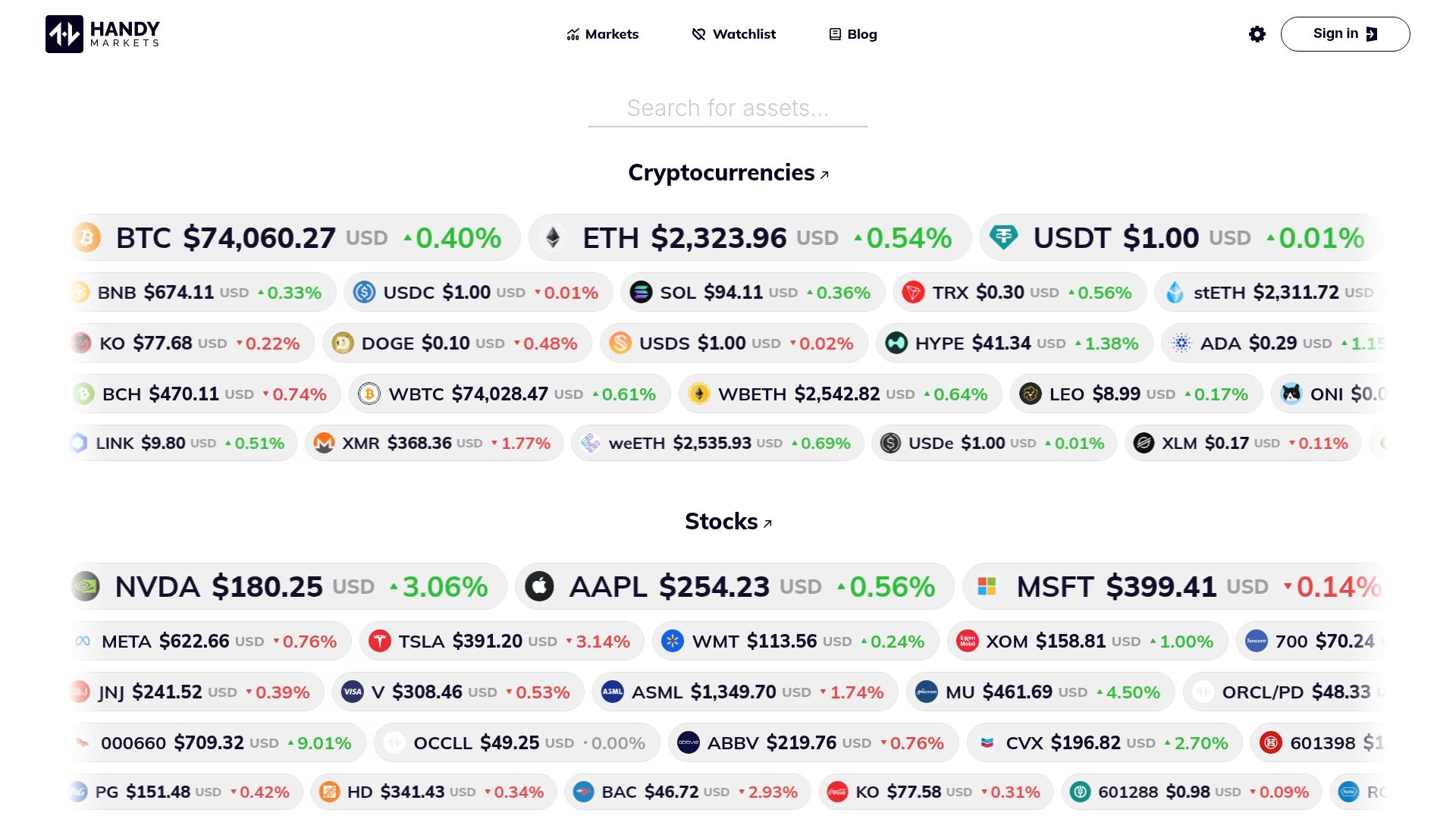
Handy.Markets gives you exactly that. Monitor crypto market prices and alerts in real time, set up volatility-triggered notifications across Telegram, Discord, Slack, SMS, and Email, and track all markets from one clean dashboard. Whether you’re running a grid strategy or watching for regime shifts, you’ll always have the data you need at your fingertips. Setting up free price alerts takes minutes and ensures you never miss a critical move. Your workflow deserves the right infrastructure behind it.
FAQ
What is a crypto market volatility workflow?
A crypto market volatility workflow is a stepwise process using volatility metrics, position sizing, stops, and discipline to manage risk and capture opportunity. It replaces emotional reactions with a structured, repeatable framework that keeps you consistent across all market conditions.
Why should I use automation in my crypto volatility workflow?
Automation removes emotional decision-making from the equation, enforcing your risk rules even during high-stress market moments. It also allows you to capture sideways volatility using grid and pairs strategies that require precise, timely order execution.
How do I set stop-losses for volatile crypto assets?
Base your stops on the asset’s current ATR rather than a fixed percentage, and set stops 2-8% depending on the volatility regime. For flash crash scenarios, widen stops to at least -15% to avoid premature exits during brief, sharp dislocations.
What crypto trading strategy works best during high volatility?
Grid trading with ATR-calibrated spacing, pairs trading with a spread filter, and risk parity portfolios all tend to outperform basic buy-and-hold in high-volatility periods. Grid and pairs strategies are specifically built to profit from price oscillation rather than directional momentum.
Recommended
- Market Volatility Checklist: Strategies For Traders | Handy.Markets
- Mastering Volatility In Investing: A Beginner’s Guide To Navigating Market Swings In 2025 | Handy.Markets
- Market Fluctuation Analysis: Methods, Tools & Strategies | Handy.Markets
- Forex Volatility Explained: Key Drivers, Risks & Insights | Handy.Markets