

TL;DR:
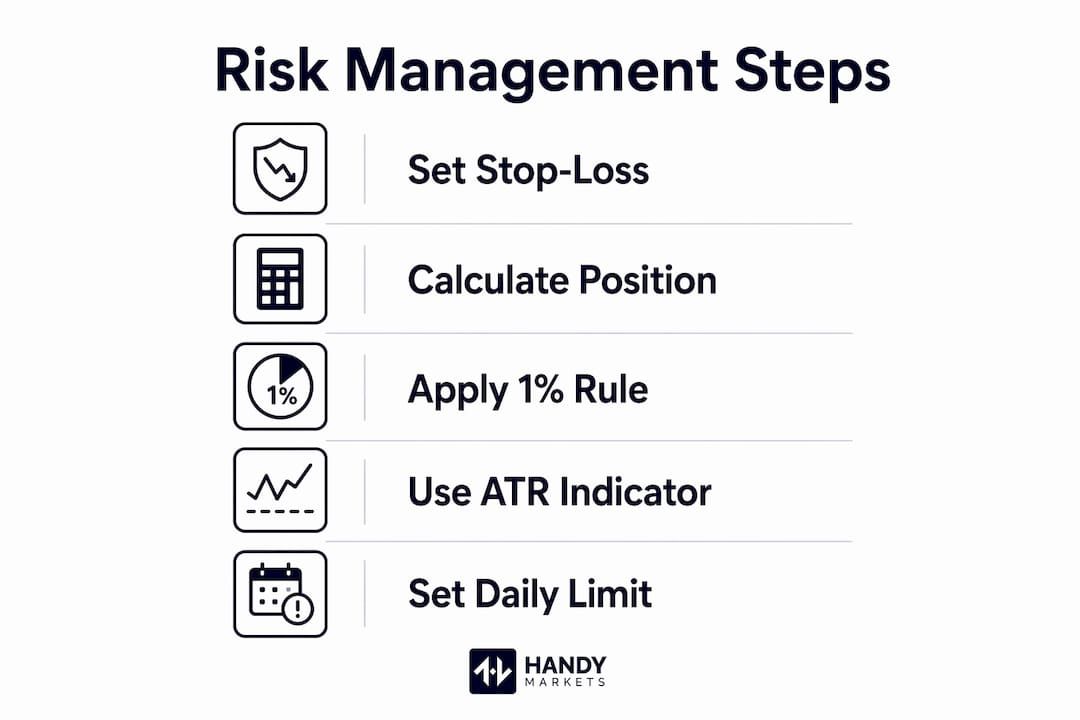
- Effective risk management in trading involves a layered system of position sizing, stop-loss orders, and daily and drawdown limits to safeguard capital during all market conditions.
- Traders should calculate position sizes using the risk dollar amount divided by stop distance and strictly follow their rules, avoiding moving stops or overriding loss limits, to prevent significant losses.
Risk management in trading is the systematic process of limiting potential losses by setting defined rules on how much capital you risk per trade, per day, and across sustained losing streaks. Without these rules, even a profitable strategy can destroy an account during a bad run. Risk management operates as a 4-layer system controlling losses at the trade level, daily level, and cumulative drawdown level before you reduce size or stop trading entirely. The core tools are position sizing, stop-loss orders, and layered loss limits. The widely cited 1% rule, popularized by Investopedia, caps per-trade risk at 1% of account value so that no single loss is catastrophic. On a $10,000 account, that means risking no more than $100 on any one trade. This framework is not optional for serious traders. It is the foundation that lets a good strategy survive long enough to compound.
What is risk management in trading, and how is it structured?
Effective risk management is a layered defense, combining per-trade controls with daily and overall drawdown limits to enable compounding of advantage over time. Think of it as a series of circuit breakers, each one designed to stop a bad day from becoming a bad month. The four layers build on each other in a specific order.
- Position sizing determines how many shares, contracts, or units you buy based on a fixed dollar risk, not a gut feeling. This is your first line of defense.
- Stop-loss placement defines the exact price where you exit a losing trade automatically. Stop-loss orders enforce discipline by removing the emotional decision to hold on and hope.
- Daily loss limits act as a hard ceiling on how much you can lose in a single session. A common threshold is 3% of account value. Once you hit it, you stop trading for the day.
- Drawdown management governs what happens when losses accumulate over days or weeks. At a defined threshold, you either reduce position size or pause trading entirely until performance recovers.
Each layer protects the one above it. If your stop-loss fails because you moved it, your daily limit catches the damage. If your daily limit is ignored, your drawdown rule is the last line of defense. Skipping any layer leaves a gap that a single bad trade can exploit.
Pro Tip: Never move a stop-loss further away from your entry after a trade goes against you. Moving a stop is not managing risk. It is abandoning your risk plan entirely.

How do traders calculate position sizes and set stop-loss levels?
Position sizing follows one formula: Size = Risk $ ÷ Stop Distance. The stop distance is the gap in price between your entry and your stop-loss level. Your risk dollar amount comes from your per-trade rule, such as 1% of account value. The position size is the output, not the starting point.
Here is a practical example using that formula:
| Variable | Example Value |
|---|---|
| Account size | $20,000 |
| Risk per trade (1%) | $200 |
| Entry price | $50.00 |
| Stop-loss price | $48.00 |
| Stop distance | $2.00 |
| Position size | 100 shares |
The critical insight here is that your stop-loss placement drives everything else. Stops represent thesis invalidation, meaning you place them at the price level where your trade idea is proven wrong by the chart, not at a round number that feels comfortable. A support level break, a moving average cross, or a prior swing low are all structurally valid stop locations. “I don’t want to lose more than $50” is not.
Many traders also use the Average True Range (ATR) indicator to set volatility-adjusted stops. If a stock has an ATR of $1.50, placing a stop $0.30 away guarantees you get shaken out by normal price movement. A stop at 1.5x to 2x ATR gives the trade room to breathe while still capping your loss at a defined dollar amount.
Pro Tip: When scaling into a position by adding a second or third entry, total cumulative risk across all clips must stay below your per-trade cap. Treat the entire position as one trade, not three separate ones.
How do daily and weekly loss limits protect your account?
Daily and weekly loss limits function as circuit breakers that prevent a losing streak from compounding into an account-ending event. Most professional traders set a daily loss limit between 2% and 3% of account value. A weekly limit typically sits between 5% and 6%. When either threshold is hit, trading stops until the next session or next week.
Here is why these limits matter more than most traders realize:
- Emotional trading accelerates after losses. Once you are down on the day, the temptation to “win it back” overrides rational decision-making. A daily limit removes that temptation by force.
- Bad days cluster. Losing streaks are not random. Poor market conditions, news events, or a strategy that stops working can produce multiple losing days in a row. A weekly cap prevents a bad week from erasing a good month.
- Graduated drawdown rules preserve capital. Rather than stopping cold at a drawdown threshold, many traders reduce position size by 25% to 50% when they hit a defined loss level. This keeps them in the game while reducing exposure.
- Hard stops versus size reduction. Hard drawdown stops can reduce returns by forcing an exit just before a rebound. Graduated size reduction is often a better balance between protecting capital and staying positioned for recovery.
The practical rule is simple: set your daily limit before the market opens, treat it as non-negotiable, and log off when you hit it. Traders who override their daily limits almost always report that the override made things worse.
What advanced quantitative tools do institutional traders use?
Retail traders work with stop-losses and position sizing. Institutional desks layer in quantitative tools that measure risk across entire portfolios, not just individual trades. Understanding these tools helps you think about risk assessment in trading at a higher level, even if you never implement them directly.
Quantitative risk tools used by institutions include parametric Value at Risk (VaR), Conditional VaR (CVaR), optimal hedge ratios, stop-loss cluster heatmaps, and flow toxicity indicators like VPIN.
| Tool | What it measures | Who uses it |
|---|---|---|
| Value at Risk (VaR) | Maximum expected loss at a confidence level (e.g., 95%) over a set period | Hedge funds, prop desks |
| Conditional VaR (CVaR) | Average loss in the worst-case scenarios beyond the VaR threshold | Risk managers, quant funds |
| Optimal hedge ratio | Position size in a hedge instrument that minimizes portfolio variance | Portfolio managers |
| Stop-loss cluster heatmaps | Price levels where large stop orders are concentrated | Institutional traders |
| VPIN (flow toxicity) | Measures order flow imbalance to predict adverse price moves | High-frequency traders |
VaR tells you the most you are likely to lose on a normal bad day. CVaR tells you what happens on the truly terrible days beyond that. For a retail trader managing a single account, the 1% rule and daily loss limits accomplish a similar goal with far less complexity. The key takeaway is that the principle is identical across both worlds: define your maximum acceptable loss before it happens, then build rules around it.
What are the most common risk management mistakes traders make?
Risk management is often neglected in favor of entry strategies, but the mistakes traders make in managing risk are what actually end careers. Knowing the errors in advance gives you a real advantage.
- Sizing by confidence, not math. Traders who bet bigger when they “feel good” about a trade are not managing risk. They are gambling. Sizing trades by feeling rather than formula destroys risk discipline and creates unpredictable loss exposure.
- Moving stop-losses after entry. This is the single most common and most damaging mistake. A stop that gets moved is no longer a stop. It is a wish.
- Ignoring daily loss limits. Setting a 3% daily limit and then overriding it “just this once” is how traders turn a bad morning into a blown account.
- Averaging down without a plan. Adding to a losing position without pre-defined rules for how much total risk you will accept is not a strategy. It is hope dressed up as discipline.
- Scaling in without tracking total risk. Each added clip increases your total exposure. Without tracking cumulative risk, you can easily hold 3x your intended position size without realizing it.
The psychological dimension of these mistakes is real. Markets pulse with opportunities and risks simultaneously, and the emotional pull to act outside your rules is strongest exactly when following them matters most. A written risk plan reviewed before each session is one of the most effective tools for staying disciplined under pressure. Pairing that with a volatility management checklist can help you stay grounded on high-movement days.
Pro Tip: Keep a trading journal that logs not just your trades but your rule compliance. Tracking whether you followed your risk rules is more valuable than tracking your P&L in the short term.
Key takeaways
Effective risk management in trading requires a layered system of position sizing, stop-loss rules, daily loss limits, and drawdown controls working together to protect capital across every market condition.
| Point | Details |
|---|---|
| Use the 1% rule | Risk no more than 1% of account value per trade to survive losing streaks. |
| Size from the formula | Calculate position size as Risk $ ÷ Stop Distance, not from gut instinct. |
| Set daily and weekly limits | Cap daily losses at 2-3% and weekly losses at 5-6% to prevent compounding damage. |
| Never move your stop | Relocating a stop-loss after entry eliminates the protection it was designed to provide. |
| Layer your defenses | Trade-level, daily, and drawdown controls each catch what the previous layer misses. |
Our honest view on risk management discipline
At Handy, we have watched traders obsess over entry signals while treating risk rules as optional guidelines. That is the wrong priority. A mediocre entry with a disciplined risk framework will outperform a brilliant entry with no risk controls over any meaningful time horizon.
The layered approach is what separates traders who survive from those who do not. Position sizing alone is not enough. Daily limits alone are not enough. The layers work because each one catches what the others miss. A trade that blows through your stop still gets contained by your daily limit. A bad week still gets capped by your drawdown rule. The system only fails when you override it.
One thing we find underappreciated is the role of market fluctuation analysis in calibrating these rules. Your stop distances and position sizes should reflect actual market volatility, not fixed dollar amounts. A $2 stop on a stock with a $3 ATR is not a stop. It is noise. Adjusting your risk parameters to the current volatility environment is what makes a risk framework durable rather than rigid.
The traders who build lasting accounts are not the ones who find the best entries. They are the ones who lose the least when they are wrong.
Stay ahead of risk with real-time market data
Managing risk starts with knowing what the market is doing before you place a trade. Handy.Markets gives you live prices, percentage changes, and price alerts across stocks, crypto, forex, commodities, and indices, all in one place.
Set up real-time price alerts through Telegram, Discord, Slack, SMS, or email so you never miss a critical level. When a stock approaches your stop zone or a key support breaks, you know instantly. Handy’s financial markets tracker lets you monitor every asset class you trade from a single dashboard, giving you the situational awareness that good risk management depends on. For traders building discipline from the ground up, pairing structured risk rules with reliable market data is the combination that actually works. Beginners can also explore TradeSoft’s risk management resources to build execution discipline alongside their data habits.
FAQ
What is risk management in trading?
Risk management in trading is the process of defining and enforcing rules that limit how much capital you can lose per trade, per day, and over a sustained drawdown period. The core tools are position sizing, stop-loss orders, and daily and weekly loss limits.
What is the 1% rule in trading?
The 1% rule caps your risk on any single trade at 1% of your total account value. On a $10,000 account, that means risking no more than $100 per trade, which prevents any single loss from causing serious damage to your capital.
How do you calculate position size for a trade?
Position size equals your risk dollar amount divided by the stop distance in price. For example, if you risk $200 and your stop is $2.00 away from entry, your position size is 100 shares. This formula keeps dollar risk fixed regardless of stop width.
What is a daily loss limit and why does it matter?
A daily loss limit is a predefined threshold, typically 2% to 3% of account value, at which you stop trading for the day. It prevents emotional overtrading after losses and stops a bad morning from becoming a catastrophic session.
What is the difference between VaR and CVaR?
Value at Risk (VaR) estimates the maximum expected loss at a given confidence level over a set period. Conditional VaR (CVaR) measures the average loss in the worst-case scenarios that exceed the VaR threshold, making it a more conservative and complete risk measure.