


Finding reliable market data and alerts that reach all your channels without extra fees or patchwork manual setups stalls your reaction time. Many providers force add-ons for cross-channel alerts or hide key integrations, pushing teams to juggle multiple tools or miss signals. This comparison shows features, asset coverage, and notification delivery across four options so you can pick a MarketTop.org alternative that fits your workflow without surprises.
Table of Contents
Handy.Markets
At a Glance
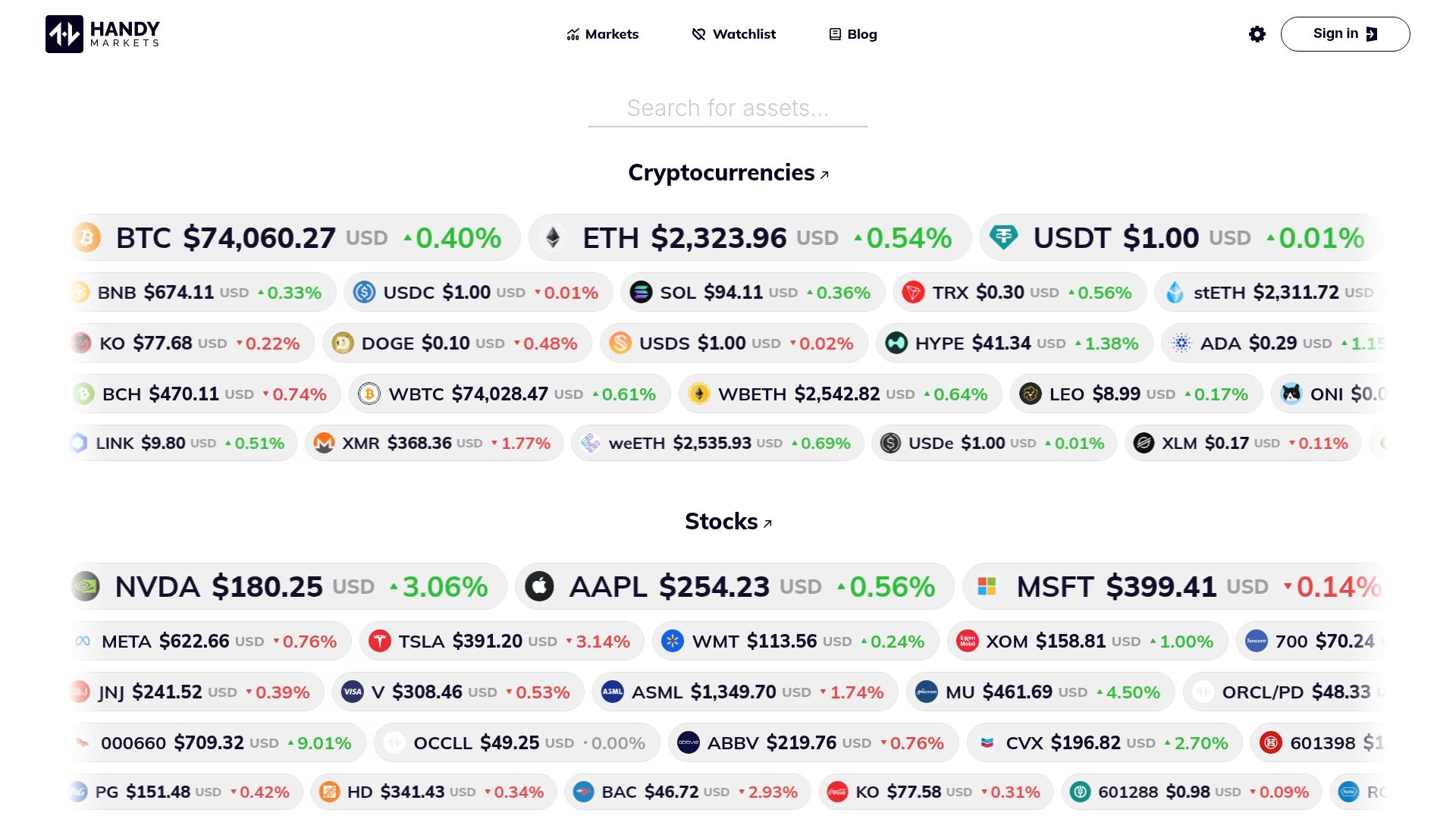
Price alerts can route to Telegram, Discord, Slack, SMS, Webhook, and Email from a single setup. The platform aggregates live prices and percentage changes across cryptocurrencies, stocks, commodities, indices, and foreign exchange. It presents multiasset monitoring in one view while not offering direct trading or execution.
Core Features
Handy.Markets delivers real-time price tracking across crypto, fiat, stocks, ETFs, bonds, and commodities and shows percentage changes for rapid comparison. The site includes portfolio management tools and a set of business-grade options such as APIs and webhooks plus embeddable price widgets. Users can create alerts and event listings, and the interface is designed for quick setup to monitor multiple asset classes in one place.
Key Differentiator
The product’s single strongest selling point is unified alert distribution to multiple messaging and delivery channels from one rule. That lets you set one threshold and notify a Telegram channel, a Slack workspace, and an automated system via Webhook simultaneously. This reduces the manual work of duplicating alerts across tools and keeps your trading signals consistent across platforms.
Pros
Handy.Markets brings multiple asset classes into a single dashboard, so you can compare crypto, equities, FX, and commodities without switching sites. The platform emphasizes speed and reliable feeds sourced from prominent exchanges, which improves intraday monitoring and reduces blind spots. Business users benefit from APIs, webhooks, and price widgets that feed internal dashboards or automation engines. The notification breadth supports messaging apps and standard channels, which helps teams and solo traders get the same alert in the channel they actually watch.
Cons
- Pricing details and specifics about the user interface are not publicly listed, which limits visibility into cost and usability before trial or contact.
Who It’s For
You are a trader, analyst, or investor who tracks multiple asset classes and needs low-friction alerts delivered where you work. You will value the ability to send the same alert to messaging apps, email, and automation endpoints. Teams that run trading bots or internal dashboards will get extra value from APIs and webhooks.
Unique Value Proposition
A single alert rule can deliver to Telegram, Discord, Slack, SMS, Webhook, and Email at once, which shortens notification setup and keeps signals identical across channels. That capability reduces missed opportunities when team members prefer different apps. For businesses, combining that delivery model with embeddable widgets and APIs lets you build internal dashboards that mirror public watchlists without manual syncing.
Real World Use Case
A forex desk monitors EURUSD, USDJPY, and crude oil on one screen and sets conditional alerts for breakout levels. When EURUSD crosses a trigger, Handy.Markets sends a Webhook to the desk’s automation engine and a Slack message to traders. The desk automates position sizing and records the event for posttrade review.
Pricing
Pricing is not publicly listed and the product description labels pricing as not applicable for informational use. Organizations seeking B2B API access or bulk alerting should request a quote or a trial to confirm plans and limits.
Website: https://handy.markets
Stock Alarm
At a Glance
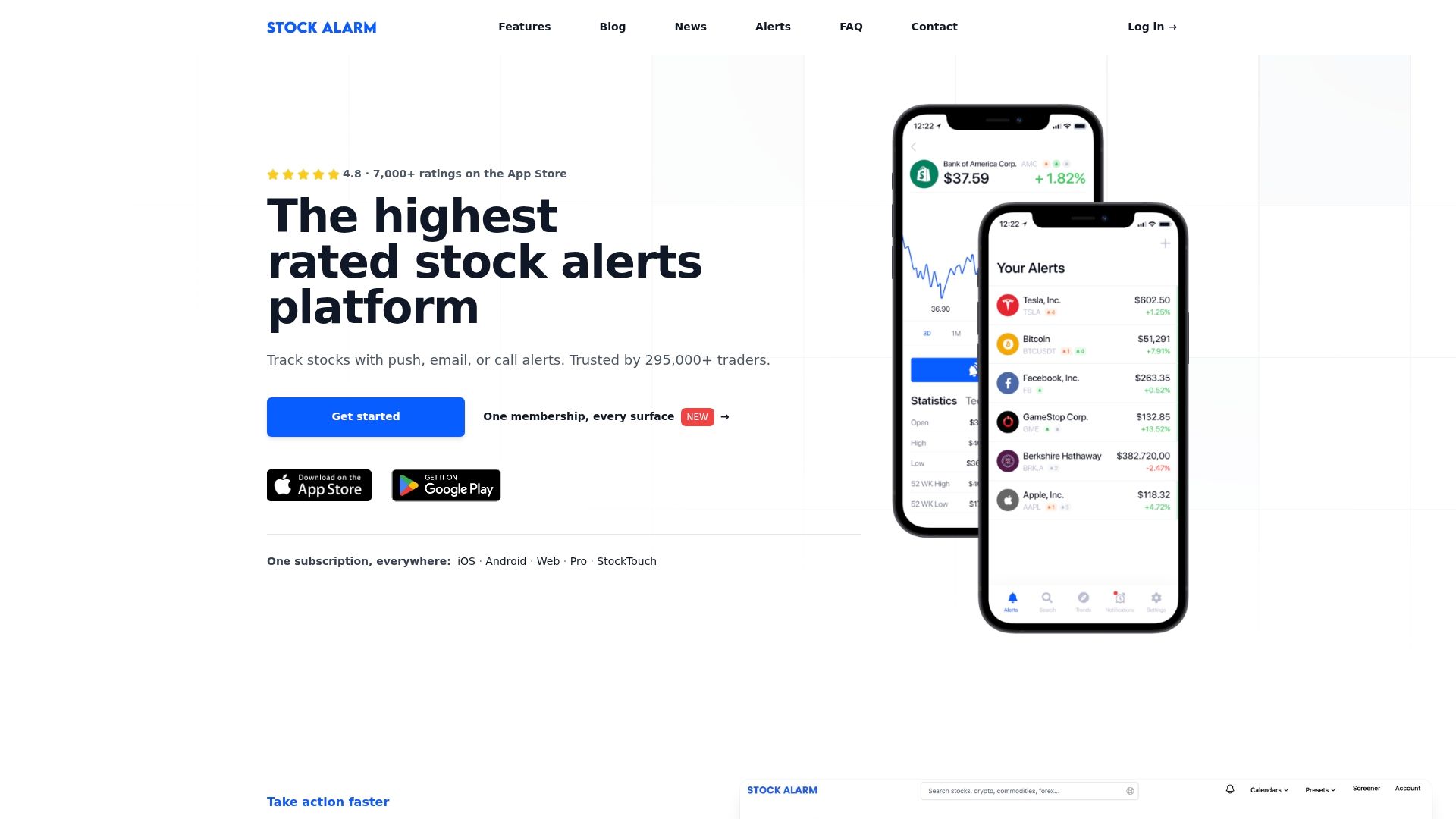
Stock Alarm reports support for more than 65,000 assets, spanning stocks, ETFs, cryptocurrencies, forex, indices, and commodities. The platform combines a large asset catalog with multi channel notifications and a market screener to filter opportunities in real time. That mix targets traders who want event driven alerts across devices without juggling multiple subscriptions.
Core Features
Stock Alarm offers customizable alerts across price moves, technical indicators, volume spikes, pattern detection, earnings, and economic data, with more than 125 trigger options. It includes a market screener for live filtering by technical and fundamental criteria and supports notifications via phone calls, texts, email, and push notifications. The platform also covers extended hours pricing and lets you receive alerts on multiple devices from a single plan.
Key Differentiator
The defining feature is the breadth of trigger logic combined with universal delivery. Stock Alarm ties 125 customizable trigger types to a broad asset set so you can build alerts that mix technical, price, and event filters. You get multi channel delivery from a single subscription, which reduces friction when you need the same alert on phone and email.
Pros
The platform’s asset breadth stands out for traders who monitor multiple markets and asset classes. Real time data streaming for listed stocks and many cryptocurrencies helps alerts arrive without unnecessary lag. Cross platform access with web and mobile apps keeps signals consistent across devices. The vendor advertises more than 295,000 traders and strong app store ratings, which suggests a sizable active user base and frequent iteration.
Cons
- Extended hours Nasdaq prices have a 15 minute delay, which can affect traders who act on after hours price moves.
- The volume of alert types can overwhelm new users trying to build a concise rule set.
- Data agreements limit exchange coverage, so some smaller or less common exchanges may be missing.
When It May Not Fit
If you trade primarily in after hours sessions and need true live quotes for Nasdaq, that 15 minute delay makes Stock Alarm a weak choice. Traders who require direct access to less common exchanges will find gaps in coverage. If your workflow depends on a minimal, simple alert set, the large number of trigger options could slow setup.
Who It’s For
Active traders, retail investors, and financial advisors who monitor multiple asset classes will get the most value. You benefit if you want detailed, rule based alerts delivered to phone, email, and other channels without managing separate subscriptions. This suits people who prioritize signal flexibility over a stripped down interface.
Real World Use Case
A day trader sets price and technical indicator alerts across several stocks and crypto holdings. Alerts arrive as push notifications and email so the trader responds quickly when thresholds are crossed. That reduces time spent watching charts and helps capture short term moves.
Pricing
A free tier is available for basic alerts and limited coverage. Paid plans add more alerts, extended asset coverage, and advanced trigger types. See the vendor pricing page for tier details and limits at https://app.stockalarm.io/pricing.
Website: https://stockalarm.io
MarketAlerts
At a Glance
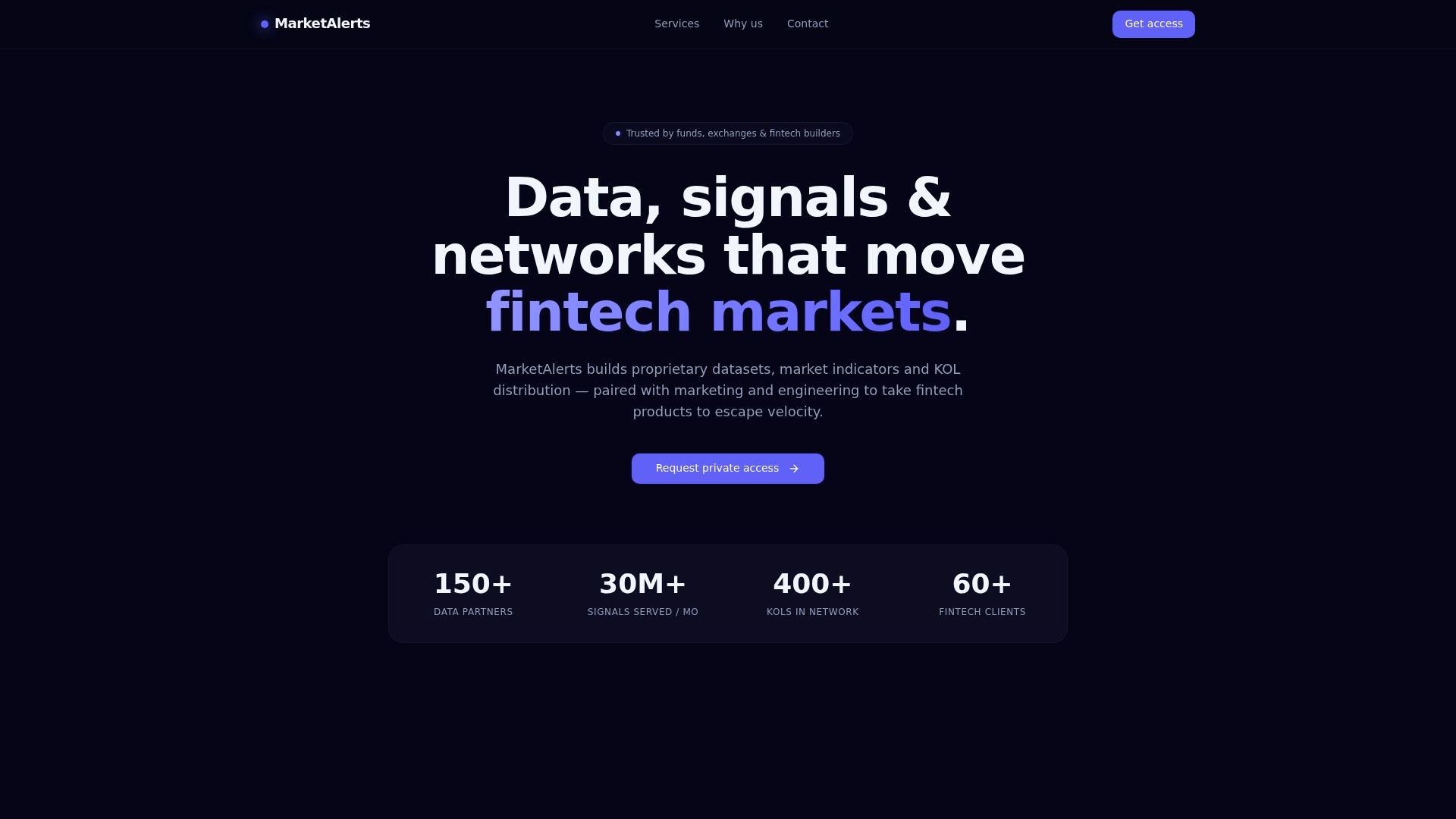
Indicators are benchmarked against live PnL, tying signals directly to trading outcomes rather than abstract scores. The offering combines raw on-chain and off-chain inputs with alternative data and quant-derived indicators. The vendor positions these assets for use via API, dashboards, or webhooks and pairs them with outreach services for fintech audiences.
Core Features
MarketAlerts delivers proprietary datasets that include on-chain, off-chain, and alternative sources for alpha discovery, and it exposes quant-built market indicators through API, dashboard, and webhook delivery. The service adds a curated KOL network for targeted regional outreach and full-stack fintech marketing that covers positioning, content, and community building. Product teams can also contract engineering support for trading infrastructure, dashboards, smart contracts, and front-end UIs.
Key Differentiator
The single stand-out element is the combination of data, signals, and distribution under one engagement model. MarketAlerts matches datasets and quant indicators with KOL distribution and marketing work to accelerate go-to-market steps. That integration aims to shorten time from signal development to measurable market and community outcomes.
Pros
MarketAlerts integrates data and product work across the fintech lifecycle, which reduces coordination overhead between analytics and engineering. The vendor emphasizes full lineage for its datasets, which supports traceability and auditability in research workflows. Packaging signals with marketing and KOL outreach lets you move from insight to activation without hiring multiple vendors. The ability to receive indicators via API, dashboard, or webhook gives flexible delivery for trading systems and research stacks.
Cons
- Limited public documentation and platform access. Many pages resolve to 404s, which creates friction for self-service evaluation.
- Likely geared toward enterprise engagements, making the cost structure and onboarding lengthy for smaller teams.
- Specific integrations and feature details are not publicly listed, so technical fit requires direct vendor discussion.
When It May Not Fit
You should avoid MarketAlerts if you need a self-serve data platform with transparent docs and immediate trial access. Smaller trading shops or individual analysts will likely find the engagement and pricing model a poor match. If you require a long list of out-of-the-box integrations, you will need to confirm availability directly with the vendor.
Who It’s For
MarketAlerts fits fintech and crypto companies, funds, exchanges, and larger product teams that need proprietary signals plus go-to-market support. Use it when your team wants a single partner to supply data, engineering resources, and promotional reach. It is most relevant for organizations with budget and governance to run enterprise integrations.
Real World Use Case
A crypto exchange ingests MarketAlerts signals through API and wires them into a market-making strategy to refine execution. The same engagement taps the KOL network to announce a new derivatives product and to seed liquidity. That combined approach shortened coordination across analytics, engineering, and marketing for a faster product launch.
Pricing
Pricing is bespoke and oriented to enterprise engagements, so there is no public list price or self-serve tier. Expect project or retainer models that cover data access, engineering time, and marketing services. Final cost and terms require direct negotiation with the vendor.
Website: https://marketalerts.com
Alpha Sentinel
At a Glance
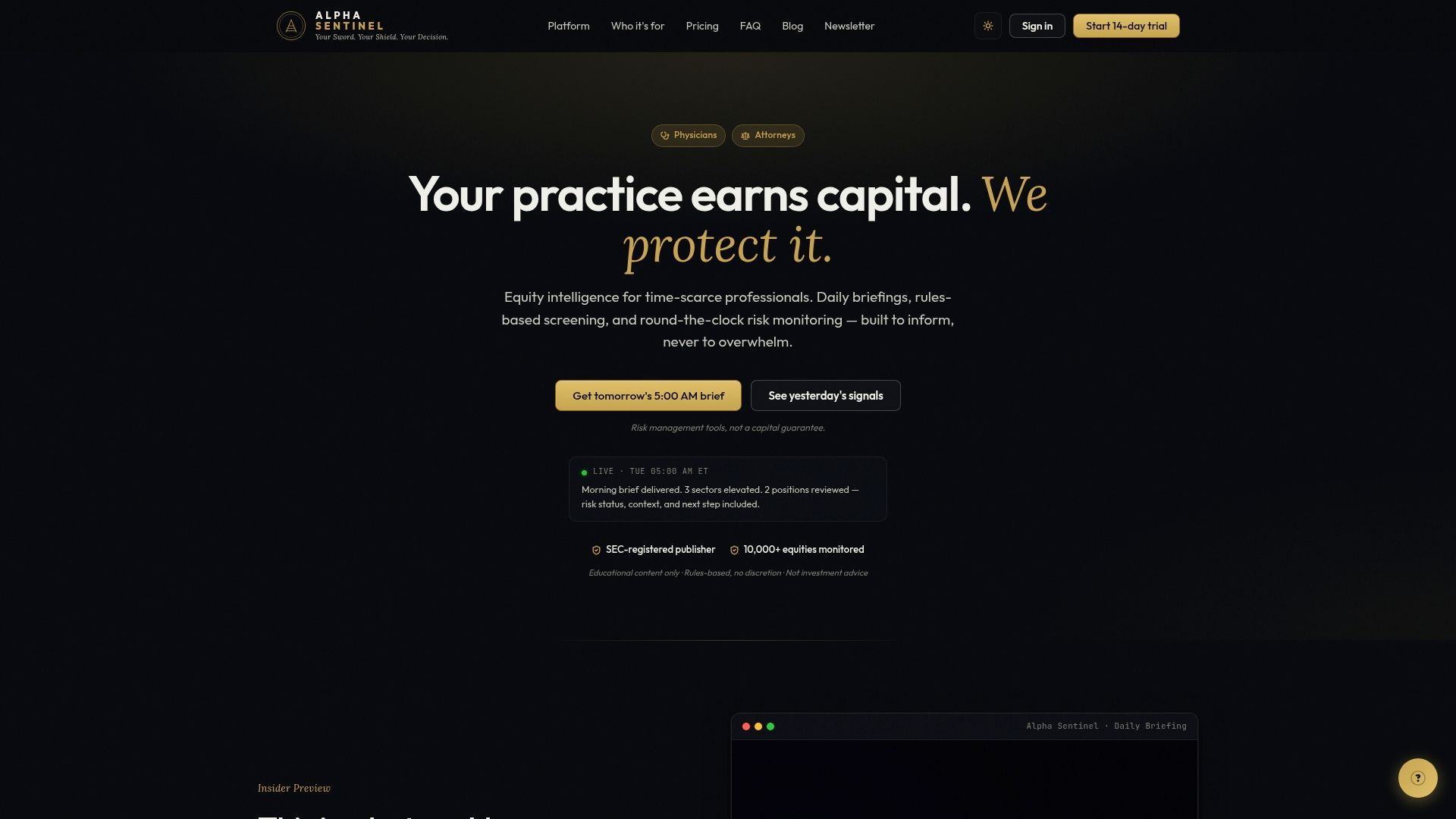
Alpha Sentinel reports it scans over 10,000 stocks each night using a five gate routine and issues plain-English alerts before market open. The platform also monitors positions during the trading day and sends notifications when conditions change. That setup targets professionals who need low-noise, rule-based market signals without constant screen time.
Core Features
Alpha Sentinel centers on a rule-based 5-Gate screening protocol that runs a full universe sweep overnight and flags matches before the session begins. It performs a pre-market scan at 8:30 AM and offers 24/7 portfolio surveillance with concise alerts via SMS, email, and dashboard. Users can request on-demand analysis of up to five stocks and receive quick technical summaries.
Key Differentiator
The standout mechanism is the night run of the five gate filter that reduces the daily list to disciplined candidates and translates triggers into plain English. That discipline aims to remove noise and help busy professionals prioritize trades and monitoring work.
Pros
Alpha Sentinel delivers structured, rule-based alerts that reduce emotional reactions and noisy signals for traders with limited time. Its plain-English messaging and scheduled pre-market reports let you act before the market opens without live monitoring. Founding members may receive a lifetime flat rate, which keeps pricing predictable for early adopters.
Cons
- No personalized investment advice or tailored buy or sell recommendations. This product focuses on signals and education rather than bespoke financial planning.
- Limited to technical, rule-based screening and not built to include fundamental company analysis. Important earnings or corporate events can go unflagged.
- Full feature access and locked pricing are tied to founding memberships and onboarding details that are not publicly listed. That restricts straightforward price discovery.
- Relies on third-party data feeds, so data accuracy or latency could affect alert timing and signal quality.
When It May Not Fit
If you need integrated fundamental research or direct buy and sell guidance, this product will feel incomplete. Active algorithmic traders who require quant models beyond rule filters will find the screening set narrow. Traders who require fully transparent, public pricing may prefer platforms with open subscription pages.
Who It’s For
This product fits busy professionals such as physicians, attorneys, and founders who cannot watch markets all day but need timely technical alerts. It also suits investors who run concentrated portfolios and prefer disciplined, rule-driven monitoring. Use it if you value structured signals and pre-market prioritization.
Real World Use Case
A physician with long surgical shifts receives pre-market alerts and midday condition updates. Those messages let the physician decide before the trading session or after rounds without continuous market access. The on-demand five-stock analysis provides quick validation when a position needs a fast check.
Pricing
According to the company, plans include Free, Scanner ($179/month), Sentinel Pro ($249/month), and Command Center ($329/month). The vendor advertises a 14-day free trial with no credit card required, and founding memberships lock a lifetime rate during onboarding.
Website: https://alphasentinel.ai
Comparing Market Data and Alerts Platforms
When deciding on a platform for comprehensive market data and multi-channel alerts, consider the features and limitations outlined below.
| Platform | Core Features | Key Differentiator | Best For | Pricing | Notable Limitation |
|---|---|---|---|---|---|
| Handy Markets | Real-time price tracking across multiple assets | Unified alerts to multiple delivery channels | Traders needing multi-asset alerts | Price not published | Limited visibility into pricing and interface |
| Stock Alarm | Alerts for price, technical, volume, and patterns | Breadth of asset and trigger combinations | Active traders prioritizing signal flexibility | Free tier and paid plans | Extended hours Nasdaq prices have a 15-minute delay |
| MarketAlerts | Proprietary datasets with API and marketing support | Comprehensive data and signal integration | Enterprises seeking data and go-to-market solutions | Price not published | Limited public documentation and self-service evaluation |
| Alpha Sentinel | Rule-based overnight stock screening and alerts | Nightly filtered stock analysis | Professionals preferring structured signals | Free and paid tiers | Limited fundamental analysis for corporate events |
How to Manage Market Alerts Across Multiple Asset Classes Efficiently
Keeping up with price movements and market signals across stocks, crypto, commodities, and forex can leave traders and investors juggling many tools and alerts. Key challenges include consolidating data in one place and ensuring alerts reach you instantly on the right platforms like Telegram, Slack, or Email. Handy Markets addresses these pain points by delivering real-time prices and percentage changes in one unified dashboard designed for multiasset tracking.
Handy Markets allows you to set price alerts that notify multiple messaging channels at once, reducing the hassle of duplicate setups while keeping your team or trading system synced. Whether you are an analyst, trader, or investor, this enables quicker, more confident reactions to market events. Start receiving consolidated alerts to your favorite channels and follow live market shifts effortlessly with Handy Markets.
Learn how Handy Markets simplifies market monitoring and set up your personalized alert rules today to respond faster to market changes.
FAQ
What specific market alerts does Handy Markets provide?
Handy Markets offers price alerts that can be sent via Telegram, Discord, Slack, SMS, Webhook, and Email. This capability allows users to monitor multiple asset classes, including cryptocurrencies, stocks, and commodities, from a single setup.
How does Handy Markets compare to Stock Alarm for asset coverage?
Stock Alarm supports more than 65,000 assets, covering stocks, ETFs, cryptocurrencies, forex, indices, and commodities. Handy Markets excels in offering real-time price tracking and unified alerts, making it better suited for users needing multi-asset monitoring without switching platforms.
Can Handy Markets help track multiple asset classes simultaneously?
Yes, Handy Markets enables users to monitor diverse asset classes within one dashboard. This feature facilitates quick comparisons and reduces the need for multiple platforms, allowing for a streamlined trading experience.
How does Handy Markets enhance user notifications compared to competitors?
Handy Markets distributes alerts to multiple messaging and delivery channels from a single rule, reducing manual effort. This feature helps ensure that users receive consistent trading signals across their preferred platforms, unlike some competitors that may only notify across one channel.
What type of pricing information is available for Handy Markets?
Pricing information for Handy Markets is not publicly listed, meaning potential users will need to contact the platform for specific costs and plans. This lack of visibility can make it challenging for users to make an immediate decision without direct inquiry.