


TL;DR:
- A truly multi asset platform provides access to diverse markets that are essential for genuine diversification and better risk management. Relying solely on the platform’s labels can create a false sense of protection, as true risk factors may be concentrated regardless of asset count. Active oversight, understanding underlying exposures, and leveraging platform features like cross-margining and alerts are crucial for effective multi asset investing.
A portfolio labeled “diversified” can still leave you dangerously exposed, and that’s not a small print warning, it’s a reality that catches even experienced investors off guard. Many traders assume that simply holding a mix of assets across one platform automatically spreads their risk. But real diversification goes much deeper than a colorful dashboard. Understanding what multi asset platforms actually do, how they structure access to different markets, and where they can mislead you is what separates reactive trading from genuinely informed investing. Let’s break this down clearly and practically.
Table of Contents
- What makes a platform truly multi asset?
- How multi asset platforms drive real diversification
- Margin efficiency and unified risk management
- The hidden risks: Diversification illusions and platform frictions
- Maximizing multi asset platforms: Practical strategies and alerts
- The uncomfortable truth about multi asset platforms
- Apply your insights with Handy.Markets
- Frequently asked questions
Key Takeaways
| Point | Details |
|---|---|
| True diversification matters | Platforms that span multiple asset classes help reduce risk more effectively than single-class brokers. |
| Cross-margining boosts efficiency | Integrated risk management lets traders deploy capital smarter and offset exposures. |
| Beware diversification illusions | Labels can mislead; review holdings for hidden concentration and platform frictions. |
| Optimization isn’t foolproof | Portfolio tools should inform decisions but not overrule hands-on analysis and review. |
| Alerts drive timely decisions | Use price and trend notifications for better-in-the-moment trading and investing performance. |
What makes a platform truly multi asset?
A multi asset platform is an investment or market monitoring tool that provides access to, or data on, multiple distinct asset classes from a single interface. We’re not talking about a stock broker that also offers a few ETFs. A genuinely multi asset platform spans meaningfully different markets, each with its own risk and return profile.
Typical asset classes you should expect to find include:
- Equities (stocks): Shares in individual companies, usually across multiple geographies
- Fixed income (bonds): Government and corporate debt instruments
- Commodities: Physical goods like gold, oil, wheat, and copper
- Cryptocurrencies: Digital assets such as Bitcoin and Ethereum
- Foreign exchange (forex): Currency pairs traded globally
- Indices: Benchmarks like the S&P 500 or FTSE 100
- ETFs and mutual funds: Pooled vehicles that can themselves span asset classes
The advantage of this breadth is not just convenience. When you’re comparing financial markets side by side, you gain perspective that single-asset platforms simply cannot offer. You can see how gold moves when equities drop, or how forex reacts to a bond market shift. That visibility is genuinely powerful for decision-making.
Research backs this up. Cross-asset diversification improves outcomes for U.S. investors, particularly across crisis periods, when a portfolio includes assets like gold, oil, and Treasuries alongside equities. That’s not just a theory, it’s an empirical finding across multiple market cycles. Understanding more about portfolio diversification benefits can further sharpen your approach.
Pro Tip: Don’t just check whether a platform claims to be “multi asset.” Click through to see exactly how many instruments are available in each class, whether data is real-time, and whether you can monitor all classes from a single unified view.
With the basics in place, let’s see how these platforms impact real-world trading outcomes.
How multi asset platforms drive real diversification
The phrase “don’t put all your eggs in one basket” is familiar, but the practical execution is where most investors stumble. Real diversification is not about owning ten stocks instead of five. It’s about holding assets whose price movements are genuinely uncorrelated, or even negatively correlated, so losses in one area are cushioned by stability or gains in another.
To see this concretely, consider how a U.S.-only equity portfolio performed versus a broader multi asset portfolio during major market stress events. Cross-asset diversification improves outcomes across crises, particularly when gold, oil, and U.S. Treasuries are included alongside equities.
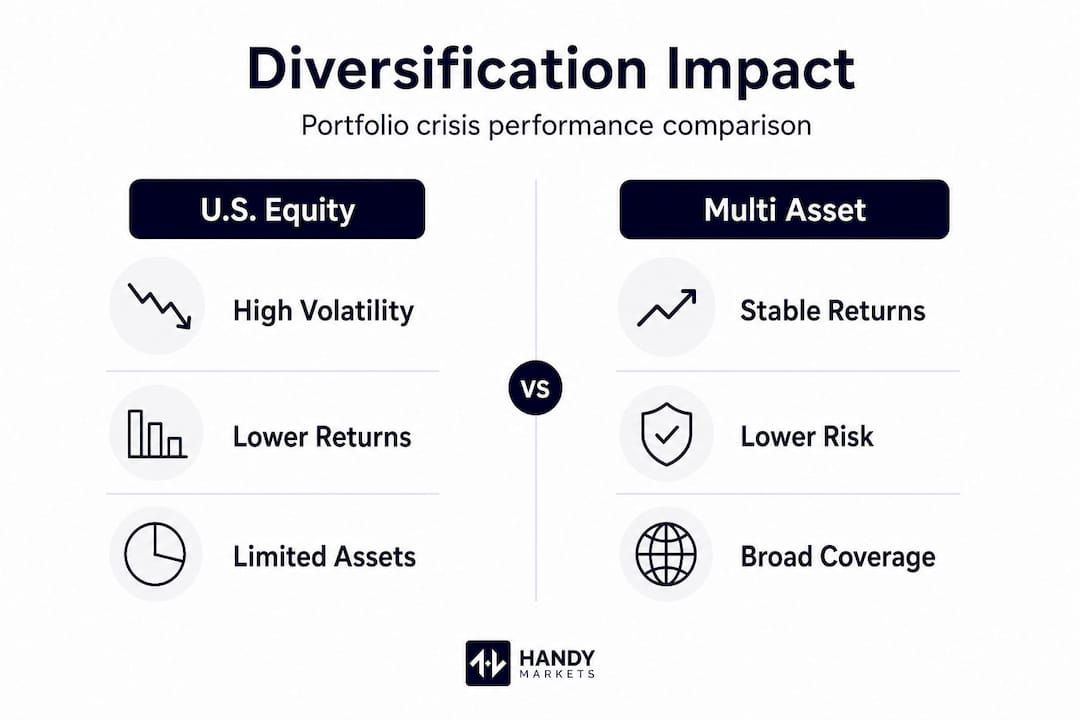
| Portfolio type | Assets included | Crisis period performance |
|---|---|---|
| U.S. equity only | S&P 500 | High volatility, steep drawdowns |
| Basic diversified | S&P 500 + Bonds | Moderate cushion in some crises |
| Multi asset (broad) | S&P 500 + Gold + Oil + Treasuries | Measurably improved outcomes |
This comparison illustrates why platform breadth matters so much. If your platform only gives you access to U.S. stocks and bonds, your “diversification” has a ceiling. Multi asset platforms remove that ceiling by making it operationally straightforward to hold and monitor exposures across genuinely different market environments.
Here’s how to build a truly diversified portfolio using a multi asset platform:
- Map your current exposures. List every asset you hold and categorize it by class, geography, and sector. You may find hidden concentrations you weren’t aware of.
- Identify correlation clusters. Assets that move together in a crisis provide less protection. Look for assets with low or negative correlations to your core holdings.
- Add genuine diversifiers. Consider commodities, international equities, or crypto as uncorrelated layers, not just more of the same.
- Set allocation targets. Decide how much of your portfolio belongs in each class and rebalance when allocations drift beyond a set threshold.
- Use platform alerts to stay informed. Price alerts on assets outside your main holdings help you spot opportunities without constant monitoring.
Explore top investment strategies and the volatility checklist for more structured approaches. You can also review why diversify investments for foundational context.
One critical caveat to keep in mind:
“Correlations between asset classes can rise sharply during market stress, precisely when diversification benefits are needed most, reducing the protection investors expected.”
This is why understanding what your platform actually offers, and checking it regularly, matters far more than relying on its label alone.
Next, let’s dig into margin efficiency and risk management enabled by advanced platform structure.
Margin efficiency and unified risk management
For active traders, platform structure has a direct impact on capital efficiency. Cross-margining is the mechanism that lets you offset risk across different asset positions, reducing the total margin you need to hold. Instead of treating each position in isolation, a cross-margining system looks at your combined exposure and nets out offsetting risks.

Think of it this way: if you hold a long position in U.S. Treasuries and a short position in interest rate futures, these two positions partially offset each other. A platform with cross-margining recognizes this and charges you less margin than if it treated each position separately. Cross-margining programs increase capital efficiency by margining combined risk across eligible products, exactly as used between U.S. Treasury securities and CME interest rate futures.
| Feature | Single asset platform | Multi asset with cross-margining |
|---|---|---|
| Margin calculation | Per position, in isolation | Combined risk across positions |
| Capital requirement | Higher, no offsets recognized | Lower, offsetting exposures reduce requirement |
| Risk visibility | Limited to one market | Full cross-asset exposure visible |
| Rebalancing flexibility | Manual, fragmented | Unified, faster to execute |
The practical benefits for active traders are significant. Lower margin requirements mean more capital available for additional trades or as a liquidity buffer during volatile periods. Unified risk visibility means you’re not blindsided by exposures you couldn’t see because they were hidden across separate platforms or accounts.
A stat worth noting: traders using properly structured multi asset platforms with cross-margining can materially reduce their capital requirements compared to maintaining equivalent positions across multiple single-asset accounts, with combined risk netting doing the heavy lifting. Learn more about market fluctuation strategies and dynamic asset allocation to apply this thinking to your own portfolio.
Pro Tip: When evaluating platforms, specifically ask whether cross-margining is supported and which asset class pairs are eligible. Not all multi asset platforms offer this, and the difference in capital efficiency can be substantial for frequent traders.
Even so, platform structure is only part of the story. Let’s tackle the hidden pitfalls many investors overlook.
The hidden risks: Diversification illusions and platform frictions
Here’s something that surprises many investors: a fund or portfolio can hold dozens of different assets and still be dangerously concentrated. How? Because the labels on assets don’t always reflect their true risk drivers.
Consider a portfolio that holds large-cap U.S. equities, U.S. corporate bonds, and USD-denominated commodities. On the surface, that looks diversified across three asset classes. But all three are heavily exposed to the same underlying risk factor: the strength of the U.S. dollar and the U.S. business cycle. When both fall, everything falls together.
Multi-asset fund diversification can be illusory when the portfolio is effectively concentrated in structural exposures like bonds, large-cap U.S. equities, and USD exposure. That’s why examining true risk drivers matters far more than counting asset classes.
Common frictions that can erode your multi asset advantage include:
- Transparency gaps: Some platforms obscure the true composition of instruments, making it hard to see real underlying exposures
- Cost drag: Trading across multiple asset classes can accumulate fees, spreads, and currency conversion costs that quietly eat into returns
- Governance and oversight: Platforms vary widely in how they handle corporate actions, dividend reinvestment, and rebalancing, which affects execution quality
- Tax treatment differences: Different asset classes attract different tax rules, and a platform that doesn’t surface this clearly can lead to surprise bills
- Rebalancing speed: Implementation quality varies widely depending on frictions like transparency, cost, governance, and practical rebalancing speeds
To audit your platform for true diversification, check whether you can see the underlying risk factors of every position, not just its label. Review your total USD exposure, your sensitivity to interest rate moves, and your geographic concentration. Look at mastering market trends for additional analytical frameworks, and review a platform comparison to benchmark what good transparency looks like.
“True risk is not always visible in asset lists. What matters is whether positions share the same underlying sensitivities, because that’s what drives real correlation during stress.”
Now, let’s put these lessons into action with practical steps for maximizing your platform’s power.
Maximizing multi asset platforms: Practical strategies and alerts
Knowing the pitfalls is half the battle. The other half is building habits and workflows that keep you genuinely in control of your portfolio. Here’s a step-by-step approach to getting the most from a multi asset platform:
- Set up real-time price alerts for each asset class. Don’t just monitor your main holdings. Set alerts for correlated assets, commodities you’re not holding yet, and currency pairs relevant to your equity exposures. Early signals in related markets often precede moves in your core positions.
- Review your true risk factor exposure monthly. Use your platform’s data to check whether your portfolio’s sensitivity to interest rates, USD strength, and market beta has shifted. Drift happens silently.
- Treat optimization tools as one input, not the final word. Portfolio optimization tools can fail under regime dependence and estimation error, meaning the model’s assumptions may not hold in the market environment you’re actually in. Use optimization as a diagnostic check, not a decision engine.
- Layer in uncorrelated assets deliberately. If your optimization tool suggests adding an asset you don’t understand, research its risk drivers before acting. The asset needs to make sense in the context of your overall strategy.
- Use multi-channel alerts to stay responsive. Telegram, Slack, email, and SMS alerts mean you don’t have to watch a screen all day to stay informed. The best platforms make it easy to route alerts to wherever you actually are.
Explore advanced analysis techniques to sharpen how you interpret the data your platform surfaces.
Building these habits transforms a multi asset platform from a passive information display into an active edge. The platform provides the data. You provide the judgment.
With actionable strategies in mind, let’s dig deeper into lessons learned from real trading and investing experience.
The uncomfortable truth about multi asset platforms
We’ve spent a lot of time in this article discussing platform features, margin mechanics, and diversification science. But here’s what we’ve observed watching traders over time: the most common failures are not technical. They’re behavioral.
Most investors who get burned by a “diversified” portfolio did not miscalculate a correlation matrix. They assumed the platform was doing the work of diversification for them. They saw a colorful dashboard with seven asset classes and felt protected. They stopped looking underneath the surface. That false sense of security is more dangerous than having no platform at all.
The platform is infrastructure. It gives you access, visibility, and data. But it cannot think for you. It cannot tell you that your gold position is too small to meaningfully offset your equity risk, or that your bond holdings are concentrated in the same duration bucket. Those insights require active, mindful engagement with your portfolio.
What actually separates successful multi asset investors is not which platform they use. It’s whether they regularly review their investment articles and other sources to stay current, whether they question their assumptions when markets shift, and whether they treat alerts and data as prompts for analysis rather than substitutes for it.
Be vigilant. Review your holdings against true risk factors, not just asset labels, at least once a month. Ask yourself: if the U.S. dollar falls 10%, what happens to my portfolio? If interest rates spike, where is my exposure? These are the questions that real diversification is built on.
Apply your insights with Handy.Markets
Understanding multi asset investing is one thing. Having the right tools to act on that understanding is another entirely.
At Handy.Markets, you can track multiple asset classes in real time from a single, clean interface, covering stocks, crypto, commodities, indices, forex, and more. No juggling multiple platforms or manually cross-referencing prices. Everything is aggregated in one place, making it far easier to spot correlations, monitor exposures, and respond to market movements as they happen. When you’re ready to act, setting up a price alert takes minutes, and you can route notifications directly to Telegram, Discord, Slack, SMS, or email. That means you stay informed across all asset classes without being chained to a screen.
FAQ
What asset classes do multi asset platforms usually cover?
Most platforms include stocks, bonds, commodities, crypto, and ETFs, but always verify specific coverage before committing, since cross-asset diversification benefits only materialize when you have genuine breadth across uncorrelated markets.
How does cross-margining improve trading efficiency?
Cross-margining enables capital efficiency by netting combined risk across eligible products, which reduces the total margin required and frees up capital for additional positions or as a liquidity buffer.
Can diversification be misleading on multi asset platforms?
Yes, and it’s a serious trap. Diversification can be illusory when holdings share the same underlying risk factors, such as USD exposure or large-cap equity sensitivity, so always examine true risk drivers, not just asset labels.
Should I rely on optimization tools for portfolio construction?
Optimization tools are valuable diagnostics but shouldn’t be your sole guide, since optimization can fail under regime shifts and estimation error, making manual review and strategic judgment essential alongside any automated output.
How can I set up price alerts across all asset classes?
Most multi asset platforms offer customizable alerts for stocks, crypto, ETFs, commodities, and forex. Check your platform’s notification settings or support documentation, and look for options to route alerts through multiple channels such as Telegram, email, or SMS for maximum responsiveness.