

TL;DR:
- Most investors have fragmented holdings across various accounts, making consolidated tracking challenging. Without a unified view, allocation decisions are based on incomplete data, risking returns and exposing hidden risks. Using secure, automated tools and regular reconciliation ensures accurate, comprehensive portfolio management across all asset classes.
Most investors don’t have a single, tidy portfolio. They have a brokerage account, a 401(k), some ETFs, maybe a crypto wallet, and perhaps a real estate position. Knowing how to track multi-asset portfolios across all of those holdings is where most people stall out. Without a consolidated view, you’re making allocation decisions based on incomplete data, and that gap can quietly erode your returns and expose you to risks you didn’t realize you were carrying. This guide walks you through exactly what to do, from building your asset inventory to using analytics tools that give you genuine portfolio intelligence.
Table of Contents
- Key Takeaways
- What to prepare before tracking your assets
- How to track and consolidate multi-asset portfolios
- Common pitfalls in multi-asset tracking
- Using analytics to make better portfolio decisions
- Our perspective on multi-asset portfolio tracking
- Track smarter with Handy.Markets
- FAQ
Key Takeaways
| Point | Details |
|---|---|
| Start with a full asset inventory | List every account and asset class before choosing any tracking method or tool. |
| Automate where possible | Use secure aggregators to sync brokerage accounts and reduce manual entry errors. |
| Organize by account type | Separate taxable, tax-advantaged, and alternative holdings to get clean performance reporting. |
| Use analytics beyond basic returns | Track risk-adjusted metrics, drawdown, and allocation drift to make smarter rebalancing decisions. |
| Set real-time alerts | Price movement and allocation threshold alerts help you act on changes before they compound. |
What to prepare before tracking your assets
Before you select a single tool, you need a clear picture of what you actually own. This step gets skipped constantly, and it’s the reason so many portfolio trackers end up showing only half of someone’s actual net worth.
Start by listing every account you hold:
- Taxable brokerage accounts (individual, joint)
- Tax-advantaged accounts (401(k), IRA, Roth IRA, HST accounts)
- Employer stock plans (RSUs, ESPPs, stock options)
- Crypto wallets and exchanges
- Real estate holdings (direct ownership, REITs, crowdfunded real estate)
- Alternative investments (private equity, hedge funds, collectibles, commodities)
- Cash and money market accounts
For each account, gather recent statements, transaction histories, and cost basis records. You’ll need these to set up tracking accurately and to calculate true performance. The global scope of multi-asset tracking matters here too: professional tools support integration with over 200 global brokers and cover more than 750,000 global assets, so most mainstream holdings can be connected automatically.
Pay attention to 90% of financial advisors already allocating client capital to alternative investments, with nearly half putting over 10% into non-traditional assets. If you’re not tracking those alternatives, you’re missing a significant portion of your exposure.
Pro Tip: Before connecting any accounts, create a simple spreadsheet listing every account, its institution, approximate current value, and primary asset class. This master list becomes your benchmark for confirming that your tracking tool has captured everything correctly.
Security matters even at this stage. Never share account passwords directly with portfolio tools. The best aggregators use read-only, token-based connections, meaning they can pull data without ever storing your login credentials or executing trades on your behalf.
How to track and consolidate multi-asset portfolios
Once you know what you own, here’s how to build a tracking system that actually works:
- Choose a portfolio aggregator with multi-broker support. Look for tools that connect to your specific brokerages and account types. Key features to prioritize include multi-broker connectivity, support for crypto and alternative assets, CSV import for unsupported accounts, and real-time data updates.
- Link your brokerage accounts using secure aggregators. Services like Plaid and Yodlee create token-based connections that sync your holdings automatically. Secure token connections do not store your login credentials, so your data remains read-only and protected from unauthorized access.
- Manually input or import unsupported assets. Not every asset has an API. Private equity, 401(k)s from smaller providers, real estate, and collectibles often require manual entry. Most tools accept CSV uploads, which speeds this up considerably. Schedule quarterly manual updates for these assets to keep your portfolio view accurate.
- Organize accounts into folders or groups by tax status. Separating taxable from tax-advantaged accounts lets you analyze performance and allocation in each context independently, which is particularly useful when planning withdrawals or assessing tax-loss harvesting opportunities.
- Create custom groupings by asset class, region, or strategy. Beyond tax status, you may want to group holdings by geography (US vs. international), by style (growth vs. value), or by risk profile (core holdings vs. speculative positions). Customizable grouping features let you slice your portfolio in whichever way supports your decision-making style.
- Set up automated alerts for price movements and allocation drift. Once your holdings are connected, configure alerts to notify you when a position moves beyond a threshold or when your asset class weights shift significantly from your target allocation.
Pro Tip: If you track multiple asset classes across crypto, stocks, forex, and commodities, look for a platform that delivers alerts through multiple channels simultaneously. Getting a Telegram message and an email at the same time means you’ll never miss a critical move regardless of which app you have open.
| Feature | Why it matters for multi-asset tracking |
|---|---|
| Multi-broker connectivity | Eliminates manual syncing across separate portals |
| CSV import | Covers unsupported accounts and private assets |
| Custom portfolio groups | Enables separate analysis by tax status or strategy |
| Real-time price updates | Reflects current market value, not end-of-day snapshots |
| Multi-channel alerts | Keeps you informed across Telegram, Email, SMS, Slack |
| Alternative asset support | Captures the full portfolio, including illiquid holdings |
Common pitfalls in multi-asset tracking
Getting your portfolio set up is one thing. Keeping it accurate over time is where most tracking efforts break down.
- Stale data from disconnected feeds. Aggregator connections occasionally break when brokerages update their systems. Set a monthly reminder to verify that all accounts are syncing correctly and that position values match your brokerage statements.
- Skipping manual updates on unsupported assets. If you own private equity or a 401(k) without API support, that position will show the last manually entered value indefinitely. Automated read-only syncing is ideal for liquid assets, but illiquid positions need a disciplined update schedule.
- Data entry errors in manual input. Entering the wrong number of shares or cost basis throws off your total return and allocation calculations. Cross-check manually entered positions against official statements at least quarterly.
- Overlapping exposure you haven’t identified. An ETF that holds 100 stocks, combined with individual stock positions in some of those same companies, creates hidden concentration risk. Your tracking tool should surface these overlaps in a holdings breakdown report.
- False confidence from incomplete data. A unified portfolio dashboard only improves your decision-making if it includes all your holdings. A portfolio that shows 80% of your assets may give you an allocation read that looks balanced when it isn’t.
“The most dangerous portfolio is one you think you understand completely, but haven’t accounted for all your positions. Regular reconciliation between your tracking tool and your actual brokerage statements is the discipline that separates serious investors from reactive ones.”
Security deserves a specific note here. Always verify that the tools you use create read-only connections and never grant transaction permissions to third-party applications. Understanding how financial markets compare across different asset classes also helps you assess whether your data feeds are pulling from appropriate pricing sources for each holding type.
Using analytics to make better portfolio decisions

Data collection is the foundation. What you do with that data is what actually drives better investment outcomes.
Key metrics worth tracking beyond total return
Most brokerage portals show you gains and losses. Good portfolio analytics go much further. Advanced platforms offer over 2,000 distinct metrics, including payout ratios, detailed valuation data, and financial health indicators that brokerage statements never show.
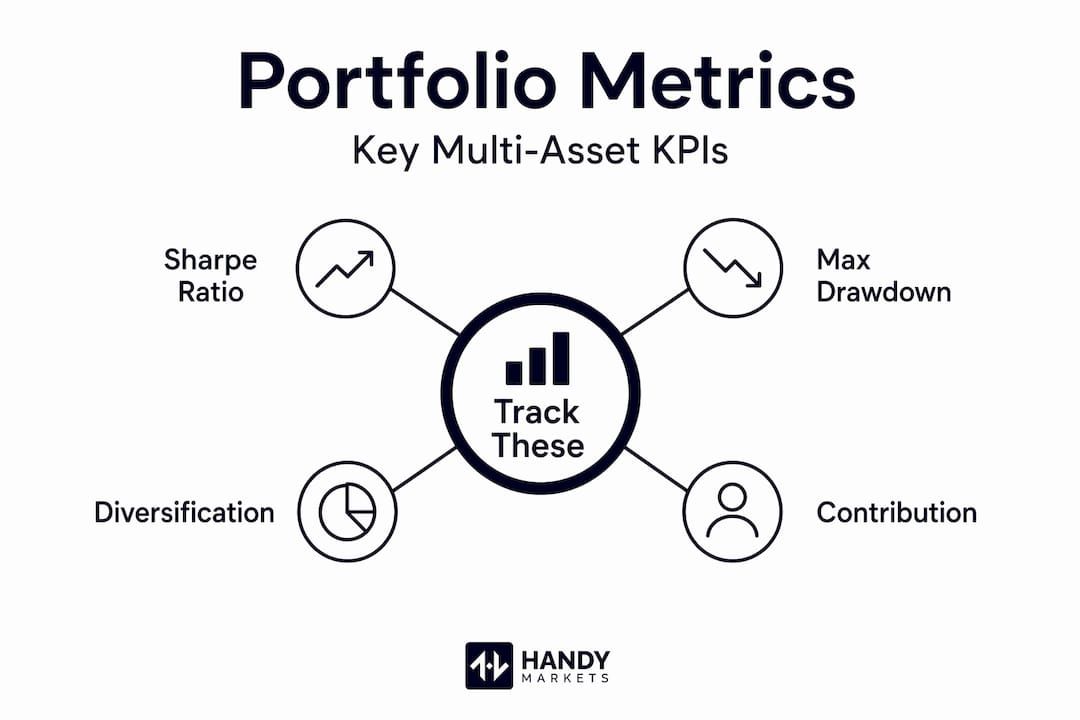
The metrics that matter most for multi-asset portfolios include risk-adjusted return (Sharpe ratio), maximum drawdown, beta relative to a benchmark, and sector and geographic concentration. Together, these give you a picture of not just how much you earned, but how much risk you took to earn it.
Benchmark comparisons and contribution reports
Comparing your portfolio to a relevant benchmark like the S&P 500 or a blended index tells you whether your allocation decisions are adding value or simply riding market beta. Contribution reports break down which positions, sectors, or asset classes drove performance in a given period, which is far more useful than looking at total return alone.
For income-focused portfolios, tracking dividend and interest cash flows by account type matters enormously. A dividend paid inside a Roth IRA compounds tax-free, while the same dividend in a taxable account generates a tax event. Your tracking system should reflect that distinction.
Alerts as a portfolio management tool
Alerts are often treated as a notification feature. They’re actually a risk management tool. Setting allocation drift alerts, for example, means you get notified when your equity weight climbs from 60% to 68% due to market appreciation, prompting a deliberate rebalancing conversation rather than a reactive one. Multi-asset allocation acts as a protective shield against market fluctuations, and alerts help you maintain the allocation that provides that protection.
Pro Tip: Set two types of alerts for each major position: a price-based alert for significant single-day moves, and an allocation-based alert for when a position grows or shrinks beyond a target weight. The first catches volatility; the second catches structural drift.
You can also use reporting features for tax efficiency analysis, comparing realized gains and losses by account type to plan year-end harvesting. Separating performance by taxable versus tax-advantaged accounts inside your tracker makes this exercise far less time-consuming at year end.
Our perspective on multi-asset portfolio tracking
I’ve watched investors lose meaningful ground not because they picked bad assets, but because they had no clear picture of what they actually owned across accounts. A stock position in a taxable account offset by the same ETF inside a 401(k), duplicate exposure to tech through three different funds, cash sitting idle while the portfolio drifted far from its target. That fragmentation is more common than most people admit.
In my experience, the biggest tracking mistake isn’t choosing the wrong tool. It’s treating tracking as a setup task rather than an ongoing practice. Connecting your accounts once and never reconciling them creates the illusion of visibility without the substance of it.
My recommendation: use automation for everything that supports it, and build a quarterly calendar reminder for the manual reconciliation that automation can’t replace. The investment strategies that hold up over time are always the ones where the investor actually knows what they own, in what proportions, and at what risk level.
One caution I’d add: be selective about which platforms you grant account access to. Read-only connections via established aggregators are safe. Anything that requests write permissions or full credentials deserves serious skepticism. Privacy and security are not inconveniences in this process. They’re non-negotiable.
Track smarter with Handy.Markets
Managing a multi-asset portfolio gets considerably more tractable when you have real-time data flowing into one place. Handy gives you live prices, percentage changes, and alerts across stocks, ETFs, crypto, forex, commodities, and indices. You can track ETF holdings and prices as they move, or follow individual stock quotes with custom alert thresholds. Alerts reach you through Telegram, Discord, Slack, SMS, Email, or Webhook, so you can monitor across whatever channels fit your workflow. Whether you’re watching allocation drift or watching for a breakout in a specific position, Handy’s markets platform keeps all your asset classes visible and actionable in one consolidated view.
FAQ
What is multi-asset monitoring?
Multi-asset monitoring means tracking the performance, value, and risk exposure of holdings across multiple asset classes, such as stocks, bonds, ETFs, crypto, and real estate, within a single consolidated view. It gives investors a complete picture of their portfolio rather than a fragmented account-by-account snapshot.
How do I consolidate accounts from multiple brokers?
Use a portfolio aggregator that supports secure, read-only connections via services like Plaid or Yodlee. These tools sync your brokerage data automatically without storing your login credentials, so your accounts stay protected while your holdings stay current.
How often should I update manually tracked assets?
Quarterly updates are the standard recommendation for assets without API support, such as private equity, certain 401(k) plans, and real estate holdings. More frequent updates may be warranted if an asset is actively changing in value or if you’re approaching a rebalancing decision.
What metrics matter most for multi-asset portfolios?
Beyond total return, the most useful metrics include Sharpe ratio for risk-adjusted performance, maximum drawdown for downside risk, beta for market sensitivity, and sector concentration for diversification gaps. Advanced platforms offer thousands of additional data points beyond what standard brokerage portals provide.
How do I track alternative investments in a portfolio tracker?
Most professional-grade trackers allow manual entry or CSV import for alternatives like private equity, collectibles, and real estate. Some platforms also integrate with alternative investment platforms directly. The key is scheduling regular manual updates so these positions don’t show stale valuations inside your consolidated view.