

TL;DR:
- Monitoring markets constantly can lead to exhaustion and emotional trading decisions.
- Smart alerts work silently in the background to notify investors only when meaningful market conditions occur, improving discipline and timing.
Watching markets around the clock sounds like dedication, but it often leads to exhaustion, emotional decisions, and missed opportunities. The truth is, no retail investor can monitor every tick across stocks, crypto, forex, and commodities simultaneously, and trying to do so creates more noise than clarity. Smart alerts change the game entirely. Rather than chaining you to a screen, they work silently in the background and tap you on the shoulder only when something genuinely meaningful happens. This guide walks you through what alerts are, how to use them strategically, and how to avoid the traps that catch even experienced traders off guard.
Table of Contents
- What are alerts in investing?
- How alerts elevate your investing strategy
- Alert fatigue and false signals: What investors must know
- Expert tips to maximize signal quality and minimize noise
- The overlooked truth: Alerts are only as useful as your plan
- Set up better alerts with Handy.Markets
- Frequently asked questions
Key Takeaways
| Point | Details |
|---|---|
| Timely action | Well-configured alerts let you react quickly to market changes without staring at screens. |
| Avoid alert fatigue | Prioritizing only key signals helps prevent information overload and missed opportunities. |
| Quality over quantity | Fewer, contextual alerts safeguard against false triggers and distraction. |
| Integration with strategy | Alerts are most effective when part of a disciplined investment plan, not stand-alone tools. |
What are alerts in investing?
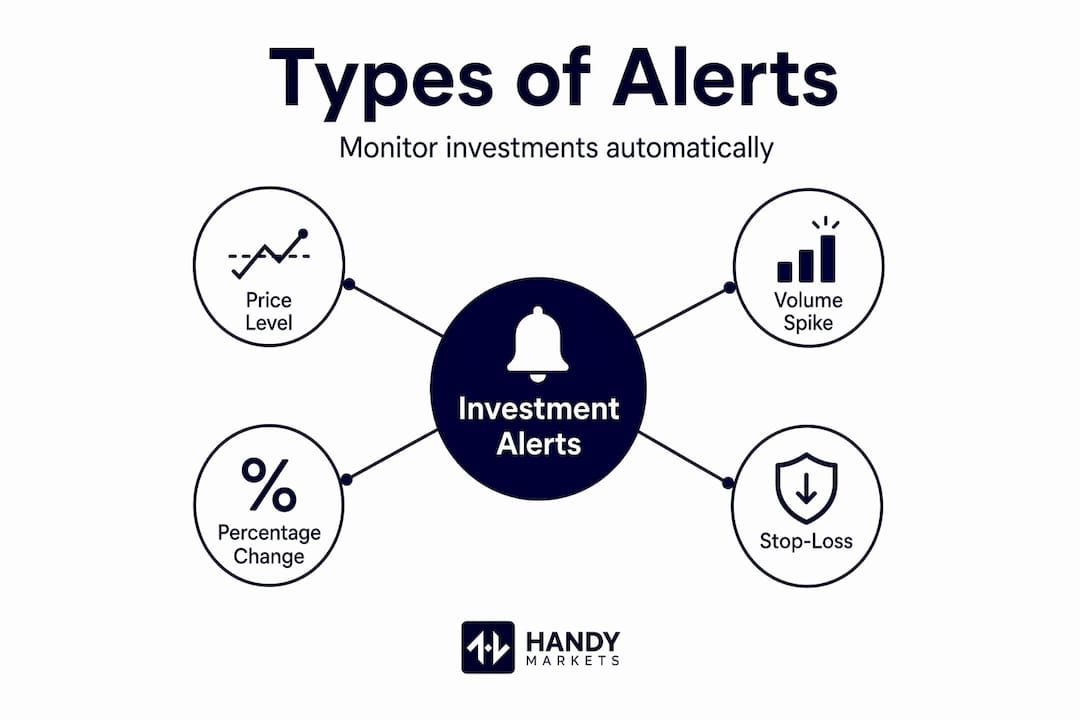
Think of alerts as your personal market watchers. You define the conditions, and they do the watching. Alerts in investing notify retail investors and traders of price levels, percentage changes, moving average crosses, volume spikes, and news events via push notifications, email, or text message. You set the rule once, and the alert fires automatically when the market meets your criteria.
The main types of investment alerts
Understanding the types of alerts available helps you build a well-rounded notification setup. Here are the most useful categories:
- Price level alert: Fires when an asset hits a specific price, like Bitcoin touching $70,000 or Apple shares crossing $200.
- Percentage change alert: Triggers when a stock moves up or down by a set percentage within a defined time window. For example, an alert when a stock drops 5% in a single session.
- Moving average cross alert: Notifies you when a short-term moving average (like the 20-day) crosses above or below a longer-term moving average (like the 50-day), often used to signal trend changes.
- Volume spike alert: Triggers when trading volume exceeds normal levels, such as 3x the average daily volume, which can signal institutional activity or an incoming price move.
- News event alert: Fires when a company announces earnings, a central bank makes a rate decision, or a major geopolitical event hits financial headlines.
You can monitor asset class alerts across stocks, crypto, forex, and commodities all in one place, which removes the need to juggle multiple platforms.
Delivery channels: Where alerts reach you
The channel you choose for receiving alerts matters more than most investors realize. Different situations call for different delivery methods.
| Delivery channel | Best use case | Response speed |
|---|---|---|
| Push notification (app) | Active trading sessions | Immediate |
| SMS/Text message | Critical price levels | Immediate |
| End-of-day review or less urgent signals | Minutes to hours | |
| Telegram/Discord/Slack | Community traders or shared watchlists | Immediate |
| Webhook | Automated systems or custom integrations | Immediate |
For breaking moves you need to act on quickly, SMS or push notifications work best. For a weekly review of which alerts triggered, email makes more sense. Setting price alerts across multiple channels means you never miss a signal, regardless of where you are or what you’re doing.
The core benefit is straightforward: alerts give you timely monitoring without constant screen presence. You free up mental energy for analysis and decision-making, the parts of investing that actually require your attention.
How alerts elevate your investing strategy
With a clear picture of what alerts are, we can explore why they matter so much for strategy execution. The biggest advantage is not simply speed. It’s discipline.
Automating your investment plan
Many investors write a solid plan, identify entry points, set stop-loss levels, and define target prices, then fail to act on those plans because they’re not watching when the moment arrives. Alerts solve that problem. Alerts enable timely monitoring without constant screen time, aiding buy and sell decisions at your targets, risk management via stop-loss notifications, and opportunity capture across assets.
Here’s a practical example. Say you believe a particular tech stock is a strong buy at $150 but is currently trading at $175. Instead of checking the price obsessively every day, you set an alert for $152, giving yourself a small buffer to confirm the move. When the alert fires, you review the context, check market indicators like RSI or volume, and then make a calm, informed decision. That sequence of alert, then review, then act is a far better process than reacting emotionally in the moment.
Four ways alerts improve your investing discipline
- Automate entry points: Set alerts at your planned buy prices so you never miss a favorable entry because you weren’t watching.
- Enforce stop-losses: Configure an alert at your maximum acceptable loss level so you can exit a position before losses compound.
- Capture breakout opportunities: Volume spike and price level alerts notify you the instant an asset starts moving beyond a consolidation range.
- Monitor correlated assets: If you hold tech stocks, set alerts on key semiconductor indices too, since correlated moves often precede individual stock moves.
Pro Tip: Pair a price alert with a volume condition in your review process. A price breakout on weak volume is far less reliable than one accompanied by 2x or 3x normal volume. Use the alert to get notified, then verify volume before acting.
“The goal of a good alert system is not to make every decision for you. It’s to make sure you’re present for the decisions that actually matter.” This reflects a broader truth about using real-time alerts as a framework, not a replacement for judgment.
For investors who follow live price tracking across multiple asset classes, a well-designed alert system essentially acts as a first-line filter, surfacing only the signals worth investigating deeper.
Alert fatigue and false signals: What investors must know
Here’s the side of alert systems that most guides skip over: more alerts can actually hurt your performance. Understanding this risk is just as important as knowing the benefits.

The problem of alert fatigue
Alert fatigue occurs when you receive so many notifications that you start ignoring them, including the important ones. It’s a well-documented phenomenon in trading. If your phone buzzes 30 times a day with market notifications, your brain begins treating each buzz as background noise rather than a meaningful signal. You start dismissing alerts reflexively, and suddenly you’ve missed the one that actually mattered.
The warning signs of alert fatigue include:
- Dismissing alerts without reading them
- Feeling anxious or irritated when your phone buzzes
- Regularly “snoozing” or ignoring active alerts
- Acting on alerts out of boredom rather than strategy
Each of these behaviors introduces risk. Dismissal means missed opportunities. Impulsive action on marginal signals leads to poor trades. Both outcomes are costly.
False signals: A real statistical problem
Beyond fatigue, false signals are a genuine mechanical challenge. False signals are common in sideways or choppy markets, with a 57 to 76 percent false rate for moving average crosses in ranging conditions. That means if you rely heavily on moving average cross alerts during a period when the market is moving sideways without a clear trend, up to three quarters of your alerts could fire unnecessarily.
This is not a reason to avoid alerts. It’s a reason to configure them intelligently. Some practical safeguards:
- Avoid MA cross alerts in clearly sideways markets. Review the broader trend context before trusting the signal.
- Use wider thresholds during volatile periods. A 1% price change alert fires constantly during a high-volatility session. A 3% threshold filters out the noise while still catching meaningful moves.
- Set expiry dates on alerts. If a thesis doesn’t play out within a defined time window, delete the alert rather than leaving it active indefinitely.
Pro Tip: Review your alert log every two weeks. Look at which alerts fired, how many were actionable, and how many were false or irrelevant. Prune ruthlessly. Quality beats quantity every time. For traders exploring crypto alert solutions, this discipline is especially critical given how frequently crypto markets swing between trending and ranging conditions.
Expert tips to maximize signal quality and minimize noise
Once you understand the risks, you’re ready to build an alert setup that actually performs. Experts consistently emphasize one principle above all else: optimize for signal quality, not speed.
The trap of speed-first alert design
Most traders configure alerts to tell them something happened as fast as possible. But prioritizing signal quality and context over speed is what separates systematic traders from reactive ones. An alert that fires 0.2 seconds faster is meaningless if it lacks the context to tell you whether to act.
Instead, include invalidation criteria in your alert review process. An invalidation rule is a condition that would make you disregard the alert even after it fires. For example, “ignore this price level alert if volume is below average” or “disregard this moving average cross if the broader index is in a confirmed downtrend.”
Building a high-quality alert system: Step by step
- Define your strategy categories first. Label each alert by its type: breakout, reversal, risk management, macro event. This helps you instantly know what kind of decision the alert demands.
- Set thresholds based on historical volatility. For a stock that typically moves 2% per day, a 1% alert will fire constantly. Use the asset’s average true range (ATR) to calibrate meaningful thresholds.
- Use custom sounds or dedicated notification channels. Assign different notification tones or channels to different alert categories. A stop-loss alert should feel different from a speculative breakout alert.
- Include context requirements in your alert notes. When you create an alert, write a one-line note explaining under what conditions you would act on it. This prevents impulsive reactions when the notification arrives.
- Schedule a weekly alert audit. Remove triggered alerts that are no longer relevant, update thresholds as conditions change, and assess which alert types are generating the most value.
“The best traders are not the ones with the most alerts. They’re the ones with the fewest, most precise alerts that align perfectly with their active positions and watchlists.”
Using customizing alerts to build strategy-specific alert groups, organized by breakout setups, income positions, speculative trades, and risk controls, gives you a structured dashboard instead of a chaotic notification stream. The alert monitoring guide provides deeper context on how to build and maintain these systems over time.
Pro Tip: Use volume-based filters on all momentum-style alerts. Require that volume exceeds 2 to 3 times the 20-day average before treating any price move as confirmed. This single filter eliminates a significant portion of false signals without requiring any additional tools.
The overlooked truth: Alerts are only as useful as your plan
Here’s something we rarely see said plainly in investing guides: alerts do not make you a better investor. Your plan does. Alerts simply make your plan easier to execute.
We see this pattern repeatedly. An investor gets excited about their alert system, sets up 50 triggers across 30 assets, and within two weeks they’re either ignoring everything or trading impulsively on half-formed signals. The problem was never the alerts. It was the absence of a disciplined framework to act within.
Alerts enhance retail strategies by providing timely insights across assets but require calibration to avoid fatigue and false signals. They work best as part of disciplined plans that include invalidation criteria. The most effective investors we observe treat their alert setup as a living document, reviewed regularly against their actual portfolio strategy and current market data trends.
The real competitive edge comes not from having alerts, but from knowing which alerts to ignore. Building “ignore rules” into your process, conditions where you consciously choose not to react despite a notification, is a mark of genuine investing maturity. True discipline often means silencing your phone and waiting for a better signal, even when the market is buzzing loudly around you.
Set up better alerts with Handy.Markets
Ready to put everything we’ve covered into practice? Handy.Markets is built for exactly this purpose, giving retail investors and traders a clean, centralized place to monitor and act on market movements without the overwhelm.
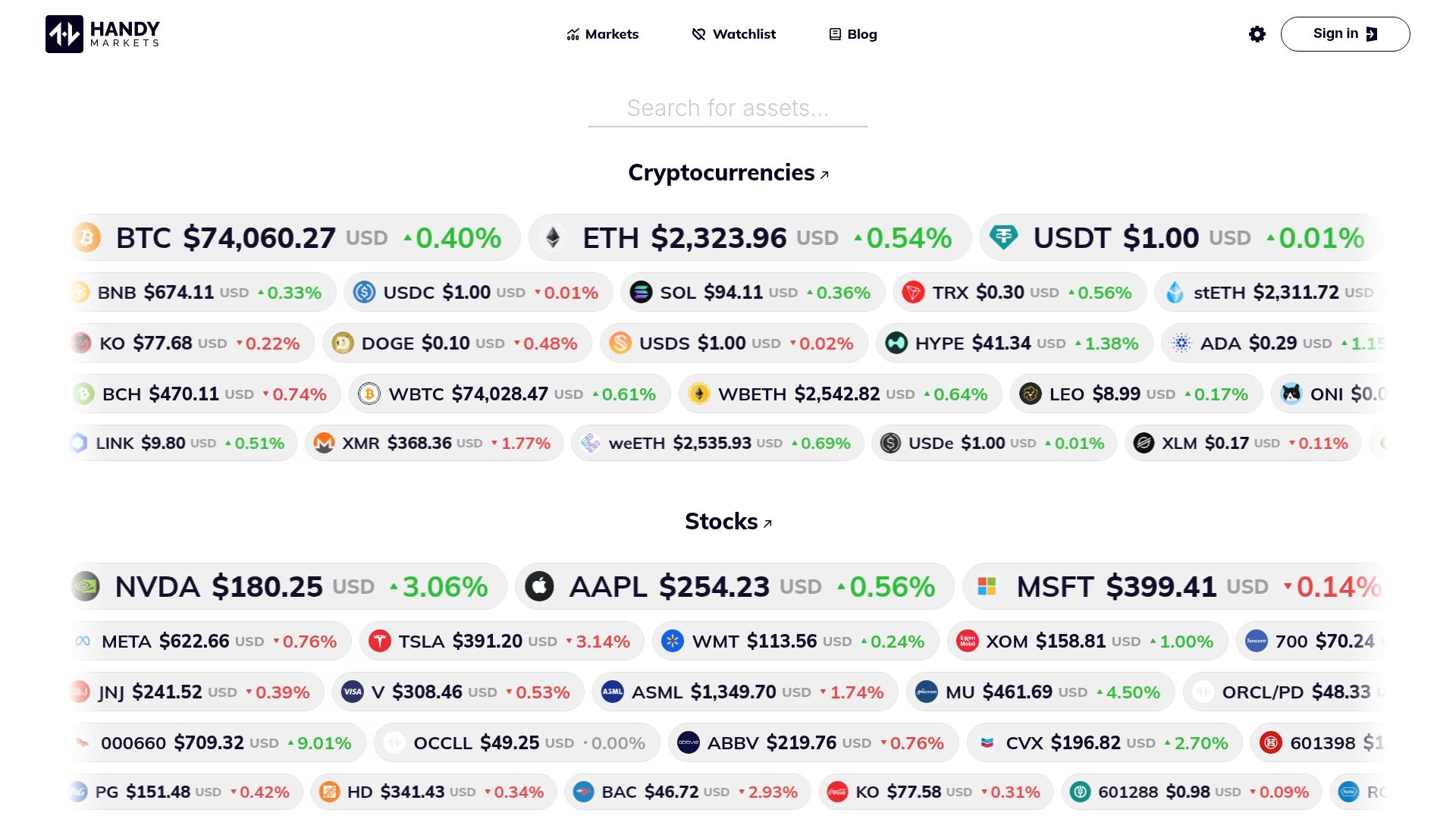
You can get started with price alerts across stocks, crypto, forex, commodities, and indices in just a few clicks. The platform delivers notifications through Telegram, Discord, Slack, SMS, Webhook, and Email, so you receive alerts on whatever channel fits your workflow. With market alerts for all assets consolidated in one place, you spend less time switching between tools and more time making confident, informed decisions. Whether you’re managing a handful of positions or tracking dozens of watchlist items, Handy.Markets gives you the infrastructure to do it right.
FAQ
What types of alerts should beginner investors start with?
Beginner investors should focus on price level, percentage movement, and stop-loss alerts to cover basic risk management and opportunity tracking. These three types cover the majority of actionable scenarios without creating overwhelming notification volume, as these core alert types form the foundation of any solid monitoring setup.
How can I avoid getting too many false alerts?
Limit triggers to key price levels, use volume conditions as a secondary filter, and audit your alerts regularly to remove those with frequent false signals. Since false signal rates for MA crosses can reach 57 to 76 percent in choppy markets, adding context criteria is essential.
Are alerts useful for all asset classes?
Yes, alerts provide equal value across stocks, crypto, forex, and commodities by automating market monitoring, and alerts across asset classes ensure you stay informed regardless of where your capital is deployed.
What does “alert fatigue” mean in trading?
Alert fatigue happens when too many signals cause you to ignore important notifications or react impulsively to marginal ones. False signal accumulation combined with high notification volume is the most common cause, which is why quality and relevance must always take priority over sheer alert quantity.
Recommended
- Set Up Price Alerts Easily For Free | Handy.Markets
- Financial Markets: Track Crypto, Stocks, Forex, Indices, Commodities & ETFs Prices With Alerts | Handy.Markets
- How To Follow Live Market Prices: Real-Time Strategies | Handy.Markets
- Stock Market Indicators: Essential List For Smarter Trading | Handy.Markets