
TL;DR:
- Global market monitoring reduces risk through diversification across imperfectly correlated assets.
- Many investors exhibit home bias, increasing portfolio concentration risk in their domestic markets.
- Professional tools combine macro analysis, risk dashboards, and alternative data to track global markets effectively.
Most investors believe sticking to familiar domestic stocks is the safe play. It feels comfortable, logical even. But that comfort comes at a cost. US investors hold roughly 80% domestic despite the US representing only 62% of global market cap, leaving a massive slice of global opportunity untouched. This article walks you through why monitoring global markets matters, how diversification actually works in practice, which methodologies professionals rely on, and what hidden pitfalls most traders never see coming. By the end, you’ll have a clear framework for making smarter, risk-efficient decisions across asset classes.
Table of Contents
- The case for monitoring global markets
- Diversification in practice: Portfolio benefits and risks
- Key methodologies for global market monitoring
- Nuances, edge cases, and market regimes
- Our perspective: What most traders get wrong about global markets
- Ready to monitor global markets smarter?
- Frequently asked questions
Key Takeaways
| Point | Details |
|---|---|
| Diversification advantage | Monitoring global markets reduces risk and smooths returns through imperfect correlations. |
| Home bias danger | Over-concentration in domestic assets increases risk and misses international opportunities. |
| Monitoring methodologies | Traders leverage macro analysis, dashboards, and real-time data for actionable insights. |
| Nuanced challenges | Rising correlations, currency risk, and regime shifts require active, informed management. |
| Actionable tools | Platforms like Handy.Markets enable real-time alerts and global asset tracking for smarter trading. |
The case for monitoring global markets
Now that you understand the risks of focusing solely on domestic markets, let’s explore the core reasons why global monitoring matters.
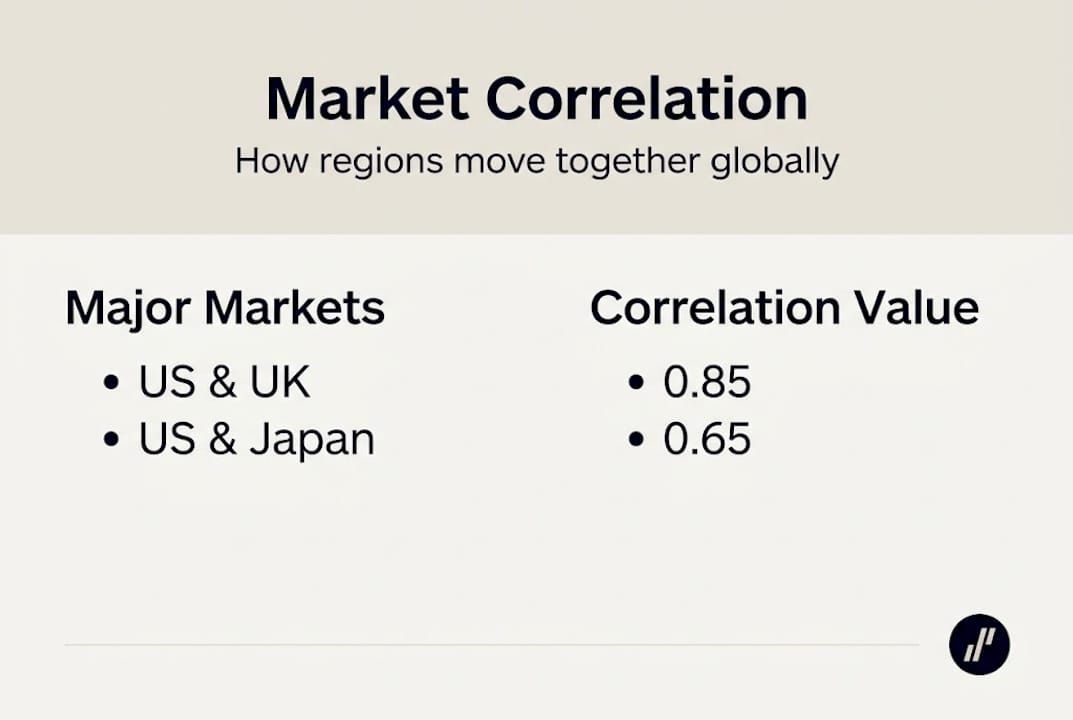
At its heart, global market monitoring is about correlation, which is the degree to which two markets move together. When correlations are low or imperfect, adding international assets to your portfolio can reduce overall volatility without necessarily sacrificing returns. Global stock markets show correlations ranging from 0.37 to 0.91, meaning no two major markets move in perfect lockstep. That gap is where diversification lives.
When you compare financial markets across regions, you quickly notice that economic cycles don’t align perfectly. While the US might be tightening monetary policy, emerging markets could be in an expansion phase. These differences create natural buffers in a well-constructed portfolio.
Here’s a simplified view of how major global equity markets have historically correlated:
| Market Pair | Approximate Correlation |
|---|---|
| US and UK | 0.85 |
| US and Germany | 0.80 |
| US and Japan | 0.65 |
| US and Brazil | 0.60 |
| US and China | 0.45 |
| US and India | 0.55 |
Lower correlation means greater diversification potential. Markets like China and India offer meaningful buffers against US-specific downturns.
The key benefits of global market monitoring include:
- Reduced concentration risk by spreading exposure across multiple economies
- Smoother portfolio returns through offsetting market cycles
- Access to faster-growing economies, particularly in Asia and Latin America
- Protection against domestic policy shocks, such as tax changes or regulatory shifts
“Diversification is the only free lunch in investing.” This widely cited principle holds especially true when applied across borders, where imperfect correlations do the heavy lifting.
Using global market tracking tools makes it far easier to spot these divergences in real time, giving you an edge that purely domestic-focused investors simply don’t have.
Diversification in practice: Portfolio benefits and risks
Understanding why monitoring global markets is crucial, let’s see how investors actually benefit and manage risk with real-world diversification.
Home bias is the tendency for investors to overweight their domestic market. It’s deeply psychological. Familiar brands, local news, and currency comfort all push investors toward what they know. But home bias creates concentration risk, leaving portfolios exposed to a single economy’s slowdowns, political shocks, or sector collapses.
Consider a US investor who held 90% domestic equities during 2022. While US markets fell sharply, certain international markets, particularly in commodity-rich countries, held up far better. That’s diversification in action, or rather, the painful cost of ignoring it.

Here’s how global allocation can look across different investor risk profiles:
| Risk Profile | Domestic Allocation | International Developed | Emerging Markets |
|---|---|---|---|
| Conservative | 60% | 30% | 10% |
| Balanced | 50% | 35% | 15% |
| Aggressive | 40% | 35% | 25% |
To start building a globally diversified portfolio, consider these practical steps:
- Audit your current holdings to identify your actual domestic vs. international split.
- Set a target allocation based on your risk tolerance and investment horizon.
- Use low-cost international ETFs to gain broad exposure without stock-picking complexity.
- Monitor currency exposure alongside asset performance, since currency swings can significantly alter real returns.
- Rebalance periodically, at least annually, to maintain your target allocations as markets shift.
Two risks deserve special attention. First, correlations tend to spike during global crises, reducing diversification benefit precisely when you need it most. Second, currency risk can quietly erode gains. A strong US dollar, for example, reduces the dollar-denominated returns of foreign assets even when those assets perform well locally. You can explore currency risk in international investing to understand how forex volatility interacts with your global positions.
Pro Tip: Watch for regime changes in global markets, such as shifts from low to high inflation environments. These transitions often cause correlations to rise across asset classes, temporarily weakening diversification. Staying alert to macro regime shifts is one of the most underrated skills in global investing.
Reading investment diversification articles regularly helps you stay current on how these dynamics evolve.
Key methodologies for global market monitoring
With the practical benefits of diversification outlined, let’s explore how professionals actually monitor these global markets.
Institutional traders and macro funds don’t just glance at price charts. They use layered, systematic approaches that combine quantitative signals with qualitative judgment. Macro analysis, risk dashboards, real-time nowcasting, and alternative data form the backbone of professional global market monitoring.
Systematic macro analysis involves tracking GDP growth rates, central bank policy decisions, inflation trends, and trade balances across major economies. These indicators reveal where a country is in its economic cycle, helping you anticipate market direction before price moves confirm it.
Risk dashboards aggregate multiple data streams into one view. A well-built dashboard might combine equity index performance, government bond yields, the VIX (a measure of expected US market volatility), credit spreads, and commodity prices. Together, these signals paint a picture of global risk appetite at any given moment.
Alternative data is where things get genuinely fascinating. Satellite imagery of retail parking lots, shipping container tracking, and social media sentiment analysis are all used by sophisticated funds to gain an informational edge. Nowcasting models use high-frequency data to estimate economic conditions in near real time, well before official statistics are published.
Here’s a practical breakdown of monitoring layers:
- Macro layer: GDP, inflation, interest rate decisions, fiscal policy
- Market layer: Equity indices, bond yields, currency pairs, commodity prices
- Sentiment layer: VIX, put/call ratios, fund flow data, news sentiment
- Alternative layer: Satellite data, web scraping, social media trends
For most individual traders and investors, the macro and market layers are the most actionable. A solid real-time market monitoring setup can cover both without requiring institutional resources. Pairing this with a guide to real-time data helps you understand which data feeds matter most for your specific strategy.
Staying on top of market data trends ensures your monitoring setup evolves alongside the markets themselves.
Pro Tip: Pair real-time price alerts with deeper weekly macro analysis. Alerts catch the immediate moves; macro analysis tells you whether those moves are noise or the start of a meaningful trend.
Nuances, edge cases, and market regimes
Even with strong methods, unique challenges arise. This section explores what most miss about monitoring global markets.
One of the most dangerous assumptions in global investing is that yesterday’s correlations will hold tomorrow. They won’t. During the 2008 financial crisis and the 2020 COVID crash, correlations spiked across global markets, and assets that normally moved independently suddenly fell together. Currency risk compounded the pain, with some investors finding that exchange rate moves dominated their actual asset returns.
Key challenges to watch for include:
- Crisis correlation spikes: When fear drives markets, investors sell everything simultaneously, erasing diversification benefits temporarily.
- Currency dominance: In some periods, currency movements can account for more than half of total return variation in international portfolios.
- Deglobalization pressures: Trade tensions, sanctions, and reshoring trends are slowly fragmenting global markets, changing how correlations behave over longer timeframes.
- Liquidity gaps: Some international markets, particularly in frontier economies, have thin trading volumes that can amplify volatility during stress events.
“Regime shifts make what worked yesterday obsolete.” This is not just a warning about strategy decay. It’s a reminder that the global investing landscape is constantly rewiring itself.
Understanding market regimes is critical. A regime is a persistent state of market behavior, such as a low-volatility bull market or a high-inflation stagflation environment. Each regime has its own correlation structure, risk premiums, and optimal asset mix. Knowing which regime you’re in changes everything about how you allocate and monitor.
For traders managing active positions, volatility strategies for traders offer practical frameworks for navigating these shifts. And for a deeper look at how to interpret price movements across regimes, market fluctuation analysis provides structured methods and tools.
The bottom line: global market monitoring isn’t a set-and-forget activity. It requires ongoing attention to how the rules of the game are changing.
Our perspective: What most traders get wrong about global markets
Having covered the technical and practical bases, it’s time for a direct, experience-driven perspective on monitoring global markets.
Most traders treat global diversification as a one-time portfolio decision rather than an ongoing monitoring discipline. They set their international allocations, buy a few ETFs, and assume the job is done. It isn’t.
The deeper mistake is over-relying on historical correlations as if they were permanent laws. They are not. Global dynamics shift fast, and the correlation structure that protected your portfolio in 2019 may actively hurt you in 2026. Currency risk and crisis correlation spikes are routinely underestimated, often because they’re invisible until they’re painful.
Our hard-won lesson: don’t outsmart yourself. Keep your monitoring system simple, robust, and flexible. Track a handful of high-signal indicators across regions, set meaningful alerts, and review your regime assumptions at least quarterly. The traders who consistently outperform aren’t the ones with the most complex systems. They’re the ones who stay genuinely curious and adapt quickly.
Staying current with investment insights is one of the simplest ways to keep that adaptability sharp.
Ready to monitor global markets smarter?
Now that you have actionable insights and perspective, here’s how to put these ideas to work with tools designed for real-time global monitoring.
Handy.Markets gives you a single, clean view of global financial markets across equities, forex, commodities, indices, and crypto. No juggling multiple platforms or drowning in noise.
With market tracking tools covering thousands of assets worldwide, you can spot divergences and opportunities the moment they appear. Setting up a price alert takes minutes and delivers notifications directly to Telegram, Discord, Slack, SMS, or email. You can also monitor ETF market alerts to stay on top of your international fund positions without constant manual checking. Smarter global monitoring starts with the right setup.
FAQ
How does global market monitoring reduce portfolio risk?
Global market monitoring lowers portfolio risk by combining assets with imperfect correlations, reducing overall volatility without necessarily sacrificing returns. When one market falls, others with low correlation can hold steady or rise, cushioning the impact.
What is home bias and why is it risky?
Home bias creates concentration risk by keeping too much capital in a single domestic market, leaving investors exposed to local economic downturns, policy changes, and missed international growth. It’s a psychological trap that quietly limits long-term returns.
What tools do institutional traders use to monitor global markets?
Institutional traders rely on macro analysis, risk dashboards, real-time nowcasting models, and alternative data sources like satellite imagery and social media sentiment to build a layered view of global market conditions.
Do global correlations always provide diversification?
No. During market crises, correlations can spike across asset classes and regions, temporarily reducing the diversification benefit. Monitoring for regime shifts helps you anticipate when this risk is elevated.
How can currency risk affect global investing?
Currency risk can dominate returns in international portfolios, sometimes offsetting strong asset performance or amplifying losses, making it essential to track forex movements alongside your underlying positions.