
TL;DR:
- Financial markets act as real-time indicators of economic expectations beyond just stock prices.
- Structured monitoring of macro signals and asset interactions can improve decision-making and reduce reactive trading costs.
- Focusing on relevant signals and periodic reviews helps investors better manage risks and enhance long-term returns.
Most investors think watching financial markets means obsessing over stock prices. That’s a costly misconception. Financial markets are actually a living, breathing economic dashboard, pulsing with signals about inflation, interest rates, and growth expectations long before official reports hit the news. When you learn to read those signals, you stop reacting to noise and start making decisions with real clarity. As a real-time economic barometer, markets reveal what millions of investors collectively expect about the future. That’s a powerful edge, and this article shows you exactly how to use it.
Table of Contents
- The economic signals behind market moves
- Modern market monitoring: Tools, techniques, and approaches
- From signals to strategy: How to apply market insights
- Risks, costs, and common misconceptions in market watching
- What most investors get wrong about watching markets
- Take your market insights further with Handy.Markets
- Frequently asked questions
Key Takeaways
| Point | Details |
|---|---|
| Markets reveal economic signals | Watching markets lets you spot inflation or rate changes before they’re announced officially. |
| Focus on macro, not micro | Periodic monitoring of broad market trends yields better investment decisions than reacting to every price swing. |
| Active trading carries hidden costs | Frequent reaction and index rebalancing lead to selection costs that weaken returns. |
| Apply evidence for better outcomes | Using structured signals and rebalancing methods improves risk-adjusted returns and reduces portfolio volatility. |
The economic signals behind market moves
Every price movement in a financial market tells a story. When bond yields rise sharply, it often signals that investors expect higher inflation or tighter monetary policy ahead. When stock indices fall across multiple sectors simultaneously, that’s rarely about one company. It’s the market pricing in a broader economic slowdown. These are not random fluctuations. They’re collective judgments made by millions of participants processing the same data.
Financial markets function as a real-time economic barometer, providing early signals on inflation, interest rates, and economic expectations through asset price movements. This means that by the time a central bank announces a rate hike, experienced market watchers already saw it coming in bond and currency markets weeks earlier.
Here’s what different market indicators typically signal:
- Rising bond yields: Expectations of higher inflation or interest rate increases
- Falling commodity prices: Slowing global demand or a stronger dollar
- Widening credit spreads: Growing concern about corporate default risk
- Surging gold prices: Investor flight to safety during uncertainty
- Equity sector rotation: Shifts from growth to value stocks often signal late-cycle economic behavior
Think of it this way: if you only check stock prices, you’re reading one chapter of a much longer book. The full picture requires watching bonds, currencies, commodities, and indices together. That’s what serious investors and business leaders do through structured market monitoring.
“Markets are not just places to buy and sell. They are the world’s most efficient aggregator of economic expectations.”
One practical example: in early 2022, the U.S. Treasury yield curve inverted, meaning short-term rates exceeded long-term rates. This is a historically reliable recession predictor. Investors who were tracking financial markets closely adjusted their portfolios months before the broader public recognized the risk. That’s the real value of market watching. It’s not about predicting the future with certainty. It’s about reducing the surprise factor and acting with better information.
Now that you know market moves reveal more than prices, let’s see how monitoring them impacts investment decisions.
Modern market monitoring: Tools, techniques, and approaches
Not all market monitoring is created equal. There’s a wide spectrum between checking your portfolio once a month and watching a live ticker all day. Both extremes carry risks. The key is finding a structured approach that keeps you informed without pulling you into emotional, reactive decisions.
Monitoring markets enables informed decision-making for strategy, investment timing, risk management, and adjustments to costs, pricing, and capital activities based on sentiment and valuations. That’s a broad mandate, and it requires the right tools.
Here are the main monitoring approaches investors use:
- Periodic review: Checking key indices, bond yields, and sector performance weekly or monthly. Low noise, high signal.
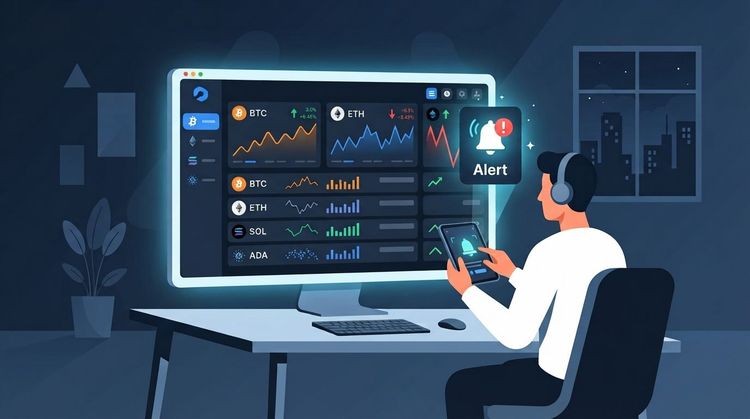
- Real-time alerts: Setting price thresholds or percentage change triggers for specific assets. Efficient and targeted.
- Macro focus: Tracking economic calendars, central bank announcements, and earnings seasons as structured events.
- Automated dashboards: Aggregating multiple asset classes in one view to spot correlations and divergences quickly.
| Approach | Best for | Main benefit | Main risk |
|---|---|---|---|
| Manual periodic review | Long-term investors | Low stress, big picture | May miss short-term signals |
| Real-time alerts | Active traders | Fast response to moves | Alert fatigue if poorly set |
| Macro event tracking | Fundamental analysts | Context-rich decisions | Requires deeper knowledge |
| Automated dashboards | All investor types | Efficiency, breadth | Data overload without focus |
Using a volatility checklist alongside your monitoring routine helps you separate meaningful moves from random noise. Most beginners make the mistake of treating every 1% dip as a crisis. Experienced investors recognize that short-term volatility is the price of long-term returns.
Pro Tip: Set alerts for macro-level thresholds, like a 10-year Treasury yield crossing 5% or the VIX (Volatility Index) spiking above 30, rather than reacting to every daily price swing. This keeps your attention on signals that actually matter for mastering market trends.
The right combination of market alerts and periodic reviews gives you the best of both worlds: awareness without anxiety.

Understanding monitoring methods, we can now explore how market signals help guide tactical investment decisions.
From signals to strategy: How to apply market insights
Knowing that markets send signals is one thing. Knowing what to do with those signals is where most investors struggle. The gap between information and action is where returns are made or lost. Here’s a practical framework for turning market data into smarter investment decisions.
- Identify the dominant trend. Before acting, determine whether the broader market is in a risk-on or risk-off environment. Rising equities with falling volatility suggest confidence. Falling equities with rising gold and bond prices suggest caution.
- Assess your current allocation. Compare your portfolio’s sector and asset class weights against current market signals. Are you overexposed to rate-sensitive assets when yields are rising?
- Adjust diversification deliberately. Use signals to rebalance, not to chase performance. If commodities are strengthening due to supply constraints, a modest increase in commodity exposure is a signal-driven move, not speculation.
- Adapt your timing. Market signals can inform when to add to positions, not just what to buy. Buying into a confirmed uptrend carries less risk than catching a falling asset.
- Review and repeat. Strategy adjustment is not a one-time event. Build a regular review cycle tied to macro events and your own risk tolerance.
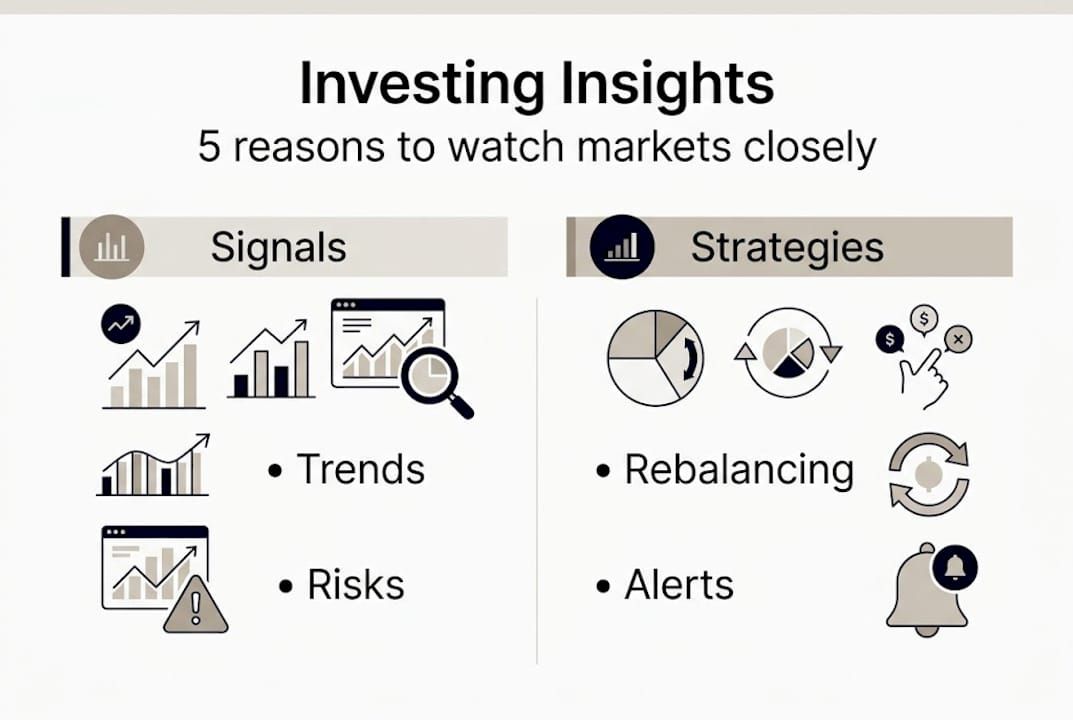
Dynamic index rebalancing reduces volatility and improves Sharpe ratios compared to static buy-and-hold strategies by aligning with economic shifts. The Sharpe ratio measures return per unit of risk, so a higher ratio means you’re being rewarded more efficiently for the risk you take.
| Strategy type | Volatility | Sharpe ratio | Flexibility |
|---|---|---|---|
| Static buy-and-hold | Higher | Lower | None |
| Dynamic signal-based rebalancing | Lower | Higher | High |
| Reactive (news-driven) trading | Highest | Lowest | Excessive |
Exploring investment strategies for 2026 and tracking stock indices alongside macro signals gives you a richer picture for comparing financial markets and finding the best fit for your goals.
Pro Tip: Rebalancing quarterly based on macro signals, rather than reacting to daily news, has been shown to reduce portfolio volatility while maintaining competitive returns. Set a calendar reminder and stick to the process.
Once you know how to use signals for strategy, it’s important to understand potential costs and hidden risks of reactivity.
Risks, costs, and common misconceptions in market watching
Here’s the uncomfortable truth: watching markets too closely can actually hurt your returns. The data is clear, and it should make every reactive trader pause.
Index funds incur roughly negative 4% annual adverse selection costs from rebalancing to market changes, essentially buying high and selling low. “Sleepy” strategies that minimize unnecessary turnover improve returns by 20 to 80 basis points per year. That’s a meaningful edge, compounded over time.
Additionally, passive ETFs like VOO show lower volatility and higher risk-adjusted returns compared to active strategies, and frequent trading is genuinely hazardous to long-term wealth.
Common pitfalls to avoid:
- Overtrading on news: Reacting to headlines rather than confirmed trends increases transaction costs and tax drag.
- Ignoring adverse selection: When index funds rebalance to include newly popular stocks, they often buy at peak prices, a hidden drag on performance.
- Mistaking activity for progress: More trades do not mean better returns. Discipline and patience outperform busyness.
- Anchoring to recent performance: A stock that rose 30% last year is not automatically a good buy today. Market signals matter more than past price action.
- Neglecting risk management: Focusing only on potential gains while ignoring volatility and drawdown risk leads to outsized losses.
Pro Tip: Review your investment articles and market analysis techniques periodically rather than daily. This reduces emotional bias and keeps your focus on structural trends rather than short-term noise. Pair this with a clear investment strategy that defines your rebalancing triggers in advance.
The goal is not to watch markets more. It’s to watch them smarter.
With a clear understanding of risks and costs, let’s wrap up with a unique perspective on what most investors miss about market watching.
What most investors get wrong about watching markets
Most investors treat market watching as a volume game. More data, more alerts, more news equals better decisions. We’d argue the opposite is true. The investors who consistently outperform are not the ones glued to their screens. They’re the ones who have defined what signals matter to them and tune out everything else.
The real power of periodic monitoring over noise is that it forces you to think structurally. When you only check markets weekly or around major macro events, you stop seeing every blip as a crisis and start seeing patterns. That shift in perspective is worth more than any single trade.
Structured approaches also reduce emotional bias, which is the single biggest destroyer of investment returns. Fear and greed are not weaknesses. They’re human. But a system that filters signal from noise keeps those emotions from driving decisions.
Our take: set up alerts for traders around the macro thresholds that actually affect your portfolio, check in periodically with a clear framework, and let the market work for you rather than against your psychology.
Take your market insights further with Handy.Markets
Putting these principles into practice requires the right tools. Handy.Markets brings together live data across stocks, ETFs, cryptocurrencies, commodities, indices, and forex in one place, so you can monitor what matters without switching between platforms.
You can set up price alerts across Telegram, Discord, Slack, SMS, Email, and Webhook in minutes, keeping you informed at the macro thresholds that actually matter to your strategy. Track ETF market alerts to monitor passive investment signals, or set stock price alerts for individual positions. Whether you’re a long-term investor or an active trader, Handy.Markets gives you the structured, real-time awareness that turns market signals into smarter decisions.
FAQ
How can financial markets signal economic changes before official reports?
Asset prices like bonds and stocks react quickly to investor expectations, often signaling inflation or interest rate shifts before official data releases. Markets function as a real-time economic barometer, making them a leading indicator rather than a lagging one.
What is the main risk of constant, reactive trading?
Frequent trading increases costs and volatility, often resulting in buying high and selling low, which erodes returns. Index funds face roughly negative 4% annual adverse selection costs from this behavior, and passive strategies consistently outperform frequent trading on a risk-adjusted basis.
How often should investors monitor financial markets?
Periodic monitoring of macro trends is more effective than constant attention to micro-movements, lowering emotional and cognitive bias. Focusing on macro signals over daily noise leads to more disciplined, higher-quality decisions.
Can market monitoring improve risk management and returns?
Yes. Tracking economic shifts and adjusting strategies accordingly reduces portfolio volatility and enables smarter diversification. Dynamic rebalancing improves Sharpe ratios compared to static strategies, meaning better returns for each unit of risk taken.