

TL;DR:
- Forex volatility is driven by institutional leverage, hedging, liquidity, and economic shocks.
- Emerging market currencies face higher volatility due to thinner markets and political instability.
- Measuring volatility with ATR and monitoring institutional activity helps traders manage risk effectively.
Forex volatility is often dismissed as random noise, something unpredictable that traders simply have to endure. That framing is wrong, and it costs people money. Currency price swings are shaped by measurable forces: institutional leverage, hedging behavior, liquidity conditions, and sensitivity to economic shocks. The BIS Quarterly Review confirms that non-bank financial institutions (NBFIs) amplify volatility through leveraged positions in FX derivatives, while dealer concentration creates fragile liquidity conditions. Understanding these mechanics is not just academic. It is the foundation of sound risk management and smarter trade decisions for both retail and institutional participants.
Table of Contents
- What is forex volatility and why does it matter?
- Core drivers of forex volatility: Institutional versus retail impacts
- Emerging market currencies: Why volatility risks are higher
- How to measure and manage forex volatility effectively
- A fresh perspective: Volatility is opportunity—if you recognize the real drivers
- Stay ahead: Real-time alerts and tools for volatility tracking
- Frequently asked questions
Key Takeaways
| Point | Details |
|---|---|
| Volatility is measurable | Tools like ATR and option-derived metrics help traders quantify and manage forex volatility. |
| Institutions drive volatility | Large players and dealer concentration significantly amplify market swings and liquidity risks. |
| Emerging markets are riskier | Emerging market currencies face greater volatility from uncertainty and lower liquidity. |
| Dynamic risk management | Retail traders should adapt stop losses based on real-time volatility metrics for smarter protection. |
What is forex volatility and why does it matter?
Forex volatility refers to the speed and magnitude of price changes in currency pairs over a given period. Think of it as the heartbeat of the market. A slow, steady pulse means calm conditions. A rapid, erratic beat signals turbulence. Neither state is inherently good or bad. What matters is how prepared you are when the rhythm changes.
At its core, volatility is a statistical measure. Traders most commonly track it using two approaches:
- Historical volatility (HV): Calculated from past price data, often using the average true range (ATR), which measures how much a currency pair moves on average over a set number of periods.
- Implied volatility (IV): Derived from options pricing, IV reflects market expectations of future price swings. It is used more by institutional desks than retail traders in spot FX.
Why does volatility matter so much? Because without it, there is no opportunity. A currency pair that never moves offers nothing to trade. But volatility that you do not understand becomes a risk amplifier rather than a profit engine. As one forex volatility overview puts it:
“Volatility is the lifeblood of forex trading. Without price movement, there is no opportunity. With too much unmanaged movement, there is only risk.”
The balance between opportunity and risk is where skill lives. Retail traders benefit from volatility for profit opportunities but must use ATR for dynamic stops to avoid being shaken out of valid positions by normal market noise.
For a broader look at how volatility fits into trading strategy, our trading articles cover a wide range of approaches. You can also explore specific volatility strategies built around different market conditions. The key takeaway here is simple: volatility is not your enemy. Ignorance of volatility is.
Core drivers of forex volatility: Institutional versus retail impacts
Now that we understand why volatility matters, let’s look at what actually drives it in the currency markets. The answer involves two very different types of market participants behaving in very different ways.
Institutional players are the dominant force. Banks, hedge funds, pension managers, and NBFIs collectively account for the vast majority of daily FX turnover. Their activity shapes liquidity and price discovery. When institutions hedge large currency exposures using FX swaps or derivatives, they can move markets significantly. NBFIs amplify volatility via leverage and hedging in FX derivatives, while dealer concentration creates the risk of sudden liquidity strains during stress events.
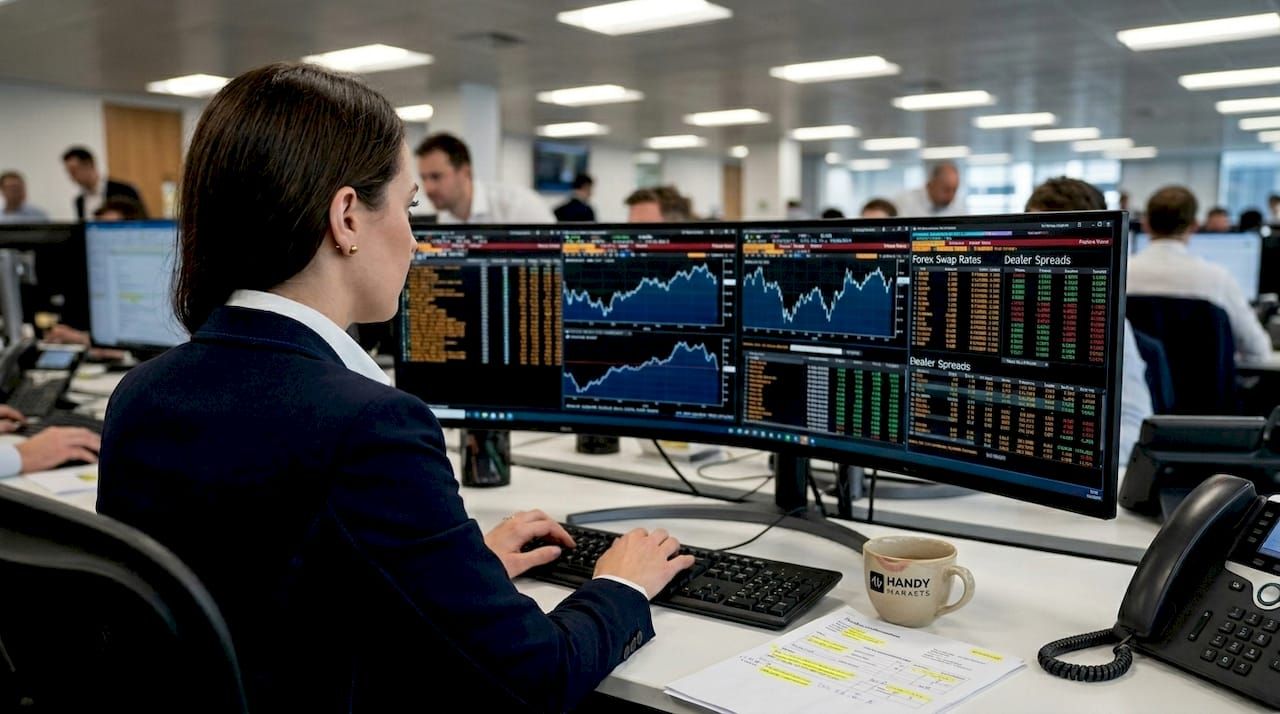
Here is a simplified breakdown of global FX turnover by instrument type:
| Instrument | Share of global FX turnover | Volatility impact |
|---|---|---|
| FX swaps | ~49% | Moderate, but systemic during stress |
| Spot transactions | ~28% | High, especially in thin markets |
| Outright forwards | ~15% | Moderate, driven by hedging demand |
| FX options | ~5% | High implied vol signal |
| Currency swaps | ~3% | Low day-to-day, high in crises |
Retail traders respond to volatility rather than create it. They tend to increase activity during high-volatility periods, often chasing momentum or reacting to news. This behavior can amplify short-term swings but rarely drives the structural moves that institutions initiate.
Key behaviors that drive institutional volatility:
- Large-scale currency hedging by multinational corporations
- Central bank interventions and policy announcements
- Leveraged NBFI positions being unwound during market stress
- Dealer concentration reducing available liquidity in thin conditions
Pro Tip: Watch for unusual spikes in FX swap volumes or sudden shifts in dealer spreads. These are early signals that institutional hedging pressure is building, often before retail traders notice any price movement.
Understanding these dynamics is central to our market fluctuation guide. For deeper analysis methods, the fluctuation analysis resource walks through practical tools. If you are newer to this space, the volatility investing guide offers a solid starting point.
Emerging market currencies: Why volatility risks are higher
Institutional and retail activity shapes volatility in all markets, but emerging market currencies carry a uniquely elevated risk profile that every trader should understand.
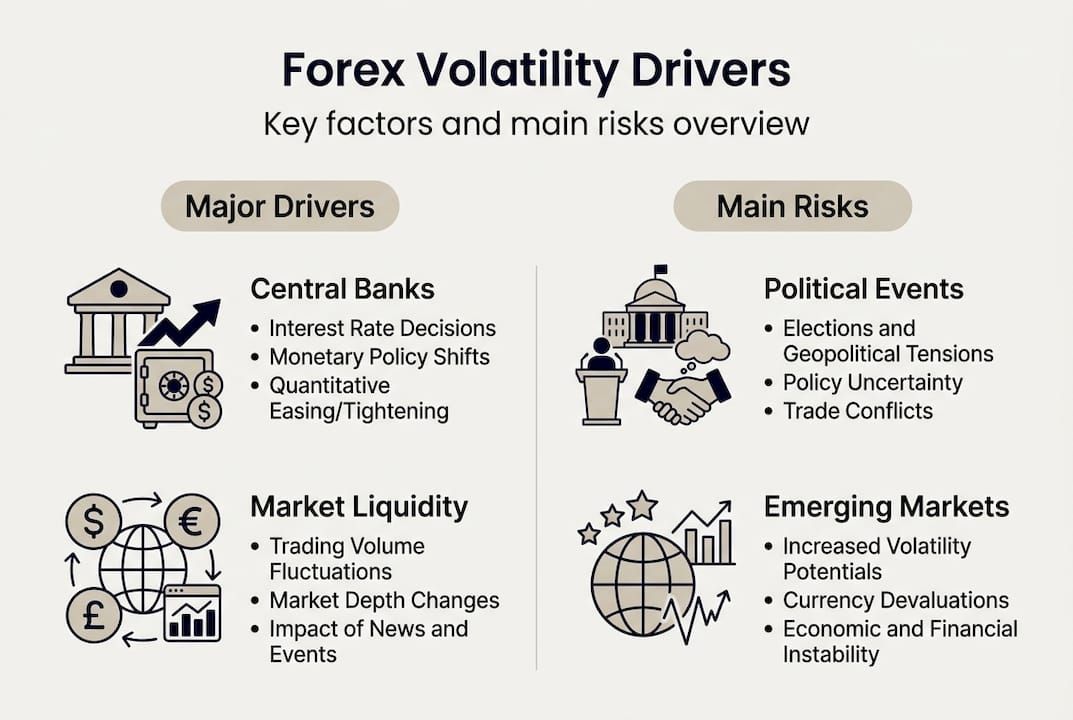
Major currency pairs like EUR/USD or USD/JPY are backed by deep liquidity pools, transparent central bank policies, and relatively stable economic fundamentals. Emerging market (EM) currencies, such as the Turkish lira, South African rand, or Brazilian real, operate in thinner markets with less predictable policy environments. Emerging market currencies are more vulnerable to uncertainty shocks, meaning that geopolitical events, inflation surprises, or global risk-off sentiment can trigger outsized moves.
Here is how the volatility profile differs between major and EM pairs:
| Metric | Major FX pairs (e.g., EUR/USD) | EM FX pairs (e.g., USD/TRY) |
|---|---|---|
| Average daily range | 0.5% to 0.8% | 1.5% to 3.5%+ |
| Liquidity depth | Very high | Low to moderate |
| Sensitivity to news | Moderate | Very high |
| Central bank intervention risk | Low | High |
| Spread during stress events | Widens slightly | Can widen dramatically |
Several factors amplify EM currency volatility specifically:
- Thin liquidity: Fewer market makers means larger price gaps during stress.
- Political uncertainty: Elections, policy shifts, or sanctions can trigger rapid devaluation.
- External debt exposure: Countries with large USD-denominated debt are sensitive to dollar strength.
- Capital flow reversals: When global risk appetite drops, investors pull capital from EM assets quickly.
For retail traders, the practical implication is clear: position sizing must be tighter when trading EM pairs, and stop distances need to reflect the wider average ranges. Monitoring live currency rates gives you a real-time view of which pairs are moving and by how much. Staying informed about 2026 currency trends helps you anticipate which EM currencies are facing structural pressure.
For institutional traders, EM volatility requires more robust hedging programs and closer attention to liquidity conditions before entering or exiting large positions.
How to measure and manage forex volatility effectively
With an appreciation of volatility’s sources and risks, let’s look at how you can quantify and manage it in practice. Measurement is not optional. It is the difference between disciplined trading and guesswork.
Here is a step-by-step framework for incorporating volatility into your trading process:
- Calculate ATR for your pair. Set ATR to a 14-period default on your chart. This tells you the average price range over the last 14 candles, giving you a baseline for what is “normal” movement.
- Compare current ATR to its historical average. If ATR is running 50% above its 30-day average, the market is in a high-volatility regime. Adjust your expectations and risk accordingly.
- Set dynamic stop losses. A common practice is placing stops at 1 to 2 times the current ATR below your entry. This keeps you in trades during normal fluctuation while protecting against larger adverse moves.
- Check implied volatility signals. For traders with access to options data, elevated implied volatility on currency options signals that the market expects larger moves ahead.
- Monitor institutional hedging activity. Rising FX swap volumes or widening dealer spreads often precede significant volatility events.
Pro Tip: Do not set your stop loss based on a fixed pip number. Instead, anchor it to the current ATR value. A 20-pip stop on EUR/USD during low volatility is reasonable. The same stop during a high-volatility event is almost guaranteed to be hit by noise before the trade has a chance to develop.
Retail traders must use ATR for dynamic stops, while institutions tend to favor FX swaps and forwards as hedging instruments during volatility spikes. Both approaches share a common principle: size your exposure to the current environment, not a fixed template.
For real-time monitoring support, our monitoring market volatility guide covers alert setups in detail. You can also review key volatility indicators to build a more complete measurement toolkit. For a broader technical reference, the forex volatility measurement resource is worth bookmarking.
A fresh perspective: Volatility is opportunity - if you recognize the real drivers
Most traders, even experienced ones, treat volatility as something that happens to them. A news event hits, the market spikes, and they react. That reactive mindset is where most losses originate.
Here is the uncomfortable truth: the majority of significant forex volatility is not random. It is the predictable result of institutional positioning, leverage cycles, and structural liquidity conditions. When you understand that volatility is essential for trading opportunity while simultaneously being a risk amplifier, you stop fearing it and start reading it.
We have seen retail traders dramatically improve their results not by finding better entry signals, but simply by aligning their trade size and stop placement with the actual volatility environment. ATR is not a sophisticated tool. It is a simple, honest measurement of market reality. Using it consistently is more valuable than any exotic indicator.
The institutional side of this equation is equally important. When NBFIs are aggressively hedging through derivatives, liquidity can evaporate fast. Knowing that dynamic, and watching for early signals in swap volumes or spread behavior, gives you an edge that most retail participants simply do not have.
Our forex trading perspectives explore these themes further. The core lesson we keep coming back to: neither fear volatility nor ignore it. Study it, measure it, and let it inform every decision you make.
Stay ahead: Real-time alerts and tools for volatility tracking
Understanding volatility is only half the equation. Acting on it in real time is where the edge becomes tangible. Markets move fast, and the difference between a well-managed position and a blown stop often comes down to how quickly you receive and respond to price information.
At Handy.Markets, we built our platform specifically for traders who need to stay connected to market movements without being glued to a screen. You can set forex price alerts across Telegram, Discord, Slack, SMS, Email, and Webhook so that critical moves reach you instantly, wherever you are. You can also track live crypto prices alongside your FX pairs, keeping your full market picture in one place. Volatile markets reward preparation. Set your alerts, monitor your key pairs, and let the data work for you.
FAQ
What makes forex markets more volatile than other asset classes?
Forex markets operate 24 hours a day across global time zones, making them sensitive to a continuous stream of economic, political, and institutional events. Institutional leverage amplifies FX volatility significantly, and emerging markets face additional vulnerability to uncertainty shocks.
Which currencies tend to be the most volatile?
Emerging market currencies and exotic pairs consistently show higher volatility than major pairs due to thinner liquidity and greater sensitivity to political or economic shocks. Emerging market currencies are structurally more exposed to sudden uncertainty-driven moves.
How do traders measure forex volatility?
Retail traders primarily use ATR to measure historical price ranges and set appropriate stop distances. Retail traders use ATR; institutions supplement this with implied volatility signals from options markets and hedging flow data.
How can traders manage risk during high volatility?
The most practical approach is adjusting stop losses to reflect current market conditions, typically placing them at 1 to 2 times the current ATR. Dynamic stops and hedging with swaps or forwards are the preferred institutional methods during stress periods.
Recommended
- Market Volatility Checklist: Strategies For Traders | Handy.Markets
- Mastering Volatility In Investing: A Beginner’s Guide To Navigating Market Swings In 2025 | Handy.Markets
- Understanding Market Fluctuations: A Guide For Traders | Handy.Markets
- Market Fluctuation Analysis: Methods, Tools & Strategies | Handy.Markets