


Investors face a unique challenge in 2026 as market concentration reaches historic highs and volatility persists across asset classes. The top 10 stocks in the S&P 500 now represent roughly 40% of total market capitalization, creating significant concentration risk for passive portfolios. Meanwhile, inflation pressures, geopolitical tensions, and shifting monetary policy demand strategic diversification across equities, commodities, and digital assets. This article explores proven investment strategies designed to maximize returns while managing risk through active allocation, quantitative approaches, and disciplined execution across global markets.
Table of Contents
- Key takeaways
- How to evaluate top investment strategies for 2026
- Active global equity rotation: diversifying beyond US tech and AI
- Commodities barbell: inflation hedging with precious and industrial metals
- Crypto investing in 2026: dollar-cost averaging with quality asset allocation
- Quantitative and systematic strategies: gaining an edge with factor momentum and regime overlays
- Explore real-time market data and alerts at Handy.Markets
- Frequently asked questions about investment strategies in 2026
Key Takeaways
| Point | Details |
|---|---|
| Active diversification beats passive | Investors should tilt toward active allocation across global stocks, commodities, and digital assets to mitigate concentration risk from US tech. |
| Commodities hedge inflation | In a 2026 environment with moderating inflation, supply constraints and growth in commodities can provide inflation protection and potential upside from physical scarcity. |
| Crypto DCA core | Balanced dollar cost averaging across select Bitcoin and Ethereum exposure is recommended to reduce timing risk. |
| Quant models boost returns | Use quantitative overlays and disciplined risk controls to enhance risk adjusted performance across global assets. |
How to evaluate top investment strategies for 2026
Selecting the right investment strategies requires a systematic framework that accounts for both opportunities and risks in the current market environment. 2026 favors resilient diversified portfolios with active tilts focusing on earnings growth and risk management. The concentration of wealth in a handful of technology stocks means passive indexing no longer provides adequate diversification, making active strategies essential for managing tail risks.
When evaluating potential strategies, consider these critical factors:
- Diversification breadth: Assess exposure across global equities, commodities, cryptocurrencies, and alternative investments to reduce correlation risk
- Active versus passive approach: Favor active rebalancing and tactical allocation over static indexing given current market concentration
- Risk-adjusted return potential: Prioritize strategies that maximize Sharpe ratios through quantitative overlays and systematic risk management
- Earnings growth sustainability: Focus on companies and sectors with durable revenue growth rather than elevated valuations alone
- Macroeconomic alignment: Consider Federal Reserve easing cycles, fiscal policy support, and geopolitical developments that impact asset class performance
The macroeconomic backdrop for 2026 includes moderating inflation, gradual interest rate normalization, and continued fiscal stimulus in major economies. These conditions create opportunities in undervalued international markets, supply-constrained commodities, and quality digital assets. Your strategy should balance growth potential with downside protection through thoughtful asset allocation and regular portfolio review. For additional context on building diversified portfolios, explore our collection of investment articles covering various market conditions and strategies.
Active global equity rotation: diversifying beyond US tech and AI
The extreme concentration in US technology stocks presents both a valuation challenge and an opportunity for strategic rotation. Top 10 S&P 500 stocks represent about 40% of market cap with AI hyperscalers exceeding GDPs of major economies, favoring rotation to international and emerging equities for growth. This concentration means passive investors face significant idiosyncratic risk from a small number of companies, many trading at stretched multiples despite impressive revenue growth.
International and emerging market equities offer compelling alternatives with lower valuations and stronger earnings momentum. European stocks trade at substantial discounts to US counterparts while benefiting from industrial reshoring and defense spending increases. Asian markets, particularly in India and Southeast Asia, provide exposure to rapidly growing consumer classes and digital infrastructure buildout. Small and mid-cap stocks in developed markets also present opportunities as they typically exhibit lower correlation to mega-cap technology performance.
Implementing an active rotation strategy involves several key steps:
- Reduce overweight positions in US large-cap technology stocks to neutral or underweight levels based on valuation metrics
- Increase allocations to European and Japanese equities benefiting from corporate governance reforms and attractive valuations
- Add emerging market exposure focusing on countries with strong fiscal positions and commodity export advantages
- Incorporate small and mid-cap stocks in sectors showing earnings acceleration and reasonable price-to-earnings ratios
- Rebalance quarterly based on relative valuation changes and earnings revision trends across geographies
Pro Tip: Monitor earnings growth rates rather than headline valuations alone, as sustainable profit expansion supports stock prices even at elevated multiples during extended bull markets.
This rotation strategy reduces portfolio concentration risk while capturing growth opportunities in underappreciated markets. You can track international equity performance and set alerts for key market movements through global equity rotation insights to support your rebalancing decisions. For deeper analysis on building resilient portfolios across market cycles, review portfolio construction insights that detail tactical allocation frameworks.
Commodities barbell: inflation hedging with precious and industrial metals
Commodities provide essential portfolio diversification and protection against currency debasement and inflation resurgence. A barbell approach combining precious metals with industrial metals captures both defensive and growth-oriented characteristics. Gold central banks held over 1,000 tons in 2023, silver faces 10% undersupply, and copper shows structural supply gap by 2031 driving demand. These supply-demand dynamics create favorable conditions for sustained price appreciation across the metals complex.
Precious metals serve as monetary hedges when fiat currency purchasing power declines or geopolitical tensions escalate. Gold benefits from continued central bank accumulation as nations diversify reserves away from dollar-denominated assets. Silver combines monetary properties with industrial applications in solar panels and electronics, creating dual demand drivers. Industrial metals like copper face structural deficits as green energy infrastructure requires massive amounts of conductive materials while new mine development lags demand growth.
Implementing a commodities barbell strategy follows this framework:
- Allocate 40-50% to gold through physical bullion, ETFs, or mining stocks for monetary hedge and portfolio stability
- Dedicate 20-30% to silver capturing both precious metal characteristics and industrial demand from renewable energy
- Invest 30-40% in copper and related base metals benefiting from electrification and infrastructure spending
- Rebalance semi-annually based on relative performance and supply-demand fundamentals in each metal
- Consider mining equities for leveraged exposure to metal prices with operational efficiency as selection criteria
Pro Tip: Watch central bank gold buying trends and industrial production data as leading indicators for precious and base metal demand shifts.
The table below compares key characteristics of metals in a barbell portfolio:
| Metal | Primary Driver | Supply Status | 2026 Outlook |
|---|---|---|---|
| Gold | Monetary hedge | Stable production | Positive from central bank buying |
| Silver | Dual monetary/industrial | 10% undersupply | Strong from solar demand |
| Copper | Infrastructure/electrification | Structural deficit | Very positive from green transition |
Monitor real-time prices and set alerts for significant moves through commodity market alerts to optimize entry points and rebalancing timing. For comprehensive guidance on precious metal allocation, explore gold investment guide covering portfolio integration strategies.
Crypto investing in 2026: dollar-cost averaging with quality asset allocation
Cryptocurrency markets mature in 2026 as institutional adoption accelerates and regulatory frameworks clarify in major jurisdictions. Dollar-cost averaging eliminates timing risk while building positions in quality digital assets with long-term value propositions. Backtested dollar-cost averaging on BTC since 2018 shows returns ranging from +1,046% to +2,056%, favoring high-quality holdings and avoiding leverage. This disciplined approach smooths volatility and removes emotional decision-making from the investment process.

A quality-focused crypto portfolio emphasizes established assets with network effects, institutional backing, and clear use cases. Bitcoin remains the primary store of value and inflation hedge in digital form, while Ethereum provides exposure to decentralized finance and smart contract platforms. Selective altcoin exposure captures innovation in specific sectors like layer-2 scaling, real-world asset tokenization, and decentralized infrastructure. Stablecoin holdings provide liquidity for opportunistic purchases during market corrections.
Building a crypto portfolio using DCA involves these steps:
- Establish core holdings with 60-70% allocation to Bitcoin and Ethereum as foundation assets
- Add selective altcoins representing 20-30% for exposure to DeFi protocols, layer-2 solutions, and emerging use cases
- Maintain stablecoin reserves of 5-10% for rebalancing opportunities and liquidity management
- Execute fixed purchases weekly or monthly regardless of price to average cost basis over time
- Avoid leverage completely as amplified volatility creates liquidation risk in crypto’s boom-bust cycles
- Focus on long-term holding rather than trading, as institutional adoption drives multi-year appreciation
Regulatory developments in 2026 favor established cryptocurrencies with clear compliance frameworks over speculative tokens. The approval of spot Bitcoin ETFs in major markets provides traditional investors with regulated access, increasing demand for quality assets. This institutional flow supports Bitcoin and Ethereum while creating higher barriers for unproven projects, making asset selection increasingly important.
Track cryptocurrency prices and set customized alerts through crypto portfolio strategies to support your DCA execution and rebalancing decisions across digital assets.
Quantitative and systematic strategies: gaining an edge with factor momentum and regime overlays
Quantitative strategies use data-driven rules to capture persistent market inefficiencies and improve risk-adjusted returns. Factor momentum, sector rotation, and regime overlays provide systematic frameworks that complement discretionary investing while reducing behavioral biases. Factor momentum strategies show Sharpe ratios up to 0.61 and 3.8-7.2% annual returns, sector rotation outperforms buy-and-hold, and regime overlays reduce drawdowns. These approaches enhance portfolio resilience during market transitions and volatility spikes.
Factor momentum exploits the tendency of winning factors to persist over medium-term horizons. Strategies rotate among value, momentum, quality, and low volatility factors based on recent performance, capturing trends while avoiding stale exposures. Sector rotation identifies industries entering expansion phases based on economic indicators and relative strength, overweighting sectors with positive momentum while underweighting laggards. Regime overlays adjust portfolio risk based on volatility conditions, reducing equity exposure during high-volatility periods and increasing it during stable markets.
The comparison table below illustrates performance characteristics:
| Strategy Type | Annual Return | Sharpe Ratio | Max Drawdown | Implementation Complexity |
|---|---|---|---|---|
| Factor Momentum | 3.8-7.2% | 0.45-0.61 | 15-20% | Medium |
| Sector Rotation | 8-12% | 0.55-0.70 | 18-25% | Medium |
| Regime Overlay | 6-10% | 0.60-0.80 | 12-18% | High |
| Buy and Hold | 7-9% | 0.40-0.50 | 30-40% | Low |
Implementing quantitative strategies provides several advantages:
- Removes emotional bias by following systematic rules rather than subjective market views
- Captures persistent inefficiencies that discretionary investors often miss or ignore
- Improves risk-adjusted returns through dynamic allocation responding to changing market conditions
- Reduces portfolio drawdowns by shifting to defensive positions during high-volatility regimes
- Complements fundamental analysis by providing tactical overlays on strategic asset allocation
These strategies require disciplined execution and regular monitoring but can significantly enhance portfolio outcomes over full market cycles. Investors can implement simplified versions through factor ETFs, sector rotation models, and volatility-based rebalancing rules without complex quantitative infrastructure. For foundational knowledge on managing portfolio volatility, review our volatility mastery guide covering risk management principles.
Explore real-time market data and alerts at Handy.Markets
Executing the investment strategies outlined above requires timely access to market data and the ability to respond quickly to price movements. Handy.Markets provides comprehensive tools to track live financial markets across stocks, cryptocurrencies, commodities, and ETFs in a single unified platform. Whether you’re implementing active equity rotation, building a commodities barbell, or dollar-cost averaging into crypto, real-time price data and customizable alerts ensure you never miss critical opportunities.
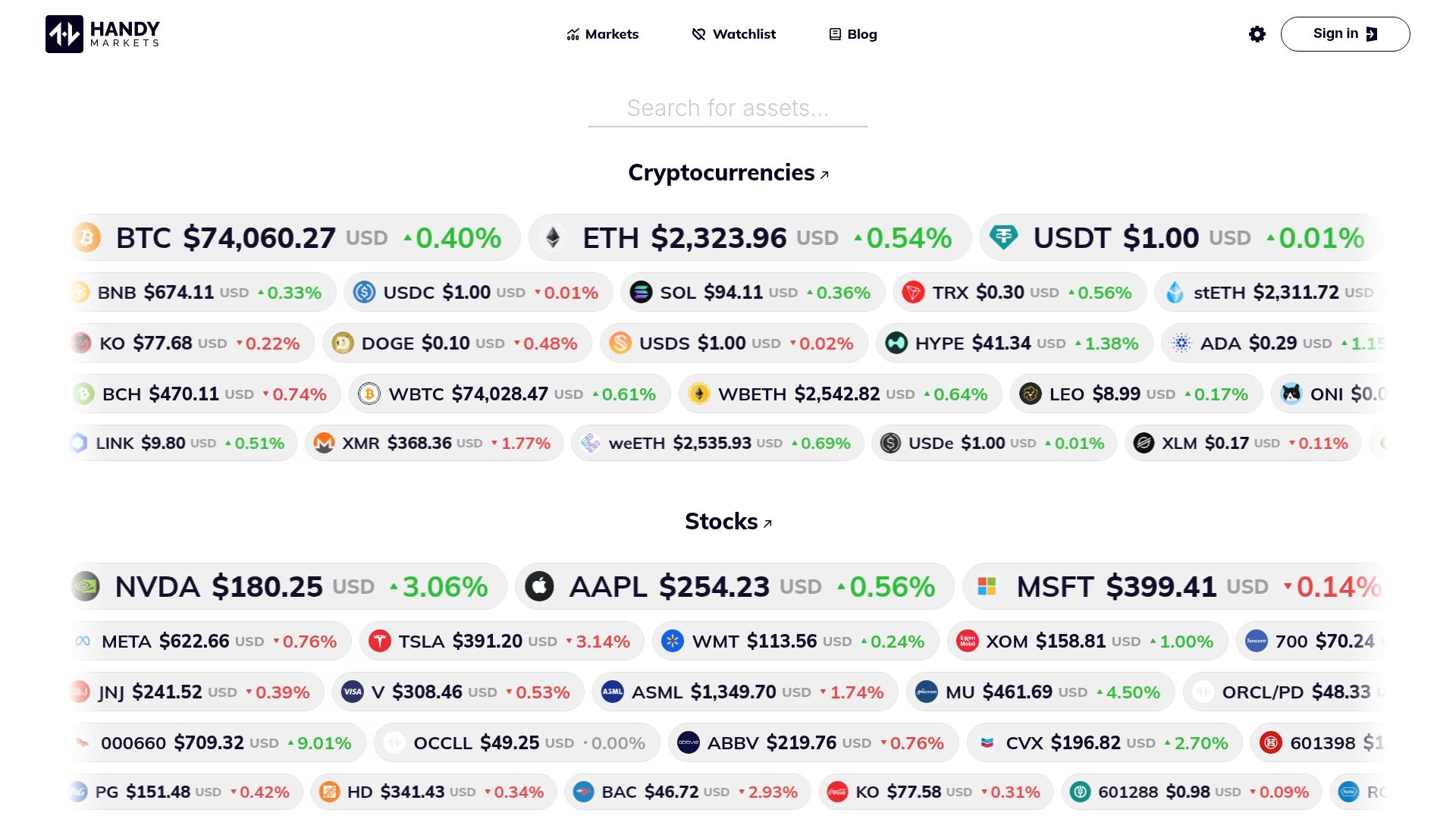
The platform enables you to set up crypto price alerts across multiple channels including Telegram, Discord, Slack, SMS, and email, ensuring you can execute DCA purchases at your predetermined intervals. Monitor commodity market data to track gold, silver, and copper prices for optimal entry points in your inflation hedging strategy. Access detailed charts and percentage changes to support quantitative rebalancing decisions and factor momentum implementations. Stay ahead with instant notifications and comprehensive market coverage that puts all asset classes at your fingertips.
FAQ
What types of diversification work best in 2026?
Geographic diversification across US, international, and emerging markets reduces concentration risk from mega-cap technology stocks. Asset class diversification including equities, commodities, and cryptocurrencies provides uncorrelated return streams and inflation protection during different market regimes.
How can I reduce risk from US tech stock concentration?
Rotate capital from overweight US large-cap technology positions into international equities, small and mid-cap stocks, and emerging markets with stronger earnings growth. Implement quarterly rebalancing based on valuation metrics and relative performance to maintain diversified exposure.
Is crypto dollar-cost averaging still effective?
Yes, DCA remains highly effective for building crypto positions while eliminating timing risk and smoothing volatility. Focus on quality assets like Bitcoin and Ethereum with institutional adoption, avoid leverage completely, and maintain a long-term holding perspective for optimal results.
What commodities should I include for inflation protection?
A barbell approach combining precious metals like gold and silver with industrial metals like copper provides both monetary hedging and growth exposure. Gold offers central bank demand support, silver benefits from solar panel production, and copper captures electrification infrastructure spending.
How can quant strategies improve portfolio stability?
Quantitative approaches like factor momentum and regime overlays systematically adjust portfolio risk based on market conditions, reducing drawdowns during volatility spikes. These strategies capture persistent inefficiencies while removing emotional bias, improving risk-adjusted returns over full market cycles.
Where can I find tools to implement these strategies?
Handy.Markets offers real-time market data and customizable alerts across all major asset classes, enabling you to execute active rebalancing, monitor commodity prices, and manage crypto DCA schedules. Explore our investment articles for ongoing strategy insights and market analysis.
Recommended
- Mastering Volatility In Investing: A Beginner’s Guide To Navigating Market Swings In 2025 | Handy.Markets
- Articles On Investments | Handy.Markets
- ETFs: Live Prices, Holdings & Market Alerts | Handy.Markets
- Financial Markets For Everyone | Handy.Markets
- How to Optimize Investment Strategies Gold for Maximum Return