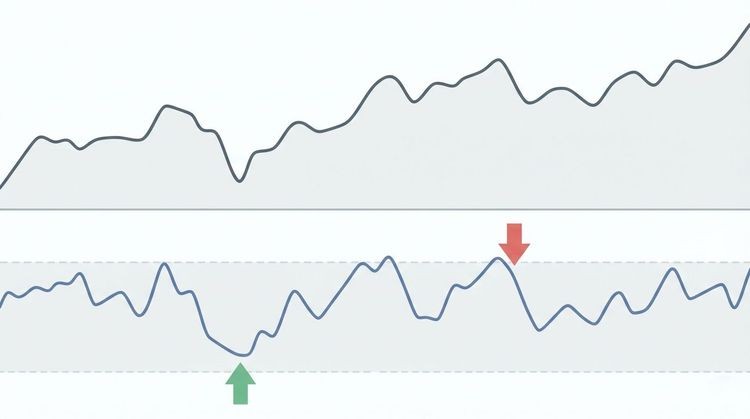


The market analysis playbook you relied on last year may already be losing its edge. In 2026, AI-driven hybrid models are reshaping how professional analysts extract signals, manage risk, and allocate across asset classes. Traders who still lean exclusively on classic technical or fundamental methods are leaving measurable performance on the table. This article walks through the most effective advanced techniques in use right now, from Transformer-MVO pipelines to regime-aware machine learning, and shows you how to build a validated, practical workflow that holds up in real markets.
Table of Contents
- The evolution of market analysis: From classic to cutting-edge
- Key market analysis techniques dominating 2026
- The quant-discretionary divide: What works and why
- Validation and risk: How to ensure analysis remains robust
- Putting it all together: Practical workflow for 2026
- Why most experts underestimate hybrid market analysis
- Take your market analysis to the next level with Handy.Markets
- Frequently asked questions
Key Takeaways
| Point | Details |
|---|---|
| Hybrid methods win | AI-augmented models combined with classical techniques yield more robust, real-world market results. |
| Validation is crucial | Statistical validation and net-of-cost benchmarking are vital to avoid costly strategy failures. |
| Classic still counts | Traditional strategies like value, risk parity, and equal-weighted portfolios remain highly competitive in 2026. |
| Practical workflow matters | Applying techniques through a structured, adaptive process is the difference between theory and actual profits. |
The evolution of market analysis: From classic to cutting-edge
Market analysis has moved through distinct eras, each building on the last. Fundamental analysis dominated the early decades, followed by technical charting, then quantitative modeling in the 1990s and 2000s. Today, we are firmly in the AI and machine learning era, where the most competitive strategies blend classical rigor with modern data science.
The shift is not just philosophical. AI and ML models such as Transformer-MVO pipelines have achieved a 16.3% CAGR from 2020 to 2026 on out-of-sample data, with a Sharpe ratio of 0.83, outperforming many standalone traditional strategies. That kind of evidence is hard to ignore.
Hybrid approaches are now the standard for top-performing desks. They combine the pattern-recognition power of deep learning with the portfolio construction discipline of classical mean-variance optimization (MVO). Regime-aware models go further, adjusting signal weights based on whether the market is trending, mean-reverting, or in a volatility spike. You can explore how these shifts are reflected in market data trends 2026 and how they connect to top investment strategies 2026.
Key drivers of this evolution include:
- Exponential growth in alternative and high-frequency data
- Cross-asset complexity requiring simultaneous signal processing
- Faster execution environments demanding real-time model updates
- Regulatory pressure pushing toward explainable, auditable models
| Technique | CAGR | Sharpe | Notes |
|---|---|---|---|
| Transformer-MVO | 16.3% | 0.83 | Best OOS performance |
| Regime-aware ML | ~8-10% | ~1.1 | Low vol, market neutral |
| Equal-weight portfolio | ~9% | ~0.9 | Surprisingly resilient |
| Vanguard multi-asset | ~7-8% | ~0.85 | Classic risk-adjusted |
“The analysts who will lead in 2026 are those who treat real-time signals not as noise to be filtered out, but as the primary language of modern markets. Adaptation is no longer optional.” — Market structure researcher, 2026
Key market analysis techniques dominating 2026
Now that we have outlined the context and major trends, it is time to dissect the most effective techniques in use by top-performing analysts.
The leading approaches in 2026 share one trait: they are built for adaptation. Static models that were trained once and left running are underperforming. Hybrid models with regime-aware ML deliver consistent, low-volatility returns and genuine market neutrality, making them especially valuable in choppy or transitional environments.

Comparison of top techniques:
| Technique | Typical CAGR | Volatility | Sharpe | Key pro | Key con |
|---|---|---|---|---|---|
| Transformer-MVO | 14-16% | Moderate | 0.80-0.85 | Strong return forecasting | Computationally intensive |
| Regime-aware ML | 8-10% | Very low | 1.0-1.2 | Market neutral | Regime misclassification risk |
| Classical MVO | 7-9% | Low-moderate | 0.75-0.90 | Well-understood | Sensitive to input estimates |
| Risk parity | 6-8% | Low | 0.80-0.95 | Robust diversification | Underperforms in bull runs |
| Macro-signal regression | 8-12% | Moderate | 0.70-0.85 | Cross-asset breadth | Lag in fast-moving regimes |
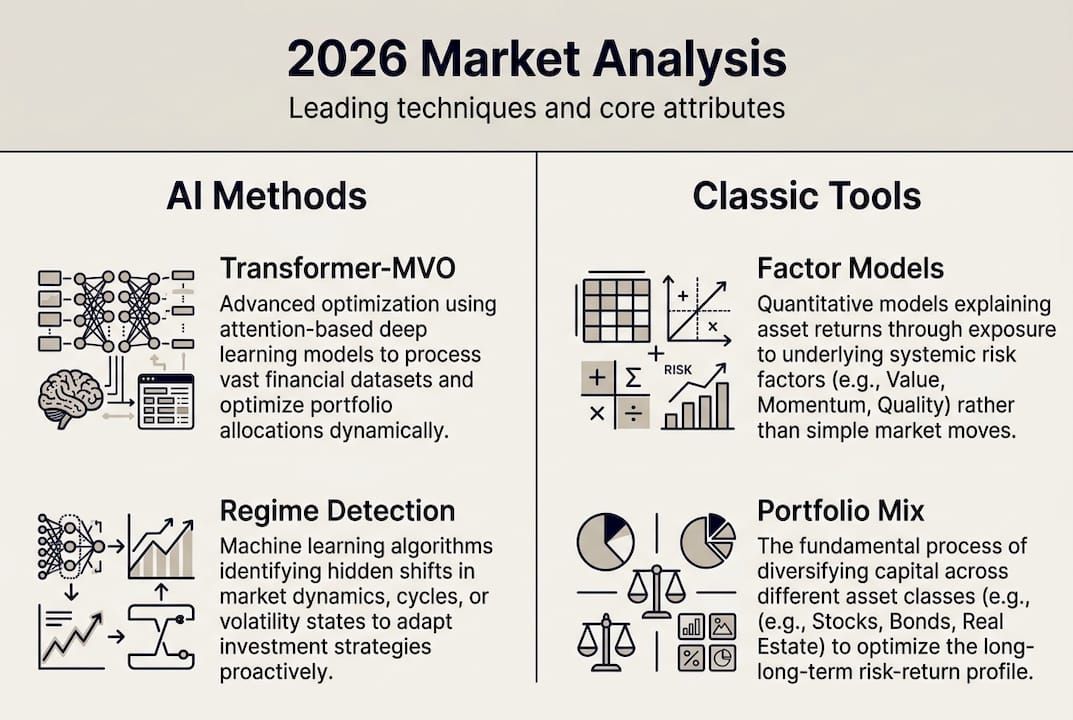
Regime-aware ML using daily OHLCV data has produced market-neutral returns in the low single digits with very low volatility, which is a meaningful edge for capital preservation mandates.
Steps to integrate AI-driven pipelines into your workflow:
- Data ingestion: Consolidate clean OHLCV, macro, and alternative data feeds into a unified pipeline
- Model selection: Choose between Transformer, LSTM, or gradient-boosted models based on your asset class and data frequency
- Validation: Run walk-forward and out-of-sample tests before any live deployment
- Deployment: Automate signal generation with defined confidence thresholds and position sizing rules
- Monitoring: Track live performance against backtest benchmarks and flag regime shifts immediately
Pro Tip: Real-time regime detection is your most valuable lever. If your model cannot identify whether the market is trending or mean-reverting right now, its signals are already stale. Prioritize regime-aware architecture from the start, and review Kinlay’s market analysis frameworks for practical implementation guidance.
The quant-discretionary divide: What works and why
Even as advanced techniques proliferate, understanding when to apply them versus relying on tried-and-true approaches remains crucial.
Quantitative models excel at processing large data volumes consistently and without emotional bias. Discretionary judgment, by contrast, brings contextual awareness that no model fully replicates, especially around geopolitical events, liquidity crises, or structural market shifts. The smartest analysts in 2026 are not choosing one over the other. They are using both.
Quant approaches in 2026:
- Pros: Speed, scalability, backtestable, removes behavioral bias
- Cons: Vulnerable to regime changes, overfitting risk, black-box opacity
Discretionary approaches in 2026:
- Pros: Contextual flexibility, handles novel events, integrates qualitative signals
- Cons: Inconsistent, slow, harder to scale, subject to cognitive bias
A practical hybrid check looks like this: your quant model flags a breakout signal in a commodity ETF. Before executing, you run a quick liquidity screen and check whether a macro catalyst (like a central bank announcement) could invalidate the setup. That two-minute fundamental check has saved many traders from entering at exactly the wrong moment. You can deepen this approach using a solid guide to market fluctuations.
“What surprised us most in our 2026 analysis was how well simple equal-weight portfolios held up. Transformers outperform momentum but do not surpass equal-weight portfolios on Sharpe, and Vanguard’s classic allocations still deliver top risk-adjusted returns in several environments. Complexity is not always the answer.” — Quantitative research team
This is a genuinely counterintuitive finding. More complexity does not automatically mean better outcomes. The Morgan Stanley insights team has noted similar patterns across multi-asset mandates, reinforcing that discipline and simplicity still have a place at the table.
Validation and risk: How to ensure analysis remains robust
Even the smartest analysis can fail without careful risk controls and validation. Here is how to safeguard your strategies in today’s landscape.
Overfitting is the silent killer of quant strategies. A model that looks brilliant in backtesting but falls apart in live markets has cost analysts far more than missed returns. Empirical benchmarks and statistical validation including Sharpe significance tests and bootstrapping are essential to ensure realism, especially as market distributions shift.
Pro Tip: Always evaluate your strategy net of realistic transaction costs, slippage, and expected regime shifts. A Sharpe of 1.5 in backtesting often becomes 0.7 in live trading once costs and market impact are factored in. Use the volatility strategies checklist and real-time data for traders to keep your validation grounded.
Robust validation process:
- Define hypotheses: State clearly what edge you expect and why it should persist
- Split data: Use a strict train/validation/test split; never touch the test set until final evaluation
- Run statistical tests: Apply Sharpe significance tests and bootstrap resampling to confirm results are not random
- Review drawdowns: Stress-test against historical crisis periods and synthetic regime shifts
- Adjust for costs: Recalculate all metrics net of realistic execution costs before declaring success
“Published performance claims in quantitative finance are frequently optimistic. Without empirical benchmarks and out-of-sample validation, you are reading a story, not a strategy.” — Kinlay validation research
Validation is not a one-time event. Markets evolve, and a strategy that passed all tests in 2024 may be structurally broken by 2026 if the underlying regime has shifted. Build recalibration into your calendar, not just your code.
Putting it all together: Practical workflow for 2026
Knowing the right techniques is just the start. The real-world differentiator is how you apply them. Here is a hands-on workflow to bring it all to life.
Panel regression with macro signals and disciplined validation improve risk-adjusted outcomes for cross-asset traders, and the workflow below reflects that principle directly.
Essential workflow steps for analysts:
- Data gathering: Pull clean, timestamped data across equities, FX, commodities, and ETFs every morning before market open
- Model deployment: Run your regime classifier first to determine which signal set is active for the day
- Signal cross-check: Validate AI-generated signals against a fundamental or macro filter before sizing positions
- Risk validation: Confirm position sizes respect your drawdown limits and correlation constraints
- Trade execution: Execute with defined entry, stop, and target levels; log everything for post-trade review
- Ongoing adaptation: Weekly, review model performance versus live benchmarks and flag any drift
Workflow adaptations matter by asset class. US equities benefit most from high-frequency regime detection and earnings-season overlays. FX strategies need macro-signal regression updated around central bank cycles. Commodities require supply-demand fundamental checks layered onto technical signals. ETFs are well-suited to real-time alerts that flag flow anomalies before price moves confirm them.
The two most common pitfalls are over-reliance on backtest results and ignoring cross-asset regime changes. Both are avoidable with the discipline to treat your workflow as a living system, not a set-and-forget machine.
Why most experts underestimate hybrid market analysis
With a complete workflow in hand, it is worth challenging some assumptions that pervade analyst circles, especially in this new era.
Most professionals gravitate toward one pole: pure quant or pure discretionary. The quant camp trusts the model implicitly; the discretionary camp dismisses it as a black box. Both camps are leaving edge on the table. The highest performers we observe are those who invest in both model tuning and market intuition, reviewing regime shifts regularly and treating signals as inputs to judgment rather than replacements for it.
There is also a cultural bias toward high-backtest optimism. Analysts who present a 20% CAGR backtest get attention. Those who present a stable 9% with a Sharpe above 1.0 get overlooked, even though the latter is far more likely to survive contact with real markets. Embracing modest, stable returns preserves capital and, frankly, your sanity.
Explore proven trend strategies to see how this balanced mindset plays out across different market environments.
Pro Tip: Schedule a monthly review to recalibrate your model signals against real-world macro triggers. Markets do not announce regime changes. You have to look for them.
Take your market analysis to the next level with Handy.Markets
Ready to leverage these insights in your daily process? The right platform can save you time and sharpen your market edge significantly.
Handy.Markets delivers real-time prices, percentage changes, and live data across stocks, crypto, commodities, FX, and ETFs, all in one place. You can set up price alerts across Telegram, Discord, Slack, SMS, and Email in minutes, so your analysis workflow is always connected to live market movements. Track market prices across every asset class you cover, and use dedicated ETF market alerts to catch flow shifts before they become trends. When your models flag a signal, Handy.Markets makes sure you never miss the moment to act on it.
FAQ
How do AI and machine learning improve market analysis in 2026?
AI and ML methods boost forecasting accuracy and enable regime-aware strategies that adapt dynamically to changing conditions. Transformer-MVO pipelines achieved a 16.3% CAGR and Sharpe of 0.83 on out-of-sample data from 2020 to 2026.
Are traditional market analysis methods still effective in 2026?
Yes, many classic approaches remain solid performers. Vanguard models and equal-weight portfolios outperform some advanced ML models on a risk-adjusted basis, proving that simplicity and discipline still deliver.
What is the biggest pitfall when adopting advanced market analysis techniques?
Overfitting and skipping out-of-sample validation are the most costly errors. Statistical validation and realism are essential, especially as market distributions shift and published performance claims often overstate real-world results.
How can traders integrate advanced techniques into their daily workflow?
Follow a structured process: gather quality data, run your regime classifier, validate signals with fundamentals, and adapt weekly. Panel regression with macro signals and disciplined workflow design consistently improve risk-adjusted outcomes for cross-asset traders.